

Abstract
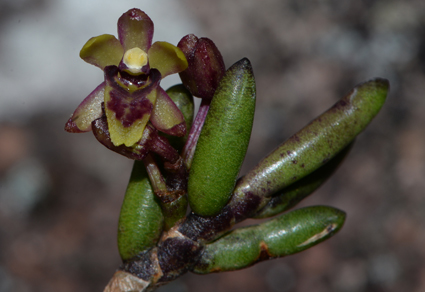
An interesting lithophytic miniature orchid belonging to genus Luisia was discovered growing on one of the red sandstone cliffs in the danxia region of Jiangxi Province, China, alongside other miniature orchids, Oberonia seidenfadenii and Pelatantheria scolopendrifolia. Owing to its small stature, the smallest known so far in the genus Luisia, with shortest leaves, smallest flowers, and distinctive floral morphology, this taxon can be readily distinguished from all other members of the genus. However, its flowers show close morphological similarity to those of Luisia hancockii and Luisia teres, with which it is compared in this manuscript. It differs in having a shorter labellum with distinct epichile and hypochile; epichile narrower towards apex bearing two lobules separated by a slight notch. Accordingly, it is described here as a new species, Luisia danxiacola. During our study of the genus Luisia in China, we also re-examined the Chinese endemic, Luisia simaoensis and conclude that it is conspecific with the Myanmar endemic Luisia amesiana. We therefore reduce Luisia simaoensis to the synonymy under Luisia amesiana based on their identical morphology and provide detailed notes supporting this taxonomic treatment. Furthermore, because the original description of Luisia amesiana was based on multiple specimens collected in Myanmar and sent to Kew, we designated one of these specimens as the lectotype to ensure nomenclatural stability of the name.
References
- Alexiades, M.N. (1996) Standard techniques for collecting and preparing Herbarium Specimens. Advances in Economic Botany 10: 99–126. [http://www.jstor.org/stable/43927613]
- Ames, O. (1911) Notes on Philippine Orchids with descriptions of New Species III. The Philippine Journal of Science 6 (C): 35–56.
- Averyanov, L.V. (1988) New taxa and nomenclatural changes in the Orchidaceae famil of Vietnamese flora. Botanicheskii Zhurnal 73 (3): 423–432.
- Averyanov, L.V. (2013) The orchids of Vietnam Illustrated Survey. Part 4. Subfamily Epidendroideae (tribes Arethuseae and Malaxideae). Turczaninowia 16 (1): 5–163.
- Bachman, S., Moat, J., Hill, A.W., de la Torre, J. & Scott, B. (2011) Supporting red List threat assessments with GeoCAT: Geospatial conservation assessment tool. In: Smith, V. & Penev, L. (Eds.) e-Infastructure for data publishing in biodiversity science. ZooKeys 150: 117–126. [Version BETA]. https://doi.org/10.3897/zookeys.150.2109.figure1
- Beentje, H. (2016) The Kew Plant Glossary, an illustrated dictionary of plant terms. (2nd ed.) Royal Botanic Gardens, Kew, 192 pp.
- Blume, C.L. (1849) Commentationes botanicæ imprimis de plantis Indiæ Orientalis. Rumphia 4: 1–75 pp., t. 174–200.
- Chen, X.Q. & Wood, J.J. (2009) Luisia. In: Wu, C.Y., Raven, P.H. & Hong, D.Y. (Eds.) Flora of China, Vol. 25. Scientific Press, Beijing, and Missouri Botanical Garden Press, St. Louis, pp. 488–490.
- Gaudichaud-Beaupre, C. (1829) Voyage autour du monde, entrepris par ordre du roi. Exécuté sur les corvettes de S.M. l’Uranie et la Physicienne, Botanique 10. Chez Pillet aîné, Paris, pp. 426–427, t. 37.
- IUCN Standards and Petitions Committee (2024) Guidelines for Using the IUCN Red List Categories and Criteria. Version 16. Prepared by the Standards and Petitions Committee. Available from: https://www.iucnredlist.org/documents/RedListGuidelines.pdf (accessed 25 June 2026)
- Kränzlin, F. (1894) Luisia amesiana. In: Reichenbach, H.G. & Kränzlin, F. (Eds.) Xenia Orchidacea: Beiträge zur Kenntniss der Orchideen, vol. 3. F.A. Brockhaus, Leipzig, pp. 139–140, t. 279.
- Kumar, P., Gale, S.W., Schuiteman, A., Bouamanivong, S. & Fischer, G.A. (2016) Identifying orchid hotspots for biodiversity conservation in Laos: the limestone karst vegetation of Vang Vieng District, Vientiane Province. Journal of Threatened Taxa 8 (12): 9397–9417. https://doi.org/10.11609/jott.2826.8.12.9397-9417
- Kumar, P., Gale, S.W., Pedersen, H.Æ., Phaxaysombath, T., Bouamanivong, S. & Fischer, G.A. (2018) Additions to the orchid flora of Laos and taxonomic notes on orchids of the Indo-Burma region. Taiwania 63 (1): 61–83. https://doi.org/10.6165/tai.2018.63.61
- Li, J.-W., Ya, J.-D., Ye, D.-P., Liu, C., Liu, Q., Pan, R., He, Z.-X., Pan, B., Cai, J., Lin, D.-L. & Jin, X.-H. (2021) Taxonomy notes on Vandeae (Orchidaceae) from China: Five new species and two new records. Plant Diversity 43 (5): 379–389. https://doi.org/10.1016/j.pld.2021.01.009
- Liu, R., Tan, T., Wang, R., Li, X., Chen, Z., Long, Q. & Wen, F. (2026) Genetic diversity and conservation significance of the endangered endemic Oreocharis cotinifolia across Danxia-like landscapes. Global Ecology and Conservation 68: e04213. https://doi.org/10.1016/j.gecco.2026.e04213
- Makino, T. (1891) Illustrations of the Flora of Japan: To Serve as an Atlas to the Nippon-shokubutsushi. Vol. 1 (7). Nippon Shokubutsushi Dzuhen, Tokyo, t. 40.
- McNeill, J. (2014) Holotype specimens and type citations: General issues. Taxon 63 (5): 112–113. https://doi.org/10.12705/635.7
- Myers, N., Mittermeier, R., Mittermeier, C., da Fonseca, G.A.B. & Kent, J. (2000) Biodiversity hotspots for conservation priorities. Nature 403: 853–858. https://doi.org/10.1038/35002501
- Ormerod, P. (2002) Some Brief Notes on Taiwanese Orchids 1. Taiwania 47 (4): 239–245.
- Ormerod, P., Kurzweil, H. & Watthana, S. (2021) Annotated list of Orchidaceae of Myanmar. Phytotaxa 481 (1): 001–262. https://doi.org/10.11646/phytotaxa.481.1.1
- Rolfe, R.A. (1893a) CCCXXII New Orchids: Decade 6. Bulletin of miscellaneous information (Royal Gardens, Kew) 79: 169–173. https://doi.org/10.2307/4111430
- Rolfe, R.A. (1893b) New or noteworthy plants. The Gardeners’ Chronicle, ser. 3, 14: 32, fig. 8.
- Rolfe, R.A. (1896) DXXXIV New Orchids Decades 17–20. Bulletin of miscellaneous information (Royal Gardens, Kew) 1896: 193–204. https://doi.org/10.2307/4118450
- Ruzin, S.E. (1999) Plant Microtechnique and Microscopy. Oxford University Press, New York, 322 pp.
- Seidenfaden, G. (1971) Notes on the Genus Luisia. Dansk Botanisk Arkiv 27 (4): 7–101.
- Su, H.J. (1999) Contribution to the Revised Flora of Taiwan III. Journal—Experimental Forest of National Taiwan University 13 (3): 203–209.
- Tanaka, Y., Htun, N. & Yee, T.T. (2004) Wild Orchids in Myanmar, vol. 2: A Poem of Wild Orchids. AA Foundation (The Foundation of Agricultural Development and Education), Bangkok, 108 pp.
- Thunberg, C.P. (1784) Caroli a Linné equitis Systema vegetabilium, secundum classes ordines genera species cum characteribus et differentiis. Gottingae Typis et impensis Jo. Christ. Dieterich, 1004 pp.
- Tsi, Z.H. & Chen, S.C. (1994) New Taxa of Orchidaceae from Xishuangbanna of South Yunnan, China. Acta Phytotaxonomica Sinica 32 (6): 553–562.
- Turland, N.J., Wiersema, J.H., Barrie, F.R., Gandhi, K.N., Gravendyck, J., Greuter, W., Hawksworth, D.L., Herendeen, P.S., Klopper, R.R., Knapp, S., Kusber, W.-H., Li, D.-Z., May, T.W., Monro, A.M., Prado, J., Price, M.J., Smith, G.F. & Zamora Señoret, J.C. (2025) International Code of Nomenclature for algae, fungi, and plants (Madrid Code). Regnum Vegetabile 162. University of Chicago Press, Chicago. https://doi.org/10.7208/chicago/9780226839479.001.0001
- UNEP-WCMC (2012) China Danxia, China. UNEP-WCMC World Heritage Information Sheets. [online] Cambridge, UK: UNEP-WCMC. Available from: https://yichuans.github.io/datasheet/output/site/china-danx (accessed 25 June 2026)
- UNESCO World Heritage (2025) Danxia Landform of China. Available from: https://whc.unesco.org/en/list/1335/ (accessed 25 June 2026)