
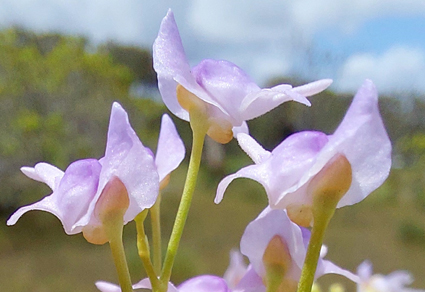

Abstract
Recent novelties regarding the diversity of Lentibulariaceae in the state of Maranhão, northeast Brazil, suggest that this is an urgent family to be taxonomically investigated. To provide a taxonomic treatment for this family in the state, we studied both herbaria collections and newly collected specimens from several field expeditions. Lentibulariaceae were represented in Maranhão by 33 species grouped in two genera. Genlisea was represented by two species, and Utricularia was represented by 31. Among the recognized species, 14 are new records for the state of Maranhão. We provide identification keys for genera and species, detailed morphological descriptions, comments on morphological aspects, taxonomic affinities and geographic distribution, along with photographic plates of species in situ and distribution maps.
References
- Alvares, C.A., Stape, J.L., Sentelhas, P.C., Gonçalves, J.L.M. & Sparovek, G. (2014) Köppen’s climate classification map for Brazil. Meteorologische Zeitschrift 22: 711–728. https://doi.org/10.1127/0941-2948/2013/0507
- Baleeiro, P.C. (2011) Diversidade do gênero Utricularia L. no Cerrado: Goiás e Tocantins. Museu Nacional, da Universidade Federal do Rio de Janeiro/UFRJ, Rio de Janeiro, 80 pp.
- Baleeiro, P.C., Gonella, P.M., Sano, P.T. & Jobson, R.W. (2022) Unveiling Utricularia amethystina’s true colours: a taxonomic revision of one of the largest species complexes (U. sect. Foliosa, Lentibulariaceae). Phytotaxa 576: 29–54. https://doi.org/10.11646/phytotaxa.576.1.2
- Baharin, A., Ting, T.Y. & Goh, H.H. (2023) Omics approaches in uncovering molecular evolution and physiology of botanical carnivory. Plants 12: 3–7. https://doi.org/10.3390/plants12020408
- Benjamin, L. (1847) Utricularieae. In: Martius, C.F.P. von, Eichler, A.W. & Urban, I. (Eds.) Flora Brasiliensis, Volume 10. F. Fleischer, Munich, Vienna, Leipzig, pp. 233–256.
- Bigelow, J. (1840) Florula Bostoniensis, a collection of plants of Boston and its vicinity. Freeman & Bolles, Boston, 468 pp. https://doi.org/10.5962/bhl.title.46343
- Candolle, A.P. (1824) Prodromus systematis naturalis regni vegetabilis1. Treuttel & Würtz, Paris, 739 pp. https://doi.org/10.5962/bhl.title.286
- De Candolle, A.L.P.P. (1844) Prodromus systematis naturalis regni vegetabilis8. Treuttel & Würtz, Paris, 684 pp.
- Ellison, A.M. & Gotelli, N.J. (2001) Evolutionary ecology of carnivorous plants. Trends in Ecology and Evolution 16: 623–629. https://doi.org/10.1016/S0169-5347(01)02269-8
- Ellison, A.M. & Gotelli, N.J. (2002) A fine-scale indicator of nitrogen saturation in northern ecosystems. Proceedings of the National Academy of Sciences 99: 4409–4412. https://doi.org/10.1073/pnas.022057199
- Fleischmann, A., Schäferhoff, B., Heubl, G., Rivadavia, F., Barthlott, W. & Müller, K.F. (2010) Phylogenetics and character evolution in the carnivorous plant genus Genlisea A. St.-Hil. (Lentibulariaceae). Molecular Phylogenetics and Evolution 56: 768–783. https://doi.org/10.1016/j.ympev.2010.03.009
- Fleischmann, A. & Rivadavia, F. (2009) Utricularia rostrata (Lentibulariaceae), a new species from the Chapada Diamantina, Brazil. Kew Bulletin 64: 155–159. https://doi.org/10.1007/s12225-008-9086-y
- Fleischmann, A., Rivadavia, F., Gonella, P.M. & Heubl, G. (2011) A revision of Genlisea subgenus Tayloria (Lentibulariaceae). Phytotaxa 33: 1–40. https://doi.org/10.11646/phytotaxa.33.1.1
- Fleischmann, A. (2012) The new Utricularia species described since Peter Taylor’s monograph. Carnivorous Plant Newsletter 41: 67–76. https://doi.org/10.55360/cpn412.af309
- Fleischmann, A. & Roccia, A. (2018) Systematics and evolution of Lentibulariaceae: I. Pinguicula. In: Ellison, A.M. & Adamec, L. (Eds.) Carnivorous plants: physiology, ecology and evolution. Oxford University Press, New York, pp. 70–80. https://doi.org/10.1093/oso/9780198779841.003.0006
- Fleischmann, A. (2018) Systematics and evolution of Lentibulariaceae: II. Genlisea. In: Ellison, A.M. & Adamec, L. (Eds.) Carnivorous plants: physiology, ecology and evolution. Oxford University Press, New York, pp. 81–88. https://doi.org/10.1093/oso/9780198779841.003.0007
- Fromm-Trinta, E. (1981) Revisão do gênero Genlisea A.St.-Hil (Lentibulariaceae) no Brasil. Boletim do Museu Nacional, Rio de Janeiro 61: 1–20. https://doi.org/10.11646/phytotaxa.33.1.1
- Fromm-Trinta, E. (1985) Utricularia poconensis Fromm-Trinta, uma nova espécie para o gênero Utricularia L. (Lentibulariaceae). Bradea 4: 139–142.
- Gonella, P.M. & Baleeiro, P.C. (2018) Utricularia biceps (Lentibulariaceae), a new carnivorous species endemic to the campos rupestres of Brazil. Phytotaxa 376: 214–222. https://doi.org/10.11646/phytotaxa.376.5.4
- Gonella, P.M., Barbosa-Silva, R.G., Fleischmann, A.S., Zappi, D.C., Baleeiro, P.C. & Andrino, C.O. (2020) Hidden biodiversity of Amazonian white sand ecosystems: two distinctive new species of Utricularia (Lentibulariaceae) from Pará, Brazil. PhytoKeys 169: 75–98. https://doi.org/10.3897/phytokeys.169.57626
- Grisebach, A.H.R. (1866) Catalogus plantarum cubensium. G. Engelmann, Leipzig, 301 pp. https://doi.org/10.5962/bhl.title.177
- Guedes, F.M., Gonella, P.M., Domínguez, Y., Moreira, A.D.R., Silva, S.R., Fleischmann, A., Díaz, Y.C.A., Menezes, C.G., Rivadavia, F. & Miranda, V.F.O. (2026) Lentibulariaceae. In: Flora do Brasil 2020. Jardim Botânico do Rio de Janeiro. Available from: http://floradobrasil.jbrj.gov.br/reflora/floradobrasil/FB146 (accessed 11 May 2026)
- IBGE (2004) Mapa de biomas do Brasil. Available from: https://geoftp.ibge.gov.br/informacoes_ambientais/estudos_ambientais/biomas/mapas/biomas_5000mil.pdf (accessed 16 June 2026)
- IBGE (2011) Mapas de vegetação, geologia, geomorfologia e solos do maranhão. Belém, Pará. Available from: http://cod.ibge.gov.br/1XUKN (accessed 25 April 2026)
- iNaturalist (2026) Available from: https://www.inaturalist.org/observations/168374601 (accessed 11 May 2026)
- Jennings, D.E. & Rohr, J.R. (2011) A review of the conservation threats to carnivorous plants. Biological Conservation 144: 1356–1363. https://doi.org/10.1016/j.biocon.2011.03.013
- Kunth, K.S. (1818) Lentibulariae Rich. R.Brown. In: Bonpland, A., Humboldt, A. & Kunth, K.S. Nova genera et species plantarum. Christoph Plantin, Antwerp, pp. 225–226.
- Kuntze, O. (1898) Revisio generum plantarum 3. A. Felix, Leipzig, 573 pp.
- Lamarck, J.B.A.P.M. (1791) Tableau encyclopédique et méthodique des trois règnes de la nature: botanique 1. Paris, 316 pp. https://doi.org/10.5962/bhl.title.218
- Linnaeus, C. (1753) Species plantarum 1. Salvius, Stockholm, 560 pp.
- Lloyd, F.E. (1942) The carnivorous plants. Chronica Botanica, Waltham, 352 pp. https://doi.org/10.5962/bhl.title.5965
- Marinho, L.C., Scatigna, A.V, Garcia, A.L., Castro, E.T.S., Amorim, G., Silva, F.A., Mendes, J.C.R., Pimenta, K.M., Feitosa, N.C.V. & Ferreira, A.W.C. (2024) Expansion of the distribution range of angiosperm species for the states of Maranhão and Tocantins, Brazil, through a territorial action plan. Check List 20: 1067–1075. https://doi.org/10.15560/20.5.1067
- Marinho, L.C., Waga, I.M. & Cardoso, D. (2026) Niche-tracking as a collecting method: Habitat-targeted search strategies for taxon-focused botany. Plants People Planet 2026: 1–10. https://doi.org/10.1002/ppp3.70261
- Merl, E.M. (1934) A new Brazilian species of the genus Utricularia. Bulletin of the Torrey Botanical Club 61: 367–371. https://doi.org/10.2307/2481021
- Michaux, A. (1803) Flora Boreali-Americana, Tomus 1. C. Crapelet, Paris & Strasbourg, 330 pp.
- Mori, S.A., Silva, L.A.M., Lisboa, G. & Coradin, L. (1989) Manual de manejo do herbário fanerogâmico. CEPLAC, Ilhéus, 104 pp.
- Oliver, D. (1860) New species of Utricularia from South America. Journal of the Proceedings of the Linnean Society, Botany 4: 169–176. https://doi.org/10.1111/j.1095-8312.1860.tb01024.x
- Pestana, M.C.A., Mendonça, N.A., Oliveira, R.F., Bastos, M.C.C., Silva, M.I., Barroso, A.M., Hora, R.C. & Guarçoni, E.A.E. (2022) First records of Utricularia breviscapa C.Wright ex Griseb. (Lentibulariaceae) for Maranhão state, northeastern Brazil. Check List 18: 861–866. https://doi.org/10.15560/18.4.861
- Pilger, R.K.F. (1901) Beitrag zur Flora von Mattogrosso. Botanische Jahrbücher fur Systematik, Pflanzengeschichte und Pflanzengeographie 30: 127–205.
- Pilger, R.K.F. (1914) Lentibulariaceae. Notizblatt des Königlichen Botanischen Gartens und Museums zu Berlin 6: 188–191. https://doi.org/10.2307/3994403
- Rodrigues, M.L., Mota, N.F.D.O., Viana, P.L., Koch, A.K. & Secco, R.D.S. (2019) Vascular flora of Lençóis Maranhenses National Park, Maranhão State, Brazil: checklist, floristic affinitiesand phytophysiognomies of restingas in the municipality of Barreirinhas. Acta Botanica Brasilica 33: 498–516. [http://dx.doi.org/10.1590/0102 33062018abb0421]
- RSIS (2026) Ramsar Sites Information Service. Available from: https://rsis.ramsar.org/ (accessed 11 May 2026)
- Rutishauser, R. & Sattler, R. (1989) Complementarity and heuristic value of contrasting models in structural botany. III Case study on shootlike ‘leaves’ and leaf-like ‘shoots’ in Utricularia macrorhiza and U. purpurea (Lentibulariaceae). Botanische Jahrbücher für Systematik 111: 121–137.
- Saint-Hilaire, A.F.C.P. (1833) Voyage dans le District des Diamans 2. Gide Library, Paris, 456 pp.
- Saint-Hilaire, A.F.C.P. & Girard, F. (1838) Monographie des Primulcées et des Lentibulariées du Brésil méridional. Compte Rendus Hebdomadaires des Séances de l’Académie des Sciences 7: 868–970.
- Salazar-Ferreira, M., Gonella, P.M. & Guarçoni, E.A.E. (2020) New records of Utricularia (Lentibulariaceae) for the state of Maranhão, Brazil. Check List 16: 121–125. https://doi.org/10.15560/16.1.121
- Scatigna, A.V., Brandão, C.M., Colletta, G.D., Teles, R.M., Cavalcante, K.S.B., Souza, V.C. & Simões, A.O. (2019) Dizygostemon riparius (Plantaginaceae, Gratioleae), a new species from Maranhão, northeastern Brazil. Willdenowia 49: 177–186. https://doi.org/10.3372/wi.49.49206
- Salazar-Ferreira, M., Gonella, P,M. & Guarçoni, E.A.E. (2026) Lentibulariaceae (Lamiales) of Parque Nacional dos Lençóis Maranhenses, Maranhão, Brazil. Hoehnea 53: e492025. https://doi.org/10.1590/2236-8906e492025.
- Scatigna, A.V. & Muniz, F.H. (2022) Rediscovery of Staurogyne repens (Acanthaceae) in the wild after 115 years. Oryx 56: 169–170. https://doi.org/10.1017/S0030605321001757
- SEMATUR – Secretaria Municipal de Meio Ambiente e Turismo (1991) Diagnóstico dos principais problemas ambientais do estado do Maranhão. SEMATUR, São Luís.
- Silva, S.R., Plachno, B.J., Carvalho, S.G.M. & Miranda, V.F.O. (2020) Genlisea hawkingii (Lentibulariaceae), a new species from Serra da Canastra, Minas Gerais, Brazil. PLoS ONE 15: 1. https://doi.org/10.1371/journal.pone.0226337
- Spegazzini, C. (1899) Plantae novae nonnullae. Comunicaciones del Museo Nacional de Buenos Aires 1: 81–90.
- Steyermark, J.A. (1953) Lentibulariaceae. Fieldiana, Botany 28: 534–553.
- Sylvén, N.O.V. (1909) Die Genliseen und Utricularieen des Regnellschen Herbariums. Mit 7 Tafeln. Arkiv för Botanik, Stockholm, 1–48 pp.
- Taylor, P. (1954) Lentibulariaceae. Flora of Trinidad and Tobago 2: 288–300.
- Taylor, P. (1967) Memoirs of the New York Botanical Garden, vol. 17 (1). New York Botanical Garden, New York, 218 pp.
- Taylor, P. (1986) New taxa in Utricularia (Lentibulariaceae). Kew Bulletin 41: 1–18. https://doi.org/10.2307/4103020
- Taylor, P. (1989) The genus Utricularia—a taxonomic monograph. Kew Bulletin Additional Series. Royal Botanical Gardens, Kew, London, UK, 724 pp.
- Tutin, T.G. (1934) Utricularia tenuissima. New species from British Guiana, Cambridge University Expedition, 1933. Journal of Botany, British and Foreign 72: 334–335.
- Vahl, M. (1804) Enumeratio plantarum. Volumen I. N. Möller & Sons, Copenhague, pp. 200–202.