

Abstract
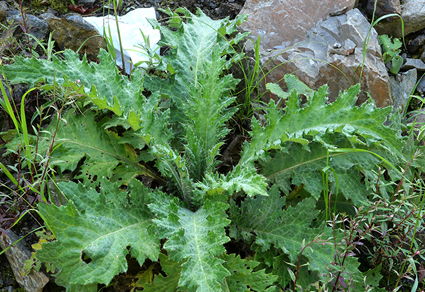
Based on a critical review of the literature, examination of herbarium specimens, and field investigations, we reassess the taxonomic status of Cirsium bolocephalum subsp. setschwanicum, which has long been treated as a synonym of C. eriophoroides. Our results demonstrate that it is morphologically distinct from C. eriophoroides; therefore, we remove it from the synonymy of the latter and reinstate it at species rank as C. setschwanicum. It differs from C. eriophoroides in having nodding capitula, inner phyllaries with spinose apices (vs. unarmed), white corollas (vs. purple), and a corolla tube approximately equal in length to the limb (vs. tube ca. 2/3 longer than the limb). Detailed photographs, a distribution map, and a morphological comparison with closely related species are provided.
References
- Hajra, P.K. (1995) Cirsium Mill. In: Hajra, P.K., Rao, R.R., Singh, D.K. & Uniyal, P.B. (Eds.) Flora of India, vol. 12. Botanical Survey of India, Calcutta, pp. 167–172.
- Handel-Mazzetti, H. (1936) Cirsium Mill. In: Handel-Mazzetti, H. (Ed.) Symbolae Sinicae: Botanische Ergebnisse der Expedition der Akademie der Wissenschaften in Wien nach Südwest-China 1914/1918. VII. Teil: Anthophyta, 4. Lieferung. Julius Springer, Wien, pp. 1164–1173.
- Hooker, J.D. (1881) Cnicus L. In: Hooker, J.D. & Clarke, C.B. (Eds.) The Flora of British India, vol. 3. Reeve & Co. Ltd., England, pp. 362–364.
- Liang, S.Y. (1987) Cirsium Mill. In: Wu, Z.Y. (Ed.) Flora Xizangica, vol. 4. Science Press, Beijing, pp. 861–865. [In Chinese]
- Petrak, F. (1912) Übersicht der europäisch-asiatischen Arten der Gattung Cirsium aus der Sektion Epitrachys DC. Bibliotheca Botanica 78: 5–9.
- Petrak, F. (1926) Plantae novae Sinenses, diagnosibus brevibus descriptae a Dre. Henr. Handel-Mazzetti (40. und letzte Fortsetzung). Anzeiger der Akademie der Wissenschaften in Wien. Mathematische-naturwissenschaftliche Klasse 63: 95–112.
- Petrak, F. (1971) Über einige Cirsien der Sektion Epitrachys aus dem Himalaya und den südwestchinesischen Hochgebirgen. Annalen des Naturhistorischen Museums in Wien 75: 149–156.
- Shi, Z. & Greuter, W. (2011) Cirsium Mill. In: Wu, Z.Y. & Raven, P.H. (Eds.) Flora of China, vols. 20–21. Science Press, Beijing & Missouri Botanical Garden Press, St. Louis, pp. 160–175.
- Shih, C. (1984) Notulae de plantis tribus Cynarearum familiae Compositarum sinicae (II). Acta Phytotaxonomica Sinica 22: 445–455.
- Shih, C. (1987) Cirsium Mill. In: Ling, Y. & Shih, C. (Eds.) Flora Reipublicae Popularis Sinicae, vol. 78 (1). Science Press, Beijing, pp. 78–135. [In Chinese]
- Zhuang, X. (2004) Compositae. In: Wu, C.Y. (Ed.) Flora Yunnanica, vol. 13. Science Press, Beijing, pp. 1–774. [In Chinese]