

Abstract
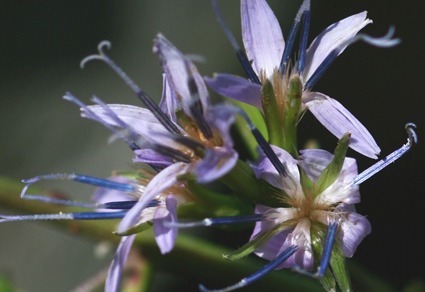
Faberia gongshanensis (Asteraceae), a new species from northwestern Yunnan, China, is described and illustrated. Faberia gongshanensis is morphologically similar to F. faberi and F. cavaleriei in having broadly ovate to pentagonal leaf blades. However, it differs from F. cavaleriei by its capitula with ca. 10 florets (vs. 10–20 florets), slender peduncles 1–7 cm long (vs. sessile or with peduncles 2–5 cm long), and outer phyllaries triangular-ovate, up to 2–3.2 mm (vs. triangular-ovate to lanceolate, up to 5–7 mm). It differs from F. faberi in having synflorescences laxly branched, racemiform, with 2–11 capitula (vs. synflorescences contracted, paniculiform, with 30–70 capitula), and nodding capitula (vs. erect) bearing ca. 10 florets (vs. ca. 5 florets). The recognition of this species as a distinct and previously undescribed taxon of Faberia is further supported by phylogenetic analyses based on molecular data.
References
- Bankevich, A., Nurk, S., Antipov, D., Gurevich, A.A., Dvorkin, M., Kulikov, A.S., Lesin, V.M., Nikolenko, S.I., Pham, S., Prjibelski, A.D., Pyshkin, A.V., Sirotkin, A.V., Vyahhi, N., Tesler, G., Alekseyev, M.A. & Pevzner, P.A. (2012) SPAdes: a new genome assembly algorithm and its applications to single-cell sequencing. Journal of Computational Biology 19 (5): 455–477. https://doi.org/10.1089/cmb.2012.0021
- Guindon, S., Dufayard, J.F., Lefort, V., Anisimova, M., Hordijk, W. & Gascuel, O. (2010) New algorithms and methods to estimate maximum-likelihood phylogenies: assessing the performance of PhyML 3.0. Systematic Biology 59 (3): 307–321. https://doi.org/10.1093/sysbio/syq010
- Hemsley, W.B. & Forbes, F.B. (1888) Enumeration of all the plants known from China Proper, Formosa, Hainan, the Corea, the Luchu Archipelago, and the Island of Hongkong; together with their distribution and synonymy. Journal of the Linnean Society, Botany 23: 1–521. https://doi.org/10.1111/j.1095-8339.1888.tb00535.x
- Johnson, M.G., Gardner, E.M. & Liu, Y. (2016) HybPiper: Extracting coding sequence and introns for phylogenetics from high-throughput sequencing reads using target enrichment. Applications in Plant Sciences 4: e1600016. https://doi.org/10.3732/apps.1600016
- Katoh, K. & Standley, D.M. (2013) MAFFT multiple sequence alignment software version 7: improvements in performance and usability. Molecular Biology and Evolution 30 (4): 772–780. https://doi.org/10.1093/molbev/mst010
- Léveillé, H. (1914) Géographie botanique du Maine. Le problème du Patis du Verger. Bulletin de Géographie Botanique 24: 207–284.
- Li, H. & Durbin, R. (2009) Fast and accurate short read alignment with Burrows-Wheeler transform. Bioinformatics 25 (14): 1754–1760. https://doi.org/10.1093/bioinformatics/btp324
- Liu, Y., Chen, Y.S. & Boufford, D.E. (2018) Faberia pinnatifida (Asteraceae; Cichorieae), a new species from Sichuan, China. Systematic Botany 43: 316–324. https://doi.org/10.1600/036364418X697049
- Liu, Y., Chen, Y.S. & Yang, Q.E. (2013) Generic status, circumscription, and allopolyploid origin of Faberia (Asteraceae: Cichorieae) as revealed by ITS and chloroplast DNA sequence data. Taxon 62: 1235–1247. https://doi.org/10.12705/626.14
- Liu, Y., Deng, T. & Yang, Q.E. (2012) Karyology of the genus Faberia (Cichorieae–Asteraceae) and its systematic implications. Nordic Journal of Botany 30: 365–371. https://doi.org/10.1111/j.1756-1051.2011.01305.x
- Minh, B.Q., Nguyen, M.A. & von Haeseler, A. (2013) Ultrafast approximation for phylogenetic bootstrap. Molecular Biology and Evolution 30 (5): 1188–1195. https://doi.org/10.1093/molbev/mst024
- Minh, B.Q., Schmidt, H.A., Chernomor, O., Schrempf, D., Woodhams, M.D., von Haeseler, A. & Lanfear, R. (2020) IQ-TREE 2: New Models and Efficient Methods for Phylogenetic Inference in the Genomic Era. Molecular Biology and Evolution 37 (5): 1530–1534. https://doi.org/10.1093/molbev/msaa015
- Price, M.N., Dehal, P.S. & Arkin, A.P. (2010) FastTree 2‐approximately maximum‐likelihood trees for large alignments. PLoS One 5 (3): e9490. https://doi.org/10.1371/journal.pone.0009490
- Shih, C. & Kilian, N. (2011) Faberia Hemsley. In: Wu, Z.Y., Raven, P.H. & Hong, D.Y. (Eds.) Flora of China, vol. 20. Science Press, Beijing & Missouri Botanical Garden, St Louis, pp. 357–361.
- Wang, G.Y., Meng, Y., Deng, T. & Yang, Y.P. (2014) Molecular phylogeny of Faberia (Asteraceae: Cichorieae) based on nuclear and chloroplast sequences. Phytotaxa 167: 223–234. https://doi.org/10.11646/phytotaxa.167.3.1
- Xu, L.S., Song, Z.Q., Liao, S.Y. & Chen, Y.S. (2024) Qineryangia, a new genus from the Hengduan Mountains and new insights into the phylogeny of the subtribe Crepidinae (Cichorieae, Asteraceae). Journal of Systematics and Evolution 62 (6): 1227–1237. https://doi.org/10.1111/jse.13066
- Yin, Z.J., Wang, Z.H., Kilian, N., Liu, Y., Peng, H. & Zhao, M.X. (2022) Mojiangia oreophila (Crepidinae, Cichorieae, Asteraceae), a new species and genus from Mojiang County, SW Yunnan, China, and putative successor of the maternal Faberia ancestor. Plant Diversity 44: 83–93. https://doi.org/10.1016/j.pld.2021.06.007