

Abstract
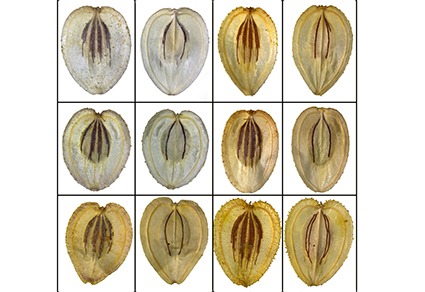
The fruit micromorphological and carpological characteristics are invaluable systematic markers for taxonomic delimitation and phylogenetic inference within the Apiaceae family. This study provides a thorough investigation of morphological differentiation among six Turkish populations of Stenotaenia macrocarpa Freyn and Sint., employing light microscopy (LM) and scanning electron microscopy (SEM). Morphometric data were analyzed using multivariate analysis of variance (MANOVA) and factor analysis of mixed data (FAMD) across various trait configurations to quantify population-level variation and assess diagnostic stability. The results revealed significant multivariate differentiation, identifying fruit length, surface area, and the total number of dorsal vittae as the most influential quantitative discriminators. Notably, population-specific clines were observed, particularly in the eastern populations of Pülümür and Karlıova, which displayed the largest fruits and the highest oil duct densities, in contrast to the smaller, oblong-fruited Seydişehir. Kastamonu, Hadim, and Yahyalı populations can be classified as an intermediate cluster due to the overlapping quantitative and qualitative characteristics. This clustering indicates a shared set of traits that facilitate comparative analysis among these populations. Optimized FAMD modeling (10-trait configuration) demonstrated that qualitative traits, specifically fruit shape and indumentum structure, served as primary drivers in the differentiation of the secondary axis. This established a reliable diagnostic framework that operates independently of size-related metrics. Population-specific diagnostic combinations of fruit size, vittae number, shape, and indumentum are provided. SEM analysis further revealed two patterns of surface ornamentation (reticulate-striate and reticulate), the presence of anomocytic stomata, and three distinct types of trichomes (prickly, pilose, and scabrid). These findings highlight the strong potential of integrating fruit macromorphological and micromorphological characteristics to refine species boundaries and enhance our understanding of taxonomic relationships within the tribe Tordylieae.
References
- Ansell, S.W., Stenøien, H.K., Grundmann, M., Russell, S.J., Koch, M.A., Schneider, H. & Vogel, J.C. (2011) The importance of Anatolian mountains as the cradle of global diversity in Arabis alpina, a key arctic-alpine species. Annals of Botany 108 (2): 241–252. https://doi.org/10.1093/aob/mcr134
- Bani, B., Karakaya, M.A. & Çeter, T. (2016) Fruit micromorphological characters of the genus Grammosciadium DC. (Apiaceae) in Turkey. Phytotaxa 246 (3): 184–191. https://doi.org/10.11646/phytotaxa.246.3.2
- Boissier, P.E. (1844) Annales des sciences naturelles: Botanique. Paris: Fortin, Masson, 339 pp.
- Candolle, A.P. de (1830) Prodromus Systematis Naturalis Regni Vegetabilis. Treuttel & Würtz, Paris, 690 pp.
- Downie, S.R., Hartman, R.L., Sun, F.J. & Katz-Downie, D.S. (2002) Polyphyly of the spring–parsleys (Cymopterus): Molecular and morphological evidence suggests complex relationships among the perennial endemic genera of western North American Apiaceae. Canadian Journal of Botany 80 (12): 1295–1324. https://doi.org/10.1139/B02-119
- Ekim, T. & Güner, A. (1986) The Anatolian Diagonal: fact or fiction? Proceedings of the Royal Society of Edinburgh, Section B: Biological Sciences 89: 69–77. https://doi.org/10.1017/S0269727000008915
- Feist, M.A.E., Downie, S.R., Magee, A.R. & Liu, M.R. (2012) Revised generic delimitations for Oxypolis and Ptilimnium (Apiaceae) based on leaf morphology, comparative fruit anatomy, and phylogenetic analysis of nuclear rDNA ITS and cpDNA trnQ–trnK intergenic spacer sequence data. Taxon 61 (2): 402–418. https://doi.org/10.1002/tax.612011
- Forycka, A. & Morozowska, M. (2020) Micromorphology and anatomy of fruits of Angelica archangelica L. (Apiaceae) and their intraspecific differentiation. Herba Polonica 66 (1): 18–30. https://doi.org/10.2478/hepo-2020-0018
- Gür, H. (2016) The Anatolian diagonal revisited: Testing the ecological basis of a biogeographic boundary. Zoology in the Middle East 62 (3): 189–199. https://doi.org/10.1080/09397140.2016.1226544
- Hoffmann, G.F. (1814) Genera Plantarum Umbelliferarum eorumque Characteres Naturales secundum Numerum, Figuram, Situm et Proportionem omnium Fructificationis Partium. Typis Academicis, Mosquae, 254 pp.
- Kadłuczka, D. & Grzebelus, E. (2022) Comparative fruit morphology and anatomy of wild relatives of carrot (Daucus, Apiaceae). Agriculture 12 (12): 2104. https://doi.org/10.3390/agriculture12122104
- Kalsoom, N., Zafar, M., Ahmad, M., Sultana, S., Usma, A. & Jabeen, A. (2019) Investigating schizocarp morphology as a taxonomic tool in the study of Apiaceae family by utilizing LM and SEM techniques. Microscopy Research and Technique 82 (7): 1012–1020. https://doi.org/10.1002/jemt.23248
- Kassambara, A. & Mundt, F. (2024) factoextra: Extract and visualize the results of multivariate data analyses (Version 2.0.0) [R package]. [https://CRAN.R-project.org/package=factoextra] (accessed 29 May 2026).
- Katz-Downie, D.S., Valiejo-Roman, C.M., Terentieva, E.I., Troitsky, A.V., Pimenov, M.G., Lee, B. & Downie, S.R. (1999) Towards a molecular phylogeny of Apiaceae subfamily Apioideae: additional information from nuclear ribosomal DNA ITS sequences. Plant Systematics and Evolution 216 (3): 167–195. https://doi.org/10.1007/BF01084397
- Kljuykov, E.V., Zakharova, E.A., Ostroumova, T.A. & Tilney, P.M. (2021) Most important carpological anatomical characters in the taxonomy of Apiaceae. Botanical Journal of the Linnean Society 195 (3): 532–544. https://doi.org/10.1093/botlinnean/boaa082
- Koch, M.A., Bani, B., German, D.A. & Huang, X.C. (2017) Phylogenetics, phylogeography and vicariance of polyphyletic Grammosciadium (Apiaceae: Careae) in Anatolia. Botanical Journal of the Linnean Society 185 (2): 168–192. https://doi.org/10.1093/botlinnean/box051
- Lê, S., Josse, J. & Husson, F. (2008) FactoMineR: An R package for multivariate analysis. Journal of Statistical Software 25 (1): 1–18. https://doi.org/10.18637/jss.v025.i01
- Liao, C., Downie, S.R., Li, Q., Yu, Y., He, X. & Zhou, B. (2013) New insights into the phylogeny of Angelica and its allies (Apiaceae) with emphasis on East Asian species, inferred from nrDNA, cpDNA, and morphological evidence. Systematic Botany 38 (1): 266–281. https://doi.org/10.1600/036364413X662060
- Linnaeus, C. (1753) Species Plantarum. Laurentius Salvius, Stockholm, 1200 pp.
- Liu, M. & Downie, S.R. (2017) The phylogenetic significance of fruit anatomical and micromorphological structures in Chinese Heracleum species and related taxa (Apiaceae). Systematic Botany 42 (2): 313–325. https://doi.org/10.1600/154823217X695539
- Liu, M. (2004) A taxonomic evaluation of fruit structure in the family Apiaceae. Doctoral dissertation, University of Johannesburg.
- Liu, M., Plunkett, G.M., Lowry, P.P., Van Wyk, B.E. & Tilney, P.M. (2006) The taxonomic value of fruit wing types in the order Apiales. American Journal of Botany 93 (9): 1357–1368. https://doi.org/10.3732/ajb.93.9.1357
- Liu, M., Plunkett, G.M., Lowry, P.P., Van Wyk, B.E., Tilney, P.M. & Nicolas, A.N. (2016) The phylogenetic significance of fruit and trichome structures in Apiaceae subfamily Mackinlayoideae. Systematic Botany 41 (3): 685–699. https://doi.org/10.1600/036364416X692541
- Liu, M.R., van Wyk, B.-E. & Tilney, P.M. (2003) The taxonomic value of fruit structure in the subfamily Saniculoideae and related African genera (Apiaceae). Taxon 52 (2): 261–270. https://doi.org/10.2307/3647394
- Mandenova, I.P. (1959) Materialy po sistematike triby Pastinaceae K.-Pol. emend. Manden. (Umbelliferae–Apioideae) [Materials on systematics of the tribe Pastinaceae K.-Pol. emend. Manden. (Umbelliferae–Apioideae)]. Trudy Tbilisskogo Botanicheskogo Instituta 20: 3–57.
- Menemen, Y. & Jury, S.L. (2001a) Comparative fruit studies in a group of Tribe Peucedaneae (Umbelliferae). Israel Journal of Plant Sciences 49 (2): 135–146. https://doi.org/10.1560/ulne-tf90-vdrn-lnrd
- Menemen, Y. & Jury, S.L. (2001b) A taxonomic revision of the genus Pastinaca L. (Umbelliferae). Israel Journal of Plant Sciences 49 (1): 67–77. https://doi.org/10.1560/mjbm-t59j-m2lx-nwpn
- Menemen, Y., Kandemir, A. & Downie, S.R. (2016) Pastinaca erzincanensis (Apiaceae), a new species from eastern Turkey and its phylogenetic position within Tordylieae. Annales Botanici Fennici 53 (5–6): 373–382. https://doi.org/10.5735/085.053.0609
- Mousavi, S., Mozaffarian, V., Mummenhoff, K., Downie, S.R. & Zarre, S. (2021) An updated lineage-based tribal classification of Apiaceae subfamily Apioideae with special focus on Iranian genera. Systematics and Biodiversity 19: 89–109. https://doi.org/10.1080/14772000.2020.1834002
- Noroozi, J., Zare, G., Sherafati, M., Mahmoodi, M., Moser, D., Asgarpour, Z. & Schneeweiss, G.M. (2019) Patterns of endemism in Turkey, the meeting point of three global biodiversity hotspots. Frontiers in Ecology and Evolution 7: 159. https://doi.org/10.3389/fevo.2019.00159
- Ostroumova, T.A. (2018) Fruit micromorphology in the Umbelliferae of the Russian Far East. Botanica Pacifica 7 (1): 41–49. https://doi.org/10.17581/bp.2018.07107
- Ostroumova, T.A. (2021) Fruit micromorphology of Siberian Apiaceae and its value for taxonomy of the family. Turczaninowia 24 (2): 120–143. https://doi.org/10.14258/turczaninowia.24.2.13
- Pimenov, M.G. & Kljuykov, E.V. (2002) A new species of Lalldhwojia Farille (Umbelliferae) from Nepal. Willdenowia 32 (1): 93–97. https://doi.org/10.3372/wi.32.32109
- Pimenov, M.G., Kljuykov, E.V., Dickoré, W.B. & Miehe, G. (2000) Four Himalayan Umbelliferae new to the flora of China, with critical notes on Tordyliopsis DC. and Keraymonia Farille. Willdenowia 30 (2): 361–367. https://doi.org/10.3372/wi.30.30213
- Plants of the World Online (2025) Facilitated by the Royal Botanic Gardens, Kew. Available from: https://powo.science.kew.org/ (accessed 29 May 2026).
- R Core Team (2024) R: A language and environment for statistical computing. R Foundation for Statistical Computing, Vienna, Austria. Available from: https://www.R-project.org/ (accessed 29 May 2026).
- Regel, E. & Herder, F. von (1866) Enumeratio plantarum in regionibus cis- et transiliensibus a cl. Semenowio anno 1857 collectarum. Bulletin de la Société Impériale des Naturalistes de Moscou 39 (3): 527–571.
- Sağıroğlu, M. & Duman, H. (2023) Ferula ermenekense (Apiaceae), an interesting new species from Southern Anatolia in the eastern Mediterranean Basin. Phytotaxa 597 (1): 51–62. https://doi.org/10.11646/phytotaxa.597.1.6
- Shahzeidi, H., Bagheri, A., Lyskov, D., Zarre, S. & Blattner, F.R. (2026) Epidermis and trichome micromorphology support generic delimitation and taxonomy in the Cachrys clade (Apioideae, Apiaceae). Plant Systematics and Evolution 306 (3): 1–17. https://doi.org/10.1016/j.flora.2026.152931
- Spalik, K. & Downie, S.R. (2001) The utility of morphological characters for inferring phylogeny in Scandiceae subtribe Scandicinae (Apiaceae). Annals of the Missouri Botanical Garden 88: 270–301. https://doi.org/10.2307/2666227
- Spalik, K., Wojewódzka, A. & Downie, S.R. (2001) The evolution of fruit in Scandiceae subtribe Scandicinae (Apiaceae). Canadian Journal of Botany 79 (11): 1358–1374. https://doi.org/10.1139/cjb-79-11-1358
- Tamamschian, S.G. & Vinogradova, V.M. (1969) Grammosciadium and Caropodium (Umbelliferae–Apioideae). Taxon 18 (5): 546–548. [http://www.jstor.org/stable/1218383] https://doi.org/10.2307/1218383
- Tamamschian, S.G. (1942) Pentataenium S. T. — новый род семейства зонтичных. [Pentataenium, a new genus of Umbelliferae]. Bulletin of the Armenian Branch of the Academy of Sciences of the USSR 3 (4): 113–122.
- Wickham, H. (2016) ggplot2: Elegant graphics for data analysis. Springer-Verlag, New York. [https://ggplot2.tidyverse.org]
- Wickham, H., François, R., Henry, L., Müller, K. & Vaughan, D. (2023) dplyr: A grammar of data manipulation (Version 1.1.4) [R package]. Available from: https://CRAN.R-project.org/package=dplyr (accessed 29 May 2026).