
Abstract
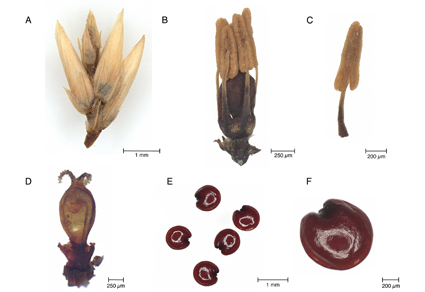
Lagrezia monosperma has long posed a taxonomic challenge due to its strikingly disjunct distribution along the Mexican Pacific coast, far from the center of diversity of Lagrezia in the Western Indian Ocean. Through morphological study of herbarium material, evaluation of pollen characters, and integration of recent molecular phylogenetic evidence, we demonstrate that Lagrezia monosperma is neither closely related to Lagrezia nor assignable to Celosia. Instead, it represents a distinct lineage within the tribe Celosieae. We therefore describe Amphoria, a new monotypic genus, to accommodate this species, and make the new combination Amphoria monosperma. Amphoria is distinguished by its tapered ovary base, uniovulate ovary, smooth shiny seeds, narrow lanceolate tepals, and a short androecial cup, as well as by its microechinate, pantoporate pollen. The genus is endemic to the Pacific lowlands of Mexico, occurring from Jalisco to Oaxaca.
References
- Al‐Qahtani, W.H. (2023) Unveiling the intricacies of Amaranthaceous pollen diversity: Advancing ultra sculpture analysis through LM and SEM. Microscopy Research and Technique 86: 1691–1698. https://doi.org/10.1002/jemt.24408
- Aublet, J.B.C.F. (1775) Histoire des Plantes de la Guiane Françoise. P. F. Didot jeune, Londres, 976 pp. https://doi.org/10.5962/bhl.title.674
- Brandegee, T.S. (1917) Plantae Mexicanae Purpusianae, VIII. University of California Publications in Botany 6: 363–375. [https://lccn.loc.gov/a13001140]
- Borsch, T. (1998) Pollen types in the Amaranthaceae. Morphology and evolutionary significance. Grana 37: 129–142. https://doi.org/10.1080/00173 58
- Candolle, A.P. de (1849) Prodromus systematis naturalis regni vegetabilis, sive, Enumeratio contracta ordinum generum specierumque plantarum huc usque cognitarium, juxta methodi naturalis, normas digesta, 13 (2). Sumptibus Sociorum Treuttel et Würtz, 468 pp. https://doi.org/10.5962/bhl.title.286
- Cavaco, A. (1962) Les Amaranthaceae de I'Afrique au sud du tropique du cancer et de Madagascar. Mémoires du Museum National d'Histoire Naturelle, Nouvelle Série, Série B, Botanique 13: 1–254 + plates 1–16.
- Endlicher, S.F.L. (1837) Genera plantarum secundum ordines naturales disposita. Apud F. Beck, Vindobonae, 1483 pp. https://doi.org/10.5962/bhl.title.728
- Fosberg, F.R. (1974) Miscellaneous notes on the flora of Aldabra and neighbouring islands: III. Kew Bulletin 29: 253–266. https://doi.org/10.2307/4108539
- Greenman, J.M. (1912) Diagnoses of new species and notes on other Spermatophytes, chiefly from Mexico and Central America. Publications of the Field Museum of Natural History, Botanical Series 2: 329–350. [https://lccn.loc.gov/87655643] https://doi.org/10.5962/bhl.title.4338
- Jacquin, N.J. (1789) Collectanea ad botanicam, chemiam, et historiam naturalem spectantia, cum figuris, vol. 2. ex officina Wappleriana, Vindobonae, 374 pp.
- Kiedaisch, T., Čalasan, A.Ž., McCauley, R.A. & Kadereit, G. (2026) New evolutionary framework and tribal circumscription of Amaranthaceae s.s. as determined through a comprehensive phylogenomic analysis. Cladistics. [early view] https://doi.org/10.1111/cla.70049
- Linnaeus, C. (1753) Species Plantarum, volls. 1–2. Impensis Laurentii Salvii, Holmiae, 1231 pp. https://doi.org/10.5962/bhl.title.669
- Martius, C.F.P. von (1837) Herbarium Florae brasiliensis. Flora oder Botanische Zeitung: welche Recensionen, Abhandlungen, Aufsätze, Neuigkeiten und Nachrichten, die Botanik betreffend, enthält 20: 1–128.
- Miller, P. (1754) The gardeners dictionary: containing the methods of cultivating and improving all sorts of trees, plants, and flowers, for the kitchen, fruit, and pleasure gardens, as also those which are used in medicine : with directions for the culture of vineyards, and making of wine in England, vol. 2. John and James Rivington, London, 472 pp. https://doi.org/10.5962/bhl.title.79061
- Moquin-Tandon, C.H.B.A. (1849) Amaranthaceae. In: Candolle, A.P. de Prodromus systematis naturalis regni vegetabilis, sive, Enumeratio contracta ordinum generum specierumque plantarum huc usque cognitarium, juxta methodi naturalis, normas digesta, vol. 13 (2). Sumptibus Sociorum Treuttel et Würtz, pp. 231–424. https://doi.org/10.5962/bhl.title.286
- Odintsova, A.V. (2025) Morphological and taxonomic overview of fruits in representatives of subclass Caryophyllidae in the flora of Ukraine. Ukrainian Botanical Journal 82: 60–78. https://doi.org/10.15407/ukrbotj82.01.060
- Rose, J.N. (1895) Report on a collection of plants made in the states of Sonora and Colima, Mexico, by Dr. Edward Palmer, in the years 1890 and 1891. Contributions from the United States National Herbarium 1: 293–434. [https://www.wikidata.org/entity/Q5785352]
- Rzedowski, J. (1978) Vegetación de México. Limusa, D.F., 432 pp.
- Sandoval-Ortega, M.H. & Zumaya-Mendoza, S. (2023) Types of some Mexican names in Amaranthaceae s.l. (Caryophyllales). Phytotaxa 597: 8–14. https://doi.org/10.11646/phytotaxa.597.1.2
- Sarmiento-Cordero, M.A., Ramírez-García, E. & Contreras-Ramos, A. (2010) Diversidad de la familia Syrphidae (Diptera) en la Estación de Biología “Chamela”, Jalisco, México. Dugesiana 17: 197–207. https://doi.org/10.32870/dugesiana.v17i2
- Schinz, H. (1896) Beiträge zur Kenntnis der Afrikanischen Flora. Bulletin de l'Herbier Boissier 4: 409–475. [https://lccn.loc.gov/ca06001433]
- Schinz, H. (1934) Amaranthaceae. In: Engler, A. & Prantl, K. (Eds.) Die natürlichen Pflanzenfamilien, ed. 2, vol. 16c. Engelmann, Leipzig, pp. 7–85.
- South, A. & South, M.A. (2017) R Package: rnaturalearth. Available from: https://cran.r-project.org/web/packages/rnaturalearth/rnaturalearth.pdf (accessed 1 Semptember 2026)
- Standley, P.C. (1915) The North American tribes and genera of Amaranthaceae. Journal of the Washington Academy of Sciences 5: 391–396. [https://lccn.loc.gov/12002649]
- Swartz, O. (1788) Nova Genera et Species Plantarum seu Prodromus. M. Swederi, Holmiae, Upsaliae, & Aboae, 152 pp. https://doi.org/10.5962/bhl.title.433
- Thiers, B. (2026) Index Herbariorum. New York Botanical Garden. Available from: http://sweetgum.nybg.org/science/ih/ (accessed 1 Semptember 2026)
- Townsend, C.C. (1993) Amaranthaceae Juss. In: Kubitzki, K., Rohwer, J.G. & Bittrich, V. (Eds.) The families and genera of vascular plants. Flowering Plants· Dicotyledons: Magnoliid, Hamamelid and Caryophyllid Families. Springer Berlin Heidelberg, Berlin, pp. 70–91.
- Vogel, T.H. (1837) Dalbergiearum genera Brasiliensia. Linnaea: Ein Journal für die Botanik in ihrem ganzen Umfange 11: 177–204. [https://www.biodiversitylibrary.org/bibliography/626]
- Wickham, H. (2016) ggplot2: Elegant Graphics for Data Analysis. Springer-Verlag New York.
- Wickham, H., François, R., Henry, L., Müller, K. & Vaughan, D. (2025) dplyr: A Grammar of Data Manipulation. R package version 1.1.4. Available from: https://dplyr.tidyverse.org (accessed 1 Semptember 2026)