
Abstract
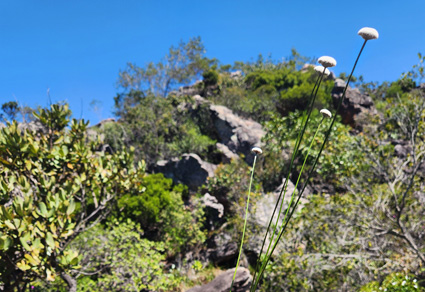
Paepalanthus macrocaulon (Eriocaulaceae) was described from the Botumirim region and adjacent areas in the Espinhaço Range, Minas Gerais, Brazil. In addition to the autonym, the species currently includes two accepted varieties described from the Pico das Almas, southern part of the Chapada Diamantina in Bahia (Brazil). Based on an extensive analysis of the type material, field populations, and herbarium specimens, we conclude that the two varieties from Bahia are distinct entities and should be recognized as two independent species, while P. macrocaulon is restricted to Minas Gerais. We propose two new status, one new name, and designate one lectotype. Detailed descriptions, illustrations, additional comments, and a comparative table are also provided. Paepalanthus kingii is easily distinguished from the type variety by the glabrous leaves with plain margin and the five series of glabrous involucral bracts with acuminate apex surpassing the floral disc. Paepalanthus raymondii may be differentiated from P. macrocaulon by the glabrous leaves with plain margin, pilose spathes and scapes, wider capitula, and the narrow spathulate floral bracts densely pilose abaxially. The two taxa treated here as species for the first time occur in sympatry and may be further differentiated by the scape pilosity and capitulum width, besides the shape and pilosity of both involucral and floral bracts.
References
- Andrino, C.O., Sano, P.T., Inglis, P.W., Hensold, N., Costa, F.N. & Simon, M.F. (2021) Phylogenetics of Paepalanthus (Eriocaulaceae), a diverse Neotropical monocot lineage. Botanical Journal of the Linnean Society 195: 34–52. https://doi.org/10.1093/botlinnean/boaa070
- de Queiroz, K. (2007) Species concepts and species delimitation. Systematic Biology 56: 879–886. https://doi.org/10.1080/10635150701701083
- Giulietti, A.M. & Parra, L.R. (1995) Eriocaulaceae. In: Stannard, B.L. (Ed.) Flora of the Pico das Almas, Chapada Diamantina – Bahia, Brazil. Royal Botanic Gardens, Kew, pp. 684–704.
- Harley, R.M. & Mayo, S.J. (1980) Towards a checklist of the Flora of Bahia. Royal Botanic Gardens, Kew, 250 pp.
- Hensold, N. (1991) Revisionary Studies in the Eriocaulaceae of Venezuela. Annals of the Missouri Botanical Garden 78: 424–440. https://doi.org/10.2307/2399571
- Körnicke, F. (1863) Eriocaulaceae. In: Martius, C.F.P. & Eichler, A.W. (Eds.) Flora brasiliensis 3 (1). Typographia Regia, Munich, pp. 273–508.
- Martius, K.F.P. (1834) Die Eriocauleae als selbstständige Pflanzen-familie aufgestellt und erläutert. Annales des sciences naturelles. Botanique Sér. 2, 2: 25–43.
- Moldenke, H.N. (1979) Notes on new and noteworthy plants CXXVI. Phytologia 43: 355–356.
- Moldenke, H.N. (1980a) Eriocaulaceae. In: Harley, R.M. & Mayo, S. (Eds.) Towards a checklist of the Flora of Bahia. Royal Botanic Gardens, Kew, pp. 72–77.
- Moldenke, H.N. (1980b) Notes on new and noteworthy plants CXXXIII. Phytologia 45: 36–40.
- O’Hara, R.J. (1993) Systematic generalization, historical fate and the species problem. Systematic Biology 42: 231–246. https://doi.org/10.1093/sysbio/42.3.231
- Oliver, G.S. (2007) A trajetória de um engenheiro de minas: ciências da terra, natureza e agricultura. In: III Simpósio Nacional sobre Ensino de geologia no Brasil. Unicamp, Campinas, pp. 1–7.
- Sano, P.T., Giulietti, A.M., Trovó, M., Parra, L.R. & Müller, G. (2010) Flora de Grão-Mogol, Minas Gerais: Eriocaulaceae. Boletim de Botânica da Universidade de São Paulo 28: 125–140. https://doi.org/10.11606/issn.2316-9052.v28i2p125-140
- Silva, R.R. (2017) Eriocaulaceae no Parque Estadual da Serra do Intendente, Conceição do Mato Dentro, Minas Gerais, Brasil. Master thesis, Universidade de São Paulo, São Paulo, 285 pp. https://doi.org/10.11606/d.41.2017.tde-12072017-085922
- Silveira, A.A. (1908) Flora e Serras Mineiras. Imprensa Official, Bello Horizonte [Belo Horizonte], 79 pp.
- Silveira, A.A. (1928) Floralia Montium. Imprensa Official, Bello Horizonte [Belo Horizonte], 426 pp.
- Thiers, B. (2026, continuously updated) Index Herbariorum: A global directory of public herbaria and associated staff. New York Botanical Garden’s Virtual Herbarium. Available from: http://sweetgum.nybg.org/ih/ (accessed 15 September 2025)
- Trovó, M. & Cardoso, P.H. (2025) The legacy of Harold Norman Moldenke to the Eriocaulaceae and Verbenaceae, with special comments on type citations. Botany Letters 173: 3–10. https://doi.org/10.1080/23818107.2025.2571938
- Turland, N.J., Wiersema, J.H., Barrie, F.R., Gandhi, K.N., Gravendyck, J., Greuter, W., Hawksworth, D.L., Herendeen, P.S., Klopper, R.R., Knapp, S., Kusber, W.-H., Li, D.-Z., May, T.W., Monro, A.M., Prado, J., Price, M.J., Smith, G.F. & Zamora Señoret, J.C. (2025) International Code of Nomenclature for algae, fungi, and plants (Madrid Code). Regnum Vegetabile 162. University of Chicago Press, Chicago, 288 pp. https://doi.org/10.7208/chicago/9780226839479.001.0001