

Abstract
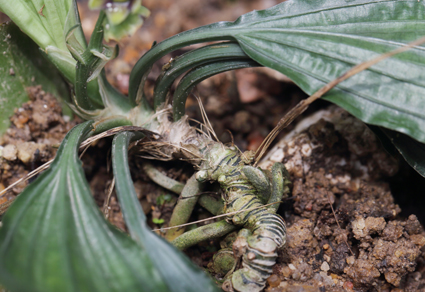
A new species of Peliosanthes (Asparagaceae), P. ehuangzhangensis, from Guangdong Province, China, is described and illustrated. It is morphologically most similar to P. macrostegia in possessing a fleshy, hemispherical corona but is readily distinguished by its dwarf habit, distinctive fleshy stolon with very short internodes, shorter inflorescence bearing (4–)6–8(–10) flowers, a superior, cylindrical pistil, and pendulous flowers. The unique subterranean stolon, a stark contrast to the typical rhizomes of compared congeners, is highlighted as a key diagnostic character and a potential adaptation for water storage. This discovery from the E'huangzhang Provincial Nature Reserve underscores the ongoing botanical diversity awaiting documentation in the region.
References
- Andrews, H.C. (1810) Peliosanthes teta. Botanist’s Repository 9: 605.
- Averyanov, L.V. & Tanaka, N. (2012) New species of Peliosanthes and Tupistra (Asparagaceae) from eastern Indochina. Taiwania 57 (2): 153–167. [http://tai2.ntu.edu.tw/taiwania/pdf/tai.2012.57.153.pdf]
- Averyanov, L.V., Tanaka, N., Nguyen, K.S., Nguyen, H.T. & Konstantinov, E.L. (2015) New species of Ophiopogon Ker Gawl., Peliosanthes Andrews and Tupistra Ker Gawl. (Asparagaceae) in the flora of Laos and Vietnam. Adansonia Sér. 3 37: 25–45. https://doi.org/10.5252/a2015n1a4
- Averyanov, L.V., Tanaka, N., Nguyen, K.S. & Nguyen, T.H. (2016) New species of Ophiopogon and Peliosanthes (Asparagaceae) from Laos and Vietnam. Taiwania 61 (3): 201–217. [http://tai2.ntu.edu.tw/taiwania/pdf/tai.2016.61.201.pdf]
- Averyanov, L.V., Tanaka, N., Nguyen, K.S., Nguyen, Q.N., Maisak, T.V. & Nguyen, T.H. (2017) New species of Peliosanthes, Rohdea and Tupistra (Asparagaceae) from Laos and Vietnam. Nordic Journal of Botany 35 (6): 697–710. https://doi.org/10.1111/njb.01660
- Averyanov, L.V., Tanaka, N., Nguyen, K.S. & Maisak, T.V. (2020) Peliosanthes cupuliformis (Asparagaceae), a new species from central Laos. Nordic Journal of Botany 38 (9)-e02851: 1–5. https://doi.org/10.1111/njb.02851
- Chase, M.W., Reveal, J.L. & Fay, M.F. (2009) A subfamilial classification for the expanded asparagalean families Amaryllidaceae, Asparagaceae and Xanthorrhoeaceae. Botanical Journal of the Linnean Society 161 (2): 132–136. https://doi.org/10.1111/j.1095-8339.2009.00999.x
- Chen, K., Pan, X.R., Sun, Y.F., Yuan, J.J. & Feng, H.Z. (2025) Peliosanthes gulinqingensis (Asparagaceae), a new species from Yunnan, Southwestern China. Phytotaxa 717 (1): 52–58. https://doi.org/10.11646/phytotaxa.717.1.3
- Feng, H.Z., Wu, R.M., Zeng, Q.G., Fang, Q. & Liao, W.B. (2024) Peliosanthes yangchunensis (Asparagaceae), a new species from Guangdong, China. Phytotaxa 650 (3): 262–268. https://doi.org/10.11646/phytotaxa.650.3.6
- International Plant Names Index (2025) Peliosanthes. Published on the Internet by The Royal Botanic Gardens, Kew, The Harvard University Herbaria, and The Australian National Botanic Gardens. Available from: https://www.ipni.org/ (accessed 10 March 2025)
- Jessop, J.P. (1976) A revision of Peliosanthes (Liliaceae). Blumea 23: 141–159.
- Kroupsky, I.A., Lyskov, D.F., Romanov, M.S., Drokina, V.G., Dac, L.X., Kuznetsov, A.N., Kuznetsova, S.P., Nguyen, K.S., Tanaka, N. & Nuraliev, M.S. (2025) Peliosanthes multiflora (Asparagaceae), a small-flowered new species from Vietnam. Phytotaxa 696 (1): 83–92. https://doi.org/10.11646/phytotaxa.696.1.5
- Lin, N.X., Li, X.F., Zhang, G.C. & Feng, H.Z. (2025) The identity of Peliosanthes revoluta and P. torulosa (Asparagaceae) described from Guangxi, and P. pseudorevoluta, a new species also from Guangxi, China. Phytotaxa 700 (2): 233–242. https://doi.org/10.11646/phytotaxa.700.2.6
- Meng, K.K., Qu, J.R., Li, R.K., Lu, L.Y., Meng, T., Wang, L.P. & Feng, H.Z. (2025) Peliosanthes purpureiflora (Asparagaceae), a new species from China. Phytotaxa 690 (1): 116–122. https://doi.org/10.11646/phytotaxa.690.1.10
- Nguyen, K.S., Tanaka, N., Averyanov, L.V., Nguyen, T.S. & Pham, V.T. (2021) Peliosanthes longiracemosa (Asparagaceae), a new species from limestone areas of northern Vietnam. Phytotaxa 514 (2): 173–179. https://doi.org/10.11646/phytotaxa.514.2.9
- Hance, H.F. (1885) Spicilecia florae Sinensis: diagnose of new and habitats of rare or hitherto unrecorade, Chinese plants. Journal of botany 23: 321–330.
- Plants of the World Online (2025) Peliosanthes. Royal Botanic Gardens, Kew. Available from: https://powo.science.kew.org/ (accessed 10 March 2025)
- Tanaka, N. (1999) Taxonomic notes on Peliosanthes (Convallariaceae) I. Acta Phytotaxonomica et Geobotanica 50 (2): 147–155. https://doi.org/10.18942/bunruichiri.KJ00001077420
- Tanaka, N. (2004a) A new species of Peliosanthes (Convallariaceae) from Vietnam and China. Kew Bulletin 59: 157–159. https://doi.org/10.2307/4111093
- Tanaka, N. (2004b) Inclusion of Neolourya in Peliosanthes (Convallariaceae). Novon 14: 360–364.
- Tanaka, N. & Nguyen, K.S. (2023) Nolinoideae (Asparagaceae) in APG III needs replacing with Convallarioideae. Phytotaxa 583 (3): 297–299. https://doi.org/10.11646/phytotaxa.583.3.9
- Wang, L.H., Bi, M.H., Chu, H.B., Zhang, G.C. & Feng, H.Z. (2024a) Peliosanthes orthocoronata (Asparagaceae), a new species from Southeastern Yunnan, China. Phytotaxa 678 (3): 167–175. https://doi.org/10.11646/phytotaxa.678.3.2
- Wang, L.H., Bi, M.H., Chu, H.B. & Feng, H.Z. (2024b) Peliosanthes planicoronata (Asparagaceae), a new species from Southeastern Yunnan, China. Phytotaxa 678 (1): 77–82. https://doi.org/10.11646/phytotaxa.678.1.8