

Abstract
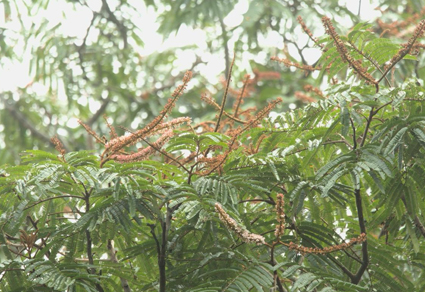
Dimorphandra (Leguminosae: Caesalpinioideae) comprises 26 species endemic to South America. During a review of Colombian herbaria, we examined Dimorphandra specimens that clearly differed from all known species of the genus, in both vegetative and reproductive characters. Therefore, we propose that these specimens represent two new species within the genus. Here, we provide a taxonomic treatment for the two new species: Dimorphandra andina and Dimorphandra bracteata. Dimorphandra andina is recognized by its spiciform panicle inflorescence with 5–12 racemes of 23.3–24.5 cm long; light pink flowers and staminodes, subsessile ovary, and falcate fruits containing 6–11 seeds, in addition to other diagnostic characters. Dimorphandra bracteata is recognized by its corymbose panicle inflorescence with 20–25 spikes, which are short (8–13.5 cm); a persistent bract 0.3–0.5 cm long; flowers 0.2–0.3 cm long; and a glabrous ovary. We provide illustrations, taxonomic comments, a map of their geographic distribution, habitat descriptions, and a preliminary conservation assessment. As a result, we recognize nine species of Dimorphandra for Colombia and provide an identification key for all species present in the country, demonstrating the floristic potential of the Andean and Amazonian regions of Colombia.
References
- Arbeláez, M.V. & Callejas, R. (1999) Flórula de la meseta de arenisca de la comunidad de Monochoa. Estudios en la Amazonia Colombiana XIX. Tropenbos Colombia, Bogotá.
- Aymard, G.A. (2025) A new species of Securidaca (Polygalaceae, Polygaleae) from Araracuararegion, middle Caquetá river basin, Colombia. Cinchonia 20 (1): 79–97.
- Bentham, G. (1840) Contributions toward a flora of South America. In: Hooker, W.J. Journal of Botany (Hooker), pp. 38–103.
- Bentham, G. (1865) Genera plantarum: ad exemplaria imprimis in Herberiis Kewensibus servata definite, 1: 434–599.
- Bentham, G. (1839) Description of the Mora tree. Transactions of the Linnean Society of London 18 (2): 209–211. https://doi.org/10.1111/j.1095-8339.1838.tb00171.x
- Cuatrecasas, J. (1958) Aspectos de la vegetación natural de Colombia. Revista de la Academia Colombiana de Ciencias Exactas, Físicas y Naturales 10 (40): 221–264. https://doi.org/10.18257/raccefyn.570
- Ducke, A. (1915) Plantes nouvelles ou peu connues de la region amazonienne. Archivos do Jardim Botânico do Rio de Janeiro 1 (1): 7–57.
- Ducke, A. (1922) Plantes nouvelles ou peu connues de la region amazonienne. Archivos do Jardim Botânico do Rio de Janeiro 3: 4–269.
- Ducke, A. (1925) Plantes nouvelles ou peu connues de la region amazonienne. Archivos do Jardim Botânico do Rio de Janeiro 4 (3): 1–205.
- Ducke, A. (1935) New species of the genus Dimorphandra Schott section Pocillum Tul. Journal of the Washington Academy of Sciences 25 (4): 193–198.
- Ducke, A. (1938) Plantes nouvelles ou peu connues de la region amazonienne. Arquivos do Instituto de Biologia Vegetal 4 (1): 1–64.
- Ducke, A. (1944) New or noteworthy Leguminosae of the Brazilian Amazon. Boletim. Tecnico do Instituto Agronomico do Norte 2: 1–33.
- Duivenvoorden, J.F. (1994) Vascular plant species counts in the rain forests of the middle Caquetfi area, Colombian Amazonia. Biodiversity and Conservation 3: 685–715. https://doi.org/10.1007/BF00126860
- Duivenvoorden, J.F. & Cleef, A.M. (1994) Amazonian savanna vegetation on the sandstone platean near Araracuara, Colombia. Phytoeconologia 24: 197–232. https://doi.org/10.1127/phyto/24/1994/197
- Fernández-Alonso, J.L. & Arbeláez, M.V. (2008) Araracuara, the new genera of the Rhamnaceae from Colombian Amazon. Anales Jard. Bot. Madrid 65 (2): 343–352. https://doi.org/10.3989/ajbm.2008.v65.i2.297
- Harms, H.A.T. (1897) Leguminosae. In: Engler, A. Die Natürlichen Pflanzenfamilien, Nachträge zum II bis IV Teil, 1. pp. 190–203.
- Holdridge, L.R. (1978) Ecología basadas em zonas de vida. Instituto Interamericano de Ciências Agrícolas. Editorial IICA: San José, Costa Rica. 235 pp.
- Hooker, W.J. (1843) Icones Plantarum. 6: 501–600.
- Hopkins, H.C.F. & Silva, G.S. (2025) Inga pectinata, basionym of Parkia pectinata, from the Río Casiquiare, Venezuela, is synonymized with Dimorphandra cuprea (Leguminosae: Caesalpinioideae: Dimorphandreae). Willdenowia 55: 51–65. https://doi.org/10.3372/wi.55.05
- IUCN Standards and Petitions Committee. (2025) Guidelines for Using the IUCN Red List Categories and Criteria. Version 14. Prepared by the Standards and Petitions Committee. Available from: http://www.iucnredlist.org/documents/RedListGuidelines.pdf (accessed 19 July 2025)
- Lewis, G.P., Schrire, B., Mackinder, B. & Lock, M. (2005) Legumes of the World. Royal Botanic Garden. pp. 1–577. https://doi.org/10.2307/25065563
- Legume Phylogeny Working Group. (2017) A new subfamily classification of the Leguminosae based on a taxonomically comprehensive phylogeny. Taxon 66: 44–77. https://doi.org/10.12705/661.3
- Maas, P.J.M. & Westra, L.Y.T. (2015) Confronting a morphological nightmare: revision of the Neotropical genus Guatteria (Annonaceae). Blumea 60 (1): 1–219. https://doi.org/10.3767/000651915X690341
- Maguire, B. & Smith, L.B. (1963) Xyridaceae. In: Maguire, B. & Wurdack, J.J. (Eds.) The botany of the Guayana highland—Part V. Memoirs of The New York Botanical Garden 10 (5): 1–278.
- Marcano-Berti, L.B., Vélez-Puerta, J.M. & Aymard-Corredor, G.A. (2023) A new species of Vochysia (Vochysiaceae, section ciliantha, subsection ferruginea) from the Colombian Amazon Forest. Harvard Papers in Botany 28 (1): 77–84. https://doi.org/10.3100/hpib.v28iss1.2023.n9
- Matos, R.P. (2015) Estudos Fitogeográficos e modelagem ecológica do gênero Dimorphandra Scott (Leguminosae, Caesalpinioideae). Dissertação de Mestrado, Universidade Federal do Ceará/Programa de Pós-graduação em Ecologia e Recursos Naturais. Fortaleza, Ceará. 81 pp. https://doi.org/10.36517/psg.v6i1
- Pipoly, J.J. & Graff, A. (1995) A Synopsis of the genus Clusia sections Criuvopsis and Braschystemon (Clusiaceae) in Northern South America. Sida 16 (3): 504–528.
- QGIS Development Team. (2020) QGIS Geographic Information System. Open Source Geospatial Foundation. Available from: https://qgis.org (accessed 10 July 2025)
- Radford, A.E., Dickison, W.C., Massey, J.R. & Bell, C.R. (1974) Vascular Plant Systematics. Harper Collins, New York, pp. 891.
- Restrepo-Santamaria, D., Valencia-Rodrígueza, D., Herrera-Pérez, J., Muñoz-Duquea, S., Galeano, A.F. & Jiménez-Segura, L. (2023) Bio Anorí, the biological expedition that documented fish diversity after the post-conflict in Antioquia, Colombia. Global Ecology and Conservation 43: 1–10. https://doi.org/10.1016/j.gecco.2023.e02445
- Ringelberg, J.J., Koenen, E.J.M., Iganci, J.R., Queiroz, L.P., Murphy, D.J., Gaudeul, M., Bruneau, A., Luckow, M., Lewis, G.P. & Hughes, C.E. (2022) Phylogenomic analysis of 997 nuclear genes reveals the need for extensive generic re-delimitation in Caesalpinioideae (Leguminosae). In: Hughes, C.E., Queiroz, L.P. & Lewis, G.P. (Eds.) Advances in Legume Systematics 14. Classification of Caesalpinioideae Part 1: New generic delimitations. PhytoKeys 205: 3–58. https://doi.org/10.3897/phytokeys.205.85866
- Rizzini, C.T. (1969) Espécies novas de árvores do Planalto Central Brasileiro. Anais da Academia Brasileira de Ciências 41 (2): 239–244.
- Ruiz, L.K., Gradstein, S.R., Bernal, R. & Romero, C. (2016) Fabaceae. In: Bernal, R., Gradstein, S.R. & Celis, M. (Eds.) Catálogo de Plantas y Liquenes de Colombia. Vol. 1. Universidad Nacional de Colombia, Bogotá.
- Sánchez, S.M. (1997) Catálogo preliminar comentado de la flora del medio Caquetá (Amazonia colombiana). Estudios en la Amazonia Colombiana. XII. Tropenbos Colombia, Bogotá.
- Sandwith, N.Y. (1932) Contributions to the Flora of Tropical America XIV. Bulletin of Miscellaneous Information, Royal Gardens, Kew (8): 395–406. https://doi.org/10.2307/4113483
- Sarmiento, F. (2008) Andes Mountains and Human Dimensions of Global Change: An Overview. Pirineos 163: 7–13. https://doi.org/10.3989/pirineos.2008.v163.18
- Sastre-Blanco, J.C. & Reichel-Dolmatoff, H. (1978) Notas botânicas sobre la región de Araracuara (río Caquetá, comisaría del, Amazonas, Colombia). Bulletin de l’Institut Français d’Études Andines 7 (1–2): 105–117. https://doi.org/10.3406/bifea.1978.1502
- Schott, H.W. (1827) Fasciculus Plantarum Brasiliensium. In: Linnaeus, C. (Ed.) Systema Vegetabilium. editio decima sexta, pp. 403–410.
- Silva, G.S. (2019) Contribuição na delimitação de espécies do gênero neotropical Dimorphandra Schott (Fabaceae-Caesalpinioideae). Masters dissertation, Instituto Nacional de Pesquisas da Amazônia, Brazil. pp. 1–134.
- Silva, G.S. & Simon, M.F. (2024) Tribe Dimorphandeae. In: Bruneau, A., Queiroz, L.P. & Ringelberg, J.J. (Eds.) Advances in Legume Systematics 14. Classification of Caesalpinioideae. Part 2: Higher-level classification. PhytoKeys 240: 177–186.
- Silva, G.S., Simon, M.F., Fortes, E.A. & Mansano, V.F. (In prep.) Filogenômica e Taxonomia do gênero Dimorphandra Schott (Leguminosae—Caesalpinoideae): descrevendo novos táxons e suas relações para a região Neotropical.
- Silva, G.S. & Hopkins, M.J.G. (2018) New record of Fabaceae (Caesalpinioideae) for Brazil: Dimorphandra davisii Sprague & Sandwith. Biota Amazonia 8 (2): 63–64.
- Silva, G.S. & Hopkins, M.J.G. (2024) Utilização da espectroscopia do infravermelho próximo (NIRS) como ferramenta na discriminação de espécies do gênero Dimorphandra Schott (Leguminosae: Caesalpinioideae). Scientia Plena 20 (3): 1–12. https://doi.org/10.14808/sci.plena.2024.031201
- Silva, M.F. (1986) Dimorphandra (Caesalpiniaceae). In: Flora Neotropica, v. 44. New York Botanical Garden. 127 pp.
- Sprague, T.A. & Sandwith, N.Y. (1932) Contributions to the Flora of Tropical America. Bulletin of Miscellaneous Information, Royal Gardens, Kew 8: 353–416. https://doi.org/10.2307/4113370
- Splitgerber, F.L. (1842) Plantis Novis Surinamensibus. In: Hoeven, J. & Vriese, W.H. (Eds.) Tijdschrift voor Natuurlijke Geschiedenis en Physiologie. pp. 95–114.
- Souza, V.C., Lima, A.G. & Silva, G.S. (2025) Dimorphandra in Flora e Funga do Brasil. Jardim Botânico do Rio de Janeiro. Available from: https://floradobrasil.jbrj.gov.br/FB78675 (accessed 28 July 2025)
- Suárez, S. & Galeano, G. (1996) Las Marantaceas de la Region de Araracuara. Universidad Nacional de Colombia, Tropenbos Colombia, 111 pp.
- Thiers, B. (2025) [continuously updated] Index Herbariorum: A global directory of public herbaria and associated staff. New York Botanical Garden’s Virtual Herbarium. Available from: http://sweetgum.nybg.org/ih/ (accessed 18 July 2025)
- Taubert, P.H.W. (1896) Leguminosae africanae I. In: Engler, A. (Ed.) Beiträge zur Flora von Africa. XII. Botanische Jahrbücher für Systematik, Pflanzengeschichte und Pflanzengeographie 23: 172–196.
- Tulasne, M.L.S. (1844) Legumineuses arborescentes de L’Amerique du Sud. Archives du Muséum d’Histoire Naturelle Paris 4: 65–195.
- Willdenow, C.L. (1806) Inga. In: Linnaeus, C. (Ed.) Species Plantarum. Editio quarta 4 (2). pp. 1004–1027.