
Abstract
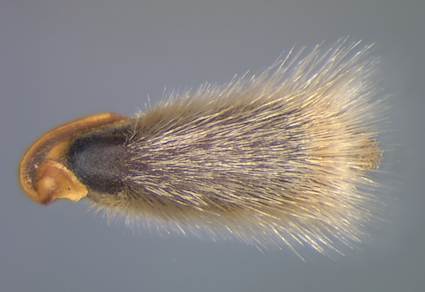
The complex seed morphology of Polygala subgen. Polygala is formally described for the Angolan taxa. Seeds were collected from herbarium specimens and microphotographs of lateral, dorsal, and ventral views were used to derive data on the measurements and shape of the structures. A standardised and illustrated explanation of quantitative attributes and descriptive terms for shapes was developed to improve consistency and facilitate comparison across taxa. An identification key of taxa based solely on seed features is also provided. The majority of the taxa (80%) can be segregated using seed characters alone, which demonstrates the value of seed morphology for the taxonomy of species in Polygala s.s.
References
- Abbott, J.R. (2011) Notes on the disintegration of Polygala (Polygalaceae), with four new genera for the flora of North America. Journal of the Botanical Research Institute of Texas 5 (1): 125–137. [https://www.jstor.org/stable/41972495]
- Abbott, J.R. & Pastore, J.F.B. (2015) Preliminary synopsis of the genus Hebecarpa (Polygalaceae). Kew Bulletin 70 (3): a39. [pp. 1–8] https://doi.org/10.1007/s12225-015-9589-2
- Adema, F. (1966) A review of the herbaceous species of Polygala in Malesia (Polygalaceae). Blumea 14 (2): 253–276. [https://repository.naturalis.nl/pub/526139/BLUM1966014002001.pdf]
- Aydın, Z.U. (2020) Comparative capsule and seed morphology of Polygala L. (Polygalaceae) species in Turkey with implications for taxonomy. Plant Biosystems – An International Journal Dealing with All Aspects of Plant Biology 154 (2): 189–196. https://doi.org/10.1080/11263504.2019.1588177
- Beentje, H. (2010) The Kew plant glossary. An illustrated dictionary of plant terms. The Board of Trustees of the Royal Botanic Gardens, Kew, 160 pp.
- Berg, R.Y. (1975) Myrmecochorous plants in Australia and their dispersal by ants. Australian Journal of Botany 23 (3): 475–508. https://doi.org/10.1071/BT9750475
- Castro, S., Ferrero, V., Loureiro, J., Espadaler, X., Silveira, P. & Navarro, L. (2010) Dispersal mechanisms of the narrow endemic Polygala vayredae: dispersal syndromes and spatio-temporal variations in ant dispersal assemblages. Plant Ecology 207 (2): 359–372. https://doi.org/10.1007/s11258-009-9679-z
- Castro, S., Silveira, P., Navarro, L., Paiva, J. & Coutinho, A.P. (2009) Pollen morphology of Chamaebuxus (DC.) Schb., Chodatia Paiva and Rhinotropis (Blake) Paiva (Polygala L., Polygalaceae). Grana 48 (3): 179–192. https://doi.org/10.1080/00173130902938428
- Chodat, R. (1893) Monographia Polygalacearum. Memoires de La Société de Physique et d’histoire Naturelle de Genève 31 (2): 1–500. [https://www.biodiversitylibrary.org/item/50023#page/203/mode/1up]
- Coelho, A.M.S. (2022) Polygala L. in Angola: seed morphology and dispersal mechanisms. MSc thesis, University of Coimbra, 142 pp. [https://hdl.handle.net/10316/102987]
- Dönmez, A.A., Ugurlu, A.Z. & Işık, S. (2015) Polygala turcica (Polygalaceae), a new species from E Turkey, and a new identification key to Turkish Polygala. Willdenowia 45 (3): 429–434. https://doi.org/10.3372/wi.45.45309
- Endress, P.K. (2011) Angiosperm ovules: diversity, development, evolution. Annals of Botany 107 (9): 1465–1489. https://doi.org/10.1093/aob/mcr120
- Eriksen, B. (1993) Phylogeny of the Polygalaceae and its taxonomic implications. Plant Systematics and Evolution 186 (1–2): 33–55. https://doi.org/10.1007/bf00937712
- Exell, A.W. (1960) Polygalaceae. In: Exell, A.W. & Wild, H. (Eds.) Flora Zambesiaca, 1 (1). Crown Agents for Oversea Governments and Administrations, London, pp. 303–336.
- Exell, A.W. & Mendonça, A. (1937) Polygalaceae. In: Exell, A.W. & Mendonça, A. Conspectus Florae Angolensis, 1 (1). Ministério do Ultramar – Junta de Investigações do Ultramar, Lisboa, pp. 90–108.
- Exell, A.W. & Mendonça, A. (1951) Polygalaceae. In: Exell, A.W. & Mendonça, A. Conspectus Florae Angolensis, 1 (2). Ministério do Ultramar – Junta de Investigações do Ultramar, Lisboa, pp. 363–367.
- Figueiredo, E., Smith, G.F. & Dressler, S. (2020) The botanical exploration of Angola by Germans during the 19th and 20th centuries, with biographical sketches and notes on collections and herbaria. Blumea 65 (2): 126–161. https://doi.org/10.3767/blumea.2020.65.02.06
- Ficalho, F.M.C.M. de & Hiern, W.P. (1881) On Central-African plants collected by Major Serpa Pinto. Transactions of the Linnean Society of London, Botany 2nd ser. 2: 11–36. [https://www.biodiversitylibrary.org/page/784428#page/18/mode/1up] https://doi.org/10.1111/j.1095-8339.1881.tb00002.x
- Forest, F., Chase, M.W., Persson, C., Crane, P.R. & Hawkins, J.A. (2007) The role of biotic and abiotic factors in evolution of ant-dispersal in the milkwort family (Polygalaceae). Evolution 61 (7): 1675–1694. https://doi.org/10.1111/j.1558-5646.2007.00138.x
- Gaertner, J. (1788) De fructibus et seminibus plantarum, 1. Typis Academiae Carolinae, Stugardiae, 384 pp. [Polygala treated on p. 294; https://www.biodiversitylibrary.org/item/114363#page/494/mode/1up]
- Hickey, M. & King, C. (2000) The Cambridge illustrated glossary of botanical terms. Cambridge University Press, Cambridge, pp. 13; 34.
- Isaacs, M.J.H., Weitz, F.M. & Johnson, C.T. (1993) Seed-coat characteristics of selected southern African species of Polygala L. (Polygalaceae). South African Journal of Botany 59 (6): 592–596. https://doi.org/10.1016/S0254-6299(16)30675-5
- Kerrigan, R.A. (2012) A treatment for Polygala of northern Australia. Australian Systematic Botany 25 (2): 83–137. https://doi.org/10.1071/SB08032
- Lack, A.J. & Kay, Q.O.N. (1987) Genetic structure, gene flow and reproductive ecology in sand-dune populations of Polygala vulgaris. Journal of Ecology 75 (1): 259–276. https://doi.org/10.2307/2260550
- Lai, H.V., Do, T.V., Ito, Y., Dang, T.M., Nguyen, H.V., Pham, H.T., Nguyen, N.Q. & Phan, T.V. (2025) Polygala tamdaoensis (Polygalaceae), a new species from northern Vietnam. Phytotaxa 698 (1): 28–34. https://doi.org/10.11646/phytotaxa.698.1.3
- Lengyel, S., Gove, A.D., Latimer, A.M., Majer, J.D. & Dunn, R.R. (2010) Convergent evolution of seed dispersal by ants, and phylogeny and biogeography in flowering plants: a global survey. Perspectives in Plant Ecology, Evolution and Systematics 12 (1): 43–55. https://doi.org/10.1016/j.ppees.2009.08.001
- Lisci, M., Bianchini, M. & Pacini, E. (1996) Structure and function of the elaiosome in some angiosperm species. Flora 191 (2): 131–141. https://doi.org/10.1016/S0367-2530(17)30704-–1
- Liu, A., Zhou, J.-j., Li, X., Yu, X.-l. & Wu, L. (2024) Polygala qii, a new species of Polygalaceae from limestone landform in Southern Hunan, China. PhytoKeys 244: 77–87. https://doi.org/10.3897/phytokeys.244.121759
- Mathew, L. & Teresa, M.V.M. (2010) Seed morphology and its systematic implications in Polygala L. (Polygalaceae). Phytomorphology 60 (3/4): 71–76.
- Mengist, W. (2019) An overview of the major vegetation classification in Africa and the new vegetation classification in Ethiopia. American Journal of Zoology 2 (4): 51–61. https://doi.org/10.11648/j.ajz.20190204.12
- Paiva, J.A.R. (1998) Polygalarum Africanarum et Madagascariensium prodromus atque gerontogaei generis Heterosamara Kuntze, a genere Polygala L. segregati et a nobis denuo recepti, synopsis monographica. Fontqueria 50: vi+346. [https://bibdigital.rjb.csic.es/idurl/1/1525936]
- Paiva, J.A.R. (2007) Polygalaceae. In: Beentje, H.J. & Ghazanfar, S.A. (Eds.) Flora of East Tropical Africa. Royal Botanic Gardens Kew, London, 64 pp.
- Paiva, J.A.R. (2008) Polygalaceae. In: Figueiredo, E. & Smith, G.F. Plants of Angola / Plantas de Angola. Strelitzia 22. South African National Biodiversity Institute, Pretoria, pp. 132–134.
- Paiva, J.A.R. (2016) Polygalaceae. In: Onana, J.-M. & Harvey, Y.B. (Eds.) Flore du Cameroun, 42. Ministry of Scientific Research and Innovation MINRESI, Yaoundé, 61 pp.
- Pastore, J.F.B. (2018) Polygala veadeiroensis (Polygalaceae), a new species of Polygala endemic to Chapada dos Veadeiros, Goiás, Brazil. Kew Bulletin 73 (3): 1–6. https://doi.org/10.1007/s12225-018-9759-0
- Pastore, J.F.B., Abbott, J.R., Neubig, K.M., Van den Berg, C., Mota, M.C.A., Cabral, A. & Whitten, W.M. (2019) Phylogeny and biogeography of Polygala (Polygalaceae). Taxon 68 (4): 673–691. https://doi.org/10.1002/tax.12119
- Pastore, J.F.B., Martinez, A., Abbott, J.R. & Neubig, K.M. (2023) Toward new generic delimitations in Polygalaceae II: Senega. Annals of the Missouri Botanical Garden 108: 126–249. https://doi.org/10.3417/2023754
- Pastore, J.F.B., Martinez, A., Negrão, R., Abbott, J.R., Forest, F., Baker, W.J., McGinnie, C., Restrepo-Sulez, K., Wang, Y., Mota, M. & Maurin, O. (2026) Toward a new generic delimitation in Polygalaceae III: Chamaebuxus, Chodatia, Heterosamara, and Paivanthus. Annals of the Missouri Botanical Garden 111: 1–39. https://doi.org/10.3417/20261005
- Persson, C. (2001) Phylogenetic relationships in the Polygalaceae based on plastid DNA sequences from the trnL-F region. Taxon 50 (3): 763–779. https://doi.org/10.2307/1223706
- Pinto, S. (1881) Como eu atravessei África do Atlântico ao Mar Índico, viagem de Benguella à contra-costa. 2: 102; 104. Sampson Low, Marston, Searle, e Rivington Eds, London, 340 pp. [Also available in English]
- Ridley, H.N. (1930) The dispersal of plants throughout the world. L. Reeve and Co., Ltd., Ashford, Kent, pp. 518–520.
- Rudall, P.J. (2007) Glossary. In: Rudall, P.J. Anatomy of flowering plants: An introduction to structure and development. Cambridge University Press, Cambridge, pp. 111–127.
- Sarvi, A., Faghir, M.B. & Shavvon, R.S. (2022) Pollen and seed micro-morphology of the genus Polygala (Polygalaceae) in Iran. Phytotaxa 542 (3): 256–270. https://doi.org/10.11646/phytotaxa.542.3.2
- Sernander, R. (1906) Entwurf einer monographie der Europäischen myrmekochoren. Kungliga Svenska Vetenskapsakademiens Handlingar 41 (7): 1–410. [https://www.biodiversitylibrary.org/item/106744#page/435/mode/1up]
- Siebert, S.J., Retief, E., Van Wyk, A.E. & Struwig, M. (2010) A new species of Polygala (Polygalaceae) from ultramafic soils in Sekhukhuneland, South Africa, with notes on its ecology. South African Journal of Botany 76 (2): 345–353. https://doi.org/10.1016/j.sajb.2010.01.003
- Stearn, W.T. (1992) Botanical Latin. 4th edition. David & Charles, Newton Abbot, Devon, xiv+546 pp.
- The J. Paul Getty Trust (2017) Getty thesaurus of geographic names. Getty Research Institute. [https://www.getty.edu/research/tools/vocabularies/tgn/index.html]
- Thiers, B. (2025) Index herbariorum: a global directory of public herbaria and associated staff. New York Botanical Garden’s Virtual Herbarium. [http://sciweb.nybg.org/science2/IndexHerbariorum.asp]
- Verkerke, W. (1985) Ovules and seeds of the Polygalaceae. Journal of the Arnold Arboretum 66 (3): 353–394. https://doi.org/10.5962/p.185931
- Verkerke, W. & Bouman, F. (1980) Ovule ontogeny and its relation to seed-coat structure in some species of Polygala (Polygalaceae). Botanical Gazette 141 (3): 277–282. https://doi.org/10.1086/337156
- Vishnu, M. & Nampy, S. (2022) Polygala idukkiana (Polygalaceae), a new species from the southern Western Ghats, India. Anales del Jardín Botánico de Madrid 79 (2): e129. https://doi.org/10.3989/ajbm.2641
- Wahlert, G.A., Schatz, G.E. & Phillipson, P.B. (2017) Two new species of Polygala from Toliara Province in Southern Madagascar. Systematic Botany 42 (3): 522–528. https://doi.org/10.1600/036364417X696096
- White, F. (1983) The vegetation of Africa; a descriptive memoir to accompany the UNESCO/AETFAT/UNSO vegetation map of Africa. UNESCO, Paris, 356 pp.