

Abstract
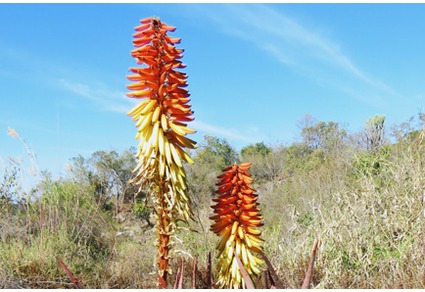
Aloe ×attwoodii (Asphodelaceae [subfam. Asphodeloideae] tr. Aloeae), the natural hybrid between A. arborescens and A. petricola, is described from the Mpumalanga province in northeastern South Africa. Both A. petricola and A. arborescens flower predominantly in mid- to late-winter but with the flowering period of A. petricola extending into spring. In places where the natural distribution ranges of the two species overlap and where plants flower together, the hybrid between the two species is often encountered. This material is here described as A. ×attwoodii.
References
- Adams, R. (2015) Aloes A–Z. Published by the author, Te Puke, New Zealand, 152 pp.
- Beentje, H. & Williamson, J. [illustrations]. (2010) The Kew plant glossary: an illustrated dictionary of plant terms. Kew Publishing, Royal Botanic Gardens Kew, Richmond, Surrey, 160 pp.
- Bloomfield, F. & Bernardi, M. (1985) Miracle plants: Aloe vera. Century Publishing Co. Ltd, London, 54 pp.
- Bornman, H. & Hardy, D.[S.] (1971) Aloes of the South African veld. Voortrekkerpers, Johannesburg, 299 pp.
- Du Preez, F.M. (2008) Aloe ferox. Die bittersoet geneser. The Office Uitgewers, Port Elizabeth [Gqeberha], 119 pp.
- Figueiredo, E. & Smith, G.F. (2019) Aloe ×caesia Salm-Dyck (Asphodelaceae) is the correct name of the common hybrid aloe [Aloe arborescens Mill. × A. ferox Mill.] from the southern Cape, South Africa. Bradleya 37: 31–40. https://doi.org/10.25223/brad.n37.2019.a25
- Grace, O.M., Klopper, R.R., Figueiredo, E. & Smith, G.F. (2011) The aloe names book. Strelitzia 28. South African National Biodiversity Institute, Pretoria, and The Royal Botanic Gardens, Kew, Richmond, Surrey, viii, 232 pp.
- Herp, B. & Román, R. (2007 [Abril]) Aloe vera. A planta milagrosa inclui também nopal, jojoba e iúca. Editorial Estampa, Lda., Lisboa, 141 [143] pp.
- Index Herbariorum. (2026+ [continuously updated]) Index herbariorum: a global directory of public herbaria and associated staff. New York Botanical Garden. Available from: https://sweetgum.nybg.org/science/ih/ (accessed July 2026)
- IPNI. (2026+) The International Plant Names Index. Available from: https://www.ipni.org/ (continuously updated; accessed July 2026)
- Lawrence, G.H.M. (1970) Taxonomy of vascular plants, 11th printing. The Macmillan Company, New York and Toronto, Ontario, 823 pp.
- Leistner, O.A. & Morris, J.W. (1976 [1 October]) Southern African place names. Annals of the Cape Provincial Museums 12. Published jointly by the Cape Provincial Museums at the Albany Museum, Grahamstown [Makhanda], 565 pp.
- Linnaeus, C. (1753) Species plantarum, exhibentes plantas rite cognitas, ad genera relatas, cum differentiis specificis, nominibus trivialibus, synonymis selectis, locis natalibus, secundum systema sexuale digestas. Volumes 1 and 2. Salvius, Stockholm, 560 pp. [volume 1] and 1200 pp. [total]; indices not paginated. https://doi.org/10.5962/bhl.title.669
- Little, R.J. & Jones, C.E. (1980) A dictionary of botany. Van Nostrand Reinhold Company Limited, New York, Cincinnati, Toronto, London, & Melbourne, 400 pp.
- Miller, P. (1768) The gardeners dictionary: containing the best and newest methods of cultivating and improving the kitchen, fruit, flower garden, and nursery, as also for performing the practical parts of agriculture: including the management of vineyards, with the methods of making and preserving wine, according to the present practice of the most skilful vignerons in the several wine countries in Europe. Together with directions for propagating and improving, from real practice and experience, all sorts of timber trees. 8th edition [revised and altered according to the latest system of botany; and embellished with several copper-plates, which were not in some former editions]. Printed for the author, London, pages not conventionally numbered. [https://www.biodiversitylibrary.org/item/10276#page/47/mode/1up] https://doi.org/10.5962/bhl.title.541
- Newton, D.J. & Vaughan, H. (1996 [November]) Trade review. South Africa’s Aloe ferox plant, parts and derivatives industry. TRAFFIC East/ Southern Africa, South African National Office, c/o Endangered Wildlife Trust, Parkview, Johannesburg, 61 pp.
- Park, Y.I. & Lee, S.K. (Eds.) (2006) New perspectives on Aloe. Springer Science + Business Media, LLC, New York, 200 pp.
- Pole-Evans, I.B. (1917 [‘1915–1916’]) Descriptions of some new aloes from the Transvaal. Part II. (With Plates LV–LVI). Transactions of the Royal Society of South Africa 5: 703–711 + Plates LV–LVI. [https://www.biodiversitylibrary.org/item/181589#page/889/mode/1up]
- Raper, P.E., Möller, L.A. & Du Plessis, L.T. (2014) Dictionary of Southern African place names. Jonathan Ball Publishers, a division of Media24 Limited, Jeppestown, Johannesburg and Cape Town, 566 pp.
- Reynolds, G.W. (1950 [December]) The aloes of South Africa. The Trustees, The Aloes of South Africa Book Fund, Johannesburg, 520 pp.
- Riley, H.P. & Majumdar, S.K. (1979) The Aloineae. A biosystematics survey. The University of Kentucky Press, place of publication not stated, likely Lexington, Kentucky, 177 pp.; some ‘Index’ pages not numbered. [https://www.jstor.org/stable/j.ctt130jhd1]
- Smith, G.F. (2016) First field guide to aloes of southern Africa, 2nd edition. Struik Nature, an imprint of Penguin Random House SA (Pty) Ltd, Century City, Cape Town, 57 pp.
- Smith, G.F. (2021) A new nothospecies, Aloe ×thammii Gideon F.Sm. (Asphodelaceae subfam Alooideae), based on the natural hybrid between A. arborescens Mill. and A. thraskii Baker from the eastern parts of the Eastern Cape province, South Africa. Haseltonia 28: 21–24. https://doi.org/10.2985/026.028.0102
- Smith, G.F. & Figueiredo, E. (2009) Aloe arborescens Mill. (Asphodelaceae) is spreading in Portugal. Bradleya 27: 165–167. https://doi.org/10.25223/brad.n27.2009.a4
- Smith, G.F. & Figueiredo, E. (2015) Garden aloes. Growing and breeding cultivars and hybrids. Jacana Media (Pty) Ltd, Auckland Park, Johannesburg, 193 pp.
- Smith, G.F. & Figueiredo, E. (2020) Aloe ×engelbrechtii (Asphodelaceae subfam. Alooideae), a new South African nothospecies with A. arborescens and A. hardyi as parents. Phytotaxa 464 (3): 252–256. https://doi.org/10.11646/phytotaxa.464.3.8
- Smith, G.F., Figueiredo, E., Crouch, N.R., Oosthuizen, D. & Klopper, R.R. (2016) Aloe ×inopinata Gideon F.SM., N.R.Crouch & Oosth., (Asphodelaceae) [Aloe arborescens Mill. × Aloe chortolirioides A.Berger var. chortolirioides]: a nothospecies from the Barberton Centre of Endemism, Eastern South Africa. Haseltonia 22: 55–63. https://doi.org/10.2985/026.022.0111
- Smith, G.F., Figueiredo, E., Verloove, F., Klopper, R.R. & Silva, V. (2023) An annotated catalogue of Aloe and Aloiampelos (Asphodelaceae subfam. Alooideae) naturalised and escaped in continental Portugal. Phytotaxa 629 (1): 35–52. https://doi.org/10.11646/phytotaxa.629.1.3
- Smith, G.F., Klopper, R.R. & Crouch, N.R. (2008a) Aloe arborescens (Asphodelaceae: Alooideae) and CITES. Haseltonia 14: 189–198. https://doi.org/10.2985/1070-0048-14.1.189
- Smith, G.F., Klopper, R.R. & Crouch, N.R. (2021) Aloe arborescens Mill. ‘Estelle Potgieter’ (Asphodelaceae subfam. Alooideae), a new cultivar in a variable species, with notes on aloes at the South African National Biodiversity Institute, Pretoria. Bradleya 39: 253–258. https://doi.org/10.25223/brad.n39.2021.a27
- Smith, G.F., Klopper, R.R., Figueiredo, E. & Crouch, N.R. (2012) Aspects of the taxonomy of Aloe arborescens Mill. (Asphodelaceae: Alooideae). Bradleya 30: 127–137. https://doi.org/10.25223/brad.n30.2012.a15
- Smith, G.F., Walters, M., Crouch, N.R. & Klopper, R.R. (2008b) Aloes of the World: a comprehensive collaboration to consolidate knowledge on the genus Aloe L. Aloe 45: 19–20.
- Smith, G.F., Walters, M., Klopper, R.R. & Crouch, N.R. (2008c) Aloes of the World: African Plants Initiative. An international web-based collaboration to promote scholarly research on Aloe L. Bradleya 26: 121–128. https://doi.org/10.25223/brad.n26.2008.a2
- Smith, G.F. & Van Wyk, B. (2008) Aloes in southern Africa. Struik Nature, an imprint of Penguin Randon House S.A. (Pty) Ltd, Publishers, Century City, Cape Town, 136 pp.
- Stearn, W.T. (1985) Botanical Latin. History, grammar, syntax, terminology and vocabulary, 3rd revised edition, new impression. David & Charles (Publishers) Limited, Newton Abbot and London (U.K.), North Pomfret, Vermont (Vt), U.S.A., 566 pp.
- Turland, N.J., Wiersema, J.H., Barrie, F.R., Gandhi, K.N., Gravendyck, J., Greuter, W., Hawksworth, D.L., Herendeen, P.S., Klopper, R.R., Knapp, S., Kusber, W.-H., Li, D.-Z., May, T.W., Monro, A.M., Prado, J., Price, M.J., Smith, G.F. & Zamora Señoret, J.C. (2025) International Code of Nomenclature for algae, fungi, and plants (Madrid Code). Regnum Vegetabile 162. The University of Chicago Press, Chicago and London, 303 pp. https://doi.org/10.7208/chicago/9780226839479.001.0001
- Van Jaarsveld, E.J. (2002) Aloe arborescens and its nine cultivars. Veld & Flora 88 (2): 63–65.
- Van Jaarsveld, E.J., Van Wyk, B-E. & Smith, G.F. (2000) Succulents of South Africa. A guide to the regional diversity. Tafelberg Publishers, Cape Town, 144 pp.
- Van Wyk, B-E. & Smith, G.F. (2025) Guide to the aloes of South Africa, 3rd edn, 2nd impression. Briza Publications, an imprint of Jonathan Ball Publishers, a division of Media24 (Pty) Ltd, Jeppestown, Johannesburg, 376 pp.
- Watt, J.M. & Breyer-Brandwijk, M.G. (1962) The medicinal and poisonous plants of southern and eastern Africa. Being an account of their medicinal and other uses, chemical composition, pharmacological effects and toxicology in man and animal. Second edition. E. & S. Livingstone Ltd, Edinburgh & London, 1457 pp.