

Abstract
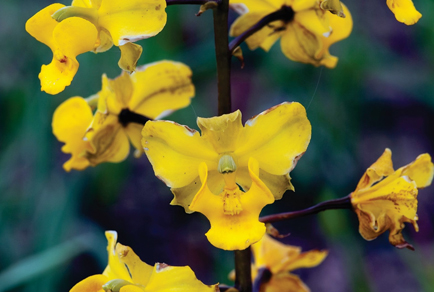
Cyrtopodium comprises ~ 50 Neotropical species, 37 of which are present in Brazil, its center of diversity. Its taxonomy is based on classical literature, descriptions of new taxa, floristic lists or synoptic treatments. We present a taxonomic treatment of Cyrtopodium species occurring in Goiás (GO) and the Federal District (DF), Brazil, comprising 23 species, representing 46% of the diversity of the genus, ~ 62.16% and ~ 80% of those occurring in Brazil and the Cerrado, respectively. Eighteen of the species recorded are common to both studied areas. The species are contrasted by means of a key, described, illustrated, mapped and discussed regarding their distribution, conservation status, flowering and fruiting periods, environmental preferences and morphological relationships. Seventeen of them are represented by photographs, and C. withneri is illustrated for the first time. Regarding their conservation status, species were arranged in the following categories: Near Threatened (C. confusum), Endangered (C. latifolium), Critically Endangered (C. linearifolium), Data Deficient (C. minutum), and Least Concern (other species). Additionally, we reviewed the typification of 17 of the studied species and designated lectotypes for the names C. paludicolum and C. poecilum var. crispa, and we do not recognize the epitype assigned to C. withneri.
References
- Bachman, S., Moat, J., Hill, A.W., De La Torre, J. & Scott, B. (2011) Supporting red list threat assessments with GeoCAT: Geospatial conservation assessment tool. ZooKeys 150: 117–126. https://doi.org/10.3897/zookeys.150.2109
- Barbosa Rodrigues, J. (1877) Genera et Species Orchidearum Novarum, I. Fleiuss, Rio de Janeiro, 209 pp.
- Barbosa Rodrigues, J. (1891) Genera et Species Orchidearum Novarum, III. Vellosia 1: 115–133.
- Barros, F., Batista, J.A.N. & Bianchetti, L.B. (2003) Epitypification and taxonomic elucidation of some Brazilian taxa of Cyrtopodium R. Br. (Orchidaceae). Taxon 52: 841–849. https://doi.org/10.2307/3647358
- Barros, F., Hall, C.F., Neto, V.B.P. & Batista, J.A.N. (2018) Check-list das Orchidaceae do estado de Mato Grosso do Sul, Brazil. Iheringia 73: 287–296. https://doi.org/10.21826/2446-8231201873s287
- Batista, J.A.N. & Bianchetti, L.B. (2001) Cyrtopodium linearifolium (Orchidaceae): a new species from central Brazil. Lindleyana 16: 226–230.
- Batista, J.A.N. & Bianchetti, L.B. (2003) Lista atualizada das Orchidaceae do Distrito Federal. Acta Botanica Brazilica 17: 183–201. https://doi.org/10.1590/S0102-33062003000200003
- Batista, J.A.N. & Bianchetti, L.B. (2004) Three new taxa in Cyrtopodium (Orchidaceae) from central and southeastern Brazil. Brittonia 56: 260–274. https://doi.org/10.1663/0007-196X(2004)056[0260:TNTICO]2.0.CO;2
- Batista, J.A.N. & Bianchetti, L.B. (2005) Two new taxa in Cyrtopodium (Orchidaceae) from southern Brazil. Darwiniana 43: 74–83. https://doi.org/10.2307/23227136
- Batista, J.A.N., Bianchetti, L.B. & Pellizzaro, K.F. (2005) Orchidaceae da Reserva Ecológica do Guará, DF, Brazil. Acta Botanica Brazilica 19: 221–232. https://doi.org/10.1590/S0102-33062005000200004
- Batista, J.A.N. & Bianchetti, L.B. (2006) A new species of Cyrtopodium (Orchidaceae) from the Cerrado of Central Brazil. Novon 16: 17–22. https://doi.org/10.3417/1055-3177(2006)16[17:ANSOCO]2.0.CO;2
- Batista, J.A.N. & Bianchetti, L.B. (2020) Cyrtopodium. In: Flora e Funga do Brasil 2020. Jardim Botânico do Rio de Janeiro. Available from: https://floradobrasil.jbrj.gov.br/FB11443 (accessed 5 June 2026)
- Batista, J.A.N. & Medeiros, A.D.S. (2022) A new putative natural hybrid of Cyrtopodium (Orchidaceae) from the south coast of Brazil. Phytotaxa 536: 279–286. https://doi.org/10.11646/phytotaxa.536.3.8
- Bentham, G. (1881) Notes on Orchideae. Journal of the Linnean Society, Botany 18: 281–360. https://doi.org/10.1111/j.1095-8339.1881.tb01258.x
- Bianchetti, L.B. & Batista, J.A.N. (2000) Cyrtopodium latifolium (Orchidaceae): a new species from central Brazil. Lindleyana 15: 222–226.
- Bianchetti, L.B. & Batista, J.A.N. (2004) Esclarecimentos sobre as espécies de Cyrtopodium coletadas pela “Comissão de Linhas Telegráficas e Estratégicas de Mato Grosso ao Amazonas”. In: Barros, F. & Kerbauy, G.B. (Orgs.) Orquidologia Sul-americana: uma compilação científica. Secretaria do Meio Ambiente, Instituto de Botânica, São Paulo, pp. 107–132.
- Brown, R. (1813) Cyrtopodium. Hortus Kewensis V: 216.
- Carvalho, F.M.V., De Marco, P. & Ferreira, L.G. (2009) The Cerrado Into-Pieces: Habitat Fragmentation as a Function of Landscape Use in the Savannas of Central Brazil. Biological Conservation 142: 1392–1403. https://doi.org/10.1016/j.biocon.2009.01.031
- Cogniaux, A. (1898–1902) Orchidaceae II. Cyrtopodium. In: Martius, C.F.P., Eichler, A.G. & Urban, I. (Eds.) Flora Braziliensis. Vol. 3, Part 5. Oldenbourg, Munich, pp. 356–375.
- Eiten, G. (1990) Vegetação do Cerrado. In: Pinto, M.N. (Coord.) Cerrado: caracterização, ocupação e perspectivas. SEMATEC, Universidade de Brasília, Brasília, pp. 9–65.
- Felfili, J.M., Ribeiro, J.F., Borges Filho, H.C. & Vale, A.T. (2004) Potencial econômico da biodiversidade do Cerrado: estádio atual e possibilidades de manejo sustentável dos recursos da flora. In: Aguiar, L.M.S. & Camargo, A.J.A. (Eds.) Cerrado: ecologia e caracterização. Embrapa Cerrados, Planaltina, Brasília, pp. 177–220.
- Felfili, J.M., Rezende, A.V. & Silva Júnior, M.C. (2007) Biogeografia do Bioma Cerrado: vegetação e solos da Chapada dos Veadeiros. Editora Universidade de Brasília/Finatec, Brasília, 256 pp.
- Flora e Funga do Brasil (2020) Angiospermas. In: Flora e Funga do Brasil 2020. Jardim Botânico do Rio de Janeiro. Available from: https://floradobrasil.jbrj.gov.br/FB128461 (accessed 5 June 2026)
- Gonçalves, H., Meneguzzo, I.S. & Moro, R.S. (2019) Políticas públicas para a conservação do Bioma Cerrado no Estado do Paraná, Brazil. Terr@ Plural 13: 138–152. https://doi.org/10.5212/TerraPlural.v.13i1.0009
- Hall, C.F., Klein, V.L.G. & Barros, F. (2013) Orchidaceae no município de Caldas Novas, Goiás, Brazil. Rodriguésia 64: 685–704. https://doi.org/10.1590/S2175-78602013000400002
- Hoehne, F.C. (1912) Cyrtopodium paludicola. Commissão de Linhas Telegraphicas, Botanica 5 (4): 24, t. 7.
- Hoehne, F.C. & Schlechter, F.R.R. (1921) Cyrtopodium lissochiloides. Anexos das Memorias do Instituto de Butantan: Seccao de Botanica 1: 40, t. 9, f. 2.
- Hoehne, F.C. (1942) Orchidaceas. Cyrtopodium. In: Hoehne, F.C. (Ed.) Flora Brazilica. 12 (6). Secretaria da Agricultura, Indústria e Comércio de São Paulo, São Paulo, pp. 8–35.
- IBGE – Instituto Brasileiro de Geografia e Estatística. (2022) Rio de Janeiro: IBGE. Available from: https://anuario.ibge.gov.br/ (accessed 10 October 2022)
- IBGE (2026) Portal IBGE. Cidades e Estados. Instituto Brasileiro de Geografia e Estatística. Available from: ibge.gov.br (accessed 7 June 2026)
- IUCN (2019) Guidelines for using the IUCN red list categories and criteria, ver. 11.—Standards and Petitions Subcommittee of the IUCNSpecies Survival Commission. Available from: www.iucnredlist.org/documents/RedListGuidelines.pdf (accessed 7 June 2026)
- Klink, C.A. & Machado, R.B. (2005) Conservation of the Brazilian Cerrado. Conservation Biology 19: 707–713. https://doi.org/10.1111/j.1523-1739.2005.00702.x
- Li, M.H., Zhang, G.Q., Liu, Z.J. & Lan, S.R. (2016) Subtribal relationships in Cymbidieae (Epidendroideae, Orchidaceae) reveal a new subtribe, Dipodiinae, based on plastid and nuclear coding DNA. Phytotaxa 246: 37–48. https://doi.org/10.11646/phytotaxa.246.1.3
- Lindley, J. (1841) Cyrtopodium cristatum. Edwards’s Botanical Register 27: sub. t. 8.
- Lindley, J. (1843) Cyrtopodium parviflorum. London Journal of Botany 2: 672.
- Medeiros, M.B., Walter, B.M.T., Silva, G.P., Gomes, B.M., Lima, I.L.P., Silva, S.R., Moser, P., Oliveira, W.L. & Cavalcanti, T.B. (2012) Vascular flora of the Tocantins River middle basin, Brazil. Check List 8: 852–885. https://doi.org/10.15560/8.5.852
- Menezes, L.C. (1991) Cyrtopodium aureum L.C. Men. sp. nov. Boletim CAOB 3: 50–52.
- Menezes, L.C. (1993) New taxa for the genus Cyrtopodium in Brazil. Schlechteriana 4: 146–151.
- Menezes, L.C. (1995a) Cyrtopodium poecilum var. fulvum (L.C. Menezes) L.C. Menezes comb. nov. Orquidário 9 (3): 68–69.
- Menezes, L.C. (1995b) New Brazilian orchids. Boletim CAOB 5: 8–13.
- Menezes, L.C. (1995c) In memory of Dr. J.A. Fowlie: Cyrtopodium fowliei L.C. Menezes sp. nov. Orchid Digest 59: 17–18.
- Menezes, L.C. (1996a) Uma nova espécie: Cyrtopodium inaldianum. Boletim CAOB 23: 11–12.
- Menezes, L.C. (1996b) Duas espécies e um híbrido natural novos. Boletim CAOB 26: 22–24.
- Menezes, L.C. (1996c) Cyrtopodium withneri L.C. Menezes sp. nov. Orchid Digest 60: 12–13.
- Menezes, L.C. (1997) Cyrtopodium paludicolum var. goiandirense. Boletim CAOB 27: 18p.
- Menezes, L.C. (1998a) Novas orquídeas brasileiras. Boletim CAOB 33: 68–72.
- Menezes, L.C. (1998b) Caiapoense, um novo Cyrtopodium. Boletim CAOB 34: 104–105.
- Menezes, L.C. (1999a) Cyrtopodium roraimense, uma nova espécie de flores amarelas. Orquidário 12: 100–104.
- Menezes, L.C. (1999b) Sarneyanum um novo Cyrtopodium. Orquidário 13: 84–85.
- Menezes, L.C. (2000) Genus Cyrtopodium: Brazilian species. IBAMA, Brasília, 208 pp.
- Menezes, L.C. (2004) Cyrtopodium minutum L.C. Menezes. Boletim CAOB 56: 100.
- Menezes, L.C. (2008) Cyrtopodium confusum L.C. Menezes. Boletim CAOB 69–70: 4.
- Menezes, L.C. (2009) Cyrtopodium witeckii L.C. Menezes. Boletim CAOB 75: 58p.
- MMA [Ministério do Meio Ambiente]. (2018) Ministério do Meio Ambiente (Portal Eletrônico). O Bioma Cerrado. Available from: http://www.mma.gov.br/biomas/cerrado (accessed 5 March 2021) https://doi.org/10.5380/dma.v47i0.62444
- Mori, S.A., Silva, L.A., Lisboa, G. & Coradin, L. (1989) Manual de Manejo do Herbário Fanerogâmico. CEPLAC, Ilhéus, 104 pp.
- Myers, N. (1988) Threatened biotas: “hot spots” in tropical forests. Environmentalist 8: 187–208. https://doi.org/10.1007/BF02240252
- Myers, N., Mittermeier, R.A., Mittermeier, C.G., Fonseca, G.A.B. & Kent, J. (2000) Biodiversity hotspots for conservation priorities. Nature 403: 853–858. https://doi.org/10.1038/35002501
- Myers, N. (2003) Biodiversity hotspots revisited. Bioscience 53: 916–917. https://doi.org/10.1641/0006-3568(2003)053[0916:BHR]2.0.CO;2
- Oliveira-Filho, A.T. & Ratter, J.A. (2002) Vegetation physiognomies and woody flora of the Cerrado biome. In: Oliveira, P.S. & Marquis, R.J. (Eds.) The cerrados of Brazil: ecology and natural history of a neotropical savanna. Columbia University Press, Columbia University, New York, pp. 91–120. https://doi.org/10.7312/oliv12042-007
- Oliveira, I.J. (2014) Chapadões descerrados: Relações entre vegetação, relevo e uso das terras em Goiás. Boletim Goiano de Geografia 34: 311–336. https://doi.org/10.5216/bgg.v34i2.31734
- Oliveira, A.M.E., Wendling, B., Ericsson, D.B.C., Xavier, M.A.S. & Xavier, A.R.E.O. (2020) Métodos de propagação e fatores que interferem na germinação das principais gramíneas nativas de Cerrado. Agrarian Sciences Journal 12: 1–8. https://doi.org/10.35699/2447-6218.2020.15845
- Pabst, J.F.G. & Dungs, F. (1975) Orchidaceae Brazilienses 1. Kurt Schmersow, Hildesheim, 408 pp.
- Pabst, G.F.J. (1978) Cyrtopodium hatschbachii. Boletim do Herbarium Bradeanum 2: 273.
- Pessoa, E.M., Araújo, A.M., Barberena, F.F.V.A., Batista, J.A.N., Benelli, A.P., Bento, J.S.P., Borba, E.L., Camelo-Júnior, A.E., Cantuária, P.C., Cavalcanti, L.W., Cintra, M.C.S., Engels, M., Feitoza, L.H.J., Felix, L.P., Ferreira, A.W.C., Fiorini, C.F., Guimarães, L.R.S., Klein, V.P., Koch, A.K., Koehler, S., Krahl, A.H., Krahl, D.R.P., Leal, B.S.S., Macedo, A., Machado, I.C.S., Mauad, A.V.S.R., Mayer, J.L.S., Meneguzzo, T.E.C., Menini-Neto, L., Moraes, A.P., Milet-Pinheiro, P., Nollet, F., Oliveira, E.M., Oliveira, M.S., Pansarin, E.R., Pinheiro, F., Royer, C.A., Santos, I.S., Silva-Pereira, V., Smidt, E.C., Vieira, T.L., Zandoná, L.R., Zavatin D. & van den Berg, C. (2025) An overview of Orchidaceae from Brazil: Advances and shortfalls after 400 years of studies. Plants 14: 3520. https://doi.org/10.3390/plants14223520
- Petini-Benelli, A. (2009) A família Orchidaceae no acervo do herbário UFMT, Cuiabá, Mato Grosso, Brazil. Heringeriana 3: 99–113. https://doi.org/10.17648/heringeriana.v3i1.65
- Petini-Benelli, A. (2012) Biogeografia das Orquídeas da Chapada dos Guimarães, Mato Grosso, Brazil. Heringeriana 26: 77–85.
- Petini-Benelli, A. (2016) Herborização de Orchidaceae com pseudobulbos espessados. Revista em Agronegócio e Meio Ambiente 9: 935–948. https://doi.org/10.17765/2176-9168.2016v9n4p935-948
- Pfitzer, E.H.H. (1887) Entwurf einer natürlichen Anordnung der Orchideen. Winter’s Universitätsbuchhandlung, Heidelberg, 105 pp. https://doi.org/10.5962/bhl.title.166408
- Quantum GIS Development Team (2018) Quantum GIS Geographic Information System. Version 2.8.2. Open-Source Geospatial Foundation Project. Available from: https://www.qgis.org/en/site/forusers/download.html (accessed 31 October 2021)
- Reichenbach f., H.G. (1849) Cyrtopodium blanchetii. Linnaea 22: 852.
- Reichenbach f., H.G. (1885) Cyrtopodium saintlegerianum. Flora 68: 301.
- Reichenbach f., H.G. (1881) Novitiate Orchidaceae Warmingiana. Otia Botanica Hamburgensia 2: 88–90.
- Rodriguez, D.P., Barros, F., Junior, G.A.D. & Bortolotto, I.M. (2009) Levantamento da família Orchidaceae no Morro Santa Cruz, Municípios de Corumbá e Ladário, Mato Grosso do Sul, Brazil. Hoehnea 36: 613–636. https://doi.org/10.1590/S2236-89062009000400004
- Romero-González, G.A., Batista, J.A.N. & Bianchetti, L.B. (2008) A synopsis of the genus Cyrtopodium (Catasetinae: Orchidaceae). Harvard Papers in Botany 13: 189–206. https://doi.org/10.3100/1043-4534(2008)13[189:ASOTGC]2.0.CO;2
- Romero-González, G.A., Carnevali, G., Duno, R., Cetzal-Ix, W.R., Ramírez-Morillo, I.M., Tamayo-Cen, I. & Holst, B. (2019) A new species of Cyrtopodium (Orchidaceae: Cyrtopodiinae) from Belize. Phytotaxa 424: 71–86. https://doi.org/10.11646/phytotaxa.424.2.1
- Santos, I.S. & Silva, M.J. (2023) Sinopse taxonômica do gênero Cyrtopodium R. Br. (Orchidaceae, Epidendroideae) para o município de Niquelândia, incluindo uma nova ocorrência para o Estado de Goiás, Brazil. Hoehnea 50: e802021. https://doi.org/10.1590/2236-8906e802021
- Sawyer, D. (2002) População, meio ambiente e desenvolvimento sustentável no cerrado. In: Hogan, D.J., Carmo, R.L., Cunha, J.M.P. & Baeninger, R. (Orgs.) Migração e ambiente no Centro-Oeste. PRONEX/UNICAMP, Campinas, São Paulo, pp. 279–299.
- Silva, A.G., Boldrini, R.F. & Kuster, R.M. (2013) Os sumarés cicatrizantes da medicina tradicional brasileira, ou, as surpresas químicas ativas do desconhecido gênero Cyrtopodium (Orchidaceae). Natureza on line 11: 152–154.
- Thiers, B. [continuously updated]. (2026) Index Herbariorum. Part I: The herbaria of the world. New York Botanical Garden. Available from: http://sweetgum.nybg.org/science/ih/ (accessed 20 January 2026)
- Turland, N.J., Wiersema, J.H., Barrie, F.R., Gandhi, K.N., Gravendyck, J., Greuter, W., Hawksworth, D.L., Herendeen, P.S., Klopper, R.R., Knapp, S., Kusber, W.-H., Li, D.-Z., May, T.W., Monro, A.M., Prado, J., Price, M.J., Smith, G.F. & Zamora Señoret, J.C. (Eds.) (2025) International Code of Nomenclature for algae, fungi, and plants (Madrid Code). Regnum Vegetabile 162. University of Chicago Press, Chicago, 351 pp. https://doi.org/10.7208/chicago/9780226839479.001.0001
- Vacchiano, M.C., Santos, J.W.C.M., Angeoletto, F. & Silva, N.M. (2019) Do Data Support Claims That Brazil Leads the World in Environmental Preservation? Environmental Conservation 46: 118–120. https://doi.org/10.1017/S0376892918000371
- Vásquez, R., Ibisch, P.L. & Gerkmann, B. (2003) Preliminary list of Bolivian Orchid species. Organisms Diversity & Evolution 4: 1–14.
- Vásquez, R., Ibisch, P.L. & Jiménez, I. (2014) Orchidaceae. In: Jørgensen, P.M., Nee, M.H. & Beck, S.G. (Eds.) Catálogo de las Plantas Vasculares de Bolivia. Monographs in Systematic Botany from the Missouri Botanical Garden 127: 894–989.
- Warming, E. (1884) Symbolae ad Floram Braziliae Centralis Cognoscendam, Part. 30. Orchideae 2. Videnskabelige Meddelelser fra Dansk Naturhistorisk Forening i Kjøbenhavn 46: 86–99.