

Abstract
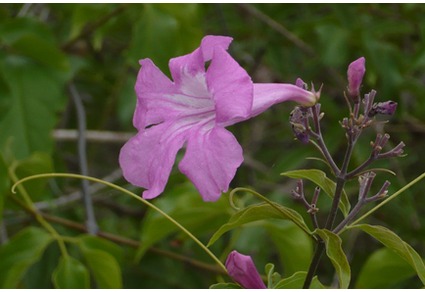
Cuspidaria is a genus of lianas and shrubs with approximately 19 species distributed from Mexico to Argentina and Paraguay. Its complex taxonomy has been investigated using integrative approaches combining molecular and morphological data. A recent phylogenetic study recovered a small clade with a unique combination of characters, distinct from all currently recognized species. Based on a comprehensive review of the protologues, nomenclatural types, and herbarium specimens of morphologically similar taxa, this lineage is here recognized as a new species. The new species of Cuspidaria occurs in the Cerrado and Caatinga domains from the states of Minas Gerais, Bahia, and Piauí, Brazil. A diagnosis, detailed description, illustration, and information on phenology, distribution, habitat, and preliminary conservation status are provided.
References
- Bachman, S., Moat, J., Hill, A., de la Torre, J. & Scott, B. (2011) Supporting Red List threat assessments with GeoCAT: Geospatial Conservation Assessment Tool. ZooKeys 150: 117–126. https://doi.org/10.3897/zookeys.150.2109.figure1
- Candolle, de, A.P. (1838) Revue sommaire de la famille des Bignoniacées. Bibliothèque Universelle Genève 17: 117–136.
- Candolle, de, A.P. (1845) Prodromus systematis naturalis regni vegetabilis 9. Fortin, Masson & Assoc., Paris, 573 pp.
- Cracraft, J. (1983) Species concepts and speciation analysis. Current Ornithology 1: 159–187. https://doi.org/10.1007/978-1-4615-6781-3_6
- De Queiroz, K. (2007) Species concepts and species delimitation. Systematic Biology 56: 879–886. https://doi.org/10.1080/10635150701701083
- Francisco, J.N.C., Fonseca, L.H.M. & Lohmann, L.G. (2023) Phylogeny and morphological evolution of the Neotropical genus Cuspidaria (Bignonieae, Bignoniaceae): combining high‐throughput sequencing and targeted loci data. Taxon 72: 1057–1079. https://doi.org/10.1002/tax.13028
- Gentry, A.H. (1973) Generic delimitations of central American Bignoniaceae. Brittonia 25: 226–242. https://doi.org/10.2307/2805585
- Gentry, A.H. (1975) Identification of Vellozo’s Bignoniaceae. Taxon 24: 337–344.
- Gentry, A.H. & Tomb, A.S. (1979) Taxonomic implications of Bignoniaceae palynology. Annals of the Missouri Botanical Garden 66: 756–855. https://doi.org/10.2307/2398917
- Hesse, M., Halbritter, H., Zetter, R., Weber, M., Buchner, R., Frosch-Radivo, A. & Ulrich, S. (2009) Pollen terminology: an illustrated handbook. Springer, Vienna, 264 pp.
- Hickey, L.J. (1973) Classification of the architecture of dicotyledonous leaves. American Journal of Botany 60: 17–33. https://doi.org/10.1002/j.1537-2197.1973.tb10192.x
- IUCN Standards and Petitions Committee (2024) Guidelines for Using the IUCN Red List Categories and Criteria. Version 16. Prepared by the Standards and Petitions Committee. Available from: https://www.iucnredlist.org/documents/RedListGuidelines.pdf (accessed 24 August 2024)
- Kaehler, M., Michelangeli, F.A. & Lohmann, L.G. (2019) Fine tuning the circumscription of Fridericia (Bignonieae, Bignoniaceae). Taxon 68: 751–770. https://doi.org/10.1002/tax.12121
- Lohmann, L.G. (2006) Untangling the phylogeny of neotropical lianas (Bignonieae, Bignoniaceae). American Journal of Botany 93: 304–318. https://doi.org/10.3732/ajb.93.2.304
- Lohmann, L.G. & Taylor, C.M. (2014) A new generic classification of tribe Bignonieae (Bignoniaceae). Annals of the Missouri Botanical Garden 99: 348–489. https://doi.org/10.3417/2003187
- Martius, C.F.P. (1827) Fridericia. Nova Acta Physico-medica Academiae Caesareae Leopoldino-Carolinae Naturae Curiosorum Exhibentia Ephemerides sive Observationes Historias et Experimenta 13: 7.
- Miers, J. (1863) Report on the plants collected by Mr. Weir, especially the Bignoniaceae. Proceedings of the Royal Horticultural Society of London 3: 179–202.
- Nogueira, A., El-Ottra, J.H.L., Guimarães, E., Machado, S.R. & Lohmann, L.G. (2013) Trichome structure and evolution in Neotropical lianas. Annals of Botany 112: 1331–1350. https://doi.org/10.1093/aob/mct201
- QGIS.org (2024) QGIS Geographic Information System. Open Source Geospatial Foundation Project. Available from: http://qgis.org (accessed 24 August 2024)
- Radford, A.E., Dickison, W.C., Massey, J.R. & Bell, C.R. (1974) Vascular plant systematics. Harper & Row Publishers, New York, 891 pp.
- SpeciesLink (2024) Sistema de informação distribuído para recuperação de dados de acervos de coleções biológicas e de observação em campo. Available from: http://splink.cria.org.br/ (accessed 7 June 2025) https://doi.org/10.11606/D.55.2021.tde-11012022-102933
- Vellozo, J.M.C. (1825) Florae Fluminensis. National Press, Rio de Janeiro, 352 pp.
- Weberling, F. (1992) Morphology of flowers and inflorescences. Cambridge University Press, Cambridge, 344 pp.