
Abstract
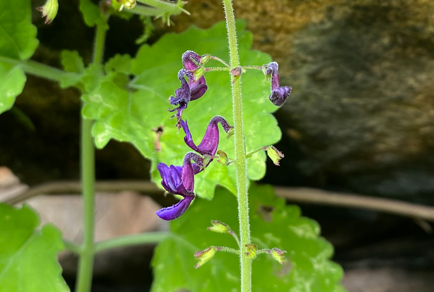
Equilabium regale is described from granite outcrops near White River in Mpumalanga Province, South Africa. The species was initially confused with Equilabium dolomiticum due to similarities in habit and the presence of a tuberous rootstock, but a detailed morphological study and field observations confirmed it as a distinct species. E. regale differs from E. dolomiticum in its larger and more robust habit, broader, thin-textured leaves and deep purple corollas. It further differs from the widespread Equilabium petiolare in its compact decumbent habit, tuberous rootstock, shorter inflorescences and predominantly eglandular indumentum. An amplified description of E. dolomiticum is provided to supplement the original account, particularly with respect to indumentum and floral morphology. Diagnostic comparisons between the morphologically similar southern African species are presented together with a key to the South African taxa. Based on its highly restricted distribution, fragmented habitat and small population size, E. regale is provisionally proposed as Critically Endangered.
References
- Bachman, S., Moat, J., Hill, A.W., de la Torre, J. & Scott, B. (2011) Supporting Red List threat assessments with GeoCAT: geospatial conservation assessment tool. In: Smith, V. & Penev, L. (Eds.) e-Infrastructures for data publishing in biodiversity science. ZooKeys 150, pp. 117–126. https://doi.org/10.3897/zookeys.150.2109
- Brown, N.E. (1906) Plectranthus selukwensis. In: Bulletin of miscellaneous information, pp. 167. Royal Botanic Gardens, Kew, pp. 167. H.M. Stationery Office, London. Available from: https://www.biodiversitylibrary.org/page/11624540 (accessed 8 May 2026)
- Codd, L.E. (1975) Plectranthus (Labiatae) and allied genera in southern Africa. Bothalia 11 (4): 371–442. https://doi.org/10.4102/abc.v11i4.1482
- Codd, L.E. (1984) A new species of Plectranthus. Bothalia 15 (1–2): 142–143. https://doi.org/10.4102/abc.v15i1/2.1114
- Codd, L.E. (1985) Plectranthus (Lamiaceae). Flora of Southern Africa 28,4: 137–172. Botanical Research Institute Department of Agriculture and Water Supply, Pretoria. [https://www.biodiversitylibrary.org/page/51375117]
- Edwards, T.J., Beaumont, A.J. & Styles, D. (2001) New records and distributional disjunctions from South Africa, Zimbabwe and Mozambique. Bothalia 31 (2): 199–202. https://doi.org/10.4102/abc.v31i2.523
- Holmes, P.M. (2001) Shrubland restoration following woody alien invasion and mining: effects of topsoil depth, seed source, and fertilizer addition. Restoration ecology 9 (1): 71–84. https://doi.org/10.1046/j.1526-100x.2001.009001071.x
- IUCN (2012) IUCN Red List Categories and Criteria: Version 3.1. IUCN, Gland.
- IUCN (2024) Guidelines for Using the IUCN Red List Categories and Criteria. Prepared by the Standards and Petitions Committee. Available from: https://www.iucnredlist.org/documents/RedListGuidelines.pdf (accessed 25 February 2026)
- Karremans, A.P., Pupulin, F., Bogarín, D., Fernández, M., Rojas-Alvarado, G., Chinchilla, I.F., Salguero-Hernández, G., Oses, L. & Oconitrillo, N. (2024) Lankester Composite Digital Plate (LCDP). Centro de Investigación Jardín Botánico Lankester, Universidad de Costa Rica. Available from: https://www.researchgate.net/publication/380151671_Lankester_Composite_Digital_Plate_LCDP (accessed 2 September 2026)
- L’Héritier de Brutelle, C.L. (1788) Stirpes Novae aut Minus Cognitae. Kew Science, pp. 84.
- Lindley, J. (1828) Streptocarpus. Edwards’s Botanical Register 14: t. 1173.
- Melese, D., Woldu, Z., Asfaw, Z. & Warkineh, B. (2025) Predicting the invasion potential of two alien plant species (Parthenium hysterophorus L., Asteraceae and Salvia tiliifolia Vahl, Lamiaceae) under the current and future climate change scenarios in Ethiopia. Ecological Processes 14 (1): 1–25. https://doi.org/10.1186/s13717-025-00626-9
- Meyer, E.H.F. (1838) Commentariorum de plantis Africae Australioris :quas per octo annos collegit observationibusque manuscriptis. Illustravit Joannes Franciscus Drege. Apud Leopoldum Voss. https://doi.org/10.5962/bhl.title.50
- Mucina, L. & Rutherford, M.C. (2006) The Vegetation of South Africa, Lesotho and Swaziland. South African National Biodiversity Institute, Pretoria.
- Musarella, C.M., Laface, V.L.A., Angiolini, C., Bacchetta, G., Bajona, E., Banfi, E., Barone, G., Biscotti, N., Bonsanto, D., Calvia, G., Cambria, S., Capuano, A., Caruso, G., Crisafulli, A., Del Guacchio, E., Di Gristina, E., Domina, G., Fanfarillo, E., Fascetti, S., Fiaschi, T., Galasso, G., Mascia, F., Mazzacuva, G., Mei, G., Minissale, P., Motti, R., Perrino, E.V., Picone, R.M., Pinzani, L., Podda, L., Potenza, G., Rosati, L., Stinca, A., Tavilla, G., Villano, C., Wagensommer, R.P. & Spampinato, G. (2024) New Alien Plant Taxa for Italy and Europe: An Update. Plants 13: 620. https://doi.org/10.3390/plants13050620
- Paton, A.J., Mwanyambo, M. & Culham, A. (2018) Phylogenetic study of Plectranthus, Coleus and allies (Lamiaceae): taxonomy, distribution and medicinal use. Botanical Journal of the Linnean Society 188 (4): 355–376. https://doi.org/10.1093/botlinnean/boy064
- Paton, A.J., Mwanyambo, M., Govaerts, R., Smitha, K., Suddee, S., Phillipson, P.B., Wilson, T.C., Forster, P.I. & Culham, A. (2019) Nomenclatural changes in Coleus and Plectranthus (Lamiaceae): a tale of more than two genera. PhytoKeys 129: 1–158. https://doi.org/10.3897/phytokeys.129.34988
- POWO-Plants of the World Online (2026) Equilabium (Benth.) Mwany. & A.J.Paton. Royal Botanic Gardens, Kew, Richmond, Surrey, UK. Available from: https://powo.science.kew.org/taxon/urn:lsid:ipni.org:names:77194273-1#children (accessed 8 May 2026)
- South African National Biodiversity Institute (SANBI) (2024) Red List of South African Plants. [SANBI Red List of South African Plants]
- Thiers, B. (2026) Index Herbariorum: A global directory of public herbaria and associated staff. New York Botanical Garden’s Virtual Herbarium. Available from: https://sweetgum.nybg.org/science/ih/ (accessed 8 May 2026)
- Van Jaarsveld, E. (2007) The Southern African Plectranthus. Fernwood Press, Simon’s Town, South Africa.