
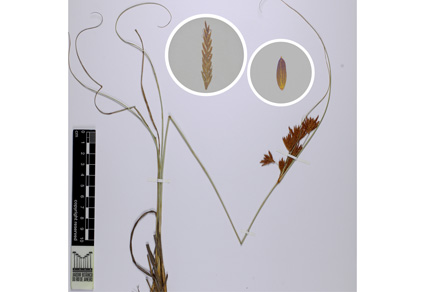

Abstract
The Caatinga is one of the richest and most threatened phytogeographic domains in Brazil, with more than 25% of endemic, rare, and poorly known species. In this work, we reveal the rediscovery of Cyperus cearaensis, an endemic species of the Caatinga, first collected between 1859-1861 and rediscovered after 157 years. The study presents a morphological description and taxonomic comments on the species, its current distribution, habitat, discussion, and preliminary conservation status, in addition to proposing lectotypification for the species name.
References
- Araujo, H.F., Canassa, N.F., Machado, C.C. & Tabarelli, M. (2023) Human disturbance is the major driver of vegetation changes in the Caatinga dry forest region. Scientific Reports 13 (1): 18440. https://doi.org/10.1038/s41598-023-45571-9
- Barbosa, T.A. & Gomes Filho, R.R. (2022) Biodiversidade e conservação da Caatinga: revisão sistemática. Journal of Environmental Analysis and Progress 7 (4): 177–189. https://doi.org/10.24221/jeap.7.4.2022.5228.177-189
- Bessa, M.A.P. & Medeiros, J.F. (2011) Levantamento florístico e fitossociológico em fragmentos de Caatinga no município de Tabuleiro Grande – RN. Revista Geotemas 1 (2): 69–83.
- Bland, L.M., Collen, B., Orme, C.D.L. & Bielby, J. (2017) Toward reassessing data-deficient species. Conservation Biology 31 (3): 531–539. https://doi.org/10.1111/cobi.12850
- Boeckeler, O. (1826) Die Cyperaceen des Königl. Herbariums zu Berlin. Linnaea : Ein Journal für die Botanik in ihrem ganzen Umfange (Vol. 38). F. Dümmler.
- Borgelt, J., Dorber, M., Høiberg, M.A. & Verones, F. (2022) More than half of data deficient species predicted to be threatened by extinction. Communications Biology 5: 679. https://doi.org/10.1038/s42003-022-03638-9
- Burkart, A. (1957) Georg Kiukenthal. Boletín de la Sociedad Argentina de Botánica 7: 53.
- EMBRAPA – Empresa Brasileira de Pesquisa Agropecuária. Bioma Caatinga. Available from: https://www.embrapa.br/agencia-de-informacao-tecnologica/tematicas/bioma-caatinga/introducao (accessed 14 June 2022) https://doi.org/10.17138/tgft(2)18-20
- Fernandes, M.F., Cardoso, D. & Queiroz, L.P.D. (2020) An updated plant checklist of the Brazilian Caatinga seasonally dry forests and woodlands reveals high species richness and endemism. Journal of Arid Environments 174: 104079. https://doi.org/10.1016/j.jaridenv.2019.104079
- Fonseca, C.R., Antongiovanni, M., Matsumoto, M., Bernard, E. & Venticinque, E.M. (2017) Conservation opportunities in the Caatinga. In: Silva, J.M.C., Leal, I.R. & Tabarelli, M. (Eds.) Caatinga: the largest tropical dry forest region in South America. Springer International Publishing, Cham, pp. 429–444. https://doi.org/10.1007/978-3-319-68339-3_17
- Govaerts, R., Jiménez-Mejías, P., Koopman, J., Simpson, D.A., Goetghebeur, P., Wilson, K.L., Egorova, T., et al. (2021) World checklist of Cyperaceae. Facilitated by the Royal Botanic Gardens, Kew. Available from: http://wcsp.science.kew.org/ (accessed 22 Nov. 2024)
- Günckel, H. (1958) El botánico Doctor Georg Kiukenthal. Revista Universidad (Anales de la Academia Chilena de Ciencias Naturales) 22: 9–11.
- Harris, J. & Harris, M. (2001) Plant Identification Terminology – An Illustrated Glossary, 2nd ed. Spring Lake Publishing, Payson, Utah.
- Hiepko, P. (1987) The collections of the Botanical Museum Berlin-Dahlem (B) and their history. Englera 7: 219–252.
- IUCN. (2024) Guidelines for Using the IUCN Red List Categories and Criteria. Version 16. International Union for Conservation of Nature, Cambridge. [https://www.iucnredlist.org/resources/redlistguidelines]
- Kükenthal, G. (1936) Cyperaceae – Scirpoideae – Cypereae. In: Engler, A. & Weinheim, A. (Eds.) Das Pflanzenreich: Regni Vegetabilis Conspectus 4. Verlag von H. R. Engelmann (J. Cramer), Stuttgart, pp. 1–621.
- Kukkonen, I. (1994) Definition of descriptive terms for the Cyperaceae. Annales Botanici Fennici 31: 37–43.
- Larridon, I., Bauters, K., Reynders, M., Huygh, W., Muasya, A.M., Simpson, D.A. & Goetghebeur, P. (2013) Towards a new classification of the giant paraphyletic genus Cyperus (Cyperaceae): phylogenetic relationships and generic delimitation in C4 Cyperus. Botanical Journal of the Linnean Society 172 (1): 106–126. https://doi.org/10.1111/boj.12020
- Leal, I.R., Tabarelli, M. & Silva, J.M.C. (2003) Ecologia e conservação da Caatinga. Editora Universitária UFPE, Recife.
- Léandri, J.D. (1963) Un botaniste français pionnier de la floristique brésilienne: Auguste-François-Marie Glaziou (28 août 1828-30 mars 1906) et ses collections au Muséum. Adansonia 3 (1): 5–18. https://doi.org/10.5962/p.296326
- Linnaeus, C. (1753) Species Plantarum. L. Salvius, Stockholm, 1200 pp.
- Luceño, M., Alves, M. & Mendes, A.P. (1997) Catálogo florístico y claves de identificación de las Cyperaceae de los estados de Paraíba y Pernambuco (Nordeste de Brasil). Anales del Jardín Botánico de Madrid 55: 67–100. https://doi.org/10.3989/ajbm.1997.v55.i1.260
- Matzenauer, W., Pereira-Silva, L. & Hefler, S.M. (2026) Cyperus in Flora e Funga do Brasil. Jardim Botânico do Rio de Janeiro. [https://floradobrasil2020.jbrj.gov.br/FB7171]
- Moro, M.F., Amorim, V.O., Queiroz, L.P., Costa, L.R.F., Maia, R.P., Taylor, N.P. & Zappi, D.C. (2024) Biogeographical districts of the Caatinga dominion: a proposal based on geomorphology and endemism. The Botanical Review 90 (4): 376–429. https://doi.org/10.1007/s12229-024-09304-5
- Pedersen, T.M. (1972) Cyperus laetus Presl and Cyperus rigens Presl, two badly understood South American sedges, with notes on some related species. Darwiniana: 527–547.
- R Core Team. (2021) R: a language and environment for statistical computing. R Foundation for Statistical Computing, Vienna. Available from: https://www.R-project.org/ (accessed 9 September 2023)
- Ribeiro, A.R.O., Alves, M. & Oliveira, R.C. (2015) A new species of Cyperus L. (Cyperaceae) from northeastern Brazil. Phytotaxa 204 (2): 153–158. https://doi.org/10.11646/phytotaxa.204.2.6
- Reid, C.S., Doyle, V.P., Carter, J.R., Vargas-Rodriguez, Y. & Urbatsch, L.E. (2017) Molecular systematics of targeted flat sedges (Cyperus, Cyperaceae) of the Americas. Plant Ecology and Evolution 150 (3): 343–357. https://doi.org/10.5091/plecevo.2017.1262
- Schneider, L.J.C., Pereira-Silva, L., Thomas, W.W., Matzenauer, W., Hefler, S.M., Nunes, C.S., Maciel-Silva, J.F., Prata, A.P.N., Jiménez-Mejías, P., Weber, P., Silva Filho, P.J.S., Costa, S.M., Soares Neto, R.L., Alves, K.N.L., Gil, A.S.B., Trevisan, R., López, M.G., Hall, C.F., Fernandes-Júnior, A.J., Vitta, F.A., Orsolano, G.N. & Wanderley, M.G.L. (2026) Cyperaceae in Flora e Funga do Brasil. Jardim Botânico do Rio de Janeiro. [https://floradobrasil.jbrj.gov.br/FB100]
- Silva, J.M.C. & Barbosa, L.C.F. (2017) Impact of human activities on the Caatinga. In: Silva, J.M.C., Leal, I.R. & Tabarelli, M. (Eds.) Caatinga: the largest tropical dry forest in South America. Springer International Publishing, Cham, pp. 359–368. https://doi.org/10.1007/978-3-319-68339-3_13
- Simpson, D.A. (1993) New Species and a New Combination in Cyperaceae from Brazil: Notes on Brazilian Cyperaceae: VI. Kew Bulletin 48 (4): 699–713. https://doi.org/10.2307/4118848
- Soares-Pinto, L.J. & de Senna-Valle, L. (2022) Scientific Exploration Commission (1859–1861): Freire Allemão and the Invisible Network of Collaborators. In: Aspects of Brazilian Floristic Diversity: From Botany to Traditional Communities. Springer International Publishing, Cham, pp. 155–178.
- Souza, D.G., Sfair, J.C., de Paula, A.S., Barros, M.F., Rito, K.F. & Tabarelli, M. (2019) Multiple drivers of aboveground biomass in a human-modified landscape of the Caatinga dry forest. Forest Ecology and Management 435: 57–65. https://doi.org/10.1016/j.foreco.2018.12.042
- Souza, C.M.Jr., Shimbo, J.Z., Rosa, M.R., Parente, L.L., Alencar, A.A., Rudorff, B.F.T., Hasenack, H., Matsumoto, M., Ferreira, L.G., Souza-Filho, P.W.M., Oliveira, S.W., Rocha, W.F., Fonseca, A.V., Marques, C.B., Diniz, C.G., Costa, D., Monteiro, D., Rosa, E.R., Vélez-Martin, E., Weber, E.J., Lenti, F.E.B., Paternost, F.F., Pareyn, F.G.C., Siqueira, J.V., Vieira, J.L., Ferreira Neto, L.C., Saraiva, M.M., Sales, M.H., Salgado, M.P.G., Vasconcelos, R., Galano, S., Mesquita, V.V. & Azevedo, T. (2020) Reconstructing three decades of land use and land cover changes in Brazilian biomes with Landsat archive and Earth Engine. Remote Sensing 12 (17): 2735. https://doi.org/10.3390/rs12172735
- Stafleu, F.A. & Cowan, R.S. (1976–1988) Taxonomic literature, 2nd ed., 7 vols. Regnum Vegetabile 94, 98, 105, 110, 112, 115, 116. Bohn, Scheltema & Holkema, Utrecht. https://doi.org/10.5962/bhl.title.48631
- Teixeira, L.P., Lughadha, E.N., Silva, M.V.C. & Moro, M.F. (2021) How much of the Caatinga is legally protected? An analysis of temporal and geographical coverage of protected areas in the Brazilian semiarid region. Acta Botanica Brasilica 35 (3): 473–485. https://doi.org/10.1590/0102-33062020abb0492
- Thiers, B. (2025) Index Herbariorum: A global directory of public herbaria and associated staff. New York Botanical Garden’s Virtual Herbarium. [http://sweetgum.nybg.org/science/ih/; Accessed on 2 August 2026]
- Torrey, J. (1836) Monograph of the North American Cyperaceae. Annals of the Lyceum of Natural History of New York 3: 239–448.
- Tucker, G.C. (2007) Cyperus alvesii (Cyperaceae), a new species from northeastern Brazil. Harvard Papers in Botany 13 (2): 237–240. https://doi.org/10.3100/1043-4534-13.2.237
- Tucker, G.C. (2007) Systematics of Cyperus L. section Diffusi Kunth (Cyperaceae) in the Neotropics. In: Barbosa, L.M. & Santos, N. A Botânica no Brasil: pesquisa, ensino e políticas públicas ambientais. Sociedade Botânica do Brasil, São Paulo, pp. 311–314.
- Tucker, G.C. (2015) Two new species of Cyperus (Cyperaceae) from Brazil. Rodriguésia 66 (2): 611–616. https://doi.org/10.1590/2175-7860201566223
- Turland, N.J., Wiersema, J.H., Barrie, F.R., Gandhi, K.N., Gravendyck, J., Greuter, W., Hawksworth, D.L., Herendeen, P.S., Klopper, R.R., Knapp, S., Kusber, W.-H., Li, D.-Z., May, T.W., Monro, A.M., Prado, J., Price, M.J., Smith, G.F. & Zamora Señoret, J.C. (2025) International Code of Nomenclature for algae, fungi, and plants (Madrid Code). Regnum Vegetabile 162. University of Chicago Press, Chicago. https://doi.org/10.7208/chicago/9780226839479.001.0001
- Urban, I. (1906) Vitae itineraque collectorum botanicorum, Notae collaboratorum biographicae, Florae Brasiliensis ratio edendi chronologica, Systema, Index Familiarum. In: Martius, C.F.P., Eichler, A.W. & Urban, I. (Eds.) Flora Brasiliensis 1 (1). apud R. Oldenbourg, Monachii [Munich], pp. 1–268. https://doi.org/10.5962/bhl.title.454