
Abstract
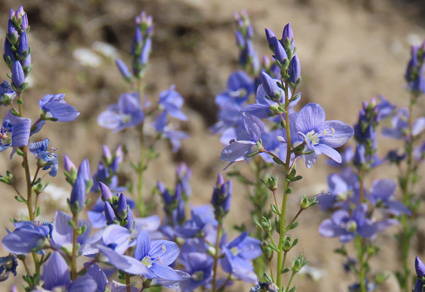
A new species, Veronica gypsicola (Plantaginaceae), is described and illustrated. It’s the first gypsophyte species in the genus and grows in a mountainous area with gypsum substrate, which is located in Erzincan province in Eastern Türkiye. Gypsum habitats is primarily centered within the Central and Eastern Anatolia in Türkiye and generally considered as “edaphic islands”, which are unique ecological hotspots characterized by high levels of endemism and specialized plant adaptations. The new species is morphologically unique in the genus, which is likely associated with the unique habitat. Its habit reminds of V. cetikiana and some variants of V. orientalis but it can easily distinguished by its erect habit, glabrous leaves, entire leaf margins and elongated glabrous capsules.
References
- Albach, D.C., Martinez-Ortega, M.M. & Chase, M.W. (2004) Veronica: Parallel morphological evolution and phylogeography in the Mediterranean. Plant Systematics and Evolution 246: 177–194. https://doi.org/10.1007/s00606-004-0148-9
- Albach, D.C., Martínez-Ortega, M.M., Delgado, L., Weiss-Schneeweiss, H., Özgökce, F. & Fischer, M.A. (2008) Chromosome numbers in Veroniceae (Plantaginaceae): Review and several new counts. Annals of the Missouri Botanical Garden 95 (4): 543–566. https://doi.org/10.3417/2006094
- Albach, D.C. & Al-Gharaibeh, M. (2015) Systematics and biogeography of veronica subg. Pentasepalae from the levant. Willdenowia 45: 5–14. https://doi.org/10.3372/wi.45.45101
- Albach, D.C. (2023) What is a species in Veronica? Reflections on the occasion of Manfred A. Fischer’s 80th birthday. Neilreichia 13: 305–323.
- Boissier, P.E. (1849) Hedysarum pestalozzae Boiss. In: Boissier, P.E. (Ed.) Diagnoses Plantarum Orientalium Novarum, ser. 9. Apud B. Hermann, Leipzig, pp. 112.
- Boissier, P.E. (1844) Prangos meliocarpoides Boiss. In: Annales des Sciences Naturelles; Botanique, ser. 3, 2: 81.
- Boissier, P.E. (1844) Scrophularia lepidota Boiss. In: Boissier, P.E. (Ed.) Diagnoses Plantarum Orientalium Novarum, ser. 1, 4. Apud B. Hermann, Leipzig, pp. 71.
- Boissier, P.E. (1844) Verbascum alyssifolium Boiss. In: Boissier, P.E. (Ed.) Diagnoses Plantarum Orientalium Novarum, ser. 1, 4. Apud B. Hermann, Leipzig, pp. 58.
- Boissier, P.E. (1843) Gypsophila lepidioides Boiss. In: Boissier, P.E. (Ed.) Diagnoses Plantarum Orientalium novarum, Ser. 1, 1. Apud B. Hermann, Lipsiae, pp. 14.
- Boissier, P.E. (1843) Astragalus aucheri Boiss. In: Boissier, P.E. (Ed.) Diagnoses Plantarum Orientalium novarum, Ser. 1, 2. Apud B. Hermann, Lipsiae, pp. 46.
- Bunge, A. (1868–1869) Astragali Species Gerontogeae. Pars 1: Claves diagnosticae. Mémoires de l’Académie impériale des sciences de St. Pétersbourg, Sér. 7, 11 (16): 140 S. Pars 2: Specierum enumeratio. l.c. 15 (1): 254 S.
- Cańadas, E.M., Ballesteros, M., Valle, F. & Lorite, J. (2014) Does gypsum influence seed germination? Turkish Journal of Botany 38 (1): 141–147. https://doi.org/10.3906/bot-1305-19
- Cera, A., Montserrat-Martí, G. & Palacio, S. (2023) Nutritional strategy underlying plant specialization to gypsum soils. AoB Plants 15 (4): 1–6. https://doi.org/10.1093/aobpla/plad041
- Chrysostomou, G., Christodoulou, C.S., Iosif, K., Vogiatzakis, I.N. & Manolaki, P. (2024) Life on gypsum: the vegetation of gypsum ecosystems in Cyprus. Plant Biosystems - An International Journal Dealing with all Aspects of Plant Biology. https://doi.org/10.1080/11263504.2024.2347852
- Çakır-Dindar, E.G. & Duman, H. (2020) İliç-Kemah (Erzincan) Jips Florası. Bağbahçe Bilim Dergisi 7 (1): 16–46.
- Çiner, A., Kosun, E. & Deynoux, M. (2002) Fluvial, evaporitic and shallow-marine facies architecture, depositional evolution and cyclicity in the Sivas Basin (Lower to Middle Miocene), Central Turkey. J. Asian Earth Sci. 21: 147–165. https://doi.org/10.1016/s1367-9120(02)00042-1
- Doostmohammadi, M., Bordbar, F., Albach, D.C. & Mirtadzadini, M. (2022) Phylogeny and historical biogeography of Veronica subgenus Pentasepalae (Plantaginaceae): Evidence for its origin and subsequent dispersal. Biology 11 (5): е639. https://doi.org/10.3390/biology11050639
- Doostmohammadi, M., Bordbar, F., Albach, D.C. & Mirtadzadini, M. (2026) Species delimitation and phylogenetic relationships of Veronica kurdica s. l. (Plantaginaceae). Plant Biosyst 160: 19. https://doi.org/10.1007/s44473-025-00049-6
- Fischer, M.A. (1977) Two New Veronica Species (Scrophulariaceae) of Turkey and Iraq. Plant Systematics and Evolution 128: 237–241. https://doi.org/10.1007/bf00984560
- Fischer, M.A. (1978) Veronica L. In: Davis, P.H. (Ed.) Flora of Turkey and the East Aegean Islands. Vol. 6. Edinburgh University Press, Edinburgh, pp. 689–753.
- Fischer, M.A. (1981) Veronica L. In: Rechinger, K.H. (Ed.) Flora Iranica (Vol. 147). Akademische Druck- und Verlagsanstalt, Graz, pp. 25–165.
- Fischer, E. (2004) Scrophulariaceae. In: Kadereit, J.K. (Ed.) The Families and Genera of Vascular Plants (Vol. 7). Springer, pp. 333–433. https://doi.org/10.1007/978-3-642-18617-2_21
- Freyn, (1903) Gypsophila heteropoda. In: Bulletin de l’Herbier Boissier, sér. 2, 3: 865.
- Grierson, A.J.C. (1975) Materials for a Flora of Turkey XXXI: Compositae, II. Notes from the Royal Botanic Garden, Edinburgh 33 (3): 409–435.
- IUCN Standards and Petitions Committee. (2022) Guidelines for Using the IUCN Red List Categories and Criteria. Version 15. Prepared by the Standards and Petitions Committee.
- Jaubert, H.F. & Spach, É. (1843) Illustrationes Plantarum Orientalium; seu, Descriptiones plantarum novarum aut minus cognitarum in regionibus orientalibus detectarum. Fortin, Masson et Cie, Paris, pp. 156.
- Kandemir, A., Türkoğlu, H.İ. & Yıldız, F. (2022) Erzincan (Türkiye) Florasına Dair Bazı Gözlemler ve Öneriler. Bağbahçe Bilim Dergisi 9 (1): 34–63.
- Kandemir, A., Aytaç, Z. & Fişne, A.Y. (2017) Aethionema erzincanum (Brassicaceae), a new species from Turkey. Annales Botanici Fennici 54 (1–3): 1–5. https://doi.org/10.5735/085.054.0301
- Kandemir, A. & Türkmen, Z. (2010) A new species of Onosma (Boraginaceae) from eastern Turkey. Turkish Journal of Botany 34 (4): 277–282. https://doi.org/10.3906/bot-0902-13
- Karadenizli, L., Varol, B.E., Saraç, G. & Gedik, F. (2016) Late eocene-early miocene palaeogeographic evolution of central Eastern Anatolian basins, the closure of the neo-tethys ocean and continental collision. Journal Geological Society of India 88: 773–798. https://doi.org/10.1007/s12594-016-0545-z
- Kumar, S., Stecher, G., Li, M., Knyaz, C. & Tamura, K. (2018) MEGA X: molecular evolutionary genetics analysis across computing platforms. Mol. Biol. Evol 35: 1547–1549. https://doi.org/10.1093/molbev/msy096
- Ledebour, C.F.v. (1852) Flora Rossica; sive, Enumeratio plantarum in totius Imperii Rossici provinciis europaeis, asiaticis et americanis hucusque observatarum. Sumtibus Librariae E. Schweizerbart, Stuttgartiae, pp. 193.
- Linnaeus, C. (1753) Scutellaria orientalis L. In: Species plantarum, vol. 2. pp. 598.
- Linnaeus, C. (1753) Veronica chamaedrys L. In: Species Plantarum, Tomus I. Holmiae [Stockholm]: Impensis Laurentii Salvii, pp. 13.
- Linnaeus, C. (1753) Veronica L. In: Species plantarum, vol. 1. pp. 9.
- Meudt, H.M., Rojas-Andrés, B.M., Prebble, J.M., Low, E., Garnock-Jones, P.J. & Albach, D.C. (2015) Is genome downsizing associated with diversification in polyploid lineages of Veronica? Botanical Journal of the Linnean Society 178 (2): 243–266. https://doi.org/10.1111/boj.12276
- Miller, P. (1768) The gardeners dictionary, 8 edn. J. & F. Rivington, London.
- Müller, K. (2005) SeqState: Primer design and sequence statistics for phylogenetic DNA datasets. Applied Bioinformatics 4: 65–69. https://doi.org/10.2165/00822942-200504010-00008
- Müller, K. & Albach, D.C. (2010) Evolutionary Rates in Veronica L. (Plantaginaceae): Disentangling the Influence of Life History and Breeding System. Journal of Molecular Evolution 70: 44–56. https://doi.org/10.1007/s00239-009-9307-5
- Özhatay, N. & Mathew, B. (1995) New Taxa and Notes on the Genus Allium (Alliaceae) in Turkey and Arabia. Kew Bulletin 50 (4): 723–731. https://doi.org/10.2307/4110233
- Öztürk, A. (1989) Veronica cetikiana. [Davis & Hedge Festschrift, Commemorating the Seventieth Birthday of Peter Hadland Davis and the Sixtieth birthday of Ian Charleson Hedge: Plant Taxonomy, Phytogeography, and related Subjects]
- Palacio, S., Escudero, A., Montserrat-Martí, G., Maestro, M., Milla, R. & Albert, M.Í.J. (2007) Plants Living on Gypsum: Beyond the Specialist Model. Annals of botany 99 (2): 333–343. https://doi.org/10.1093/aob/mcl263
- Palacio, S., Aitkenhead, M., Escudero, A., Montserrat-Martí, G., Maestro, M. & Jean Robertson, A.H. (2014) Gypsophile chemistry unveiled: Fourier transform infrared (FTIR) spectroscopy provides new insight into plant adaptations to gypsum soils. PLoS ONE 9 (9): e107285. https://doi.org/10.1371/journal.pone.0107285
- Pérez-García, F.J., Akhani, H., Parsons, R.F., Silcock, J.L., Kurt, L., Özdeniz, E., Spampinato, G., Musarella, C.M., Salmerón-Sánchez, E., Sola, F., Merlo, M.E., Martínez-Hernández, F., Mendoza-Fernández, A.J., Garrido-Becerra, J.A. & Mota, J.F. (2018) A first inventory of gypsum flora in the Palearctic and Australia. Mediterranean Botany 39 (1): 35–49.
- Ronquist, F., Teslenko, M., van der Mark, P., Ayres, D.L., Darling, A., Höhna, S., Larget, B., Liu, L., Suchard, M.A. & Huelsenbeck, J.P. (2012) MrBayes 3.2: Efficient Bayesian phylogenetic inference and model choice across a large model space. Systematic Biology 61 (3): 539–542. https://doi.org/10.1093/sysbio/sys029
- Sonibare, M.A., Armagan, M., Özgökce, F., Yaprak, A.E., Mayland-Quellhorst, E. & Albach, D.C. (2014) Analysis of taxonomic and geographic patterns of Turkish Veronica orientalis using nuclear and plastid DNA and morphological data. Plant Systematics and Evolution 300: 645–664. https://doi.org/10.1007/s00606-013-0909-4
- Thiers, B. (2026) Index Herbariorum: A global directory of public herbaria and associated staff. New York Botanical Garden’s Virtual Herbarium. Available from: http://sweetgum.nybg.org/science/ih/ (accessed 11 August 2026)
- Wagenitz, G. & Kandemir, A. (2008) Two new species of the genus Psephellus (Compositae, Cardueae) from eastern Turkey. Willdenowia 38 (2): 521–526. https://doi.org/10.3372/wi.38.38211
- White, T.J., Bruns, T.D., Lee, S. & Taylor, J. (1990) Amplification and direct sequencing of fungal ribosomal RNA genes for phylogenetics. In: Innis, M.A., Gelfand, D.H., Sninsky, J.J. & White, T.J. (Eds.) PCR protocols: A guide to methods and applications (Vol. 3). Academic Press, San Diego, pp. 15–22. https://doi.org/10.1016/B978-0-12-372180-8.50042-1
- Willdenow, C.L. (1803) Astragalus aduncus Willd. In: Species plantarum, vol. II, pars II, pp. 1269.