

Abstract
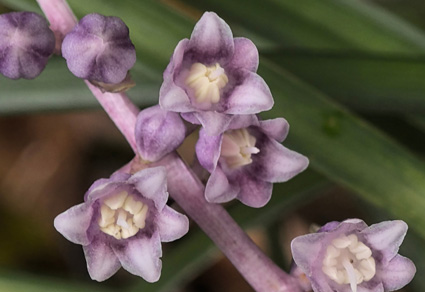
Ophiopogon nanlingensis, a new species from the Nanling Mountains, Guangdong Province, China, is described and illustrated. It is most similar to O. angustifoliatus originally described from SW China, but is clearly distinguishable mainly by its densely caespitose habit with a robust rhizome (vs. prostrate with slender, creeping rhizome/stolons), free anthers that become reflexed after anthesis (vs. laterally connate, not reflexed), and shorter pedicels (3.5–4.5 mm) with the joint at the middle (vs. longer pedicels (6–8 mm) with the joint below the middle). Information on habitat, conservation status (tentatively assessed as Vulnerable (VU, criterion D2)), phenology, and taxonomic affinities with related congeners is also provided.
References
- Andrews, H.C. (1810) Peliosanthes teta. Botanists’ repository, for new, and rare plants 9: t. 605. [https://www.biodiversitylibrary.org/item/108763#page/2/mode/1up]
- APG (Angiosperm Phylogeny Group) III (2009) An update of the Angiosperm Phylogeny Group classification for the orders and families of flowering plants: APG III. Botanical Journal of the Linnean Society 161 (2): 105–121. https://doi.org/10.1111/j.1095-8339.2009.00996.x
- APG (Angiosperm Phylogeny Group) IV (2016) An update of the Angiosperm Phylogeny Group classification for the orders and families of flowering plants: APG IV. Botanical Journal of the Linnean Society 181 (1): 1–20. https://doi.org/10.1111/boj.12385
- Averyanov, L.V., Tanaka, N. & Nguyen, K.S. (2016) New species of Ophiopogon and Peliosanthes (Asparagaceae) from northern Vietnam and China. Taiwania 61 (4): 275–284. https://doi.org/10.6165/tai.2016.61.201
- Beentje, H. (2016) The Kew plant glossary, an illustrated dictionary of plant terms (second edition, illus. by Williamson J.). Royal Botanic Gardens, Kew, Kew Publishing, 184 pp.
- Chase, M.W., Reveal, J.L. & Fay, M.F. (2009) A subfamilial classification for the expanded asparagalean families Amaryllidaceae, Asparagaceae and Xanthorrhoeaceae. Botanical Journal of the Linnean Society 161 (2): 132–136. https://doi.org/10.1111/j.1095-8339.2009.00999.x
- Chen, S.C. (1988) An addition to the lily flora of China. Acta Phytotaxonomica Sinica 26 (2): 139–143.
- Chen, X.Q. & Tamura, M.N. (2000) Ophiopogon Ker Gawler. In: Wu, Z.Y., Raven, P.H. & Hong, D.Y. (Eds.) Flora of China 24. Science Press, Beijing, Missouri Botanical Garden Press, St. Louis, pp. 252–261.
- Dahlgren, R.M.T., Clifford, H.T. & Yeo, P.F. (1985) The Families of the Monocotyledons. Springer-Verlag, Berlin, 520 pp.
- Don, D. (1825) Prodromus florae Nepalensis. Veneunt Apud J. Gale, Londoni, 256 pp. [https://www.biodiversitylibrary.org/item/1820#page/2/mode/1up]
- Fischer, E. (2015) Ruscaceae. In: Frey, W. (Ed.) Syllabus of Plant Families – A. Engler's Syllabus der Pflanzenfamilien, 13th ed., Part 2/1. Borntraeger, Stuttgart, 324 pp.
- Floden, A. & Schilling, E.E. (2018) Using phylogenomics to reconstruct phylogenetic relationships within tribe Polygonateae (Asparagaceae), with a special focus on Polygonatum. Molecular Phylogenetics and Evolution 129: 202–213. https://doi.org/10.1016/j.ympev.2018.08.017
- Hance, H.F. (1868) A decade of new Chinese plants. Journal of botany, British and foreign 6: 111–115.
- Ker Gawler, J.B. (1807) Ophiopogon. Curtis’s Botanical Magazine 27: t. 1063. [https://www.biodiversitylibrary.org/page/472608#page/9/mode/1up]
- Kim, J.H., Kim, D.K., Forest, F., Fay, M.F. & Chase, M.W. (2010) Molecular phylogenetics of Ruscaceae sensu lato and related families (Asparagales) based on plastid and nuclear DNA sequences. Annals of Botany 106: 775–790. https://doi.org/10.1093/aob/mcq167
- Liang, S.Y. & Dai, L.K. (1992) Pollen morphology of the tribes Ophiopogoneae and Peliosantheae (Liliaceae). Acta Phytotaxonomica Sinica 30 (5): 427–432.
- Le, T.M.L., Ly, N.S., Pham, V.T., Nguyen, P.H., Tran, D.B., Dong, L.N., Averyanov, L.V., Tanaka, N. & Nguyen, K.S. (2024) Molecular phylogeny of Convallarioideae (Asparagaceae), with emphasis on Vietnamese species. Academia Journal of Biology 45 (4): 93–109. https://doi.org/10.15625/2615-9023/18765
- Loureiro, J.D. (1790) Flora Cochinchinensis 1. Typis academicis, Ulyssipone, 353 pp.
- Nguyen, K.S., Tanaka, N., Averyanov, L.V., Maisak, T.V., Nguyen, P.H. & Tran, D.B. (2021) Two new species, Ophiopogon dolichocaulis and O. trigonantherus (Asparagaceae), from northern Vietnam. Phytotaxa 523 (4): 291–298. https://doi.org/10.11646/phytotaxa.523.4.3
- Reveal, J.L. (2012) An outline of a classification scheme for extant flowering plants. Phytoneuron 37: 1–221.
- Tanaka, N. (2001) Taxonomic notes on Ophiopogon (Convallariaceae) of East Asia (III). The Journal of Japanese Botany 76 (4): 205–218. [http://www.jjbotany.com/pdf/JJB_076_205_218.pdf]
- Tanaka, N. & Nguyen, K.S. (2023) Nolinoideae (Asparagaceae) in APG III needs replacing with Convallarioideae. Phytotaxa 583 (3): 297–299. https://doi.org/10.11646/phytotaxa.583.3.9
- Thunberg, C.P. (1780) Kempferus illustrates seu explicatio illarum plantarum, quas kempferus in iaponia collegit et in fasciculo quinato amoenitatum exoticarum adnotavit, secundum systema sexuale ad classes, ordinas, genera et species Iam redactarum. Nova acta Regiae Societatis Scientiarum Upsaliensis 3: 196–210.
- Wang, F.T. & Tang, T. (eds.) (1978) Flora Reipublicae Popularis Sinicae 15. Science Press, Beijing, 280 pp.
- Wang, G.Y., Meng, Y., Huang, J.L., Yang, Y.P. (2014) Molecular phylogeny of Ophiopogon (Asparagaceae) inferred from nuclear and plastid DNA sequences. Systematic Botany 39: 776–784. https://doi.org/10.1600/036364414X682201