

Abstract
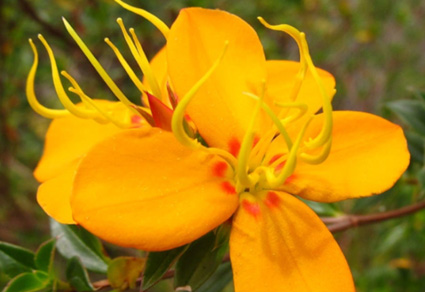
Acanthella (Melastomataceae, Marcetieae) is a small genus previously comprising two species endemic to the Guiana Shield. Acanthella includes shrubs with flowers with yellow or orange petals, and capsules bearing winged seeds. Despite its morphological distinctiveness, the genus has remained poorly known. Here, we provide a synoptic taxonomic treatment for the genus, including the description of a new species from Venezuela, and an identification key for the species. Specimens from 30 herbaria were examined, totaling about 260 collections or 540 sheets studied. Scanning electron microscopy was performed to assist in the description and illustration of the seed micromorphology of the genus, as well as the leaf surface of the new species. Distributional data indicate that the genus is restricted to northern South America, with the Cerro Cuao region in Venezuela representing its diversity center. Based on herbarium data, Acanthella species exhibit distinct phenological patterns among themselves. Regarding conservation status, Acanthella pulchra is preliminarily assessed as Endangered, A. sprucei as Least Concern, and A. vestita as Data Deficient. We also clarify the long-standing taxonomic confusion involving Melastoma confertum, which is here lectotypified and placed under Cambessedesia espora.
References
- Armenteras, D., Meza, M.C., González, T.M., Oliveras, I., Balch, J.K. & Retana, J. (2021) Fire threatens the diversity and structure of tropical gallery forests. Ecosphere 12: e03347. https://doi.org/10.1002/ecs2.3347
- Bachman, S., Moat, J., Hill, A.W., de la Torre, J. & Scott, B. (2011) Supporting red list threat assessments with GeoCAT: Geospatial conservation assessment tool. ZooKeys 150: 117–126. https://doi.org/10.3897/zookeys.150.2109
- Barbosa-Silva, R.G., Andrino, C.O., Azevedo, L., Lucresia, L., Lovo, J., Hiura, A.L., Viana, P.L., Giannini, T.C. & Zappi, D.C. (2022) A wide range of South American inselberg floras reveal cohesive biome patterns. Frontiers in Plant Science 13: 928577. https://doi.org/10.3389/fpls.2022.928577
- Beentje, H.J. (2016) The Kew Plant Glossary: an illustrated dictionary of plant terms, Second edition. Royal Botanic Gardens, Kew, Richmond, 185 pp.
- Bentham, G. & Hooker, J.D. (1867) Melastomaceæ. In: Bentham, G. & Hooker, J.D. (Eds.) Genera Plantarum, Vol. 1. Reeve & Co. and Williams & Norgate, London, pp. 725–773.
- Berry, P.E. (2001) Acanthella. In: Berry, P.E., Yatskievych, K. & Holst, B.K. (Eds.) Flora of the Venezuelan Guayana 6 (Liliaceae-Myrsinaceae). Missouri Botanical Garden Press, St. Louis, pp. 268–270.
- Bland, L.M., Bielby, J., Kearney, S., Orme, C.D.L., Watson, J.E.M. & Collen, B. (2017) Toward reassessing data-deficient species. Conservation Biology 31: 531–539. https://doi.org/10.1111/cobi.12850
- Borgelt, J., Dorber, M., Høiberg, M.A. & Verones, F. (2022) More than half of data deficient species predicted to be threatened by extinction. Communications Biology 5: 679. https://doi.org/10.1038/s42003-022-03638-9
- Brito, V.L.G., Leite, F.B., Telles, F.J., Jorge, L.R. & Sazima, M. (2021) The attractive role of floral elements in heterantherous species without pronounced stamen differences. Arthropod-Plant Interactions 15: 23–31. https://doi.org/10.1007/s11829-020-09794-1
- Brito, M.R., Dagallier, L.P.M.J., Bacci, L.F., Reginato, M., Ore-Rengifo, M.I., Acha, S., Veranso-Libalah, M.C., Chen, L., Kadereit, G., Goldenberg, R., Liu, Y., Zhou, R., Penneys, D.S., Sekarathil, R., Nampy, S., Stone, R.D., Almeda, F., Judd, W.S., Cellinese, N., Michelangeli, F.A. & Majure, L.C. (2026) Phylogenomics of Melastomataceae: rooting out discordance across organellar and nuclear genomes. Molecular Phylogenetics and Evolution 221: 108628. https://doi.org/10.1016/j.ympev.2026.108628
- Candolle, A.P. (1828) Melastomaceae. In: Candolle, A.P. (Ed.) Prodromus systematis naturalis regni vegetabilis, Vol. 3. Sumptibus Sociorum Treuttel et Würtz, Parisiis [Paris], pp. 99–202. https://doi.org/10.5962/bhl.title.286
- Cazalis, V., Santini, L., Lucas, P.M., González-Suárez, M., Hoffmann, M., Benítez-López, A., Pacifici, M., Schipper, A.M., Böhm, M., Zizka, A., Clausnitzer, V., Meyer, C., Jung, M., Butchart, S.H.M., Cardoso, P., Mancini, G., Akçakaya, H.R., Young, B.E., Patoine, G. & Di Marco, M. (2023) Prioritizing the reassessment of data-deficient species on the IUCN Red List. Conservation Biology 37: e14139. https://doi.org/10.1111/cobi.14139
- Chittka, L. & Raine, N.E. (2006) Recognition of flowers by pollinators. Current Opinion in Plant Biology 9: 428–435. https://doi.org/10.1016/j.pbi.2006.05.002
- Cogniaux, A. (1883) Tribus I. Microlicieae Triana. In: Martius, C.F.P. & Eichler, A.G. (Eds.) Flora brasiliensis, Vol. 14. Frid. Fleischer, Monachii et Lipsiae [Munich & Leipzig], pp. 205–510.
- Cogniaux, A. (1886) Tribus IV. Merianieae Triana. In: Martius, C.F.P., Eichler, A.G. & Urban, I. (Eds.) Flora brasiliensis, Vol. 14. Frid. Fleischer, Monachii et Lipsiae [Munich & Leipzig], pp. 4–48.
- Dahl, M.H., Ebus, B. & González, W. (2021) The Venezuelan gold rush. On Human Rights violations and environmental destruction in the Orinoco mining arc. ReVista: Harvard Review of Latin America. Available from: https://revista.drclas.harvard.edu/the-venezuelan-gold-rush/ (accessed 8 September 2025)
- Dijkshoorn, J.A., van Engelen, V.W.P., Huting, J.R.M. & Tempel, P. (2014) Soil and Terrain Database for Latin America and the Caribbean (SOTERLAC). Version 2.0 [shapefile]. 1:5 million. ISRIC, Wageningen. Available from: https://data.isric.org/geonetwork/srv/api/records/436bd4b0-7ffc-4272-be57-686b7d7eea7d (accessed 7 October 2025)
- Garcia-Suabita, W., Pacheco, M.J. & Armenteras, D. (2024) Multitemporal dynamics of fuels in forest systems present in the Colombian Orinoco River Basin Forests. Fire 7: 171. https://doi.org/10.3390/fire7060171
- Gleason, H.A. (1952) Botanical exploration in Venezuela—II: Melastomaceae. Fieldiana, Botany 28: 424–438.
- Gleason, H.A. (1953) The Botany of the Guayana Highland: Melastomaceae. Memoirs of the New York Botanical Garden 8: 133–144.
- Gleason, H.A. (1957) Botanical exploration in Venezuela—IV: Melastomaceae. Fieldiana, Botany 28: 1025–1041.
- Global Forest Watch (2025) Venezuela: Amazonas. Available from: https://www.globalforestwatch.org/dashboards/country/VEN/ (accessed 8 September 2025)
- Gröger, A. & Renner, S.S. (1997) Leaf anatomy and ecology of the Guayana endemics Acanthella sprucei and A. pulchra (Melastomataceae). BioLlania 6: 369–374.
- Huber, O. (2006) Herbaceous ecosystems on the Guayana Shield, a regional overview. Journal of Biogeography 33: 464–475. https://doi.org/10.1111/j.1365-2699.2005.01454.x
- Huber, O., Prance, G.T., Kroonenberg, S.B. & Antonelli, A. (2018) The Tepuis of the Guiana Highlands. In: Hoorn, C., Perrigo, A. & Antonelli, A. (Eds.) Mountains, Climate and Biodiversity. John Wiley & Sons Ltd, Oxford, UK, pp. 339–353.
- Index Herbariorum (updated continuously) Index Herbariorum: A Global Directory of Public Herbaria and Associated Staff. New York Botanical Garden. Available from: https://sweetgum.nybg.org/science/ih (accessed 20 August 2026)
- IUCN (2012) IUCN Red List Categories and Criteria. Version 3.1. Ed. 2. IUCN, Gland, Switzerland and Cambridge, UK.
- IUCN Standards and Petitions Committee (2024) Guidelines for Using the IUCN Red List Categories and Criteria. Version 16. Available from: https://www.iucnredlist.org/documents/RedListGuidelines.pdf (accessed 8 September 2025)
- Kimball, S., Mattis, P. & the GIMP Developer Team (1995–2025) GNU Image Manipulation Program (GIMP). Version 3.0.2. Available from: https://www.gimp.org/ (accessed 30 June 2025)
- Lichter-Marck, I.H. & Baldwin, B.G. (2023) Edaphic specialization onto bare, rocky outcrops as a factor in the evolution of desert angiosperms. PNAS 120: e2214729120. https://doi.org/10.1073/pnas.2214729120
- Lima, H.C. (1995) Leguminosas da Flora Fluminensis—J.M. da C. Vellozo—Lista atualizada das espécies arbóreas. Acta Botanica Brasilica 9: 123–146. https://doi.org/10.1590/S0102-33061995000100006
- Lunau, K., Wacht, S. & Chittka, L. (1996) Colour choices of naive bumble bees and their implications for colour perception. Journal of Comparative Physiology A 178: 477–489. https://doi.org/10.1007/BF00190178
- Magdalena, U.R., Silva, L.A.E., Lima, R.O., Bellon, E., Ribeiro, R., Oliveira, F.A., Siqueira, M.F. & Forzza, R.C. (2018) A new methodology for the retrieval and evaluation of geographic coordinates within databases of scientific plant collections. Applied Geography 96: 11–15. https://doi.org/10.1016/j.apgeog.2018.05.002
- Michelangeli, F.A., Almeda, F., Goldenberg, R., Judd, W.S., Becquer-Granados, E.R. & Tulig, M. (2009) PBI Miconieae: A complete web-based monograph of the tribe Miconieae (Melastomataceae). The New York Botanical Garden, Bronx, NY. Available from: https://sweetgum.nybg.org/science/projects/melastomataceae/portfolio/gleason/ (accessed 6 October 2025) https://doi.org/10.3897/phytokeys.63.7368.figure1
- Michelangeli, F.A., Guimarães, P.J.F., Penneys, D.S., Almeda, F. & Kriebel, R. (2013) Phylogenetic relationships and distribution of New World Melastomeae (Melastomataceae). Botanical Journal of the Linnean Society 171: 38–60. https://doi.org/10.1111/j.1095-8339.2012.01295.x
- Ocampo, G., Michelangeli, F.A., Penneys, D.S., Handley, V., González-Moreno, R., Herrera-Dimas, E. & Almeda, F. (2022) A new perspective on seed morphological features in Melastomataceae. In: Goldenberg, R., Michelangeli, F.A. & Almeda, F. (Eds.) Systematics, Evolution, and Ecology of Melastomataceae. Springer, Cham, Switzerland, pp. 491–531. https://doi.org/10.1007/978-3-030-99742-7_23
- Pacifico, R. & Fidanza, K. (2025) Cambessedesia in Flora e Funga do Brasil. Jardim Botânico do Rio de Janeiro. Available from: https://floradobrasil.jbrj.gov.br/FB9432 (accessed 6 October 2025)
- Pastore, J.F.B., Mota, M., Menezes, H.F. & Trovó, M. (2021) Vellozo’s Florae Fluminensis: A new assessment of the São Paulo part of the collecting itinerary, its vegetation, and species list. Taxon 70: 1078–1095. https://doi.org/10.1002/tax.12509
- Penneys, D.S., Almeda, F., Reginato, M., Michelangeli, F.A., Goldenberg, R., Fritsch, P.W. & Stone, R.D. (2022) A new Melastomataceae classification informed by molecular phylogenetics and morphology. In: Goldenberg, R., Michelangeli, F.A. & Almeda, F. (Eds.) Systematics, Evolution, and Ecology of Melastomataceae. Springer, Cham, Switzerland, pp. 109–165. https://doi.org/10.1007/978-3-030-99742-7_5
- R Core Team (2024) R: A language and environment for statistical computing. R Foundation for Statistical Computing. Available from: http://www.R-project.org/ (accessed 13 December 2024)
- Rajakaruna, N. (2018) Lessons on evolution from the study of edaphic specialization. The Botanical Review 84: 39–78. https://doi.org/10.1007/s12229-017-9193-2
- Reginato, M. (2016) monographaR: An R package to facilitate the production of plant taxonomic monographs. Brittonia 68: 212–216. https://doi.org/10.1007/s12228-015-9407-z
- Reginato, M., Vasconcelos, T.N.C., Kriebel, R. & Simões, A.O. (2020) Is dispersal mode a driver of diversification and geographical distribution in the tropical plant family Melastomataceae? Molecular Phylogenetics and Evolution 148: 106815. https://doi.org/10.1016/j.ympev.2020.106815
- Renner, S.S. (1993) Phylogeny and classification of the Melastomataceae and Memecylaceae. Nordic Journal of Botany 13: 519–540. https://doi.org/10.1111/j.1756-1051.1993.tb00096.x
- Rocha, M.J.R., Batista, J.A.N., Guimarães, P.J.F. & Michelangeli, F.A. (2016) Phylogenetic relationships in the Marcetia alliance (Melastomeae, Melastomataceae) and implications for generic circumscription. Botanical Journal of the Linnean Society 181: 585–609. https://doi.org/10.1111/boj.12429
- Rocha, M.J.R., Guimarães, P.J.F., Michelangeli, F.A. & Batista, J.A.N. (2018) Taxonomy of Marcetieae: A new Neotropical tribe of Melastomataceae. International Journal of Plant Sciences 179: 50–74. https://doi.org/10.1086/694932
- Rull, V., Huber, O., Vegas-Vilarrúbia, T. & Señaris, C. (2019) Definition and characterization of the Pantepui biogeographical province. In: Rull, V., Vegas-Vilarrúbia, T., Huber, O. & Señaris, C. (Eds.) Biodiversity of Pantepui: The pristine “Lost World” of the Neotropical Guiana Highlands. Academic Press, London, UK, pp. 3–32. https://doi.org/10.1016/B978-0-12-815591-2.00001-X
- Silveira, F.A.O., Dayrell, R.L.C., Fiorini, C.F., Negreiros, D. & Borba, E.L. (2020) Diversification in ancient and nutrient poor neotropical ecosystems: How geological and climatic buffering shaped plant diversity in some of the world’s neglected hotspots. In: Rull, V. & Carnaval, A.C. (Eds.) Neotropical diversification: Patterns and processes. Springer International, Heidelberg, pp. 329–368. https://doi.org/10.1007/978-3-030-31167-4_14
- Standley, P.C. & Steyermark, J.A. (1953) Botanical exploration in Venezuela—III: Rubiaceae. Fieldiana, Botany 28: 565–617.
- Stearn, W.T. (1983) Botanical Latin. 3rd rev. ed. David & Charles, Great Britain.
- Tackenberg, O., Poschlod, P. & Bonn, S. (2003) Assessment of wind dispersal potential in plant species. Ecological Monographs 73: 191–205. https://doi.org/10.1890/0012-9615(2003)073[0191:AOWDPI]2.0.CO;2
- Turland, N.J., Wiersema, J.H., Barrie, F.R., Gandhi, K.N., Gravendyck, J., Greuter, W., Hawksworth, D.L., Herendeen, P.S., Klopper, R.R., Knapp, S., Kusber, W.-H., Li, D.-Z., May, T.W., Monro, A.M., Prado, J., Price, M.J., Smith, G.F. & Zamora Señoret, J.C. (2025) International Code of Nomenclature for algae, fungi, and plants (Madrid Code). Regnum Vegetabile 162. The University of Chicago Press, Chicago and London. https://doi.org/10.7208/chicago/9780226839479.001.0001
- Vanschoenwinkel, B., de Paula, L.F.A., Snoeks, J.M., van der Stocken, T., Buschke, F.T., Porembski, S. & Silveira, F.A.O. (2025) The ecological and evolutionary dynamics of inselbergs. Biological Reviews 100: 481–507. https://doi.org/10.1111/brv.13150
- Vellozo, J.M.C. (1829) Florӕ Fluminensis. Typographia Nationali, Flumine Januario [Rio de Janeiro]. https://doi.org/10.5962/bhl.title.745
- Vellozo, J.M.C. (1831) Florae fluminensis icones. Vol. 4. Officina lithographica A. Senefelder, Parisiis [Paris]. https://doi.org/10.5962/bhl.title.70380
- Whiffin, T. & Tomb, A.S. (1972) The systematic significance of seed morphology in the Neotropical capsular-fruited Melastomataceae. American Journal of Botany 59: 411–422. https://doi.org/10.1002/j.1537-2197.1972.tb10112.x
- Willdenow, C.L. (1802) Species Plantarum. Vol. 3. G.C. Nauk, Berolini Impensis [Berlin].
- Wurdack, J.J. (1964) The Botany of the Guayana Highlands—Part V: Melastomataceae. Memoirs of the New York Botanical Garden 10: 135–186.
- Wurdack, J.J. (1973) Flora de Venezuela: Melastomataceae. Instituto Botanico, Caracas.