
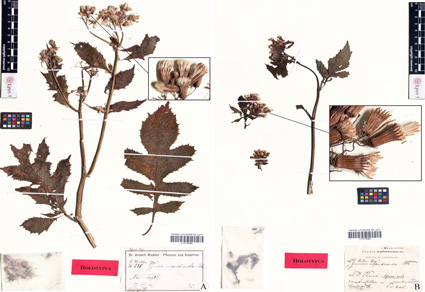

Abstract
Gynura molleri, G. papillosa, and G. winkleri (Asteraceae: Senecioneae) are three species names originally published from West Africa. Since their publication, they have been largely overlooked in subsequent taxonomic revisions and floristic studies. However, they are currently all listed as accepted names in major global plant databases. In this study, we located their type specimens and reassessed their taxonomic identities. Our results show that Gynura molleri and G. winkleri are conspecific with Crassocephalum montuosum and should be treated as its synonyms, whereas G. papillosa is conspecific with C. crepidioides and is here reduced to synonymy under the latter.
References
- Charbonnel, J.B. (1927) L’abbé Michel Gandoger. Bulletin de la Société Botanique de France 74: 3–11. https://doi.org/10.1080/00378941.1927.10833641
- Davies, F. (1978) The genus Gynura (Compositae) in Africa. Kew Bulletin 33: 335–342. https://doi.org/10.2307/4109588
- Exell, A.W. (1944) Catalogue of the vascular plants of S. Tomé (with Principe and Annobon). Trustees of the British Museum, London, 428 pp.
- Exell, A.W. (1956) Supplement to the catalogue of the vascular plants of S. Tomé. Trustees of the British Museum, London, 53 pp.
- Exell, A.W. (1973) Angiosperms of the islands of the Gulf of Guinea (Fernando Po, Príncipe, S.Tomé and Annobon). Bulletin of the British Museum (Natural History) Botany 4: 327–411.
- Figueiredo, E. & Smith, G.F. (2019) The type status of collections made by Adolfo Moller and Francisco Quintas in the floras of São Tomé and Príncipe. Phytotaxa 425: 87–95. https://doi.org/10.11646/phytotaxa.425.2.3
- Figueiredo, E., Paiva, J., Stévart, T., Oliveira, F. & Smith, G.F. (2011) Annotated catalogue of the flowering plants of São Tomé and Princípe. Bothalia 41: 41–82. https://doi.org/10.4102/abc.v41i1.34
- Figueiredo, E., Smith, G.F. & Lima, R.F. de (2024) Plant collecting in São Tomé and Príncipe—collectors and their itineraries during the colonial period. Phytotaxa 640: 90–124. https://doi.org/10.11646/phytotaxa.640.2.2
- Fuchs, H.P. (1960) Réflexions sur la validité des binômes publiés par Gandoger dans sa Flora Europae 1883–1891. Bulletin de la Société Botanique de France 107: 108–112. https://doi.org/10.1080/00378941.1960.10837922
- Gandoger, M.M. (1918) Sertum plantarum novarum. Pars prima. Bulletin de la Société Botanique de France 65: 24–69. https://doi.org/10.1080/00378941.1918.10836046
- Hooker, W.J. (1849) Niger Flora, or, an Enumeration of the Plants of Western Tropical Africa. Hippolyte Bailliere, London, 587 pp.
- Hutchinson, J. & Dalziel, J.M. (1931) Flora of West Tropical Africa, vol. 2, part 1. Crown Agents for the Colonies, London, 292 pp.
- Hutchinson, J. & Dalziel, J.M. (1963) Flora of West tropical Africa, ed. 2, vol. 2. Revised by Hepper, F.N. Crown Agents for Oversea Governments and Administrations, London, 544 pp.
- Jeffrey, C. (1986) The Senecioneae in East Tropical Africa: Notes on Compositae: IV. Kew Bulletin 41: 873–943. https://doi.org/10.2307/4102988
- Meyer, F.K. (1969) Müssen wir Gandoger wirklich noch gerecht werden? Taxon 18: 415–420. https://doi.org/10.2307/1218472
- Milne-Redhead, E. (1951) Crassocephalum montuosum (S. Moore) Milne-Redhead. In: Anonymous (Ed.) Tropical African plants: XXI. Kew Bulletin 5: 376–377.
- Moore, S.M. (1902) A contribution to the Compositae Flora of Africa. Journal of the Linnean Society, Botany 50: 305–367. https://doi.org/10.1111/j.1095-8339.1902.tb00597.x
- Moore, S.M. (1912) The genus Crassocephalum Moench. Journal of Botany, British and Foreign 50: 209–213.
- Rothmaler, W. (1962) Müssen wir Gandoger gerecht werden? Taxon 11: 156–160. https://doi.org/10.2307/1216719
- Stafleu, F.A. (1970) Nomenclature at Seattle. Taxon 19: 36–42. https://doi.org/10.2307/1217910
- Stafleu, F.A. & Cowan, R.S. (1976) Taxonomic Literature, ed. 2, vol. 1. Bohn, Scheltema & Holkema, Utrecht, 1136 pp.
- Vanijajiva, O. & Kadereit, J.W. (2011) A revision of Gynura (Asteraceae: Senecioneae). Journal of Systematics and Evolution 49: 285–314. https://doi.org/10.1111/j.1759-6831.2011.00139.x