
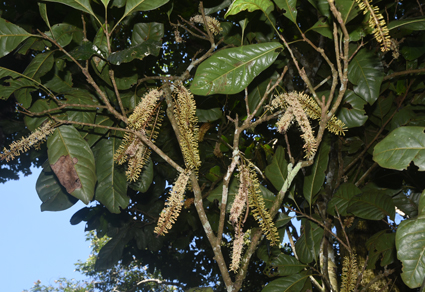

Abstract
Heliciopsis guiliangii, a new cauliflorous tree species from limestone monsoon forests of southeastern Yunnan, China, is described. The racemose inflorescence with paired flowers, functional dioecy, drupaceous fruit, and reticulate pollen sexine place the species in the genus Heliciopsis. The new species is distinguished by its lack of lobed leaves and pink to purple cauliflorous inflorescences. A synopsis and key to three Heliciopsis species from continental Asia excluding Malay Peninsula south to the Alor Star-Singgora Line are provided, with lectotypification for relevant names and H. henryi synonymized under H. terminalis. We provide detailed pollen and wood descriptions for Heliciopsis guiliangii, with notes on its cauline domatia. The new species expands the morphological spectrum for Heliciopsis to include species with completely unlobed leaves and indicates underlying diversity of the genus in continental Asia.
References
- Benson, W.W. (1985) Amazon ant plants. In: Prance, G.T. & Lovejoy, T.E. (Eds.) Amazonia. Pergamon Press, Oxford, pp. 239–266.
- Bergius, P.J. (1767) Aulax. In: Descriptiones plantarum ex Capite Bonae Spei. Typis et Impensis Direct. Laur. Salvii, Stockholm, pp. 33.
- Botany Vietnam Group (2026) Vietnam Plant Data Center. Published online: https://www.botanyvn.com/ (accessed 27 May 2026)
- Brown, R. (1810) On the Proteaceae of Jussieu. Transactions of the Linnean Society of London 10 (1): 15–226. https://doi.org/10.1111/j.1096-3642.1810.tb00013.x
- Chattaway, M.M. (1948) The wood anatomy of the Proteaceae. Australian Journal of Biological Sciences 1 (3): 279–302.
- Chung, R.C.K. (1998) New species of Helicia Lour. and Heliciopsis Sleumer (Proteaceae) from Borneo. The Gardens’ Bulletin, Singapore 50 (2): 151–160.
- Chung, R.C.K. (2001) Taxonomic notes on the Bornean Helicia and Heliciopsis (Proteaceae). Journal of Tropical Forest Science 13 (3): 534–547.
- Chung, R.C.K. (2002) Proteaceae. In: Soepadmo, E., Saw, L.G. & Chung, R.C.K. (Eds.) Tree Flora of Sabah and Sarawak, Vol. 4. Sabah Forestry Department, Forest Research Institute Malaysia, Sarawak Forestry Department, Malaysia, pp. 169–201. https://doi.org/10.26525/tfss4005
- De Labillardière, J.J.H. (1805) Novae Hollandiae plantarum specimen. Ex typographia Dominæ Huzard, Paris, pp. 28.
- de Loureiro, J. (1790) Flora cochinchinensis: sistens plantas in regno Cochinchina nascentes. Quibus accedunt aliae observatae in Sinensi imperio, Africa Orientali, Indiaeque locis variis. Omnes dispositae secundum systema sexuale Linnaeanum. Labore. Ulyssipone, Typis et expensis academicis, 83 pp.
- Diels, F.L.E. (1915) Heliciae novae descriptae. Repert. Spec. Nov. Regni Veg. 13: 527–528. https://doi.org/10.1002/fedr.19150133308
- Fichtler, E. & Worbes, M. (2012) Wood anatomical variables in tropical trees and their relation to site conditions and individual tree morphology. IAWA Journal 33 (2): 119–140. https://doi.org/10.1163/22941932-90000084
- Foreman, D.B. (1998) New species of Helicia Lour. (Proteaceae) from the Vogelkop Peninsula, Irian Jaya. Kew Bulletin 53 (3): 669–681. https://doi.org/10.2307/4110485
- Grierson, A.J.C. & Long, D.G. (1983) Proteaceae. In: Grierson, A.J.C. & Long, D.G. (Eds.) Flora of Bhutan, Including a Record of Plants from Sikkim. Royal Botanic Garden, Edinburgh, Edinburgh, pp. 134–136.
- Halbritter, H., Ulrich, S., Grímsson, F., Weber, M., Zetter, R., Hesse, M., Buchner, R., Svojtka, M. & Frosch-Radivo, A. (2018) Illustrated pollen terminology. Springer, Switzerland, 483 pp. https://doi.org/10.1007/978-3-319-71365-6
- Hewson, H.J. (2019) Plant Indumentum: A Handbook of Terminology, revised edition. Australian Biological Resources Study, Commonwealth of Australia, Australia, 47 pp.
- Hô, P.H. (1992) Proteaceae. In: Morat, P. (Ed.) Flore du Cambodge, du Laos et du Vietnam. Vol. 26. Museum national d’histoire naturelle, Paris, pp. 82–114.
- Hooker, J.D. (1886) Proteaceae. In: Hooker, J.D. (Ed.) The Flora of British India. Gilbert and Rivington, Limited, London, pp. 189–192.
- Index Herbariorum (updated continuously) Index Herbariorum: A Global Directory of Public Herbaria and Associated Staff. New York Botanical Garden. Published online: https://sweetgum.nybg.org/science/ih/ (accessed 26 May 2026)
- InsideWood (2004 onwards) Published online: http://insidewood.lib.ncsu.edu/search (accessed 26 July 2026)
- IUCN (2026) The IUCN Red List of Threatened Species. Version 2025-2. Published online: https://www.iucnredlist.org (accessed 1 June 2026)
- Johnson, L.A. & Briggs, B.G. (1975) On the Proteaceae—the evolution and classification of a southern family. Botanical journal of the Linnean Society 70 (2): 83–182. https://doi.org/10.1111/j.1095-8339.1975.tb01644.x
- Kanehira, R. (1921) Anatomical characters and identification of Formosan woods with critical remarks from the climatic point of view. Bureau of Productive Industries, Government of Formosa.
- Kiu, H.S. & Weston, P.H. (2003) Proteaceae. In: Wu, C.Y., Raven, P.H. & Hong, D.Y. (Eds.) Flora of China, Vol. 5. Science Press, Beijing, and Missouri Botanical Garden Press, St. Louis, pp. 192–199.
- Kiu, H.S. (1988) Proteaceae. In: Fl. China Ed. Committee (Ed.) Flora Reipublicae Popularis Sinicae, Vol. 24. Science Press, Beijing, pp. 7–29.
- Knight, J. (1809) Grevillea. In: On the cultivation of the plants belonging to the natural order of Proteeae, with their generic as well as specific characters and places where they grow wild. Publisher unknown, 127 pp.
- Kochummen, K.M. & Whitmore, T.C. (1973) Notes on the Systematy of Malayan Phanerogams XVIII–XXII. The Gardens’ Bulletin, Singapore 26 (2): 287.
- Kurz, W.S. (1877) Forest flora of British Burma. Vol. 2. Office of the superintendent of government printing, Calcutta, pp. 310–313.
- Leaf Architecture Working Group (1999) Manual of Leaf Architecture - morphological description and categorization of dicotyledonous and net-veined monocotyledonous angiosperms. Washington, D.C.
- Lecomte, H. (1910) Protéacées de l’Indo-Chine. Notulae systematicae (Paris) 1: 189.
- Li, H.L. (1943) Notes on the Flora of Indo-China. J. Arnold Arbor 24: 363.
- Malabrigo Jr, P.L., Umali, A.G.A., Eduarte, G.T., Navidad, J.R.L. & Tobias, A.B. (2023) Helicia danlagunzadii (Proteaceae), a new species from the Mt. Mantalingahan Protected Landscape, Palawan, Philippines. Philippine Journal of Science 152 (2): 581–589.
- Mast, A.R., Willis, C.L., Jones, E.H., Downs, K.M. & Weston, P.H. (2008) A smaller Macadamia from a more vagile tribe: inference of phylogenetic relationships, divergence times, and diaspore evolution in Macadamia and relatives (tribe Macadamieae; Proteaceae). American Journal of Botany 95 (7): 843–870. https://doi.org/10.3732/ajb.0700006
- Merrill, E.D. (1930) A third supplementary list of Hainan plants. Lingnan Sci. J. 6: 276.
- Mo, S.L. (1991) Proteaceae. In: Lee, S.K. & Liang, C.F. (Eds.) Flora of Guangxi. Science and Technology Publishing House, Guangxi, pp. 626–635.
- na Songkhla, B. (1987) Proteaceae. In: Smitinand, T. & Larsen, K. (Eds.) Flora of Thailand. Vol. 5, part 1. The Forest Herbarium, Royal Forest Department, Bangkok, pp. 106–117.
- Nguyen, P.H., Pham, T.Q., Nguyen, H.H., Vu, T.N.D., Ngo, T.H. & Nguyen, T.H. (2021) Inhibition of cell proliferation and enhancement of apoptosis of liver and breast cancer cells by methanol extract of Heliciopsis lobata leaves. Hue University Journal of Science: Natural Science 130 (1A): 51–59.
- Onstein, R.E., Jordan, G.J., Sauquet, H., Weston, P.H., Bouchenak‐Khelladi, Y., Carpenter, R.J. & Linder, H.P. (2016) Evolutionary radiations of Proteaceae are triggered by the interaction between traits and climates in open habitats. Global Ecology and Biogeography 25 (10): 1239–1251. https://doi.org/10.1111/geb.12481
- Pearce, R.B. (1996) Antimicrobial defences in the wood of living trees. New Phytologist 132 (2): 203–233. https://doi.org/10.1111/j.1469-8137.1996.tb01842.x
- Pillon, Y., Bruy, D., Henry, B. & Gotty, K. (2025) A new monocaulous species of Virotia (Proteaceae) from New Caledonia and a rare case of co-accumulation of nickel and manganese. Telopea 29: 149–154.
- POWO (2025) Plants of the World Online. Facilitated by the Royal Botanic Gardens, Kew. Available from: https://powo.science.kew.org/ (accessed 25 May 2026)
- Salisbury, R.A. (1807) Mimetes. In: Paradisus Londinensis: or Coloured Figures of Plants Cultivated in the vicinity of the Metropolis. London, William Hooker, pp. 67.
- Schweingruber, F.H., Borner, A. & Schulze, E.D. (2006) Atlas of woody plant stems: evolution, structure, and environmental modifications. Springer, Berlin, Heidelberg, 229 pp.
- Scrivenor, J.B. (1921) The Physical Geography of the Southern Part of the Malay Peninsula. Geographical Review 11 (3): 351–371. https://doi.org/10.2307/207549
- Skeels, A., Sauquet, H., Mast, A., Weston, P.H., Olde, P.M., Jordan, G.J., Carpenter, R.J., Fenker, J., Reynolds, Z.K.M., Lemmon, A.R., Lemmon, E.M., Pichardo-Marcano, F.J. & Cardillo, M. (2025) Paleobiome dynamics shaped a large Gondwanan plant radiation. Proceedings of the National Academy of Sciences 122 (29): e2502129122. https://doi.org/10.1073/pnas.2502129122
- Sleumer, H. (1955) Studies in old world Proteaceae. Blumea: Biodiversity, Evolution and Biogeography of Plants 8 (1): 2–95.
- Smith, J.E. (1798) The Characters of Twenty New Genera of Plants. Trans. Linn. Soc. London 4: 213–223.
- Smith, L.S. (1952) Opisthiolepis, a New Genus of Proteaceae from Queensland. The Proceedings of the Royal Society of Queensland 62: 79–81. https://doi.org/10.5962/p.351757
- Smith, W.W. (1918) Helicia pallidiflora. In: Specierum Novarum in herbario Horti Regii Botanici Edinburgensis cognitarum. CCCLI–CCCC. Notes Roy. Bot. Gard. Edinburgh 10: 179.
- Strasburger, E., Noll, F., Schenk, H. & Schimper, A.F.W., revised by Sitte, P., Weiler, E.W., Kadereit, I.W., Bresinsky, A. & Korner, C. (2002) Lehrbuch der Botanik 35. Auflage. Spektrum Akademischer, Heidelberg Berlin.
- Takeuchi, W. (2014) A distinctive addition to the tree flora of Papua New Guinea: Helicia woxvoldiana sp. nov. (Proteaceae), a large-flowered myrmecophyte from the upper Sepik. Phytotaxa 172 (2): 094–100. https://doi.org/10.11646/phytotaxa.172.2.4
- Tan, P.X. (1964) Proteaceae. In: Chun, H.Y. (Ed.) Flora of Hainan. Science Press, Beijing, pp. 441–446.
- Tepe, E.J., Kelley, W.A., Rodriguez-Castañeda, G. & Dyer, L.A. (2009) Characterizing the cauline domatia of two newly discovered Ecuadorian ant plants in Piper: an example of convergent evolution. Journal of Insect Science 9 (1): 27. https://doi.org/10.1673/031.009.2701
- Tepe, E.J., Vincent, M.A. & Watson, L.E. (2007) Stem diversity, cauline domatia, and the evolution of ant–plant associations in Piper sect. Macrostachys (Piperaceae). American Journal of Botany 94 (1): 1–11. https://doi.org/10.3732/ajb.94.1.1
- Thouars, L.M.A. (1806) Dilobeia. In: Nov. Gen. Madag. Publisher unknown, pp. 7.
- Turland, N.J., Wiersema, J.H., Barrie, F.R., Gandhi, K.N., Gravendyck, J., Greuter, W., Hawksworth, D.L., Herendeen, P.S., Klopper, R.R., Knapp, S., Kusber, W.-H., Li, D.-Z., May, T.W., Monro, A.M., Prado, J., Price, M.J., Smith, G.F. & Zamora Señoret, J.C. (2025) International Code of Nomenclature for algae, fungi, and plants (Madrid Code). Regnum Vegetabile 162. University of Chicago Press, Chicago.
- van Steenis, C.G.G.J. (1950) The delimitation of Malaysia and its main plant geographical divisions. In: Flora Malesiana. Ser. I, vol. 1. Noordhoff-Kolff, Djakarta, pp. LXX–LXXV.
- Venkata, R.C. (1971) Proteaceae. Botanical Monograph 6. Council of Scientific and Industrial Research, New Delhi, 208 pp.
- von Linné, C. (1782) Banksia. In: Supplementum plantarum Systematis vegetabilium editionis decimae tertiae, Generum plantarum editionis sextae, et Specierum plantarum editionis secunda. Impensis Orphanotrophei, Brunsvigae, pp. 126.
- von Mueller, F. (1858) Account of some new Australian plants. Transactions of the Philosophical Institute of Victoria 2: 62–77.
- von Mueller, F. (1865) Cardwellia. In: Fragmenta phytographiae Australiae. Auctoritate Gubern. Coloniae Victoriae, Ex Officina Joannis Ferres, Melbourne, pp. 23.
- von Mueller, F. (1868) Carnarvonia. In: Fragmenta phytographiae Australiae. Auctoritate Gubern. Coloniae Victoriae, Ex Officina Joannis Ferres, Melbourne, pp. 80–81.
- von Mueller, F. (1868) Proteaceae. In: Fragmenta phytographiae Australiae. Auctoritate Gubern. Coloniae Victoriae, Ex Officina Joannis Ferres, Melbourne, pp. 236–248.
- Wang, W.T. (1956) Preliminary Study on Chinese Helicia Lour. and Heliciopsis Sleum. Acta Phytotaxonomica Sinica 5 (4): 285–309.
- Wei, Z.X. & Xu, T.Z. (1993) Pollen morphology and wall ultrastructure of Proteaceae in China. Plant Diversity 15 (03): 1–3.
- Weston, P.H. & Barker, N.P. (2006) A new suprageneric classification of the Proteaceae, with an annotated checklist of genera. Telopea 11 (3): 314–344. https://doi.org/10.7751/telopea20065733
- Weston, P.H. & Crisp, M.D. (1991) Alloxylon (Proteaceae), a new genus from New Guinea and eastern Australia. Telopea 4 (3): 497–507. https://doi.org/10.7751/telopea19814946
- Weston, P.H. (2007) Proteaceae: Proteaceae Juss., Gen. Pl.: 78 (1789). In: Kubitzki, K. (Ed.) Flowering Plants · Eudicots: Berberidopsidales, Buxales, Crossosomatales, Fabales p.p., Geraniales, Gunnerales, Myrtales p.p., Proteales, Saxifragales, Vitales, Zygophyllales, Clusiaceae Alliance, Passifloraceae Alliance, Dilleniaceae, Huaceae, Picramniaceae, Sabiaceae, vol. VI. Springer, Berlin, Heidelberg, pp. 364–404. https://doi.org/10.1007/978-3-540-32219-1_42
- Wheeler, E.A., Baas, P. & Rodgers, S. (2007) Variations in dieot wood anatomy: a global analysis based on the Insidewood database. IAWA Journal 28 (3): 229–258. https://doi.org/10.1163/22941932-90001638
- Wheeler, E.A. (2011) InsideWood – A Web Resource for Hardwood Identification. IAWA Journal 32 (2): 199–211.
- Wheeler, E.A., Gasson, P.E. & Baas, P. (2020) Using the InsideWood Web Site: Potentials and Pitfalls. IAWA Journal 41 (4): 412–462. https://doi.org/10.1163/22941932-bja10032
- Wu, C.Y. (1977) Proteaceae. In: Wu, C.Y. (Ed.) Flora Yunnanica. Science Press, Beijing, pp. 25–40.
- Zachariades, C. & Midgley, J.J. (1999) Extrafloral nectaries of South African Proteaceae attract insects but do not reduce herbivory. African Entomology 7 (1): 67–76.