
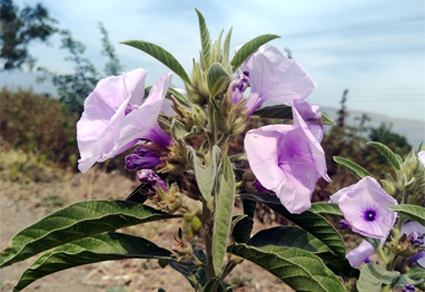

Abstract
The genus Astripomoea (Convolvulaceae), previously considered endemic to tropical and southern Africa, with some presence on the Arabian Peninsula, is being reported for first time from South Asia, representing phytogeographical significant range extension. A new species Astripomoea bharatii is described from Northern Western Ghats, Maharashtra, India, now represents the genus in the South Asia. It shares characters with A. malvacea, A. polycephala and A. hyoscyamoides. It is distinguished as separate taxon from the later taxa based on distinct morphological characters and cladistics analysis. The present study provides a detailed species description, a diagnostic key, cladogram, photographs, illustration, and a comparative analysis with closely allied species.
References
- Baker. (1876) Convolvulaceae. In: Hooker, J.D. (Ed.) The Flora of British India Vol. II. L. Reeve, London, pp. 67.
- BSI. (2025) Indian Virtual Herbarium. Botanical Survey of India, Kolkata. Available from: https://www.bsi.gov.in (accessed 1 December 2025)
- Candolle, A.P.de & Candolle, A.de (1838) Prodromus systematis naturalis regni vegetabilis. pp. 299. Available from: https://www.biodiversitylibrary.org/page/150240 (accessed 11 May 2026)
- Chiovenda, E. (1929) Flora Somala, Vol. I. Ministry of the Colonies, Somalia, 236 pp.
- Choisy. (1845) Convolvulaceae. In: Candolle, A.P.de & Candolle, A.de (Eds.) Prodromus systematis naturalis regni vegetabilis, Vol. 9. pp. 355–461. Available from: https://www.biodiversitylibrary.org/page/162723 (accessed 17 May 2026)
- Clarke, C.B. (1885) Convolvulaceae. In: Hooker, J.D. (Ed.) The Flora of British India Vol. IV. L. Reeve & Co., London, pp. 179–228.
- Cooke, T. (1903) The Flora of the Presidency of Bombay Vol. I. Taylor and Francis, London, 293 pp.
- Cooke, T. (1908) The Flora of the Presidency of Bombay, Vol. II. Taylor and Francis, London, pp. 290–331. https://doi.org/10.5962/bhl.title.10884
- Dalzell, N.A. (1850) Contributions to the Botany of Western India. Hooker’s Journal of Botany and Kew Miscellany 2: 257–265. Available from: https://www.biodiversitylibrary.org/page/776709 (accessed 10 May 2026)
- eFloraofIndia. (2026) Database of plants of Indian subcontinent: Convolvulaceae. Available from: https://efloraofindia.com/efi/convolvulaceae/ (accessed 20 January 2026)
- Gamble, J.S. (1956) Flora of the Presidency of Madras, Vol. II. Adlard & Son, London, pp. 633–654.
- GBIF. (2026) GBIF occurrence data for Astripomoea. Available from: https://www.gbif.org (accessed December 2025 to January 2026)
- Hallier, f. (1893a) Versuch einer natürlichen Gliederung der Convolvulaceen auf morphologischer und anatomischer Grundlage. Botanische Jahrbucher fur Systematik, Pflanzengeschichte und Pflanzengeographie 16: 453–591. Available from: https://www.biodiversitylibrary.org/ (accessed 14 May 2026)
- Hallier, f. (1893b) Convolvulaceae Africanae. Botanische Jahrbucher fur Systematik, Pflanzengeschichte und Pflanzengeographie 18: 81–160. Available from: https://www.biodiversitylibrary.org/page/203108 (accessed 14 May 2026)
- Hammer, Ø. & Harper, D.A.T. (2006) Paleontological data analysis. Blackwell Publishing, Oxford, 351 pp. https://doi.org/10.1002/9780470750711
- Hammer, Ø., Harper, D.A.T. & Ryan, P.D. (2001) PAST: Paleontological Statistics software package for education and data analysis. Palaentologia Electronica 4 (1): 1–9.
- Harper, D.A.T. (1999) Numerical Paleobiology. John Wiley & Sons Inc, New York, 478 pp.
- Heine, H. (1963) Convolvulaceae. In: Hutchinson, J. & Dalziel, J.M. (Eds.) Flora of West Tropical Africa, ed. 2. Crown Agents for Oversea Governments and Administrations, London, pp. 335–352+496. Available from: https://dn710809.ca.archive.org/0/items/FloraOfWestTropi00hutc/FloraOfWestTropicalAfrica-JohnHutchinson.pdf (accessed 19 January 2026)
- IBIS. (2026) Indian Biodiversity Information System. Available from: https://indianbiodiversity.org/SpeciesDashboard/index (accessed 19 January 2026)
- Index Herbariorum. (2026) Index Herbariorum: A global directory of public herbaria and associated staff. New York Botanical Garden’s Virtual Herbarium. Available from: http://sweetgum.nybg.org/science/ih/ (accessed 12 January 2026)
- IPNI. (2026) International Plant Names Index: Astripomoea. Available from: https://www.ipni.org/search?q=Astripomoea (accessed 19 January 2026)
- JACQ consortium. (2026) Virtual Herbaria Website. Available from: https://www.jacq.org/ (accessed January 2026)
- Jain, S.K. & Rao, R.R. (1977) A Handbook of Field and Herbarium Methods. Today & Tomorrow’s Printers and Publishers, Delhi, 157 pp.
- JSTOR Global Plants. (2025) Global Plants database: Astripomoea. Available from: https://plants.jstor.org (accessed 20 January 2026)
- Karthikeyan, S., Sanjappa, M. & Moorthy, S. (2009) Flowering plants of India—Dicotyledons, Vol. I (Acanthaceae- Avicenniaceae). Botanical Survey of India, Kolkata, 365 pp.
- Klotzsch. (1861) Breweria malvacea. In: Peters, W.C.H. (Ed.) Naturwissenschaftliche Reise nach Mossambique 6 (Bot. 1). G. Reimer, Berlin, pp. 245. Available from: https://www.biodiversitylibrary.org/page/36335934 (accessed 14 May 2026)
- Linnaeus, C. (1753) Species Plantarum, Vol. I. pp. 159. Available from: https://www.biodiversitylibrary.org/page/358178 (accessed 19 May 2026)
- Linné, C.von & Orphanotrophei. (1781) Supplementum plantarum Systematis vegetabilium editionis decimae tertiae, Generum plantarum editionis sextae, et Specierum plantarum editionis secunda. Impensis Orphanotrophei, Brunsvigae. Available from: https://www.biodiversitylibrary.org/page/411364 (accessed 16 May 2026) https://doi.org/10.5962/bhl.title.555
- Linné, C.von, Römer, J.J., Schultes, J.A., Schultes, J.H. & Cotta, J.G. (1824) Mantissa 2. pp. 430. Available from: https://www.biodiversitylibrary.org/page/798588 (accessed 10 May 2026) https://doi.org/10.5962/bhl.title.60078
- Linné, C.von, Willdenow, K.L., Link, H.F., Nauck, G.C. & Schwaegrichen, F. (1803) Caroli a Linné Species Plantarum ed. 4. 3. pp. 1731. Available from: https://www.biodiversitylibrary.org/page/667120 (accessed 10 May 2026)
- Linné, C.von, Willdenow, K.L., Link, H.F., Nauck, G.C. & Schwaegrichen, F. (1800) Caroli a Linné Species plantarum exhibentes plantas rite cognitas, ad genera relatas, cum differentiis specificis, nominibus trivialibus, synonymis selectis, locis natalibus, secundum systema sexuale digestas Species Plantarum ed. 4. 3 (1). pp. 400. Available from: https://www.biodiversitylibrary.org/page/623364 (accessed 10 May 2026)
- Manos, P.S., Miller, R.E. & Wilkin. (2001) Phylogenetic analysis of Ipomoea, Argyreia, Stictocardia, and Turbina suggests a generalized model of morphological evolution in morning glories. Systematic Botany 26: 585–602.
- Meeuse, A.D.J. (1957) The South African Convolvulaceae. Bothalia 6 (4): 643–792. https://doi.org/10.4102/abc.v6i4.1788
- Ohashi, H. & Ohashi, K. (2018) Grona, a genus separated from Desmodium (Leguminosae, tribe Desmodieae). Journal of Japanese Botany 93 (2): 104–120.
- Phillips, S.M. (1975) A Review of the Genus Oropetium (Gramineae). Kew Bulletin 30 (3): 467–470. https://doi.org/10.2307/4103072
- Pilger, R. (1910) Convolvulaceae Africanae II. Botanische Jahrbücher fur Systematik, Pflanzengeschichte und Pflanzengeographie 45 (2): 218–222. Available from: https://www.biodiversitylibrary.org/page/217020 (accessed 17 May 2026)
- POWO. (2026) Plants of the World Online. Facilitated by the Royal Botanic Gardens, Kew. Available from: https://powo.science.kew.org/ (accessed January 2026)
- Rafinesque, C.S. (1836) Flora Telluriana Part IV. [Printed for the author by H. Probasco], Philadelphia, pp. 81. Available from: https://www.biodiversitylibrary.org/item/32191 (accessed 19 May 2026)
- Rattanakrajang, P., Sumanon, P., Traiperm, P., Staples, G. & Utteridge, T. (2022) Reduction of Blinkworthia (Convolvulaceae) based on multilocus phylogenetic reconstruction and resurrection of a species from synonymy revealed by phenetic analyses. Kew Bulletin 77: 859–883. https://doi.org/10.1007/s12225-022-10052-1
- Retzius, A.J., König, J.G., Copieux & Crusium, S.L. (1786) Observationes botanicae: sex fasciculis comprehensae. 4. Siegfried Lebrecht Crusium, Lipsiae [Leipzig], pp. 29. Available from: https://www.biodiversitylibrary.org/page/12127555 (accessed 16 May 2026)
- Roth, A.W. (1821) Novae plantarum species praesertim Indiae orientalis: Ex collectione doct. Benj. Heynii: cum descriptionibus et observationibus. Sumptibus H. Vogleri, Halberstadii. Available from: https://www.biodiversitylibrary.org/page/11163346 (accessed 10 May 2026) https://doi.org/10.5962/bhl.title.10723
- Royal Botanic Garden, Edinburgh. (2025) Royal Botanic Garden Edinburgh, Herbarium. Available from: http://rbge.org.uk/collections/ (accessed December 2025)
- Royal Botanic Gardens, Kew. (2025) Herbarium Catalogue: Astripomoea. Available from: https://specimens.kew.org (accessed 12 December 2026)
- Santapau, H. & Henry, A.N. (1973) A Dictionary of the Flowering Plants in India. CSIR, New Delhi, pp. 16–170.
- Simoes, A.R.G., Shimpale, V.B., Rattanakrajang, P., Traiperm, P., Kagame, S.P., Huerta-Ramos, G., Goray, S., Gowda, V., Nayi, T., Moreira, A.L.C., Barbosa, J.C.J., More, S.S., Paixão, C.P., Atta-Adjei, P., Williams, B.D. & Eserman, L.A. (2024) Reinstating Palaeotropical genera of Convolvulaceae: Argyreia, Stictocardia, Turbina and Astripomoea (tribe Ipomoeeae, subtribe Argyreiineae). Rheedea 34 (5): 533–552. https://doi.org/10.22244/rheedea.2024.34.05.15
- Singh, N.P., Lakshminarasimhan, P., Karthikeyan, S. & Prasanna, P.V. (2001) Flora of Maharashtra State, Dicotyledons. Vol. II. Botanical Survey of India, Calcutta, pp. 437–489.
- Stefanovic, S.D., Austin, F. & Olmstead, R.G. (2003) Classification of Convolvulaceae: A phylogenetic approach. Systematic Botany 28: 791–806.
- Thulin, M. (2003) Notes on Convolvulus, Astripomoea, Ipomoea and Merremia (Convolvulaceae) from the Horn of Africa. Nordic Journal Botany 23: 629–640. https://doi.org/10.1111/j.1756-1051.2003.tb00444.x
- Vatke, W. (1882) Plants in itinere Africano ab J.M. Hilderbrandt collectas determinare pergit: Convolvulaceae. Linnaea 43: 507–526. Available from: https://www.biodiversitylibrary.org/page/125500 (accessed 10 May 2026)
- Verdcourt, B. (1958) Notes from the East African Herbarium: VI. Notes on African Convolvulaceae (part 2). Kew Bulletin 13 (2): 185–197. https://doi.org/10.2307/4109511
- Verdcourt, B. (1963) Convolvulaceae. Flora of Tropical East Africa. Kew Publishing, Kew, pp. 1–161.
- WFO. (2026) World Flora Online, Plant List. Available from: https://www.worldfloraonline.org/taxon/wfo-0001298688 (accessed 5 May 2026)
- Wilkin, P. (1999) A morphological cladistic analysis of the Ipomoeeae (Convolvulaceae). Kew Bulletin 54 (4): 853–876. https://doi.org/10.2307/4111164
- Wood, J.R.I, Munoz-Rodriguez, P. & Scotland, R.W. (2022) Priorities for taxonomic studies of Indian Convolvulaceae. Journal of Economic & Taxonomic Botany 46: 5–14.
- Wood, J.R.I. (2014) New names and combinations in Indian Acanthaceae. Novon 23 (3): 385–395. https://doi.org/10.3417/2013046