
Abstract
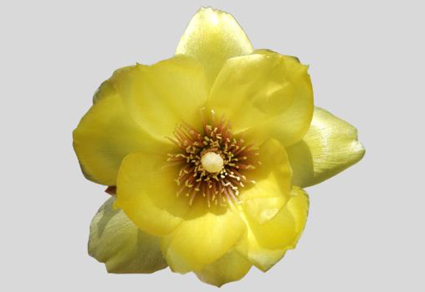
Opuntia fortanelli is recognized here as a new synonym of O. decumbens based on molecular and morphological data, check of original literature, and examination of both plants in field and herbarium specimens. The phylogenetic hypothesis was performed with maximum parsimony, maximum likelihood and Bayesian Inference. A detailed micromorphology description of O. decumbens with additional taxonomic characters and photographs is provided.
References
- Bouckaert, R., Heled, J., Kühnert, D., Vaughan, T., Wu, C.-H., Xie, D., Suchard, M.A., Rambaut, A. & Drummond, A.J. (2014) BEAST 2: A software platform for Bayesian Evolutionary analysis. PLOS Computational Biology 10: e1003537. https://doi.org/10.1371/journal.pcbi.1003537
- Bravo-Hollis, H. (1978) Las Cactáceas de México, vol. 1. Universidad Nacional Autónoma de México, México City, 351 pp.
- Britton, N.L. & Rose, J.N. (1919) The Cactaceae: Description and illustrations of plants of the Cactus Family, vol. 1. Carnegie Institution, Washington, 236 pp. https://doi.org/10.5962/bhl.title.45556
- Cheng, Z., Shu, H., Zhang, S., Luo, B., Gu, R. & Zhang, R. (2020) From folk taxonomy to species confirmation of Acorus (Acoraceae): evidences based on phylogenetic and metabolomic analyses. Frontiers in Plant Science 11: 965. https://doi.org/10.3389/fpls.2020.00965
- Claridge, M.F., Dawah, H.A. & Wilson, M.R. (1997) Species: The units of biodiversity. The Quarterly Review of Biology 73: 529. https://doi.org/10.1086/420496
- Crook, R. & Mottram, R. (1996) Opuntia Index Part 2: Nomenclatural note and C-E. Bradleya: 99–144. https://doi.org/10.25223/brad.n14.1996.a15
- Darriba, D., Posada, D., Kozlov, A.M., Stamatakis, A., Morel, B. & Flouri, T. (2020) ModelTest-NG: a new and scalable tool for the selection of DNA and protein evolutionary models. Molecular Biology and Evolution 37: 291–294. https://doi.org/10.1093/molbev/msz189
- de Queiroz, K. (1998) The general lineage concept of species, species criteria, and the process of speciation. In: Howar & Berlocher, S.H. (Eds.) Species and speciation. Oxford University Press, Oxford, pp. 57–75. https://doi.org/10.1093/oso/9780195109009.003.0005
- Duminil, J. & Di Michele, M. (2009) Plant species delimitation: a comparison of morphological and molecular markers. Plant Biosystems 143: 528–542. https://doi.org/10.1080/11263500902722964
- Eisenring, M., Altermatt, F., Westram, A.M. & Jokela, J. (2016) Habitat requirements and ecological niche of two cryptic amphipod species at landscape and local scales. Ecosphere 7: e01319. https://doi.org/10.1002/ecs2.1319
- Hall, T.A. (1999) BioEdit: a user-friendly biological sequence alignment editor and analysis program for Windows 95/98/NT. Nucleic Acids Symposium Series 41: 95–98.
- Hernández, H.M., Gómez, H.C., Bárcenas, R.T., Puente, P. & Reyes, A.J. (2014) A checklist of the subfamily Opuntioideae (Cactaceae) from North and Central America. In: Hunt, D.R. (Ed.) Further Studies in Opuntioideae (Cactaceae). Succulent Plant Research 8: pp. 185–200.
- Hooker, W.J. (1841) Opuntia decumbens Salm-Dyck. Curtis’s botanical magazine 68: 3914–3915.
- Katoh, K., Misawa, K., Kuma, K. & Miyata, T. (2002) MAFFT: a novel method for rapid multiple sequence alignment based on fast Fourier transform. Nucleic Acids Research 30 (14): 3059–3066. https://doi.org/10.1093/nar/gkf436
- Katoh, K., Rozewicki, J. & Yamada, K.D. (2017) MAFFT online service: multiple sequence alignment, interactive sequence choice and visualization. Briefings in Bioinformatics 20 (4): 1160–1166. https://doi.org/10.1093/bib/bbx108
- Korotkova, N., Aquino, D., Arias, S., Eggli, U., Franck, A., Gómez-Hinostrosa, C., Guerrero, P.C., Hernández, H.M., Kohlbecker, A., Köhler, M., Luther, K., Majure, L.C., Müller, A., Metzing, D., Nyffeler, R., Sánches, D., Schlumpberger, B. & Berendsohn, W.G. (2021) Cactaceae at Caryophyllales.org—a dynamic online species-level taxonomic backbone for the family. Willdenowia 51: 251–270. https://doi.org/10.3372/wi.51.51208
- Lodé, J. (2015) Taxonomy of the Cactaceae (Supplement). Alphabetical INDEX of taxa in current usage and their synonyms. Cactus Adventures International, Barcelona, 46 pp.
- Maddison, W.P. & Maddison, D.R. (2021) Mesquite: a modular system for evolutionary analysis. Version 3.70. Available from: http://mesquiteproject.org (accessed 16 April 2024)
- Majure, L., Puente, R., Griffith, M.P., Judd, W.S., Soltis, P.S. & Soltis, D.E. (2012) Phylogeny of Opuntia s.s. (Cactaceae): clade delineation, geographic origins, and reticulate evolution. American Journal of Botany 99: 847–864. https://doi.org/10.3732/ajb.1100375
- Martínez-González, C.R., Ramírez-Mendoza, R., Jiménez-Ramírez, J., Gallegos-Vázquez, C. & Luna-Vega, I. (2017) Improved method for genomic DNA extraction for Opuntia Mill. (Cactaceae). Plant Methods 13: 1–10. https://doi.org/10.1186/s13007-017-0234-y
- Müller, K., Quandt, D., Müller, J. & Neinhuis, C. (2005) PhyDE®-Phylogenetic data editor. Program distributed by the authors, versión 10.0. Available from: https://www.phyde.de (accessed 16 April 2025)
- Rambaut, A. (2018) FigTree-Tree Figure Drawing Tool. Version v.1.4.4. [http://tree.bio.ed.ac.uk/software/figtree/]
- Rambaut, A., Suchard, M.A., Xie, D. & Drummond, A.J. (2014) Tracer v1.6. Available from: http://beast.bio.ed.ac.uk/Tracer (accessed 16 April 2025)
- Reyes-Agüero, J.A., Orta-Salazar, C., Heindorf, C. & Carranza-González, E. (2024) Opuntia fortanelli (Cactaceae), a new species from the Huastec region of San Luis Potosí, México. Haseltonia 31: 26–33. https://doi.org/10.2985/026.031.0104
- Ronquist, F., Teslenko, M., Van Der Mark, P., Ayres, D.L., Darling, A., Höhna, S., Larget, B., Liu, L., Suchard, M.A. & Huelsenbeck, J.P. (2012) MrBayes 3.2: efficient Bayesian phylogenetic inference and model choice across a large model space. Systematic Biology 61: 539–542. https://doi.org/10.1093/sysbio/sys029
- Salm-Dyck, J. (1834) Hortus Dyckensis oder Verzeichniss der in dem botanischen Garden zu Dyck wachsenden Pflanzen. Düsseldorf, Arnz.
- Scheinvar, L., Gallegos-Vázquez, C., Gámez-Tamariz, N. & Olalde-Parra, G. (2020) Atlas de los Nopales Silvestres Mexicanos. Universidad Nacional Autónoma de México, Mexico City, 607 pp.
- Schmitz-Linneweber, C., Maier, R., Jean-Pierre, A., Cottet, A., Herrmann, R. & Mache, R. (2001) The plastid chromosome of spinach (Spinacia oleracea): complete nucleotide sequence and gene organization. Plant Molecular Biology 45: 307–315. https://doi.org/10.1023/A:1006478403810
- Sites, J.W. & Marshall, J.C. (2003) Delimiting species: a renaissance issue in systematic biology. Trends in Ecology & Evolution 18: 462–470. https://doi.org/10.1016/S0169-5347(03)00184-8
- Stamatakis, A. (2014) RAxML version 8: a tool for phylogenetic analysis and post-analysis of large phylogenies. Bioinformatics 30: 1312–1313. https://doi.org/10.1093/bioinformatics/btu033
- Stamatakis, A., Hoover, P. & Rougemont, J. (2008) A rapid bootstrap algorithm for the RAxML web servers. Systematic Biology 57: 758–771. https://doi.org/10.1080/10635150802429642
- Su, X., Wu, G., Li, L. & Liu, j. (2015) Species delimitation in plants using the Qinghai-Tibet plateau endemic Orinus (Poaceae: Tridentinae) as an example. Annals of Botany 116: 35–48. https://doi.org/10.1093/aob/mcv062
- Swofford, D.L. (2002) PAUP*, Phylogenetic Analysis Using Parsimony (* and Other Methods). Version 4.10. Sinauer Associates, Sunderland, Massachusetts.
- Taberlet, P.G., Ludovic, P., Guy, P. & Bouvet, J. (1991) Universal primers for amplification of three non-coding regions of chloroplast DNA. Plant Molecular Biology 17: 1105–1109. https://doi.org/10.1007/BF00037152
- Thiers, B. (2026) Index herbariorum: a global directory of public herbaria and associated staff. New York Botanical Gardenʾs Virtual Herbarium. Available from: http://sweetgum.nybg.org/ih (accessed 27 January 2026)
- Turland, N.J., Wiersema, J.H., Barrie, F.R., Gandhi, K.N., Gravendyck, J., Greuter, W., Hawksworth, D.L., Herendeen, P.S., Klopper, R.R., Knapp, S., Kusber, W.H., Li, D.Z., May, T.W., Monro, A.M., Prado, J., Price, M.J., Smith, G.F. & Zamora Señoret, J.C. (2025) International Code of Nomenclature for algae, fungi, and plants (Madrid Code). Regnum Vegetabile 162. University of Chicago Press, Chicago.
- Villaseñor, J.L. (2016) Checklist of the native vascular plants of Mexico. Revista Mexicana de Biodiversidad 87 (3): 559–902. https://doi.org/10.1016/j.rmb.2016.06.017
- Villaseñor, J.L. & Meave, J.A. (2022) Floristics in Mexico today: Insights into a better understanding of biodiversity in a megadiverse country. Botanical Science 100: 14–33. https://doi.org/10.17129/botsci.3050
- Wheeler, Q. (2020) A taxonomic renaissance in three acts. Megataxa 1 (1): 4–8. https://doi.org/10.11646/megataxa.1.1.2
- White, T.J., Bruns, T.D., Lee, S. & Taylor, J.W. (1990) Amplification and direct sequencing of fungal ribosomal RNA genes for phylogenies. In: Innis, M.A., Gelfand, D.H., Sninsky, J.J. & White, T. (Eds.) PCR Protocols: a guide to methods and applications. Academic Press, San Diego, pp. 135–322. https://doi.org/10.1016/B978-0-12-372180-8.50042-1
- Wiley, E.O. & Mayden, R. (2000) The evolutionary species concept. In: Wheeler & Meier, R. (Eds.) Species concepts and phylogenetic theory: A debate. Columbia University Press, New York, pp. 70–89.
- Wilcox, C.D., Dove, S., McDavis, W. & Greer, D. (2002) UTHSCSA. Image Tool. version 3.0. University of Texas Health Center, San Antonio, 56 pp.
- Zhang, Z., Schwartz, S., Wagner, L. & Miller, W. (2000) A greedy algorithm for aligning DNA sequences. Journal of Computational Biology 7: 203–214. https://doi.org/10.1089/10665270050081478