

Abstract
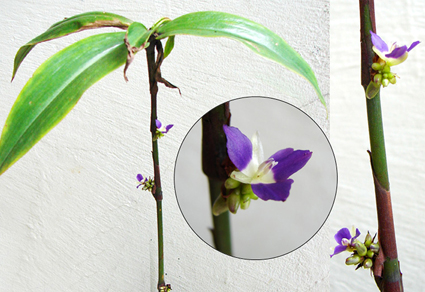
We describe, discuss, and illustrate Dichorisandra mariadocarmoae, a new species from the Atlantic Forest in southern Bahia, Brazil, based on field and herbarium studies. The species is assessed as Endangered (EN), mainly due to its restricted distribution in forest fragments. Its morphological relationships are discussed and compared with those of D. ordinatiflora and D. marantoides. However, it is distinguished from all of them by the combination of leaf blade and ovary indumentum, leaf blade texture and shape, and inflorescence position. We also present a distribution map of the species and taxonomic comments.
References
- Alfonso, O.A. & Ledru, M.-P. (2025) Mid-Pleistocene pollen types of the Brazilian Atlantic Forest (Colônia, São Paulo, Brazil). Review of Palaeobotany and Palynology 334: 105234. https://doi.org/10.1016/j.revpalbo.2024.105234
- Aona, L.Y.S. & Amaral, M.C.E. (2020) Flora e Funga do Brasil. Jardim Botânico do Rio de Janeiro. Available from: https://floradobrasil.jbrj.gov.br/FB6924 (accessed 10 February 2024)
- Aona, L.Y.S. (2008) Revisão taxonômica e análise cladística do gênero Dichorisandra J. C. Mikan (Commelinaceae). Ph.D. Thesis. Universidade Estadual de Campinas, Campinas, Brazil, 310 pp.
- Aona, L.Y.S., Souza, E.H., Almeida Júnior, R.A.C., Marinho, L.C., Bittrich, V. & Amaral, M.C.E. (2022) Dichorisandra rhizantha (Commelinaceae), a new morphologically unusual species from Bahia, Brazil. Phytotaxa 538: 257–264. https://doi.org/10.11646/phytotaxa.538.3.9
- Aona, L.Y.S., Souza, E.H., Bittrich, V. & Amaral, M.C.E. (2024) Dichorisandra flesheri (Commelinaceae), a new delicate species from South Bahia, Brazil. Phytotaxa 647: 199–206. https://doi.org/10.11646/phytotaxa.647.2.6
- Aona, L.Y.S., Souza, E.H., Bittrich, V. & Amaral, M.C.E. (2025) Dichorisandra fadenii (Commelinaceae), a new villose species from southwestern Amazonia. Phytotaxa 682: 288–294. https://doi.org/10.11646/phytotaxa.682.3.10
- Aona-Pinheiro, L.Y.S. & Amaral, M.C.E. (2012) Four new species of Dichorisandra J.C. Mikan (Commelinaceae) from Southeast Brazil. Phytotaxa 48: 7–22. https://doi.org/10.11646/phytotaxa.48.1.2
- Bachman, S., Moat, J., Hill, A.W., Torre, J. & Scott, B. (2011) Supporting Red List threat assessments with GeoCAT: geospatial conservation assessment tool. In: Smith, V. & Penev, L. (Eds.) e‒Infrastructures for data publishing in biodiversity science. ZooKeys 150: 117–126. https://doi.org/10.3897/zookeys.150.2109
- Faden, R.B. & Hunt, D.R. (1991) The classification of the Commelinaceae. Taxon 40: 19–31. https://doi.org/10.2307/1222918
- Ferreira, G.M.D., Leme, E.M.C., Aona, L.Y.S., Souza, F.V.D., Moura, H.C.P. & Souza, E.H. (2024) Microendemism, high diversity and taxonomic novelties in Bromeliaceae: studies from an Atlantic Forest hotspot in Bahia, Brazil. Journal for Nature Conservation 79: 126599. https://doi.org/10.1016/j.jnc.2024.126599
- Hickey, M. & King, C. (2004) The Cambridge illustrated glossary of botanical terms. Cambridge University Press, Cambridge, 208 pp.
- IUCN (2019) Standards and Petitions Committee. 2019. Guidelines for Using the IUCN Red List Categories and Criteria. Version 14. Prepared by the Standards and Petitions Committee. Available from: http://www.iucnredlist.org/documents/RedListGuidelines.pdf (accessed 7 January 2026)
- IUCN (2024) Standards and Petitions Committee. Guidelines for Using the IUCN Red List Categories and Criteria. Version 16. Prepared by the Standards and Petitions Committee. Available from: https://www.iucnredlist.org/documents/RedListGuidelines.pdf (accessed 24 October 2024)
- Jussieu, A. (1824) De Euphorbiacearum Generibus Tentamen, Tabulis Aeneis 18 Illustratum. Didot, Parisiis. https://doi.org/10.5962/bhl.title.51511
- Lima, R.A.F., Dauby, G., Gasper, A.L., Fernandez, E.P., Vibrans, A.C., Oliveira, A.A., Prado, P.I., Souza, V.C., Siqueira, M.F. & Steege, H. (2024) Comprehensive conservation assessments reveal high extinction risks across Atlantic Forest trees. Science 383: 219–225. https://doi.org/10.1126/science.abq5099
- Linnaeus, C. (1753) Species Plantarum. Vol. 2. Laurentii Salvii, Holmiae, 1200 pp.
- Massante, J.C. & Gastauer, M. (2023) Evolutionary history of marginal habitats regulates the diversity of tree communities in the Atlantic Forest. Annals of Botany 131 (2): 261–274. https://doi.org/10.1093/aob/mcac111
- Mikan, J.C. (1820) Delectus Florae et Faunae Brasiliensis: jussu et auspiciis Francisci I. Austriae Imperatoris investigatae. Vol. 1. Sumptibus Auctoris, Vindobonae. https://doi.org/10.5962/bhl.title.63994
- Mirbel, C.F.B. (1804) Histoire naturelle, générale et particulière, des plantes. Vol. 8. Paris, pp. 177.
- Müller Argoviensis, J. (1865) Euphorbiaceae. Vorläufige Mittheilungen aus dem für De Candolle’s Prodromus bestimmten Manuscript über diese Familie. Linnaea 34: 1–224.
- Radford, A.E., Dickson, W.C., Massey, J.R. & Bell, C.R. (1974) Vascular plants systematics. Harper & Ro., New York, 891 pp.
- Shorthouse, D.P. (2010) SimpleMappr, an online tool to produce publication-quality point maps. Available from: https://www.simplemappr.net/ (accessed 23 January 2026)
- Silva, J.M.C. & Casteleti, C.H.M. (2003) Status of the biodiversity of the Atlantic forest of Brazil. In: Galindo-Leal, C. & Câmara, I.G. (Eds.) The Atlantic Forest of South America: biodiversity status, trends, and outlook. Center for Applied Biodiversity Science and Island Press, Washington, pp. 43–59.
- Souza, E.H., Aona, L.Y.S., Souza, F.V.D. & Leme, E.M.C. (2021) Lymania involucrata (Bromeliaceae: Bromelioideae), a new ornamental species from Bahia, Brazil. Phytotaxa 489 (2): 209–215. https://doi.org/10.11646/phytotaxa.489.2.9
- Souza, E.H. & Leme, E.M.C. (2021) New Cryptanthus species (Bromeliaceae: Bromelioideae) from the State of Bahia, Brazil. Phytotaxa 523 (2): 179–191. https://doi.org/10.11646/phytotaxa.523.2.5
- Thiers, B.M. (2026) [Continuously updated] Index Herbariorum. New York Botanical Garden’s Virtual Herbarium. Available from: http://sweetgum.nybg.org/science/ih (accessed 11 April 2026)