

Abstract
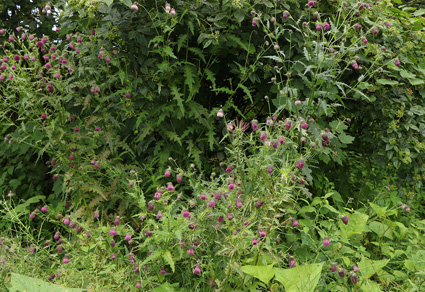
Cirsium rubricorollatum (Asteraceae), a new species from Gansu, Sichuan, Shaanxi and Yunnan, China, is described and illustrated. It is morphologically similar to C. handelii in having nodding capitula and a campanulate involucre, but differs in its elliptic (vs. lanceolate) cauline leaves, pinnatipartite (vs. pinnatilobed or pinnatifid) leaf blades, lanceolate to narrowly triangular (vs. semiorbicular lateral or broadly triangular) lobes, outer and middle phyllaries bearing apical spines ca. 3 mm long (vs. ca. 5 mm long), and filiform (vs. non-filiform) corolla tubes. The new species is also similar to C. pendulum in terminal racemose-paniculate synflorescences, nodding capitula, and campanulate involucre, but differs in having leaf segments with unequally sized triangular teeth along the margins (vs. segments deeply or shallowly lobed on one side only, with the opposite side entire), and corolla tubes equaling the limbs in length (vs. ca. 1.5 times longer than the limbs). Phylogenetic analyses further support the recognition of C. rubricorollatum as a distinct species.
References
- Bankevich, A., Nurk, S., Antipov, D., Gurevich, A.A., Dvorkin, M., Kulikov, A.S., Lesin, V.M., Nikolenko, S.I., Pham, S., Prjibelski, A.D., Pyshkin, A.V., Sirotkin, A.V., Vyahhi, N., Tesler, G., Alekseyev, M.A. & Pevzner, P.A. (2012) SPAdes: a new genome assembly algorithm and its applications to single-cell sequencing. Journal of Computational Biology 19 (5): 455–477. https://doi.org/10.1089/cmb.2012.0021
- Candolle, A.P. de (1838) Prodromus Systematis Naturalis Regni Vegetabilis, vol. 6. Treuttel & Würtz, Paris, 706 pp.
- Guindon, S., Dufayard, J.F., Lefort, V., Anisimova, M., Hordijk, W. & Gascuel, O. (2010) New algorithms and methods to estimate maximum-likelihood phylogenies: assessing the performance of PhyML 3.0. Systematic Biology 59 (3): 307–321. https://doi.org/10.1093/sysbio/syq010
- Jin, Z.C. & Chen, Y.S. (2025) Reinstatement of Cirsium tibeticum (Asteraceae, Cardueae) and the synonymization of C. argyracanthum under C. verutum. Phytotaxa 720 (3): 273–280. https://doi.org/10.11646/phytotaxa.720.3.7
- Johnson, M.G., Gardner, E.M., Liu, Y., Medina, R., Goffinet, B., Shaw, A.J., Zerega, N.J.C. & Wickett, N.J. (2016) HybPiper: Extracting coding sequence and introns for phylogenetics from high-throughput sequencing reads using target enrichment. Applications in Plant Sciences 4: e1600016. https://doi.org/10.3732/apps.1600016
- Katoh, K. & Standley, D.M. (2013) MAFFT multiple sequence alignment software version 7: improvements in performance and usability. Molecular Biology and Evolution 30 (4): 772–780. https://doi.org/10.1093/molbev/mst010
- Li, H. & Durbin, R. (2009) Fast and accurate short read alignment with Burrows-Wheeler transform. Bioinformatics 25 (14): 1754–1760. https://doi.org/10.1093/bioinformatics/btp324
- Linnaeus, C. (1753) Species Plantarum. L.Salvius, Holmia, 1200 pp.
- Mandel, J.R., Dikow, R.B., Funk, V.A., Masalia, R.R., Staton, S.E., Kozik, A., Michelmore, R.W., Rieseberg, L.H. & Burke, J.M. (2014) A target enrichment method for gathering phylogenetic information from hundreds of loci: An example from the Compositae. Applications in Plant Sciences 2: e1300085. https://doi.org/10.3732/apps.1300085
- Miller, P. (1754) The Gardeners Dictionary (4th ed.), corrected and enlarged, vol. 1. Printed for the author, London.
- Minh, B.Q., Nguyen, M.A. & von Haeseler, A. (2013) Ultrafast approximation for phylogenetic bootstrap. Molecular Biology and Evolution 30 (5): 1188–1195. https://doi.org/10.1093/molbev/mst024
- Minh, B.Q., Schmidt, H.A., Chernomor, O., Schrempf, D., Woodhams, M.D., von Haeseler, A. & Lanfear, R. (2020) IQ-TREE 2: New Models and Efficient Methods for Phylogenetic Inference in the Genomic Era. Molecular Biology and Evolution 37 (5): 1530–1534. https://doi.org/10.1093/molbev/msaa015
- Moreyra, L.D., Susanna, A., Calleja, J.A., Ackerfield, J.R., Arabacı, T., Blanco-Gavaldà, C., Brochmann, C., Dirmenci, T., Fujikawa, K., Galbany-Casals, M., Gao, T., Gizaw, A., Mehregan, I., Vilatersana, R., Viruel, J., Yıldız, B., Leliaert, F., Seregin, A.P. & Roquet, C. (2025) A thorny tale: The origin and diversification of Cirsium (Compositae). Molecular Phylogenetics and Evolution 204: e108285. https://doi.org/10.1016/j.ympev.2025.108285
- Petrak, F. (1926) Plantae novae Sinenses, diagnosibus brevibus descriptae a Dre. Henr. Handel-Mazzetti (40. und letzte Fortsetzung). Anzeiger der Akademie der Wissenschaften in Wien. Mathematische-naturwissenschaftliche Klasse 63: 95–112.
- POWO (2026) Plants of the World Online. Facilitated by the Royal Botanic Gardens, Kew. Available from: http://www.plantsoftheworldonline.org/ (accessed 15 July 2026)
- Price, M.N., Dehal, P.S. & Arkin, A.P. (2010) FastTree 2‐approximately maximum‐likelihood trees for large alignments. PLoS One 5 (3): e9490. https://doi.org/10.1371/journal.pone.0009490
- Shi, Z. & Greuter, W. (2011) Cirsium Mill. In: Wu, Z.Y. & Raven, P.H. (Eds.) Flora of China, vols. 20–21. Science Press, Beijing & Missouri Botanical Garden Press, St. Louis, pp. 160–175.
- Trautvetter, E.R. von & Meyer, C.A. (1856) Florula ochotensis phanerogama. In: Middendorff, A.Th. von Reise in den äussersten Norden und Osten Sibiriens, vol. 1 (2,2). Keiserliche Akademie der Wissenschaften, St. Petersburg, pp. 1–133.