

Abstract
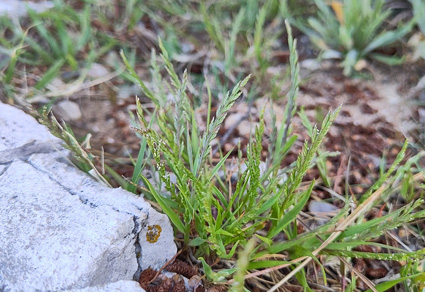
Some scientific names in the genus Catapodium (Poaceae) are investigated. Lectotypes were designated for Desmazeria balearica, Sclerochloa rigida var. major, and Sclerochloa zwierleinii, respectively on specimens preserved at COI (barcode COI00038421), W (W1889025838), and PAL (PAL76847). Concerning Festuca hemipoa, a neotypification is required since original material was not traced [neotype at PI (PI064083)]. Regarding Desmazeria pauciflora, the authors decided to leave it as untypified since 1) we cannot be sure that original material is not in extant (the staff of the herbarium LOU never sent a reply to our requests) and 2) no specimen from locus classicus (the better choice as a neotype) was traced for a possible neotypification. Finally, an epitype (LINN no. 87.37) was designated for the Linnaean name Poa rigida since Bauhin’s illustration of Gramen panicula multiplici (designated by Stace in 2000) cannot be unambiguously identified, lacking magnification of a flower which is necessary for a proper identification of the subspecies under Catapodium rigidum. The distribution of C. pauciflorum is updated with the addition of 1) a new Italian regional record (Treviso Province, Veneto region, north-eastern Italy) representing also the more inland site hitherto known, 2) new national records for Croatia, Greece, Montenegro, and Slovenia (based on specimens previously identified as Catapodium marinum) extending eastward the current distribution area of the species, 3) new national record for Portugal, extending westward the current distribution area of the species, and 4) first sites along Atlantic coast of France which allow to extend the distribution area toward north.
References
- African Plant Database (2022) Catapodium pauciflorum (Merino) Brullo, Giusso del Galdo & al. Available from: https://africanplantdatabase.ch/en (accessed 3 April 2025)
- Bartolo, G., Brullo, S. & Pavone, P. (1978) Numeri cromosomici per la flora italiana: 484–493. Informatore Botanico Italiano 10 (2): 267–277.
- Bauhin, C. (1620) Prodromus theatri botanici. Puli Jacobi, Francofurti ad Moenum, 160 pp.
- Bock, B. (2024) Référentiel des trachéophytes de France métropolitaine et régions avoisinantes. Version 9.01 du 23 janvier 2024. Catapodium marinum (L.) C.E.Hubb. Available from: https://www.tela-botanica.org/eflore/?referentiel=bdtfx&niveau=2&module=fiche&action=fiche&num_nom=14801&type_nom=&nom=&onglet=nomenclature (accessed 3 April 2025)
- Brullo, S., Giusso del Galdo, G., Minissale, P. & Spampinato, G. (2003) Considerazioni tassonomiche sui generi Catapodium Link, Desmazeria Dumort. e Castellia Tineo (Poaceae) in Italia. Informatore Botanico Italiano 35 (1): 158–170.
- Cafferty, S., Jarvis, C.E. & Turland, N.J. (2000) Typification of Linnaean plant names in the Poaceae (Gramineae). Taxon 49: 239–260. https://doi.org/10.2307/1223839
- Del Guacchio, E. & Caputo, P. (2020) A rediscovered work of Karel B. Presl and other sins of his youth. Taxon 69 (6): 1293–1310. https://doi.org/10.1002/tax.12361
- Eggli, U. & Leuenberger, B.E. (2008) Type specimens of Cactaceae names in the Berlin Herbarium (B) [De herbario berolinensi notulae 48]. Willdenowia 38: 213–280. https://doi.org/10.3372/wi.38.38116
- HUH Index of botanists (2013–onwards) Index of botanists, Harward University Herbaria & Libraries. Available from: https://kiki.huh.harvard.edu/databases/botanist_search.php?mode=details&id=83407 (accessed 12 August 2026)
- IPNI (2025) International Plant Name Index. Available from: https://www.ipni.org/ (accessed 2 April 2025)
- Jarvis, C. (2007) Order out of Chaos; Linnaean Plant Names and their Types. Society of London and the Natural History Museum, London, 1016 pp.
- Laínz, M. (1954) Histoire et état actuel de l'herbier MERINO. Taxon 3 (1): 3–4. https://doi.org/10.2307/1216285
- Linnaeus, C. (1755) Centuria I Plantarum. Reg. Acad. Typogr., Stockholmiae, 36 pp.
- Lojacono-Pojero, M. (1885) Una escursione botanica in Lampedusa (Cont. e fine). Naturalista Siciliano, Giornale de Scienze Naturali. Palermo 4 (6): 133–139.
- Martini, F. (2006) La flora vascolare spontanea della città di Trieste (Italia nordorientale). Webbia 61 (1): 5–94. https://doi.org/10.1080/00837792.2006.10670795
- Martini, F., Nardini, S. & Rizzardini, S. (1997) Appunti sulla flora del Friuli-Venezia Giulia. Gortania 19: 149–159.
- Merino, B. (1909) Flora descriptiva é illustrada de Galicia. Tip. Galaica, Santiago, 692 pp.
- Montesinos-Tubée, D.B. & Iamonico, D. (2023) Neotypification for five names linked to Arenaria (Caryophyllaceae) for the endemic flora of Peru and Bolivia. Phytokeys 230: 131–144. https://doi.org/10.3897/phytokeys.230.107263
- Pino Peréz, R. (2017) Revisión nomenclatural y tipificación de nombres nuevos en Cormophyta de Baltasar Merino: Equisetaceae, Polypodiaceae, Hypolepidaceae, Aspleniaceae, Athyriaceae, Aspidiaceae, Blechnaceae, Ranunculaceae, Papaveraceae, Portulacaceae, Chenopodiaceae, Polygonaceae y Plumbaginaceae. Ph.D. Thesis. Universidade de Vigo, Vigo, 680 pp.
- Pino Peréz, R. (2019) El herbario de Cormophyta de Baltasar Merino (1845–1917) en el Museo de Ciencias Naturales “D. Mariano García Martínez” del IES Sánchez Cantón de Pontevedra (España). Aula, Museos y Colecciones 6: 5–46. https://doi.org/10.29077/aula/6/01_pino_herbario
- Portal to the Flora of Italy (2025) Catapodium pauciflorum (Merino) Brullo, Giusso, Miniss. & Spamp. Available from: https://dryades.units.it/floritaly/index.php?procedure=taxon_page&tipo=all&id=7323 (accessed 3 April 2025)
- POWO (2025) Plants Of the World Online. Catapodium Link. Available from: https://powo.science.kew.org/taxon/urn:lsid:ipni.org:names:17689-1 (accessed 7 February 2025)
- Presl, C.B. (1818) Graminae Siculae. Pragae, 40 pp.
- Presl, C.B. (1820) Cyperaceae et Gramineae Siculae. D. Hartmann, Pragae, 58 pp.
- Presl, C.B. (1826) Flora Sicula, exhibens plantas vasculosas in Sicilia aut sponte crescentes aut frequentissime cultas, secundum systema naturale digestas, vol. 1. A. Borrosch, Pragae, 216 pp.
- Rodríguez y Femenías, J.J. (1904) Florulade Menorca. Imprenta de Francisco Fábregués, Mahón, 198 pp.
- Silva Pando, F.J. (1996) Sobre el estado actual del herbario Merino. Boletín de la Asociación de Herbarios Ibero-Macaronésicos 1: 4–5.
- Silva Pando, F.J., Pino Peréz, R. & Vásquez, M.P. (2024) El Herbario LOU de plantas vasculares en la actualidad. Boletín de la Asociación de Herbarios Ibero-Macaronésicos 19: 57–66.
- Sprengel, C. (1827) Systema vegetabilium ed. 16 vol. 4 (2). Sumtibus Librariae Dieterichianae, Gottingae, 410 pp.
- Stafleu, F.A. & Cowan, R.S. (1981) Taxonomic Literature, vol. 3. Scheltema & Holkema, Bohn.
- Stafleu, F.A. & Cowan, R.S. (1985) Taxonomic Literature, 2nd ed., vol. 5 (Sal–Ste). Bohn & Utrecht: Scheltema & Holtema.
- Thiers, B. (2026+) Index Herbariorum: A global directory of public herbaria and associated staff. New York Botanical Garden’s Virtual Herbarium. Available from: http://sweetgum.nybg.org/ih/ (accessed 7 February 2025)
- Tkach, N., Rasti, S.L. & Röser, M. (2024) Disentangling conflicting molecular phylogenetic signals in nuclear and plastid DNA of the western Eurasian-Mediterranean grass genus Cynosurus and its relatives (Poaceae subtribes Cynosurinae and Parapholiinae). Molecular Phylogenetics and Evolution 201: 108204. https://doi.org/10.1016/j.ympev.2024.108204
- Turland, N.J., Wiersema, J.H., Barrie, F.R., Gandhi, K.N., Gravendyck, J., Greuter, W., Hawksworth, D.L., Herendeen, P.S., Klopper, R.R., Knapp, S., Kusber, W.-H., Li, D.-Z., May, T.W., Monro, A.M., Prado, J., Price, M.J., Smith, G.F. & Zamora Señoret, J.C. (2025) International Code of Nomenclature for algae, fungi, and plants (Madrid Code). Regnum Vegetabile 162. University of Chicago Press, Chicago. https://doi.org/10.7208/chicago/9780226839479.001.0001
- Urban, J. (1891) Der Koenigl. botanische Garten und botanische Museum zu Berlin in den Jahren 1878–1892. Botanische Jahrbuecher für Systematik, Pflanzengeschichte und Pflanzengeographie 14 (suppl. 32): 9–64.
- Valtueña, F.J., López, J. & Devesa, J.A. (2020) Catapodium Link. In: Devesa, J.A., Romero Zarco, C., Buira, A., Quintanar, A. & Aedo, C. (Eds.) Flora iberica, vol. 19 (1). Real Jardín Botánico, CSIC, Madrid, pp. 464–469.
- Willkomm, H.M. (1890) Über neue und kritische Pflanzen der spanisch-portugiesischen und balearischen Flora. Oesterreichische Botanische Zeitschrift 40 (5): 183–188. https://doi.org/10.1007/BF01794171