
Abstract
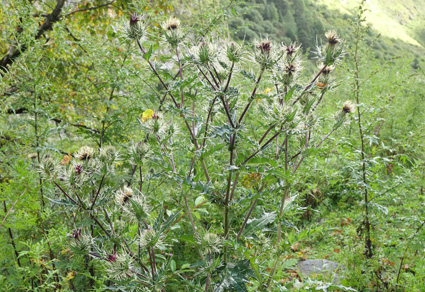
Cirsium yadongense and C. jilongense (Asteraceae), two new species from southern Xizang, China, are described and illustrated. Cirsium yadongense is morphologically similar to C. subulariforme in having a campanulate involucre and pinnatilobate cauline leaves, but differs in having leaves concolorous (vs. discolorous), green and glabrous or sparsely tomentose abaxially (vs. abaxially grayish white and densely tomentose), cordate near the involucre (vs. lanceolate or linear), and a purplish corolla (vs. white). Cirsium jilongense is morphologically similar to C. nishiokae in having pinnatisect leaves and erect capitula, but differs in having leaves concolorous (vs. discolorous), green and glabrous or sparsely tomentose abaxially (vs. abaxially grayish white and densely tomentose), and acuminate phyllaries (vs. phyllaries with margins above the base expanded into yellowish, scarious, lacerate wings). The recognition of these two species as distinct, previously undescribed taxa of Cirsium is further supported by phylogenetic analyses based on Hyb-Seq data.
References
- Bankevich, A., Nurk, S., Antipov, D., Gurevich, A.A., Dvorkin, M., Kulikov, A.S., Lesin, V.M., Nikolenko, S.I., Pham, S., Prjibelski, A.D., Pyshkin, A.V., Sirotkin, A.V., Vyahhi, N., Tesler, G., Alekseyev, M.A. & Pevzner, P.A. (2012) SPAdes: a new genome assembly algorithm and its applications to single-cell sequencing. Journal of Computational Biology 19 (5): 455–477. https://doi.org/10.1089/cmb.2012.0021
- Don, D. (1825) Prodromus Florae Nepalensis. J. Gale, London, 167 pp.
- Guindon, S., Dufayard, J.F., Lefort, V., Anisimova, M., Hordijk, W. & Gascuel, O. (2010) New algorithms and methods to estimate maximum-likelihood phylogenies: assessing the performance of PhyML 3.0. Systematic Biology 59 (3): 307–321. https://doi.org/10.1093/sysbio/syq010
- Hooker, J.D. (1881) Cnicus L. In: Hooker, J.D. & Clarke, C.B. (Eds.) The Flora of British India, vol. 3. Reeve & Co. Ltd., England, pp. 362–364.
- Jin, Z.C. & Chen, Y.S. (2025a) Reinstatement of Cirsium belingschanicum (Asteraceae, Cardueae) as distinct from C. japonicum. Phytotaxa 720 (2): 165–171. https://doi.org/10.11646/phytotaxa.720.2.7
- Jin, Z.C. & Chen, Y.S. (2025b) Reinstatement of Cirsium tibeticum (Asteraceae, Cardueae) and the synonymization of C. argyracanthum under C. verutum. Phytotaxa 720 (3): 273–280. https://doi.org/10.11646/phytotaxa.720.3.7
- Johnson, M.G., Gardner, E.M., Liu, Y., Medina, R., Goffinet, B., Shaw, A.J., Zerega, N.J. & Wickett, N.J. (2016) HybPiper: Extracting coding sequence and introns for phylogenetics from high-throughput sequencing reads using target enrichment. Applications in Plant Sciences 4 (7): apps.1600016. https://doi.org/10.3732/apps.1600016
- Katoh, K. & Standley, D.M. (2013) MAFFT multiple sequence alignment software version 7: improvements in performance and usability. Molecular Biology and Evolution 30 (4): 772–780. https://doi.org/10.1093/molbev/mst010
- Kitamura, S. (1968) Compositae of Southeast Asia and Himalayas II. Acta Phytotaxonomica et Geobotanica 19: 65–81.
- Li, H. & Durbin, R. (2009) Fast and accurate short read alignment with Burrows-Wheeler transform. Bioinformatics 25 (14): 1754–1760. https://doi.org/10.1093/bioinformatics/btp324
- Linnaeus, C. (1753) Species Plantarum. L.Salvius, Holmia, 1200 pp.
- Mandel, J.R., Dikow, R.B., Funk, V.A., Masalia, R.R., Staton, S.E., Kozik, A., Michelmore, R.W., Rieseberg, L.H. & Burke, J.M. (2014) A target enrichment method for gathering phylogenetic information from hundreds of loci: An example from the Compositae. Applications in Plant Sciences 2: apps.1300085. https://doi.org/10.3732/apps.1300085
- Miller, P. (1754) The Gardeners Dictionary (4th ed.), corrected and enlarged, vol. 1. Printed for the author, London.
- Minh, B.Q., Nguyen, M.A. & von Haeseler, A. (2013) Ultrafast approximation for phylogenetic bootstrap. Molecular Biology and Evolution 30 (5): 1188–1195. https://doi.org/10.1093/molbev/mst024
- Minh, B.Q., Schmidt, H.A., Chernomor, O., Schrempf, D., Woodhams, M.D., von Haeseler, A. & Lanfear, R. (2020) IQ-TREE 2: New Models and Efficient Methods for Phylogenetic Inference in the Genomic Era. Molecular Biology and Evolution 37 (5): 1530–1534. https://doi.org/10.1093/molbev/msaa015
- Moreyra, L.D., Susanna, A., Calleja, J.A., Ackerfield, J.R., Arabacı, T., Blanco-Gavaldà, C., Brochmann, C., Dirmenci, T., Fujikawa, K., Galbany-Casals, M., Gao, T., Gizaw, A., Mehregan, I., Vilatersana, R., Viruel, J., Yıldız, B., Leliaert, F., Seregin, A.P. & Roquet, C. (2025) A thorny tale: The origin and diversification of Cirsium (Compositae). Molecular Phylogenetics and Evolution 204: e108285. https://doi.org/10.1016/j.ympev.2025.108285
- Petrak, F. (1912) Der Formenkreis des Cirsium eriophorum (L.) Scop. in Europa. Bibliotheca Botanica 78: 1–88.
- POWO (2025) Plants of the World Online. Facilitated by the Royal Botanic Gardens, Kew. Available from: http://www.plantsoftheworldonline.org/ (accessed 15 January 2026)
- Price, M.N., Dehal, P.S. & Arkin, A.P. (2010) FastTree 2‐approximately maximum‐likelihood trees for large alignments. PLoS One 5 (3): e9490. https://doi.org/10.1371/journal.pone.0009490
- Shi, Z. & Greuter, W. (2011) Cirsium Mill. In: Wu, Z.Y. & Raven, P.H. (Eds.) Flora of China, vols. 20–21. Science Press, Beijing & Missouri Botanical Garden Press, St. Louis, pp. 160–175.
- Shih, C. (1987) Cirsium Mill. In: Ling, Y. & Shih, C. (Eds.) Flora Reipublicae Popularis Sinicae, vol. 78 (1). Science Press, Beijing, pp. 78–135. [In Chinese]
- Sprengel, C.P.J. (1826) Caroli Linnaei systema vegetabilium, ed. 16, vol. 3. Sumtibus Librarariae Dieterichianae, Göttingen, 936 pp.