
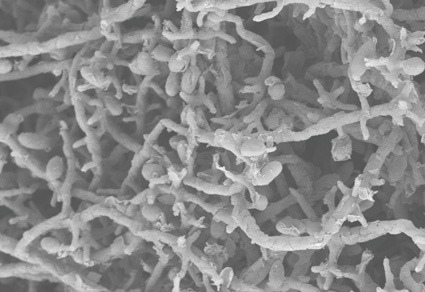

Abstract
A new species of Phaeoacremonium magnosporus sp. nov. was isolated in culture from the air in Sichuan Province, China, and described. Phylogenetic tree derived from neighbor-joining analysis based on a multi-locus concatenated dataset of the internal transcribed spacers (ITS), actin (ACT) and β-tubulin (TUB2) genes revealed that the novel species clustered within the Phaeoacremonium clade with a distinct lineage. Two strains of Phaeoacremonium magnosporus were related to P. paululum and P. alvesii. Unlike P. paululum CBS 142705, the new species exhibited growth well at 30 °C; and the new species differed from P. alvesii CBS 110034 in that it could not produce yellow pigment. The most distinctive characteristic of the novel species is its lack of a host association, which distinguishes it from all previously described Phaeoacremonium species. Herein, we propose a new species, P. magnosporus sp. nov.
References
- Agustí-Brisach, C., Gramaje, D., García-Jiménez, J. & Armengol, J. (2013) Detection of black-foot and petri disease pathogens in soils of grapevine nurseries and vineyards using bait plants. Plant and Soil 364: 5–13. https://doi.org/10.1007/s11104-012-1333-1
- Aigoun-Mouhous, W., Mahamedi, A.E., León, M., Chaouia, C., Zitouni, A., Barankova, K., Eichmeier, A., Armengol, J., Gramaje, D. & Berraf-Tebbal, A. (2021) Cadophora sabaouae sp. nov. and phaeoacremonium species associated with petri disease on grapevine propagation material and young grapevines in algeria. Plant Disease 105: 3657–3668. https://doi.org/10.1094/PDIS-11-20-2380-RE
- Aroca, A., Luque, J., Raposo, R., Yakoubi, S., Desbiez, C., Fakhfakh, H., Wipf-Scheibel, C., Marrakchi, M. & Lecoq, H. (2008) First report of phaeoacremonium viticola affecting grapevines in spain. Plant Pathology 57: 386–386. https://doi.org/10.1111/j.1365-3059.2007.01656.x
- Bruno, G. & Sparapano, L. (2006) Effects of three esca-associated fungi on Vitis vinifera L.: I. Characterization of secondary metabolites in culture media and host responses to the pathogens in calli. Physiological and Molecular Plant Pathology 69: 209–223. https://doi.org/10.1016/j.pmpp.2007.04.008
- Calabon, M.S., Bagacay, J.F.E., Nim, J.A., Sadaba, R.B., Ferriols, V.M.E.N., Concha, M.J., Velo, J. & Jones, E.B.G. (2024) Phaeoacremonium philippinense (Togniniales, Sordariomycetes), a novel freshwater fungus from the Philippines. Phytotaxa 644: 177–189. https://doi.org/10.11646/phytotaxa.644.3.1
- Calabon, M.S., Jones, E.B.G., Boonmee, S., Doilom, M., Lumyong, S. & Hyde, K.D. (2021) Five novel freshwater ascomycetes indicate high undiscovered diversity in lotic habitats in thailand. Journal of Fungi 7: 117. https://doi.org/10.3390/jof7020117
- Da Silva, M.A., Correia, K.C., Barbosa, M.A.G., Câmara, M.P.S., Gramaje, D. & Michereff, S.J. (2017) Characterization of Phaeoacremonium isolates associated with Petri disease of table grape in Northeastern Brazil, with description of Phaeoacremonium nordesticola sp. nov. European Journal of Plant Pathology 149: 695–709. https://doi.org/10.1007/s10658-017-1219-4
- Damm, U., Mostert, L., Crous, P.W. & Fourie, P.H. (2008) Novel phaeoacremonium species associated with necrotic wood of prunus trees. Persoonia—Molecular Phylogeny and Evolution of Fungi 20: 87–102. https://doi.org/10.3767/003158508X324227
- Glass, N.L. & Donaldson, G.C. (1995) Development of primer sets designed for use with the PCR to amplify conserved genes from filamentous ascomycetes. Applied and Environmental Microbiology 61: 1323–1330. https://doi.org/10.1128/aem.61.4.1323-1330.1995
- Graham, A.B., Johnston, P.R. & Weir, B.S. (2009) Three new phaeoacremonium species on grapevines in new zealand. Australasian Plant Pathology 38: 505. https://doi.org/10.1071/AP09035
- Gramaje, D., Agustí-Brisach, C., Pérez-Sierra, A., Moralejo, E., Olmo, D., Mostert, L., Damm, U. & Armengol, J. (2012) Fungal trunk pathogens associated with wood decay of almond trees on Mallorca (Spain). Persoonia—Molecular Phylogeny and Evolution of Fungi 28: 1–13. https://doi.org/10.3767/003158512X626155
- Gramaje, D., Mostert, L., Groenewald, J.Z. & Crous, P.W. (2015) Phaeoacremonium: From esca disease to phaeohyphomycosis. Fungal Biology 119: 759–783. https://doi.org/10.1016/j.funbio.2015.06.004
- Halleen, F., Baloyi, M.A., Bester, M.C. & Mostert, L. (2020) Aerial inoculum patterns of petri disease pathogens in south african vineyards and rootstock mother blocks. Phytopathologia Mediterranea 59: 515–536.
- Huang, S.-K., Jeewon, R., Hyde, K.D., Bhat, D.J., Chomnunti, P. & Wen, T.-C. (2018) Beta-tubulin and Actin gene phylogeny supports Phaeoacremonium ovale as a new species from freshwater habitats in China. MycoKeys 41: 1–15. https://doi.org/10.3897/mycokeys.41.27536
- Jeewon, R. & Hyde, K.D. (2016) Establishing species boundaries and new taxa among fungi: recommendations to resolve taxonomic ambiguities. Mycosphere 7: 1669–1677. https://doi.org/10.5943/mycosphere/7/11/4
- Lim, S.-K., Azmi, M.H., Kim, M.-K., Kim, S.-H., Lee, S.-Y. & Jung, H.-Y. (2025) A Novel Phaeoacremonium Species Isolated from Galls on the Chinese Magnolia-Vine (Schisandra chinensis) in Korea. Mycobiology 53: 243–249. https://doi.org/10.1080/12298093.2024.2438463
- Marchi, G., Roberti, S., D’Ovidio, R. & Mugnai, L. (2001) Pectic enzymes production by Phaeomoniella chlamydospora 40: 1000–1010. https://doi.org/10.1400/14657
- Martín, L. & Martín, M.T. (2013) Multi-gene sequence analysis and phenotypic diversity of Phaeoacremonium species isolated from grapevines in Spain. European Journal of Plant Pathology 137: 343–361. https://doi.org/10.1007/s10658-013-0247-y
- Mostert, L., Groenewald, J.Z., Summerbell, R.C., Gams, W. & Crous, P.W. (2006a) Taxonomy and Pathology of Togninia (Diaporthales) and its Phaeoacremonium Anamorphs. Studies in Mycology 54: 1–113. https://doi.org/10.3114/sim.54.1.1
- Mostert, L., Groenewald, J.Z., Summerbell, R.C., Robert, V., Sutton, D.A., Padhye, A.A. & Crous, P.W. (2005) Species of Phaeoacremonium Associated with Infections in Humans and Environmental Reservoirs in Infected Woody Plants. Journal of Clinical Microbiology 43: 1752–1767. https://doi.org/10.1128/JCM.43.4.1752-1767.2005
- Mostert, L., Halleen, F., Fourie, P. & Crous, P.W. (2006b) A review of phaeoacremonium species involved in petri disease and esca of grapevines. Phytopathologia Mediterranea 45: S12–S29. https://doi.org/10.1400/52258
- Mostert, L., Whipp, M., Woodgyer, A., Summerbell, R.C., Gramaje, D. & Spies, C.F.J. (2024) Phaeoacremonium tuscanicum and Phaeoacremonium indicum sp. nov. associated with subcutaneous phaeohyphomycosis. Mycology 15: 129–135. https://doi.org/10.1080/21501203.2024.2312917
- Petrović, E., Vrandečić, K., Ćosić, J., Kanižai Šarić, G. & Godena, S. (2022) First Report of Phaeoacremonium iranianum Causing Olive Twig and Branch Dieback. Plants 11: 3578. https://doi.org/10.3390/plants11243578
- Phukhamsakda, C., Nilsson, R.H., Bhunjun, C.S., De Farias, A.R.G., Sun, Y.-R., Wijesinghe, S.N., Raza, M., Bao, D.-F., Lu, L., Tibpromma, S., Dong, W., Tennakoon, D.S., Tian, X.-G., Xiong, Y.-R., Karunarathna, S.C., Cai, L., Luo, Z.-L., Wang, Y., Manawasinghe, I.S., Camporesi, E., Kirk, P.M., Promputtha, I., Kuo, C.-H., Su, H.-Y., Doilom, M., Li, Y., Fu, Y.-P. & Hyde, K.D. (2022) The numbers of fungi: Contributions from traditional taxonomic studies and challenges of metabarcoding. Fungal Diversity 114: 327–386. https://doi.org/10.1007/s13225-022-00502-3
- Raimondo, M.L., Lops, F. & Carlucci, A. (2014) Phaeoacremonium italicum sp. nov., associated with esca of grapevine in southern Italy. Mycologia 106: 1119–1126. https://doi.org/10.3852/14-080
- Santos, C., Fragoeiro, S., Valentim, H. & Phillips, A. (2006) Phenotypic characterisation of phaeoacremonium and phaeomoniella strains isolated from grapevines: Enzyme production and virulence of extra-cellular filtrate on grapevine calluses. Scientia Horticulturae 107: 123–130. https://doi.org/10.1016/j.scienta.2005.04.014
- Shang, Q.-J., Hyde, K.D. & Liu, J.-K. (2021) Phaeoacremonium fusiformostromum sp. nov. and a new record of P. croatiense from China. Phytotaxa 516: 59–72. https://doi.org/10.11646/phytotaxa.516.1.4
- Spies, C.F.J., Moyo, P., Halleen, F. & Mostert, L. (2018) Phaeoacremonium species diversity on woody hosts in the Western Cape Province of South Africa. Persoonia—Molecular Phylogeny and Evolution of Fungi 40: 26–62. https://doi.org/10.3767/persoonia.2018.40.02
- To, K.K.W., Lau, S.K.P., Wu, A.K.L., Lee, R.A., Ngan, A.H.Y., Tsang, C.C.C., Ling, I.W.H., Yuen, K.-Y. & Woo, P.C.Y. (2012) Phaeoacremonium parasiticum invasive infections and airway colonization characterized by agar block smear and ITS and β-tubulin gene sequencing. Diagnostic Microbiology and Infectious Disease 74: 190–197. https://doi.org/10.1016/j.diagmicrobio.2012.06.014
- Tummidi, S., Naik, B., Shankaralingappa, A., Balakrishna, P., Bhadada, A.A. & Kosaraju, N. (2020) Phaeoacremonium species detected in fine needle aspiration: a rare case report. Diagnostic Pathology 15: 113. https://doi.org/10.1186/s13000-020-01023-w
- Verkley, G.J.M., Dukik, K., Renfurm, R., Göker, M. & Stielow, J.B. (2014) Novel genera and species of coniothyrium-like fungi in montagnulaceae (ascomycota). Persoonia—Molecular Phylogeny and Evolution of Fungi 32: 25–51. https://doi.org/10.3767/003158514X679191
- Zhang, X., Tibpromma, S., Karunarathna, S.C., Du, T.-Y., Han, L.-S., Elgorban, A.M., Kumla, J., Senwanna, C., Dai, D.-Q., Suwannarach, N. & Wang, H.-H. (2025) Additions to the saprobic fungi (ascomycota) associated with macadamia trees from the greater mekong subregion. MycoKeys 113: 1–29. https://doi.org/10.3897/mycokeys.113.140031
- Zhou, Y., Manawasinghe, I.S., He, Z., Zhang, W., Liu, M., Song, J., Li, S., Fan, Z. & Yan, J. (2024) Microfungi Associated with Peach Branch Diseases in China. Journal of Fungi 10: 217. https://doi.org/10.3390/jof10030217