
Abstract
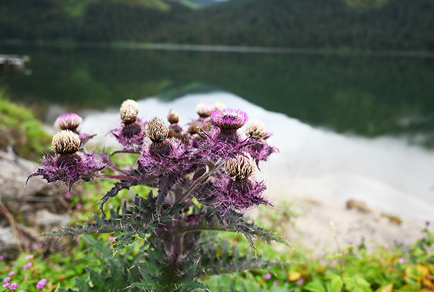
Cirsium medogense (Asteraceae), a new species from southeastern Xizang, China, is described and illustrated. Based on comprehensive morphological comparisons and molecular phylogenetic analyses, C. medogense is placed in Cirsium sect. Epitrachys. The new species is morphologically most similar to C. eriophoroides and C. lipskyi, but is readily distinguished from both by its glabrous, campanulate involucre in combination with more numerous, erect capitula and broadly elliptic leaves. Phylogenetic analyses of nuclear ITS and three chloroplast markers (matK, ndhF, trnL-trnF) indicate that C. medogense is sister to two accessions of C. lipskyi, and together they form a well-supported clade with C. eriophoroides. The recognition of C. medogense is therefore supported by both morphological distinctiveness and molecular evidence. This discovery enhances understanding of species diversity and phylogenetic relationships within Cirsium and underscores the importance of continued botanical exploration and conservation efforts in this floristically rich region.
References
- Ackerfield, J., Susanna, A., Funk, V., Kelch, D., Park, D.S., Thornhill, A.H., Yildiz, B., Arabaci, T. & Dirmenci, T. (2020) A prickly puzzle: generic delimitations in the Carduus-Cirsium group (Compositae: Cardueae: Carduinae). Taxon 69: 715–738. https://doi.org/10.1002/tax.12288
- Adanson, M. (1763) Familles des plantes. Chez Vincent, Paris, 116, 605 pp. https://doi.org/10.5962/bhl.title.271
- Cai, H., Lin, D.-L., Ye, C., Wang, H.-C., Yang, B.-Y. & Jin, X.-H. (2023) Neottia linzhiensis (Orchidaceae, Epidendroideae, Neottieae), a new species from Xizang, China. Phytotaxa 629: 155–162. https://doi.org/10.11646/phytotaxa.629.2.5
- Capella-Gutiérrez, S., Silla-Martínez, J.M. & Gabaldón, T. (2009) TrimAl: a tool for automated alignment trimming in large-scale phylogenetic analyses. Bioinformatics 25: 1972–1973. https://doi.org/10.1093/bioinformatics/btp348
- Cassini, H. (1818) Aperçu des genres ou sous-genres nouveaux formés par M. Henri Cassini dans la famille des Synanthérées. Bulletin des Sciences, par la Société Philomatique de Paris 1818: 165–169.
- Charadze, A.L. (1963) Cirsium Mill. In: Bobrov, E.G. & Czerepanov, S.K. (Eds.) Flora of the USSR, vol. 28. Academy of Sciences of the USSR, Moscow & Leningrad, pp. 51–215. [In Russian]
- Chen, J.-T., Huang, X.-H., Lv, Z.-Y., Kuang, T.-H., Luo, J., Deng, Y.-F. & Deng, T. (2020) Strobilanthes sunhangii (Acanthaceae), a new species from Tibet, China. PhytoKeys 166: 117–127. https://doi.org/10.3897/phytokeys.166.58831
- Cheng, S.-Z. & Ni, Z.-C. (1985) The outline of flora in the Mt. Namjagbarwa region. Mountain Research 3: 284–290.
- Cuvier, F. (1822) Dictionnaire des Sciences Naturelles, dans lequel on traite méthodiquement des différens êtres de la nature, considérés soit en eux-mêmes, d'aprés l'état actuel de nos connoissances, soit relativement à l'utilité quén peuvent retirer la médecine, l'agriculture, le commerce et les arts, edition 2, vol. 25. F.G. Levrault, Paris & Strasbourg; Le Normant, Paris, 225 pp.
- Davis, P.H. & Parris, B.S. (1975) Cirsium Mill. In: Davis, P.H. (Ed.) Flora of Turkey and the East Aegean Islands, vol. 5. Edinburgh University Press, Edinburgh, pp. 370–412.
- Del Guacchio, E., Bureš, P., Iamonico, D., Carucci, F., De Luca, D., Zedek, F. & Caputo, P. (2022) Towards a monophyletic classification of Cardueae: restoration of the genus Lophiolepis (= Cirsium p.p.) and new circumscription of Epitrachys. Plant Biosystems-An International Journal Dealing with All Aspects of Plant Biology 156: 1269–1290. https://doi.org/10.1080/11263504.2022.2131924
- Duby, J.E. (1828) Botanicon gallicum (2nd ed.), vol. 1. Ve Desray, Paris.
- Han, W.-D., Yao, G., Xu, F.-X. & Zheng, W.-L. (1992) Investigation of plant resources in Motuo, Xizang. Journal of Plant Resources and Environment 1: 62–64.
- Herrando-Moraira, S., Calleja, J.A., Galbany-Casals, M., Garcia-Jacas, N., Liu, J.-Q., López-Alvarado, J., López-Pujol, J., Mandel, J.R., Massó, S., Montes-Moreno, N., Roquet, C., Sáez, L., Sennikov, A.N., Susanna, A. & Vilatersana, R. (2019) Nuclear and plastid DNA phylogeny of tribe Cardueae (Compositae) with Hyb-Seq data: a new subtribal classification and a temporal diversification framework. Molecular Phylogenetics and Evolution 137: 313–332. https://doi.org/10.1016/j.ympev.2019.05.001
- Hooker, J.D. (1881) Cnicus L. In: Hooker, J.D. & Clarke, C.B. (Eds.) The Flora of British India, vol. 3. Reeve & Co. Ltd., England, London, pp. 362–364.
- Jin, J.-J., Yu, W.-B., Yang, J.-B., Song, Y., dePamphilis, C.W., Yi, T.-S. & Li, D.-Z. (2020) GetOrganelle: a fast and versatile toolkit for accurate de novo assembly of organelle genomes. Genome Biology 21: e241. https://doi.org/10.1186/s13059-020-02154-5
- Jin, Z.-C. & Chen, Y.-S. (2022) Cirsium lipskyi (Asteraceae) is reinstated for C. interpositum, and C. chrysolepis is a new synonym of C. nishiokae. Phytotaxa 547: 87–96. https://doi.org/10.11646/phytotaxa.547.1.8
- Katoh, K., Misawa, K., Kuma, K. & Miyata, T. (2002) MAFFT: a novel method for rapid multiple sequence alignment based on fast Fourier transform. Nucleic Acids Research 30: 3059–3066. https://doi.org/10.1093/nar/gkf436
- Katoh, K. & Standley, D.M. (2013) MAFFT multiple sequence alignment software version 7: improvements in performance and usability. Molecular Biology and Evolution 30: 772–780. https://doi.org/10.1093/molbev/mst010
- Lanfear, R., Frandsen, P.B., Wright, A.M., Senfeld, T. & Calcott, B. (2017) PartitionFinder 2: new methods for selecting partitioned models of evolution for molecular and morphological phylogenetic analyses. Molecular Biology and Evolution 34: 772–773. https://doi.org/10.1093/molbev/msw260
- Li, L.-J., Xu, X.-T., Qian, H., Huang, X.-H., Liu, P.-J., Landis, J.B., Fu, Q.-S., Sun, L., Wang, H.-C., Sun, H. & Deng, T. (2022) Elevational patterns of phylogenetic structure of angiosperms in a biodiversity hotspot in eastern Himalaya. Diversity and Distributions 28: 2534–2548. https://doi.org/10.1111/ddi.13513
- Linnaeus, C. (1753) Species plantarum. L. Salvius, Stockholm, 1200 pp.
- Lv, Z.-Y., Huang, X.-H., Zhang, X., Yusupov, Z., Wang, H.-C., Tojibaev, K., Deng, T. & Li, Z.-M. (2019) Cornus sunhangii (Cornaceae), a new species from Tibet (China). Phytotaxa 409: 273–282. https://doi.org/10.11646/phytotaxa.409.5.3
- Miller, P. (1754) The Gardeners Dictionary (4th ed.), corrected and enlarged, vol. 1. Printed for the author, London, 334 pp.
- Minh, B.Q., Nguyen, M.A.T. & von Haeseler, A. (2013) Ultrafast approximation for phylogenetic bootstrap. Molecular Biology and Evolution 30: 1188–1195. https://doi.org/10.1093/molbev/mst024
- Moreyra, L.D., Garcia-Jacas, N., Roquet, C., Ackerfield, J.R., Arabacı, T., Blanco-Gavaldà, C., Brochmann, C., Calleja, J.A., Dirmenci, T., Fujikawa, K., Galbany-Casals, M., Gao, T., Gizaw, A., López-Alvarado, J., Mehregan, I., Vilatersana, R., Yıldız, B., Leliaert, F., Seregin, A.P. & Susanna, A. (2023) African mountain thistles: three new genera in the Carduus-Cirsium group. Plants 12: e3083. https://doi.org/10.3390/plants12173083
- Moreyra, L.D., Susanna, A., Calleja, J.A., Ackerfield, J.R., Arabacı, T., Blanco-Gavaldà, C., Brochmann, C., Dirmenci, T., Fujikawa, K., Galbany-Casals, M., Gao, T., Gizaw, A., Mehregan, I., Vilatersana, R., Viruel, J., Yıldız, B., Leliaert, F., Seregin, A.P. & Roquet, C. (2025) A thorny tale: The origin and diversification of Cirsium (Compositae). Molecular Phylogenetics and Evolution 204: e108285. https://doi.org/10.1016/j.ympev.2025.108285
- Nguyen, L.T., Schmidt, H.A., von Haeseler, A. & Minh, B.Q. (2015) IQ-TREE: a fast and effective stochastic algorithm for estimating maximum-likelihood phylogenies. Molecular Biology and Evolution 32: 268–274. https://doi.org/10.1093/molbev/msu300
- Petrak, F. (1911) Über eine neue Art der Gattung Cirsium aus dem nördlichen Indien. Repertorium Novarum Specierum Regni Vegetabilis 9: 197–199. https://doi.org/10.1002/fedr.19110091303
- Petrak, F. (1912) Der Formenkreis des Cirsium eriophorum (L.) Scop. in Europa. Bibliotheca Botanica 78: 1–92.
- Petrak, F. (1917) Die nordamerikanischen Arten der Gattung Cirsium. Beihefte zum Botanischen Centralblatt 35: 223–567.
- Petrak, F. (1938) Ü̈ber eine neue, in phylogenetischer Hinsicht sehr interessante Art der Gattung Cirsium (C. interpositum) aus China. Repertorium Novarum Specierum Regni Vegetabilis 43: 283–285. https://doi.org/10.1002/fedr.19380431706
- POWO (2025) Plants of the World Online. Facilitated by the Royal Botanic Gardens, Kew. Available from: https://powo.science.kew.org/ (accessed 23 September 2025)
- Ronquist, F., Teslenko, M., van der Mark, P., Ayres, D.L., Darling, A., Höhna, S., Larget, B., Liu, L., Suchard, M.A. & Huelsenbeck, J.P. (2012) MrBayes 3.2: efficient Bayesian phylogenetic inference and model choice across a large model space. Systematic Biology 61: 539–542. https://doi.org/10.1093/sysbio/sys029
- Shi, Z. & Greuter, W. (2011) Cirsium Mill. In: Wu, Z.Y. & Raven, P.H. (Eds.) Flora of China, vols. 20–21. Science Press, Beijing & Missouri Botanical Garden Press, St. Louis, pp. 160–175.
- Shih, C. (1984) Notulae de plantis tribus cynarearum familiae compositarum sinicae (II). Journal of Systematics and Evolution 22: 386–396.
- Shih, C. (1987) Cirsium Mill. In: Ling, Y. & Shih, C. (Eds.) Flora Reipublicae Popularis Sinicae, vol. 78 (1). Science Press, Beijing, pp. 78–135. [In Chinese]
- Sun, H. & Zhou, Z.-K. (1996) The characters and origin of the flora from the big bend gorge of Yalutsangpu (Brahmabutra) River, Eastern Himalayas. Acta Botanica Yunnanica 18: 185–204.
- Sun, L., Luo, J., Qian, L., Deng, T. & Sun, H. (2020) The relationship between elevation and seed-plant species richness in the Mt. Namjagbarwa region (Eastern Himalayas) and its underlying determinants. Global Ecology and Conservation 23: e01053. https://doi.org/10.1016/j.gecco.2020.e01053
- Tian, D.-K., Wang, W.-G., Xiao, Y., Wang, S.-W. & Zhong, X. (2024) One new species and one new record of Begonia from Xizang of China. Taiwania 69: 545–553. https://doi.org/10.6165/tai.2024.69.545
- Wang, H.-C. & Jin, X.-H. (2025) Gastrodia motuoensis (Orchidaceae, Epidendroideae), a new species of mycoheterotrophic plant from Xizang, China, based on morphological and molecular evidence. Phytotaxa 710: 283–289. https://doi.org/10.11646/phytotaxa.710.3.5
- Wu, X.-X., Wang, Y., Chen, Y.-Y., Liu, L.-J., Xu, C., Zheng, H.-L., Yang, F.-S. & Wang, Q. (2025) Integrated morphological and phylogenomic analyses revealed a novel genus Paramicrotoena (Lamiaceae-Pogostemoneae) discovered in the Pan-Himalaya. Molecular Phylogenetics and Evolution 212: e108421. https://doi.org/10.1016/j.ympev.2025.108421
- Xiang, C.-Y., Gao, F.-L., Jakovlić, I., Lei, H.-P., Hu, Y., Zhang, H., Zou, H., Wang, G.-T. & Zhang, D. (2023) Using PhyloSuite for molecular phylogeny and tree‐based analyses. iMeta 2: e87. https://doi.org/10.1002/imt2.87
- Xiong, X.-H., Xu, B., Ju, W.-B., Gao, Y.-D., Deng, H.-N. & Gao, X.-F. (2018) Notes on Rubus L. (Rosaceae) from Mêdog, Tibet, China. Guihaia 38: 1411–1421. https://doi.org/10.11931/guihaia.gxzw201803018
- Yang, B., Ya, J.-D., Tong, Y.-H., Wang, P.-Y., Liu, C., Zhao, W.-L., Liu, Z. & Tan, Y.-H. (2022) Agapetes huangiana (Ericaceae), a new species from Southeast Xizang, China. Taiwania 67: 254–259. https://doi.org/10.6165/tai.2022.67.254
- Zhang, D., Gao, F.-L., Jakovlić, I., Zou, H., Zhang, J., Li, W.-X. & Wang, G.-T. (2020) PhyloSuite: An integrated and scalable desktop platform for streamlined molecular sequence data management and evolutionary phylogenetics studies. Molecular Ecology Resources 20: 348–355. https://doi.org/10.1111/1755-0998.13096