
Abstract
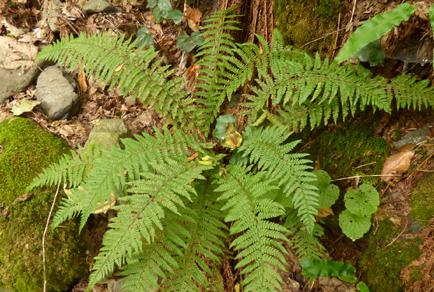
A new fern species, Polystichum caucasicum sp. nov., is described from the Caucasus region and adjacent areas of Georgia, Armenia, Turkey and Russia. The species was likely overlooked due to its morphological similarity to P. braunii and P. aculeatum, but it can be distinguished by a combination of characters, including a densely scaly rachis, enlarged basal acroscopic pinnules, and long-pointed pinnae. P. caucasicum could also be misidentified as P. kadyrovii in this region; however, a revision of the type material confirms that P. kadyrovii is conspecific with P. aculeatum and therefore not related to the newly described taxon. Genome size analyses (flow cytometry) of 20 individuals revealed an average 2C genome size of 44.7 pg, indicating a hexaploid cytotype, which is also supported by guard cell size measurements. In addition, a comprehensive comparative analysis of genome size characteristics was conducted across the majority of European and Caucasian Polystichum species, providing estimates of genome size, monoploid genome size (1Cx), and genomic GC content. The species produces well-developed fertile spores. Polystichum caucasicum appears to be an endemic of the Caucasus region and adjacent areas, growing in a wide ecological range in humus-rich and rocky beech, ravine or alluvial forests dominated by Acer, Fagus, Tilia and Alnus. Its habitat preferences are documented through four phytosociological relevés and realized climatic niche of the species at known locations was performed using the Chelsa Bioclim dataset.
References
- Askerov, A.M. (1977) Pteridophyta Azerbajdžana [Pteridophytes in Azerbaijan]. Botaničeskij Žurnal 62: 1022–1030.
- Askerov, A.M. (2022) Forest ferns of the Caucasus, its systematic and eco-geographical analyzis. Acta Botanica Caucasica 1: 42–48. https://doi.org/10.30546/abc.2022.1.1.42
- Askerov, A.M. & Bobrov, A.E. (1972) K systematike nekotorych rodov paporotnikov iz Talisha [To the taxonomy of some genera of ferns from Talish]. Botaničeskij Žurnal 57: 1296–1301.
- Barrington, D.S., Paris, C.A. & Ranker, T.A. (1986) Systematic inferences from spore and stomata size in the ferns. American Fern Journal 76: 149–159. https://doi.org/10.2307/1547723
- Barrington, D.S. (2006) Cytological information for the genus Polystichum. University of Vermont, Burlington. Available from: https://www.uvm.edu/~dbarring/polystichum.htm (accessed 25 April 2025)
- Barrington, D.S., Patel, N.R. & Southgate, M.W. (2020) Inferring the impacts of evolutionary history and ecological constraints on spore size and shape in the ferns. Applications in Plant Sciences 8 (4): e11339. https://doi.org/10.1002/aps3.11339
- Bizot, A., Holveck, P., Thomas, J.-F. & Viane, R. (2015) Biométrie stomatique dans le genre Polystichum en Europe : résultats, enseignements et intérêts. Bulletin de la Société d’Histoire Naturelle d’Ardennes 105: 44–68.
- Dengler, J., Chytrý, M. & Ewald, J. (2008) Phytosociology. In: Jørgensen, S.E. & Fath, B.D. (Ed.) Encyclopedia of Ecology 4. Elsevier, Oxford, pp. 2767–2779. https://doi.org/10.1016/B978-008045405-4.00533-4
- Doležel, J., Sgorbati, S. & Lucretti, S. (1992) Comparison of three DNA fluorochromes for flow-cytometric estimation of nuclear DNA content in plants. Physiologia Plantarum 85: 625–631. https://doi.org/10.1111/j.1399-3054.1992.tb04764.x
- Doležel, J., Greilhuber, J., Lucretti, S., Meister, A., Lysák, M.A., Nardi, L. & Obermayer, R. (1998) Plant genome size estimation by flow cytometry: inter-laboratory comparison of 24 plant species. Annals of Botany 82 (3): 263–271.
- Ekrt, L., Podroužek, J., Hornych, O., Košnar, J. & Koutecký, P. (2021) Cytotypes of bracken (Pteridium aquilinum) in Europe: widespread diploids and scattered triploids of likely multiple origin. Flora 274: 151725. https://doi.org/10.1016/j.flora.2020.151725
- Euro+Med (2006–Present) The Euro+Med PlantBase – the information resource for Euro-Mediterranean plant diversity. Available from: https://europlusmed.org/ (accessed 19 May 2025)
- Fée, A.L.A. (1852) Mémoires sur la famille des fougères. Cinquième mémoire : Genera Filicum 5: 278.
- Fomin, A.V. (1911) Два новых папоротника с Кавказа [Zwei neue Farne aus dem Kaukasus]. Vĕstnik Tiflisskago Botaniceskago Sada 18: 20–23.
- Hahne, V. (1904) Ueber Farnhybriden. Allgemeine Botanische Zeitschrift für Systematik, Floristik und Pflanzengeographie 10: 102–106.
- Hanušová, K., Čertner, M., Urfus, T., Koutecký, P., Košnar, J., Rothfels, C.J., Jarolímová, V., Ptáček, J. & Ekrt, L. (2019) Widespread co-occurrence of multiple ploidy levels in fragile ferns (Cystopteris fragilis complex; Cystopteridaceae) probably stems from similar ecology of cytotypes, their efficient dispersal and inter-ploidy hybridization. Annals of Botany 123: 845–855. https://doi.org/10.1093/aob/mcy219
- Hassler, M. (2025) World Ferns – Synonymic checklist of the Ferns and Lycophytes of the World. Available from: https://www.worldplants.de/world-plants-complete-list/complete-plant-list (accessed 23 April 2025)
- Henry, T.A., Bainard, J.D. & Newmaster, S.G. (2014) Genome size evolution in Ontario ferns (Polypodiidae): evolutionary correlations with cell size, spore size, and habitat type and an absence of genome downsizing. Genome 57: 555–566. https://doi.org/10.1139/gen-2014-0090
- Hodgetts, N.G., Söderström, L., Blockeel, T.L., Caspari, S., Ignatov, M.S., Konstantinova, N.A., Lockhart, B., Papp, C., Schröck, M., Sim-Sim, D., Bell, N.E., Bell, H.H., Blom, M.A., Bruggeman-Nannenga, M.A., Brugués, J., Enroth, K.I., Flatberg, R., Garilleti, R., Hedenäs, L., Holyoak, D.T., Hugonnot, V., Kariyawasam, I., Köckinger, H., Kučera, J., Lara, F. & Porley, R.D. (2020) An annotated checklist of bryophytes of Europe, Macaronesia and Cyprus. Journal of Bryology 42: 1–116. https://doi.org/10.1080/03736687.2019.1694329
- Hornych, O. & Ekrt, L. (2017) Spore abortion index (SAI) as a promising tool of evaluation of spore fitness in ferns: an insight into sexual and apomictic species. Plant Systematics and Evolution 303: 497–507. https://doi.org/10.1007/s00606-016-1386-3
- Hornych, O., Ekrt, L., Riedel, F., Koutecký, P. & Košnar, J. (2019) Asymmetric hybridization in the Central European populations of the Dryopteris carthusiana group. American Journal of Botany 106 (11): 1477–1486. https://doi.org/10.1002/ajb2.1369
- Jorgensen, S.A. & Barrington, D.S. (2017) Two Beringian origins for the allotetraploid fern Polystichum braunii (Dryopteridaceae). Systematic Botany 42 (1): 6–16. https://doi.org/10.1600/036364417X694557
- Karger, D.N., Conrad, O., Böhner, J., Kawohl, T., Kreft, H., Soria-Auza, R.W., Zimmermann, N.E., Linder, H.P. & Kessler, M. (2017) Climatologies at high resolution for the Earth’s land surface areas. Scientific Data 4: 170122. https://doi.org/10.1038/sdata.2017.122
- Le Péchon, T., He, H., Zhang, L., Zhou, X.-M., Gao, X.-F. & Zhang, L.-B. (2016) Using a multilocus phylogeny to test morphology-based classifications of Polystichum (Dryopteridaceae), one of the largest fern genera. BMC Evolutionary Biology 16: 55. https://doi.org/10.1186/s12862-016-0626-z
- Little, D.P. & Barrington, D.S. (2003) Major evolutionary events in the origin and diversification of the fern genus Polystichum (Dryopteridaceae). American Journal of Botany 90: 508–514. https://doi.org/10.3732/ajb.90.3.508
- Manton, I. & Reichstein, T. (1961) Zur Cytologie von Polystichum braunii (Spenner) Fée und seiner Hybriden. Bericht der Schweizerischen Botanischen Gesellschaft 71: 370–383.
- Morero, R.E., Chiarini, F.E., Urdampilleta, J., Barboza, G.E. & Barrington, D.S. (2015) Cytological study of Polystichum (Dryopteridaceae) species from southern South America. Australian Journal of Botany 63: 403. https://doi.org/10.1071/BT14287
- Mossion, V., Koenen, E., Grant, J., Croll, D., Farrar, D.R. & Kessler, M. (2025) Global diversification of the common moonwort ferns (Botrychium lunaria group, Ophioglossaceae) was mainly driven by Pleistocene climatic shifts. Annals of Botany 135 (7): 1475–1496. https://doi.org/10.1093/aob/mcae228
- Novák, P., Kalníková, V., Szokala, D., Aleksanyan, A., Batsatsashvili, K., Fayvush, G., Kolbaia, S., Nakhutsrishvili, G., Sedláček, V., Štěrba, T. & Zukal, D. (2023) Transcaucasian Vegetation Database – a phytosociological database of the Southern Caucasus. Vegetation Classification and Survey 4: 231–240. https://doi.org/10.3897/VCS.105521
- Otto, F. (1992) Preparation and stain of cells for high-resolution DNA analysis. In: Radbruch, A. (Ed.) Flow Cytometry and Cell Sorting. Springer-Verlag, Berlin, pp. 101–104. https://doi.org/10.1007/978-3-662-02785-1_8
- PPG I. (2016) A community-derived classification for extant lycophytes and ferns. Journal of Systematics and Evolution 54 (6): 563–603. https://doi.org/10.1111/jse.12229
- Roth, A.W. (1799) Tentamen florae Germanicae; continens enumerationem plantarum in Germania sponte nascentium. Vol. 3, pars 1. Lipsiae: In Bibliopolio I.G. Mülleriano.
- Sleep, A. (2014) Hybridization in Polystichum (Dryopteridaceae: Pteridophyta). Fern Gazette 19: 319–341.
- Sleep, A. & Reichstein, T. (1967) Der Farnbastard Polystichum × meyeri hybr. nov. = Polystichum braunii (Spenner) Fée × P. lonchitis (L.) Roth und seine Cytologie. Bauhinia 3: 299–309, 363–374.
- Šmarda, P., Bureš, P., Horová, L., Foggi, B. & Rossi, G. (2008) Genome size and GC content evolution of Festuca: ancestral expansion and subsequent reduction. Annals of Botany 101: 421–433. https://doi.org/10.1093/aob/mcm307
- Thiers, B.M. (2025) Index Herbariorum. Available from: https://sweetgum.nybg.org/science/ih/ (accessed 12 June 2025)
- Tunçkol, B., Yaşayacak, H., Liang, Z.-L., Aksoy, N. & Zhang, L.-B. (2020) Polystichum asiae-minoris (Dryopteridaceae), a new fern from Kastamonu, Turkey. Phytotaxa 447: 296–300. https://doi.org/10.11646/phytotaxa.447.4.8
- Urfus, T., Chrtek, J., Kaplan, Z., Prančl, J., Ponert, J., Trávníček, P. & Slovák, M. (2025) Flow cytometry in conservation: detecting hybridization risks in threatened plant species. Biodiversity and Conservation 34: 2337–2358. https://doi.org/10.1007/s10531-025-03062-5
- Vejvodová, K., Krejčí, J., Lučanová, M., Hornych, O., Koutecký, P. & Ekrt, L. (2024) High mountains of Central Europe as a refuge of surprising cytotype diversity of Huperzia selago (Lycopodiaceae). Alpine Botany 134: 87–100. https://doi.org/10.1007/s00035-024-00312-0
- Wagner, D.H. (1979) Systematics of Polystichum in western North America, north of Mexico. Pteridologia 1: 1–64. https://doi.org/10.5962/bhl.title.124884
- Woynar, H.K. (1913) Bemerkungen über Farnpflanzen Steiermarks. Mitteilungen des Naturwissenschaftlichen Vereins für Steiermark 49: 120–200.
- Zhang, L.-B. & Barrington, D.S. (2013) Polystichum Roth. In: Flora of China. Vols. 2–3 (Lycopodiaceae–Polypodiaceae). Missouri Botanical Garden Press, St Louis, pp. 627–713.