

Abstract
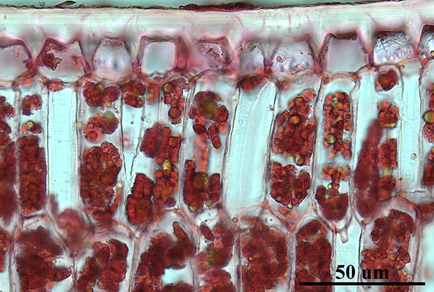
In the genus Garcinia, most species are dioecious; moreover, the flowers in this genus are usually very small (5–30 mm) compared to the leaves, making floral-based identification among the species very challenging. Hence, we examined vegetative structures to identify reliable taxonomic characters of 16 species and three varieties covering the entire Western Ghats. Bright-field microscopy revealed several variable features in the leaf, including cuticle thickness, sinuosity of the epidermal cells, number of palisade and spongy cell layers, site of occurrence of druses, resin canals, arrangement of vascular bundles like triangular, arc-shaped, U-shaped or V-shaped with varying degrees of curled distal ends. In petiole anatomy, the outline showed distinct shapes viz. circular, semi-circular or pentagonal, with prominent wings and wavy border. Disparity in petiole anatomy was noted i.e. the thickness of the cuticle, presence of trichomes, vasculature types, druses and resin canals either scattered or in distinct rings. In stem anatomy, variability was observed in the outline like circular, elliptical or squarish with distinct number of wings and wavy margin. Other notable characters viz. hypodermal cells, vascular system, druses, positioning of resin canals in the cortex and pith were found to be noteworthy in identification. The above findings concluded that the distinct anatomical characteristics of leaf, petiole and stem were significant in distinguishing Garcinia species at the vegetative stage.
References
- Ahmad, K.H., Khan, M.A., Ahmad, M., Shaheen, N.I. & Nazir, A.B. (2010) Taxonomic diversity in epidermal cells of some sub-tropical plant species. International Journal of Agriculture and Biology 12 (1): 115–118.
- Ajayi, I.A., Oderinde, R.A., Ogunkoya, B.O., Egunyomi, A. & Taiwo, V.O. (2007) Chemical analysis and preliminary toxicological evaluation of Garcinia mangostana seeds and seed oil. Food Chemistry 101 (3): 999–1004. https://doi.org/10.1016/j.foodchem.2006.02.053
- Amanda, A.C., Fabricio, J.P., Marcio, P.P., Felipe, F.C., Evaristo, M.C. & Breno, R.S. (2013) Anatomy of stems, leaves, roots and the embryo of Garcinia brasiliensis Mart.-Clusiaceae. Revista de Ciencias Agrarias 56: 23–29. http://dx.doi.org/10.4322/rca.2013.076
- Anderson, T. (1874) Guttiferae. In: Hooker, J.D. (Ed.) Flora of British India 1. L. Reeve & Co., London, pp. 258–278.
- Atasagun, B. (2022) Comparative anatomy and pollen morphology of two endemic Noccaea species (Brassicaceae) and their taxonomic significance. Notulae Botanicae Horti Agrobotanici Cluj-Napoca 50 (3): 12849. https://doi.org/10.15835/nbha50312849
- Aytac, Z., Nordt, B. & Parolly, G. (2006) A new species of Noccaea (Brassicaceae) from South Anatolia, Turkey. Botanical Journal of the Linnean Society 150 (3): 409–416. https://doi.org/10.1111/j.1095-8339.2006.00472.x
- Baliga, M.S., Bhat, H.P., Pai, R.J., Boloor, R. & Palatty, P.L. (2011) The chemistry and medicinal uses of the underutilized Indian fruit tree Garcinia indica Choisy (kokum): a review. Food Research International 44 (7): 1790–1799. https://doi.org/10.1016/j.foodres.2011.01.064
- Beddome, R.H. (1872) The flora sylvatica for Southern India (parts 15–24). Gantz Brothers, Madras, pp. 169–288.
- Begum, A. (2020) Epidermal features, venation pattern and petiole anatomy of Garcinia nigrolineata Planch. ex T. Anderson, newly reported species from North East India. Plant Archives 20 (2): 8912–8916.
- Begum, A., Barthakur, S.K. & Sarma, J. (2013) Garcinia dulcis (Roxburgh) Kurz [Clusiaceae]: a new distributional record for Assam, India. Pleione 7 (2): 545–548.
- Begum, A., Borthakur, S.K. & Sarma, J. (2014) Two new varieties of Garcinia morella Desrousseaux (Clusiaceae) from the Tinsukia district of Assam, India. Pleione 8 (2): 491–497.
- Blume, C.L. (1826) Bijdragen tot de Flora van Nederlandsch Indie 14.
- Bohra, P., Waman, A.A. & Giri, N.A. (2021) Garcinia andamanica King (Clusiaceae): an important horticultural genetic resource from Indian islands. Genetic Resources and Crop Evolution 68 (4): 1675–1689. https://doi.org/10.1007/s10722-021-01136-1
- Bonpland, A., Humboldt, A. von. & Kunth, K.S. (1815) Nova genera et species plantarum Vol. 5: 147. Ex officina Christophori Plantin, Paris. Available from: https://www.biodiversitylibrary.org/page/6629 (accessed on 22 December 2025)
- Brahma, J., Islary, A. & Ray, S. (2024) Nutritional evaluation and GC–MS analysis of bioactive compounds present in methanol extracts of dried fruit pericarp of Garcinia pedunculata Roxb. Journal of Food Technology Research 11 (2): 27–37. https://doi.org/10.18488/jftr.v11i2.3702
- Brullo, S., Tomaselli, V. & Wagensommer, R.P. (2015) A new species of Odontites (Orobanchaceae) from southern Italy. Phytotaxa 213 (3): 271–281. https://doi.org/10.11646/phytotaxa.213.3.7
- Buchanan-Hamilton, F. (1827) Description of a plant of the order of Guttiferae, which Dr Roxburgh called Garcinia pedunculata. Edinburg Journal of Science 7: 45–46.
- Bueno, L.H., Hernandez-Hernandez, B., Francener, A., Amorim, A.M. & Pace, M.R. (2025) Anatomical conservatism in the wood and bark of the species-rich Byrsonimoid clade (Malpighiaceae). Botanical Journal of the Linnean Society 207 (2): 143–167. https://doi.org/10.1093/botlinnean/boae039
- Butt, M.A., Zafar, M., Ahmad, M., Kayani, S., Bahadur, S., Ullah, F. & Khatoon, S. (2021) The use of taxonomic studies to the identification of wetlands weeds. Advances in Weed Science 39: 222645. https://doi.org/10.51694/AdvWeedSci/2021;39:000013
- Campana, R.C., Mourao, K.S.M. & Marzinek, J. (2010) Morphology, anatomy and ontogeny of the fruits and seeds of Clusia lanceolata Cambess (Clusiaceae). Acta Scientiarum - Biological Sciences 32 (4): 437–444. https://doi.org/10.4025/actascibiolsci.v32i4.3567
- Casella, F., Vurro, M., Valerio, F., Perrino, E.V., Mezzapesa, G.N. & Boari, A. (2023) Phytotoxic Effects of Essential Oils from Six Lamiaceae Species. Agronomy 13 (1): 257. https://doi.org/10.3390/agronomy13010257
- Choisy, J.D. (1824) Guttiferae. In: Candolle, A.P. de (ed.) Prodromus Systematis Naturalis Regni Vegetabilis 1. Treuttel & Wurtz, Paris, pp. 560–561.
- CSIR. (1956) The Wealth of India - Raw Materials. Vol. 5. New Delhi, India.
- D'Arcy, W.G. & Keating, R.C. (1979) Anatomical support for the taxonomy of Calophyllum (Guttiferae) in Panama. Annals of the Missouri Botanical Garden : 557–571. https://doi.org/10.2307/2398849
- de Melo, M.S., Quintans, J.D.S.S., Araujo, A.A.D.S., Duarte, M.C., Bonjardim, L.R., Nogueira, P.C.D.L., Moraes, V.R.D.S., Araujo-Junior, J.X.D., Ribeiro, E.A.N. & Quintans-Junior, L.J. (2014) A Systematic Review for Anti‐Inflammatory Property of Clusiaceae Family: A Preclinical Approach. Evidence‐Based Complementary and Alternative Medicine (1): 960258. https://doi.org/10.1155/2014/960258
- Di Pietro, R., Di Marzio, P., Medagli, P., Misano, G., Silletti, G.N., Wagensommer, R.P. & Fortini, P. (2016) Evidence from multivariate morphometric study of the Quercus pubescens complex in southeast Italy. Botanica Serbica 40 (1): 83–100. https://doi.org/10.5281/zenodo.48865
- Diel, K.A.P., Marinho, L.C. & von Poser, G.L. (2022) The ethnobotanical relevance of the tribe Symphonieae (Clusiaceae) around the world. Journal of Ethnopharmacology 284: 114745. https://doi.org/10.1016/j.jep.2021.114745
- Dutta, B., Baruah, K., Sarma, J. & Borthakur, S.K. (2014) Garcinia nervosa Miq. A new record from Mainland India. Indian Journal of Plant Sciences 4 (3): 34–36.
- Emlee, A.M., Amri, C.N.A.C. & Midin, M.R. (2023) Taxonomic significance of leaf micromorphology in selected Garcinia from Peninsular Malaysia. Revelation and Science 1 (1). https://doi.org/10.31436/revival.v1i1.378
- Fernandes, M.C. & Krishnan, S. (2019) Anatomical characterization of Strobilanthes (Acanthaceae) species from the northern Western Ghats of India and its implication for identification at vegetative state. Nordic Journal of Botany 37 (11). https://doi.org/10.1111/njb.02550
- Franceschi, V.R. & Horner, H.T. (1980) Calcium oxalate crystals in plants. The Botanical Review 46 (4): 361–427. https://doi.org/10.1007/BF02860532
- Gaertner, J. & Sturm, J. (1788) De fructibus et seminibus plantarum 2. Sumtibus Auctoris, Typis Academiae Carolinae. pp. 106. Available from: https://www.biodiversitylibrary.org/page/37208095 (accessed 22 December 2025)
- Genua, J.M. & Hillson, C.J. (1985) The occurrence, type and location of calcium oxalate crystals in the leaves of fourteen species of Araceae. Annals of Botany 56 (3): 351–361. https://doi.org/10.1093/oxfordjournals.aob.a087021
- Gray, A. (1886) Physalis microphysa. In: Proceedings of the American Academy of Arts and Sciences 21. Metcalf and Co. pp. 402. Available from: https://www.biodiversitylibrary.org/page/8865336 (accessed 22 December 2025)
- Gupta, P.C., Kar, A., Sharma, N., Sethi, N., Pandey, P., Saharia, D. & Goswami, N.K. (2019) Pharmacognostic and Physicochemical Studies of Garcinia lanceifolia Roxb. Var. oxyphylla. Research Journal of Pharmacy and Technology 12 (2): 706–710. https://doi.org/10.5958/0974-360X.2019.00125.2
- Gupta, P.C., Kar, A., Sharma, N., Sethi, N., Saharia, D. & Goswami, N.K. (2018a) Pharmacognostic study and establishment of quality parameters of Garcinia xanthochymus (Gamboge). Journal of Pharmacognosy and Phytochemistry 7 (4): 912–916.
- Gupta, P.C., Kar, A., Sharma, N., Sethi, N., Saharia, D. & Goswami, N.K. (2018b) Morphoanatomical and physicochemical evaluation of Garcinia pedunculata Roxb. ex. Buch.-Ham. International Journal of Pharmacognosy 5 (9): 630–636. https://doi.org/10.13040/IJPSR.0975-8232.IJP.5(9).630-36
- Horiguchi, G., Mizokami, Y., Hirotsu, N. & Noguchi, K. (2025) Characterization of biochemistry and anatomy for underwater carbon uptake in leaves of the amphibious plant Hygrophila difformis. Journal of Experimental Botany 76 (16): 4581–4597. https://doi.org/10.1093/jxb/eraf250
- Howard, R.A. (1962) The vascular structure of the petiole as a taxonomic character. In: Garnaud, J.C. (ed.) Advances in Horticultural Science and their Applications. Pergamon Press, Oxford, UK, pp. 7–13.
- Howard, R.A. (1974) The stem-node-leaf continuum of the Dicotyledoneae. Journal of the Arnold Arboretum 55 (2): 125–181. Available from: https://www.jstor.org/stable/43781932 (accessed 22 December 2025)
- Howard, R.A. (1979) The petiole. In: Metcalfe, C.R. & Chalk, L. (Eds.) Anatomy of the dicotyledons. Vol. 1 (2). Clarendon Press, Oxford, England, pp. 88–96.
- Ilarslan, H., Palmer, R.G. & Horner, H.T. (2001) Calcium oxalate crystals in developing seeds of soybean. Annals of Botany 88 (2): 243–257. https://doi.org/10.1006/anbo.2001.1453
- Junior, V.V., de Souza, K.R.D., Bressanin, L.A., dos Reis, P.E., Maiolini, T.C.S., Soares, M.G., dos Santos Filho, P.R., Arantes, S.D., dos Santos, M.H. & de Souza, T.C. (2022) Seasonal changes of physiological and biochemical characteristics of Garcinia brasiliensis leaves. South African Journal of Botany 147: 349–358. https://doi.org/10.1016/j.sajb.2022.01.041
- King, G. (1890) Materials for a flora of the Malay Peninsula. Journal of the Asiatic Society of Bengal, Natural Science 59 (2): 113–172.
- Kinzel, H. (1989) Calcium in the vacuoles and cell walls of plant tissue. Flora 182 (1–2): 99–125. https://doi.org/10.1016/S0367-2530(17)30398-5
- Konyar, S.T., Ozturk, N. & Dane, F. (2014) Occurrence, types and distribution of calcium oxalate crystals in leaves and stems of some species of poisonous plants. Botanical studies 55 (32): 1–9. https://doi.org/10.1186/1999-3110-55-32
- Koppad, A.G. & Shivanna, H. (2010) Garcinia indica: a medicinally important tree of the Western ghats. In: Vasudeva, R., Janagoudar, B.S., Reddy, B.M., Bhuwon, S. & Singh, H.P. (ed.) Resource Book of Garcinia Symposium. College of Forestry, Sirsi, India, pp. 176–179.
- Kurz, W.S. (1874) Contributions towards a knowledge of the Burmese flora. Journal of the Asiatic Society of Bengal 43: 39–141.
- Lersten, N.R. & Horner, H.T. (2000) Calcium oxalate crystal types and trends in their distribution patterns in leaves of Prunus (Rosaceae: Prunoideae). Plant Systematics and Evolution 224 (1): 83–96. https://doi.org/10.1007/BF00985267
- Lersten, N.R. & Horner, H.T. (2006) Crystal macropattern development in Prunus serotina (Rosaceae, Prunoideae) leaves. Annals of Botany 97 (5): 723–729. https://doi.org/10.1093/aob/mcl036
- Liakoura, V., Stefanou, M., Manetas, Y., Cholevas, C. & Karabourniotis, G. (1997) Trichome density and its UV-B protective potential are affected by shading and leaf position on the canopy. Environmental and Experimental Botany 38 (3): 223–229. https://doi.org/10.1016/S0098-8472(97)00005-1
- Lindley, J. (1836) Clusiaceae. In: A Natural System of Botany (ed. 2); or a systematic view of the organization, natural affinities, and geographical distribution, of the whole vegetable kingdom: together with the uses of the most important species in medicine, the arts, and rural or domestic economy. Longman, Rees, Orme, Brown, Green, and Longman, pp. 74. Available from: https://www.biodiversitylibrary.org/page/53331025 (accessed 22 December 2025)
- Linnaeus, C. (1753) Species Plantarum. Vol. 1. Laurentius Salvius, Stockholm.
- Mabberley, D.J. (2017) Mabberley’s plant book, 4th Edition. Cambridge University Press, Cambridge, UK.
- Manohar, S.H., Naik, P.M., Patil, L.M., Karikatti, S.I. & Murthy, H.N. (2014) Chemical composition of Garcinia xanthochymus seeds, seed oil, and evaluation of its antimicrobial and antioxidant activity. Journal of Herbs, Spices & Medicinal Plants 20 (2): 148–155. https://doi.org/10.1080/10496475.2013.847886
- Metcalfe, C.R. & Chalk, L. (1950) Anatomy of the Dicotyledons. Clarendon Press, Oxford, England. Vol. 1.
- Metcalfe, C.R. & Chalk, L. (1957) Anatomy of the Dicotyledons. Clarendon Press, Oxford, England. Vol. 2.
- Miquel, F.A.G. (1864) Observationes de Clusiaceis. Annales Musei Botanici Lugduno-Batavi 1: 208.
- Mishra, A., Bapat, M.M., Tilak, J.C. & Devasagayam, T.P. (2006) Antioxidant activity of Garcinia indica (kokam) and its syrup. Current science 91 (1): 90–93. https://www.jstor.org/stable/24094182
- Mourao, K.S.M. & Beltrati, C.M. (2001) Morphology and anatomy of developing fruits and seeds of Vismia guianensis (Aubl.) Choisy (Clusiaceae). Revista Brasileira de Biologia 61 (1): 147–158. https://doi.org/10.1590/S0034-71082001000100019
- Mourao, K.S.M. & Marzinek, J. (2009) Fruit ontogenesis in Clusia parviflora Humb. & Bonpl. ex Willd. (Clusiaceae). Acta Botanica Brasilica 23 (3): 797–804. https://doi.org/10.1590/S0102-33062009000300020
- Nayar, T.S., Beegam, A.R. & Sibi, M. (2014) Flowering plants of the Western Ghats, India. Vol. 1 (Dicots). Jawaharlal Nehru Tropical Botanic Garden and Research Institute, St. Joseph’s Press, Thiruvananthapuram. https://doi.org/10.13140/2.1.4197.1528
- Nazre, M., Newman, M.F., Pennington, R.T. & Middleton, D.J. (2018) Taxonomic revision of Garcinia section Garcinia (Clusiaceae). Phytotaxa 373 (1): 1–52. https://doi.org/10.11646/phytotaxa.373.1.1
- Negi, P.S., Jayaprakasha, G.K. & Jena, B.S. (2008) Antibacterial activity of the extracts from the fruit rinds of Garcinia cowa and Garcinia pedunculata against food borne pathogens and spoilage bacteria. LWT-Food Science and Technology 41 (10): 1857–1861. https://doi.org/10.1016/j.lwt.2008.02.009
- Ozgisi, K., Ocak, A. & Ozudogru, B. (2018) Noccaea birolmutlui, a New Crucifer Species from South West Anatolia, Turkey. Phytotaxa 345 (1): 59–67. https://doi.org/10.11646/phytotaxa.345.1.7
- Padhye, S., Ahmad, A., Oswal, N. & Sarkar, F.H. (2009) Emerging role of Garcinol, the antioxidant chalcone from Garcinia indica Choisy and its synthetic analogs. Journal of hematology & oncology 2 (38). https://doi.org/10.1186/1756-8722-2-38
- Palkar, R.S., Janarthanam, M.K. & Krishnan, S. (2017) Taxonomic identity and occurrence of Garcinia spicata and G. talbotii (Clusiaceae) in peninsular India. Rheedea 27 (2): 143–151. https://doi.org/10.22244/rheedea.2017.27.2.28
- Palkar, R.S., Janarthanam, M.K. & Sellappan, K. (2020) Prediction of potential distribution and climatic factors influencing Garcinia indica in the Western Ghats of India using ecological niche modeling. National Academy Science Letters 43 (6): 585–591. https://doi.org/10.1007/s40009-020-00918-y
- Palkar, R.S. & Sellappan, K. (2019) Genetic diversity between and within the natural populations of Garcinia indica (Thouars) Choisy: a high value medicinal plant from Northern Western Ghats of India using ISSR markers. Journal of Applied Research on Medicinal and Aromatic Plants 15: 100219. https://doi.org/10.1016/j.jarmap.2019.100219
- Pandey, S., Chaudhary, L.B., Singh, L., Srivastava, R.P., Singh, A., Msihra, A.K., Dixit, P. & Saxena, G. (2023) Taxonomic implications of leaf epidermal characteristics in subfamily Caesalpinioideae (Leguminosae). Phytotaxa 606 (4): 237–258. https://doi.org/10.11646/phytotaxa.606.4.1
- Pasha, P.F. & Ramachandran, H.D. (2014) Plant profile, phytochemistry and pharmacology of Garcinia indica: a review. International Journal of Pharmaceutical Sciences Review and Research 3 (10): 1514–1528.
- Pathirana, P.S.K. & Herat, T.R. (2004) Comparative vegetative anatomical study of the genus Garcinia L. (Clusiaceae/Guttiferae) in Sri Lanka. Ceylon Journal of Science (Biological Sciences) 32: 39–66.
- Patil, M.M., Muhammed, A.M. & Anu-Appaiah, K.A. (2016) Lipids and fatty acid profiling of major Indian Garcinia fruit: A comparative study and its nutritional impact. Journal of the American Oil Chemists' Society 93 (6): 823–836. https://doi.org/10.1007/s11746-016-2825-6
- Payne, W.W. (1978) A glossary of plant hair terminology. Brittonia 30 (2): 239–255. https://doi.org/10.2307/2806659
- Perrino, E.V. & Calabrese, G. (2018) Endangered segetal species in southern Italy: distribution, conservation status, trends, actions and ethnobotanical notes. Genetic Resource and Crop Evolution 65 (8): 2107–2134. https://doi.org/10.1007/s10722-018-0678-6
- Perrino, E.V., Wagensommer, R.P., Mezzapesa, G.N. & Trani, A. (2024) Stachys italica Mill.: synecology, functional compounds and potential use of an Italian endemic taxon. Planta 260: 138. https://doi.org/10.1007/s00425-024-04571-3
- Pfeiffer, T.W., Peyyala, R., Ren, Q. & Ghabrial, S.A. (2003) Increased soybean pubescence density: yield and soybean mosaic virus resistance effects. Crop science 43 (6): 2071–2076. https://doi.org/10.2135/cropsci2003.2071
- Priya, C. & Hari, N. (2018) A study on leaf and petiole anatomy of endemic and vulnerable species of Garcinia. Journal of Emerging Technologies and Innovative Research 5 (12): 509–512. Available from: http://www.jetir.org/papers/JETIR1812883.pdf (accessed 22 December 2025)
- Priya, C. & Hari, N. (2020) Anatomy, histochemistry and DNA barcoding of Garcinia intermedia (Pittier) Hammel. Life Sciences International Research Journal 7 (1): 32–38.
- Priya, C. & Hari, N. (2021) Anatomical and histochemical analysis of leaf and petiole in Garcinia mangostana L. In: International Seminar on Life Sciences for Sustainable Development: Issues and Challenges. Department of Botany, University College, TVM, Kerala, India.
- Priya, C. & Hari, N. (2022) Morphological and anatomical characteristics of leaf and stem anatomy in Garcinia mangostana L. GAU Research Journal 47 (1): 38–41.
- Priya, C., Koshy, K.K.K. & Hari, N. (2018) Taxonomic relationship on Garcinia species based on anatomical characteristics. Life Sciences International Research Journal 5 (2): 104–109.
- Prychid, C.J. & Rudall, P.J. (1999) Calcium oxalate crystals in monocotyledons: a review of their structure and systematics. Annals of botany 84 (6): 725–739. https://doi.org/10.1006/anbo.1999.0975
- Rai, P., Bhutia, K. & Moktan, S. (2024) Comparative study on root anatomy of six species of Himalayan Dendrobium Swartz. Flora 310: 152424. https://doi.org/10.1016/j.flora.2023.152424
- Rama Rao, V., Shiddamallayya, N., Kavya, N., Kavya, B. & Venkateshwarlu, G. (2015) Diversity and therapeutic potentiality of the family Lamiaceae in Karnataka State, India: An overview. History 13 (37): 6–14.
- Roberts, E. (1984) Vegetable materia medica of India and Ceylon. Bishen Singh Mehendra Pal Singh, Dehra Dun, India.
- Robson, N.K.B. & Adams, P. (1968) Chromosome Numbers in Hypericum and Related Genera. Brittonia 20 (2): 95–106. https://doi.org/10.2307/2805614
- Rudall, P.J. (1992) Anatomy of flowering plants: an introduction to structure and development. 2nd Edition. Cambridge University Press, Cambridge, UK.
- Ruiz, L.H. & Pavon, J.A. (1794) Peperomia In: Flora Peruvianae, et Chilensis Prodromus 8.
- Sabu, T., Mohanan, N.N., Krishnaraj, M.V.N., Shareef, S.M., Shameer, P.S. & Roy, P.E. (2013) Garcinia pushpangadaniana (Clusiaceae), a new species from the southern Western Ghats, India. Phytotaxa 116 (2): 51–56. https://doi.org/10.11646/phytotaxa.116.2.2
- Sarma, J., Shameer, P.S. & Mohanan, N.N. (2016) A new species of Garcinia (Clusiaceae) from Assam, north east India. Phytotaxa 252 (1): 73–76. https://doi.org/10.11646/phytotaxa.252.1.8
- Schofield, E.K. (1968) Petiole anatomy of the Guttiferae and related families. Memoirs of the New York Botanical Garden 18: 1–55.
- Shameer, P.S., Rameshkumar, K.B. & Mohanan, N. (2016) Diversity of Garcinia species in the Western Ghats. In: Rameshkumar, K.B. (ed.) Diversity of Garcinia species in the Western Ghats: Phytochemical Perspective. Jawaharlal Nehru Tropical Botanic Garden and Research Institute Palode, Thiruvananthapuram, India, pp. 1–18.
- Shameer, P.S., Sabu, T. & Mohanan, N.N. (2017) Garcinia gamblei (Clusiaceae), a new species from the southern Western Ghats, India. Phytotaxa 297 (1): 71–76. https://doi.org/10.11646/phytotaxa.297.1.7
- Shameer, P.S., Sarma, J., Mohanan, N.N. & Begum, A. (2021) Garcinia sibeswarii (Clusiaceae), a new species from Assam, India. Phytotaxa 507 (2): 191–197. https://doi.org/10.11646/phytotaxa.507.2.7
- Solereder, H. (1908) Systematic Anatomy of the Dicotyledons: Introduction. Polypetalae. Gamopetalae. Clarendon Press, Oxford, England.
- Suwanphakdee, C., Sutthinon, P. & Hodkinson, T.R. (2024) Characterization of anatomical characters of Peperomia (Piperaceae) from Asia for taxonomy. Botanical Journal of the Linnean Society 205 (3): 268–291. https://doi.org/10.1093/botlinnean/boad075
- Swartz, O. (1799) Dendrobium. In: Nova Acta Regiae Societatis Scientiarum Upsaliensis Ser. 2, 6: 82–85.
- Thouars, L.M.A. du Petit (1806) Brindonia. In: Cuvier, G.-F. (Ed.) Dictionnaire des sciences naturelles dans lequel on traite methodiquement des differents etres de la nature 5. Le Normant, Paris, pp. 339–341.
- Vesque, J. (1893) Guttiferae. In: de Candolle, C. (ed.) Monographiae phanerogamarum. Vol. 8. Mason, Paris, pp. 229–548.
- Vestal, P.A. (1937) The significant of comparative anatomy in establishing the relationship of the Hypericaceae to the Guttiferae and their allies. The Philippine journal of science 64: 199–256.
- Vijishna, L.V., Indira, G. & Sonia Johny (2021) Pharmacognostical and preliminary phytochemical studies on the leaves of Garcinia mangostana L., Guttiferae. Asian Journal of Pharmaceutical and Health Sciences 11 (3): 2512–2517. https://doi.org/10.5530/ajphs.2021.11.16
- Wang, Y., Huang, Q., Zhang, L., Zheng, C. & Xu, H. (2022) Biphenyls in Clusiaceae: Isolation, structure diversity, synthesis and bioactivity. Frontiers in Chemistry 10: 987009. https://doi.org/10.3389/fchem.2022.987009
- Webb, M.A. (1999) Cell-mediated crystallization of calcium oxalate in plants. The plant cell 11 (4): 751–761. https://doi.org/10.1105/tpc.11.4.751
- Wetzel, M.L.R., Sylvestre, L.D.S., Barros, C.F. & Vieira, R.C. (2017) Vegetative anatomy of Aspleniaceae Newman from Brazilian Atlantic rainforest and its application in taxonomy. Flora 233: 118–126. https://doi.org/10.1016/j.flora.2017.05.010
- Yuceol, F., Cecen, O, Gokturk, R.S., Kaya, E. & Agar, H. (2024) Valeriana alanyense (Caprifoliaceae): a new species from Southwest Anatolia (Turkey) based on morphological and molecular data. Phytotaxa 653 (1): 79–90. https://doi.org/10.11646/phytotaxa.653.1.6
- Zamora-Tavares, P., Martinez, M. & Vargas-Ponce, O. (2023) Cataracta, a new monotypic genus segregated from Physalis (Solanaceae). Phytotaxa 616 (3): 247–257. https://doi.org/10.11646/phytotaxa.616.3.4