
Abstract
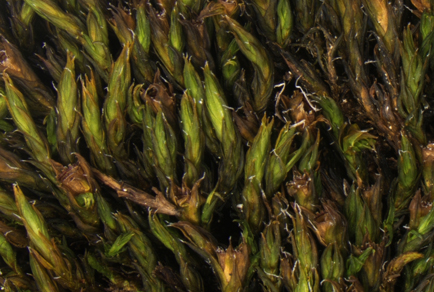
Schistidium pratense and S. heribertii, two distinctive and locally abundant components of the Alpine flora, are here formally described as new species from Europe. Although recognised for over two decades, their official taxonomic treatment has been long overdue. This paper provides an integrative account, combining morphological and molecular evidence, outlining their currently known distribution, and discussing their relationships to related species. Schistidium pratense is closely allied to S. dupretii in both molecular and morphological traits but differs in its larger overall size, including longer shoots and leaves, as well as in the absence of stomata. Schistidium heribertii resembles S. atrofuscum in its black coloration but is distinguished by its prominent leaf hairpoints and a pruinose appearance on the upper parts of the shoots. Molecular analyses place S. heribertii as the sister species to the clade comprising S. atrofuscum and S. helveticum. Both new species share similar ecological preferences, typically colonising calcareous substrates. Schistidium pratense is widespread and locally abundant in subalpine pastures, while S. heribertii has a more scattered distribution and predominantly inhabits warm sites across a broad elevational range in valleys with a continental climate. To date, S. heribertii is known only from the Alps, whereas S. pratense has also been recorded in Scandinavia, the Dinarides, the Apennines and the Black Forest in Germany.
References
- Amann, G., Köckinger, H., Reimann, M., Schröck, C. & Zechmeister, H. (2013) Bryofloristische Ergebnisse der Mooskartierung in Vorarlberg. Stapfia 99: 87–140.
- Amann, J., Meylan, Ch. & Culmann, P. (1918) Flore des mousses de la Suisse. Deuxième partie: Bryogéographie de la Suisse. Herbier Boissier, Genève, 414 pp.
- Bednarek-Ochyra, H. (1995) Rodzaj Racomitrium (Musci, Grimmiaceae) w Polsce: taksonomia, ekologia i fitogeografia [The genus Racomitrium (Musci, Grimmiaceae) in Poland: taxonomy, ecology and phytogeography]. Fragmenta Floristica et Geobotanica Series Polonica 2: 3–307. [In Polish with extensive English summary]
- Bednarek-Ochyra, H. (2006) A taxonomic monograph of the moss genus Codriophorus P. Beauv. (Grimmiaceae). W. Szafer Institute of Botany, Polish Academy of Sciences, Kraków, 276 pp.
- Blom, H.H. (1996) A revision of the Schistidium apocarpum complex in Norway and Sweden. Bryophytorum Bibliotheca 49: 1–333.
- Blom, H.H. (1997) An account on the genus Schistidium (Grimmiaceae) in two areas of the Swiss Alps. Meylania 12: 27–29.
- Blom, H.H. (1998) Schistidium. In: Nyholm, E. (Ed.) Illustrated flora of Nordic mosses, 4. Aulacomniaceae – Meesiaceae – Catoscopiaceae – Bartramiaceae – Timmiaceae – Encalyptaceae – Grimmiaceae – Ptychomitriaceae – Hedwigiaceae – Orthotrichaceae. Nordic Bryological Society, Copenhagen and Lund, pp. 287–330.
- Blom, H.H. & Darigo, C.E. (2009) Schistidium viride (Grimmiaceae), a new name for a common but neglected species in Eastern North America. The Bryologist 112: 273–277. https://doi.org/10.1639/0007-2745-112.2.273
- Blom, H.H. & De Zuttere, Ph. (2002) Quelques Schistidium intéressants récoltés dans les Alpes française (Savoie et Haut-Alpes) ainsi que suisses (Valais). Nowellia Bryologica 23: 36–38.
- Blom, H.H., Bednarek-Ochyra, H. & Ochyra, R. (2016) Studies on Schistidium (Grimmiaceae, Bryophyta) in Europe, with particular reference to the Alps: I. A description of S. marginale sp. nov. Phytotaxa 247 (3): 210–218. https://doi.org/10.11646/phytotaxa.247.3.4
- Bruch, Ph., Schimper, W.Ph. & Gümbel, Th. (1845) Bryologia europaea seu genera muscorum europaeorum monographice illustrata. 3. Schistidium et Grimmia. E. Schweizerbart, Stuttgart, pp. 93–132 + pls. 231–252, 254–261 [Fasc. 25–28 Monogr.: 1–10, Tab. i–v].
- Corley, M.F.V., Crundwell, A.C., Düll, R., Hill, M.O. & Smith, A.J.E. (1981) Mosses of Europe and the Azores; an annotated list of species, with synonyms from the recent literature. Journal of Bryology 11: 609–689. https://doi.org/10.1179/jbr.1981.11.4.609
- Deguchi, H. (1979) Les veritables caracteres de Schistidium alpicola (Sw. ex Hedw.) Limpr. et son nouveau synonyme, Schistidium agassizii Sull. et Lesqu. Revue Bryologique et Lichénologique Nouvelle Série 45: 425–435.
- De Notaris, J. (1836) Mantissa muscorum ad Floram Pedemontanam. Memorie della Reale Accademia delle Scienze di Torino 39: 211–258.
- Düll, R. (1984) Distribution of the European and Macaronesian mosses (Bryophytina). Part I. Bryologische Beiträge 4: 1–113.
- Ellis, L.T., Asthana, A.K., Srivastava, P., Omar, I., Rawat, K.K., Sahu, V., Cano, M.J., Costa, D.P., Dias, E.M., Dias dos Santos, N., Silva, J.B., Fedosov, V.E., Kozhin, M.N., Ignatova, E.A., Germano, S.R., Golovina, E.O., Gremmen, N.J.M., Ion, R., Ştefǎnuţ, S., von Konrat, M., Jimenez, M.S., Suárez, G.M., Kiebacher, T., Lebouvier, M., Long, D.G., Maity, D., Ochyra, R., Parnikoza, I., Plášek, V., Fialová, L., Skoupá, Z., Poponessi, S., Aleffi, M., Sabovljević, M.S., Sabovljević, A.D., Saha, P., Aziz, M.N., Sawicki, J., Suleiman, M., Sun, B.-Y., Váňa, J., Wójcik, T., Yoon, Y.-J., Żarnowiec, J. & Larraín, J. (2016) New national and regional bryophyte records, 46. Journal of Bryology 38: 47–63. https://doi.org/10.1080/03736687.2015.1123344
- Frisvoll, A.A. (1983) A taxonomic revision of the Racomitrium canescens group (Bryophyta, Grimmiaceae). Gunneria 41: 1–181.
- Frisvoll, A.A. (1988) A taxonomic revision of the Racomitrium heterostichum group (Bryophyta, Grimmiaceae) in N. and C. America, N. Africa, Europe and Asia. Gunneria 59: 1–289.
- Guerra, J., Jiménez-Martínez, J.F., Cano, M.J., Alonso, M. & Gallego, M.T. (2019) Schistidium convergens (Grimmiaceae, Bryophyta), a new species from southern Spain and Morocco. Nova Hedwigia 109: 65–80. https://doi.org/10.1127/nova_hedwigia/2019/0529
- Guerra, J., Martínez, M., Jiménez, J.A., Cano, M.J. & Gallego, M.T. (2020) A new species of moss emerges from molecular and morphological data: Schistidium memnonium sp. nov. (Grimmiaceae, Bryophyta). Plant Biosystems 155: 567–578. https://doi.org/10.1080/11263504.2020.1762789
- Hedwig, J. (1801) Species muscorum frondosum descriptae et tabulis aeneis LXXVII coloratis illustratae. Opus posthumum editum a Frederico Schwaegrichen. Sumtu Joannis Ambrosii Barthii, Lipsiae and apud Amand Koenig, Parisiis, vi + 357 pp. + Tab. lxxvii. https://doi.org/10.5962/bhl.title.26
- Katoh, K. & Standley, D.M. (2013) MAFFT multiple sequence alignment software version 7: Improvements in performance and usability. Molecular Biology and Evolution 30: 772–780. https://doi.org/10.1080/03736687.2020.1784587
- Kiebacher, T. (2020) Schistidium succulentum Ignatova & H.H.Blom (Grimmiaceae) new to Europe. Journal of Bryology 42: 277–280.
- Kiebacher, T., Köckinger, H. & Blom, H.H. (2021) Schistidium foraminis-martini sp. nov. (Grimmiaceae), a high mountain calcicole from the European Alps molecularly related to S. agassizii. Bryophyte Diversity & Evolution 44: 1–11. https://doi.org/10.11646/bde.44.1.1
- Kiebacher, T., Yousefi, N., Meier, M., Hodgson, A. & Blom, H.H. (2024) Homoplasy rather than intergeneric hybridisation explains mammillose leaf cells in Schistidium mammillosum sp. nov. (Grimmiaceae). Bryophyte Diversity and Evolution 47: 31–50. https://doi.org/10.11646/bde.47.1.7
- Köckinger, H., Suanjak, M., Schriebl, A. & Schröck, C. (2008) Die Moose Kärntens. Naturwissenschaftlicher Verein für Kärnten, Klagenfurt, 319 pp.
- Limpricht, K.G. (1888–1889) Die Laubmoose Deutschlands, Oesterreichs und der Schweiz. I. Abtheilung: Sphagnaceae, Andreaeaceae, Archidiaceae, Bryineae (Cleistocarpae, Stegorcarpae [Acrocarpae]). 69. Gattung: Schistidium. In: Dr. L. Rabenhorst’s Kryptogamen-Flora von Deutschland, Oesterreich und der Schweiz. Zweite Auflage. Band 4. Die Laubmoose Deutschlands, Oesterreichs und der Schweiz. Verlag von Eduard Kummer, Leipzig, pp. 702–718.
- Lüth, M. (2019) Mosses of Europe. A Photographic Flora. Volume 1. Privately published, Freiburg, 328 pp.
- Nees von Esenbeck, C.G.D. & Hornschuch, C.F. (1827) Bryologia germanica, oder Beschreibung der in Deutschland und in der Schweiz wachsenden Laubmoose. Zweiter Theil. Erste Abtheilung. Bei Friedrich Fleischer, Leipzig, 182 pp. + Tab. xiii–xxiv.
- Ochyra, R. (1989) Lectotypification of Schistidium pulvinatum (Hedw.) Brid. (Musci: Grimmiaceae) and its consequences. Nova Hedwigia 48: 85–106.
- Ochyra, R., Żarnowiec, J. & Bednarek-Ochyra, H. (2003) Census catalogue of Polish mosses. Institute of Botany, Polish Academy of Sciences, Kraków, 372 pp.
- Rambaut, A., Suchard, M. & Drummond, A. (2013) Tracer v1.6 – MCMC trace analysis package. [http://tree.bio.ed.ac.uk/software/tracer/]
- Ronquist, F., Teslenko, M., Van Der Mark, P., Ayres, D.L., Darling, A., Höhna, S., Larget, B., Liu, L., Suchard, M.A. & Huelsenbeck, J.P. (2012) MrBayes 3.2: Efficient Bayesian phylogenetic inference and model choice across a large model space. Systematic Biology 61: 539–542. https://doi.org/10.1093/sysbio/sys029
- Schimper, W.Ph. (1876) Synopsis muscorum europaeorum praemissa introductione de elementis bryologicis tractante. 2. Specierum descriptio. E. Schweizerbart, Stuttgart, 886 pp.
- Schkuhr, [Ch.] (1811) Deutschland‘s kryptogamische Gewächse. Zweyter Theil. Oder vier und zwanzigste Pflanzenklasse. II. Abtheilung, die deutschen Moose enthaltend. 2. Ernst Fleischer, Leipzig, pp. 41–82, Tab. 20–37.
- Schlüssmayr, G. & Schröck, C. (2013) Bemerkenswerte Neu- und Wiederfunde zur Moosflora von Oberösterreich. Stapfia 99: 75–86.
- Schröck, C., Köckinger, H., Amann, G. & Zechmeister, H. (2013) Rote Liste gefährderter Moose Voralbergs. Inatura Erlebnis Naturschau – Rote Listen 8. Inatura – Erlebnis Naturschau, Dornbirn, 236 pp.
- Simmons, M.P. & Ochoterena, H. (2000) Gaps as characters in sequence-based phylogenetic analyses. Systematic Biology 49: 369–381. https://doi.org/10.1093/sysbio/49.2.369
- Stamatakis, A. (2014) RAxML version 8: a tool for phylogenetic analysis and post-analysis of large phylogenies. Bioinformatics 30: 1312–1313. https://doi.org/10.1093/bioinformatics/btu033
- Stöver, B.C. & Müller, K.F. (2010) TreeGraph 2: Combining and visualizing evidence from different phylogenetic analyses. BMC Bioinformatics 11: 1–9. https://doi.org/10.1186/1471-2105-11-7
- Thériot, I. (1907) Grimmia dupretii, n. sp. The Bryologist 10: 62–64. https://doi.org/10.1639/0007-2745(1907)10[62:GDNS]2.0.CO;2
- Weber, W.A. (1976) New combinations in the Rocky Mountain flora. Phytologia 33: 105–106. https://doi.org/10.5962/bhl.part.16783
- Zander, R.H. (1978) New combinations in Didymodon (Musci) and a key to the taxa in North America north of Mexico. Phytologia 41: 11–32. https://doi.org/10.5962/bhl.part.20773