

Abstract
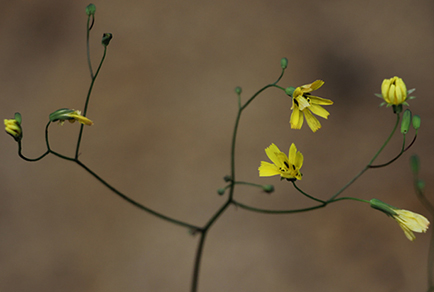
Youngia jianningensis, a new species from Jianning County, Fujian Province, China, is described and illustrated based on morphology and DNA analysis. Morphological comparisons indicated that this species is similar to Y. jiulongshanensis and Y. heterophylla, but differs by its slender and soft stems, different leaf shapes, number of florets per capitula and number of inner phyllaries. Phylogenetic analyses based on nuclear ribosomal ITS and three plastid marker sequences (atpB-rbcL, psbA-trnH and trnL-trnF) support that the new species is closely related to Y. jiulongshanensis.
References
- Babcock, E.B. & Stebbins, G.L. (1937) The genus Youngia. Carnegie Institution of Washington Publication 484: 1–106.
- Cai, X., Xu, Y.L., Liu, J.L., Zhou, H.L. & Jin, X.F. (2019) Youngia jiulongshanensis (Asteraceae: Liguliflorae), a new species from Zhejiang, East China. Phytotaxa 425: 244–252. https://doi.org/10.11646/phytotaxa.425.4.5
- Gao, Z.L. (2007) Study on the subtribe Lactucinae of Compositae from Shandong. Master degree dissertation. Shandong Normal University. [in Chinese]
- Kalyaanamoorthy, S., Minh, B.Q., Wong, T.K.F., von Haeseler, A. & Jermiin, L.S. (2017) ModelFinder: Fast model selection for accurate phylogenetic estimates. Nature Methods 14: 587–589. https://doi.org/10.1038/nmeth.4285
- Katoh, K., Misawa, K., Kuma, K. & Miyata, T. (2002) MAFFT: A novel method for rapid multiple sequence alignment based on fast Fourier transform. Nucleic Acids Research 30: 3059–3066. https://doi.org/10.1093/nar/gkf436
- Liu, Q., Zhang, T., Lin, N., Zhang, D., Huang, X., Yang, J., Tojiboeva, U., Zhang, J. & Deng, T. (2024) Rediscovery of Youngia longipes reveals a new species of Youngia (Asteraceae) in China. Phytotaxa 655: 21–36. https://doi.org/10.11646/phytotaxa.655.1.2
- Nakamura, K., Chung, K.-F., Huang, C. Jr., Kono, Y., Kokubugata, G. & Peng, C.-I. (2012) Extreme habitats that emerged in the Pleistocene triggered divergence of weedy Youngia (Asteraceae) in Taiwan. Molecular Phylogenetics and Evolution 63: 486–499. https://doi.org/10.1016/j.ympev.2012.01.023
- Nguyen, L.T., Schmidt, H.A., von Haeseler, A. & Minh, B.Q. (2014) IQ-TREE: A fast and effective stochastic algorithm for estimating maximum-likelihood phylogenies. Molecular Biology and Evolution 32: 268–274. https://doi.org/10.1093/molbev/msu300
- Peng, Y., Pu, X., Xiong, X. & Cheng, L. (2024) Youngia lushanensis, a new species of Asteraceae from Sichuan, China, inferred from morphology and nr ITS phylogeny. Frontiers in Plant Science 15: e1453759. https://doi.org/10.3389/fpls.2024.1453759
- Ronquist, F., Teslenko, M., Mark, P.V.D., Ayres, D.L., Darling, A., Hohna, S., Larget, B., Liu, L., Suchard, M.A. & Huelsenbeck, J.P. (2012) MrBayes 3.2, efficient Bayesian phylogenetic inference and model choice across a large model space. Systematic Biology 61 (3): 539–542. https://doi.org/10.1093/sysbio/sys029
- Sennikov, A.N. & Illarionova, I.D. (2008) Generic delimitation of the subtribe Ixeridinae newly segregated from Crepidiinae (Asteraceae-Lactuceae). Komarovia 5: 57–115.
- Shih, C. (1997) Youngia. In: Ling, Y. & Shih, C. (Eds.) Flora Reipublicae Popularis Sinicae, vol. 80 (1). Science Press, Beijing, pp. 125–159.
- Swofford, D.L. & Sullivan, J. (2003) Phylogeny inference based on parsimony and other methods using PAUP*. In: Lemley, P., Salemi, M. & Vandamme, A.-M. (Eds.) The phylogenetic handbook: a practical approach to phylogenetic analysis and hypothesis testing. Cambridge University Press, Cambridge, UK, pp. 60–206.
- Wang, H., Wortley, A.H. & Blackmore, S. (2009) Pollen morphology of Crepidinae and Lactucinae (Asteraceae: Cichorieae) and its systematic significance. Grana 48: 160–178. https://doi.org/10.1080/00173130902931209
- Zhang, D., Gao, F., Jakovlić, I., Zou, H., Zhang, J., Li, W.X. & Wang, G.T. (2020) PhyloSuite: An integrated and scalable desktop platform for streamlined molecular sequence data management and evolutionary phylogenetics studies. Molecular Ecology Resources 20: 348–355. https://doi.org/10.1111/1755-0998.13096