
Abstract
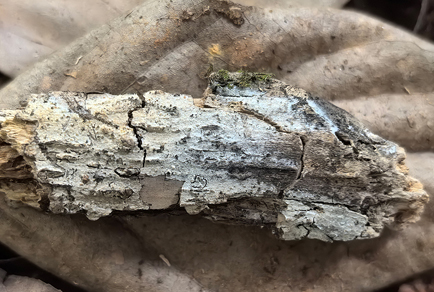
The corticioid fungi, distinguished by their longitudinally septate basidia, represent a unique group within the Auriculares taxa. A new corticioid fungus, Protomerulius wumengshanensis was discovered in Yunnan Province, southwest China, and is described and illustrated based on morphological and molecular evidence. It is characterized by producing white and smooth basidiomata, a monomitic system with clamp connections, hyphoid cystidia, longitudinally septate basidia, and thin-walled and oblong-ellipsoid, ellipsoid to ovoid, basidiospores measuring 4.3–5.9 × 3.0–4.0 µm. The new species resembles Protomerulius dubius macroscopically, but the latter differs in having larger basidiospores (5.2–8.0 × 3.7–4.7 μm vs. 4.3–5.9 × 3.0–4.0 μm). In nuclear large subunit rDNA (nLSU) and internal transcribed spacer (ITS) based phylogenies, the new species formed a distinct lineage in the Protomerulius clade. A full description, illustrations and phylogeny analysis results of the new species are provided.
References
- Anonymous (1969) Flora of British fungi: Colour identification chart. Her Majesty's Stationery Office, London, Britain, 3 pp.
- Bernicchia, A. & Gorjón, S.P. (2010) Fungi Europaei 12: Corticiaceae s.l. Edizioni Candusso, Lomazzo, 1007 pp.
- Dai, Y.C., Cui, B.K., Si, J., He, S.H., Hyde, K.D., Yuan, H.S., Liu, X.Y. & Zhou, L.W. (2015) Dynamics of the worldwide number of fungi with emphasis on fungal diversity in China. Mycological Progress 14: 62. https://doi.org/10.1007/s11557-015-1084-5
- Deng, Y.L., Chen, M., Liu, L.F., Zhao, R., Li, Q., Miao, J.Y., Zhao, C.L. & Zhou, H.M. (2024a) Molecular phylogeny and morphology reveal a new Eichleriella species (Auriculariales, Basidiomycota) from China. Phytotaxa 675 (3): 247–260. https://doi.org/10.11646/phytotaxa.675.3.4
- Deng, Y.L., Li, J.F., Zhao, C.L. & Zhao, J. (2024b) Four new fungal species in forest ecological system from southwestern China. Journal of Fungi 10: 194. https://doi.org/10.3390/jof10030194
- Dong, J.H., Gu, Z.R., Wang, Y.Y., Shi, Y.M. & Zhao, C.L. (2024a) A new corticioid fungus, Alloexidiopsis sinensis (Auriculariales, Basidiomycota), in China, evidenced by morphological characteristics and phylogenetic analyses. Phytotaxa 658 (3): 227–239. https://doi.org/10.11646/phytotaxa.658.3.1
- Dong, J.H., Zhu, Y.G., Qian, C.B. & Zhao, C.L. (2024b) Taxonomy and phylogeny of Auriculariales (Agaricomycetes, Basidiomycota) with descriptions of four new species from south-western China. MycoKeys 108: 115–146. https://doi.org/10.3897/mycokeys.108.128659
- Dong, J.H., Li, Q., Yuan, Q., Luo, Y.X., Zhang, X.C., Dai, Y.F., Zhou, Q., Liu, X.F., Deng, Y.L., Zhou, H.M., Akmal, M. & Zhao, C.L. (2024c) Species diversity, taxonomy, molecular systematics and divergence time of wood-inhabiting fungi in Yunnan-Guizhou Plateau, Asia. Mycosphere 15: 1110–1293. https://doi.org/10.5943/mycosphere/15/1/10
- Gu, Z.R., Zhou, H.M. & Zhao, C.L. (2024) Morphological characteristics and phylogenetic analyses reveal Scopuloides yunnanensis (Polyporales, Basidiomycota), a new wood-decaying fungus from China. Phytotaxa 665 (2): 85–95. https://doi.org/10.11646/phytotaxa.665.2.1
- Hall, T.A. (1999) Bioedit: A user-friendly biological sequence alignment editor and analysis program for windows 95/98/NT. Nucleic Acids Symposium Series 41: 95–98.
- Hibbett, D.S., Binder, M., Bischoff, J.F., Blackwell, M., Cannon, P.F., Eriksson, O.E., Huhndorf, S., James, T., Kirk, P.M., Lücking, R., Lumbsch, H., Lutzoni, F., Matheny, P.B., McLaughlin, D.J., Powell, M.J., Redhead, S., Schoch, C.L., Spatafora, J.W., Stalpers, J.A., Vilgalys, R., Aime, M.C., Aptroot, A., Bauer, R., Begerow, D., Benny, G.L., Castlebury, L.A., Crous, P.W., Dai, Y.C., Gams, W., Geiser, D.M., Griffith, G.W., Gueidan, C., Hawksworth, D.L., Hestmark, G., Hosaka, K., Humber, R.A., Hyde, K.D., Ironside, J.E., Kõljalg, U., Kurtzman, C.P., Larsson, K.H., Lichtwardt, R., Longcore, J., Miadlikowska, J., Miller, A., Moncalvo, J.M., Mozley-Standridge, S., Oberwinkler, F., Parmasto, E., Reeb, V., Rogers, J.D., Roux, C., Ryvarden, L., Sampaio, J.P., Schüssler, A., Sugiyama, J., Thorn, R.G., Tibell, L., Untereiner, W.A., Walker, C., Wang, Z., Weir, A., Weiss, M., White, M.M., Winka, K., Yao, Y.J. & Zhang, N. (2007) A higher-level phylogenetic classification of the Fungi. Mycological Research 111 (5): 509–547. https://doi.org/10.1016/j.mycres.2007.03.004
- Kalyaanamoorthy, S., Minh, B.Q., Wong, T.K.F., von Haeseler, A. & Jermiin, L.S. (2017) ModelFinder: Fast model selection for accurate phylogenetic estimates. Nature Methods 14: 587–589. https://doi.org/10.1038/nmeth.4285
- Malysheva, V. & Spirin, V. (2017) Taxonomy and phylogeny of the Auriculariales (Agaricomycetes, Basidiomycota) with stereoid basidiocarps. Fungal Biology 121 (8): 689–715. https://doi.org/10.1016/j.funbio.2017.05.001
- Malysheva, V., Spirin, V., Miettinen, O., Motato-Vásquez, V., Hernawati, S.J.S.S. & Larsson, K.H. (2018) Revision of Protohydnum (Auriculariales, Basidiomycota). Mycological Progress 17: 805–814. https://doi.org/10.1007/s11557-018-1393-6
- Mendes-Alvarenga, R.L., Westphalen, M.C. & Gibertoni, T.B. (2023) Elmerina and Protomerulius: novelties from Brazil based in morphological and molecular analyses. Plant Systematics and Evolution 309: 1–12. https://doi.org/10.1007/s00606-023-01875-x
- Miettinen, O., Spirin, V. & Niemelä, T. (2012) Notes on the genus Aporpium (Auriculariales, Basidiomycota), with a new species from temperate Europe. Annales Botanici Fennici 49 (5–6): 359–368. https://doi.org/10.5735/085.049.0607
- Petersen, J.H. (1996) The Danish Mycological Society´s colour-chart. Foreningen til Svampekundskabens Fremme, Greve, Denmark.
- Ronquist, F., Teslenko, M., van der Mark, P., Ayres, D.L., Darling, A. & Höhna, S. (2012) MrBayes 3.2: Efficient Bayesian phylogenetic inference and model choice across a large model space. Systematic Biology 61: 539–542. https://doi.org/10.1093/sysbio/sys029
- Spirin, V., Malysheva, V., Miettinen, O., Vlasák, J., Alvarenga, R.L.M., Gibertoni, T.B., Ryvarden, L. & Larsson, K.H. (2019) On Protomerulius and Heterochaetella (Auriculariales, Basidiomycota). Mycological Progress 18: 1079–1099. https://doi.org/10.1007/s11557-019-01507-0
- Wang, C.G., Dai, Y.C., Kout, J., Gates, G.M., Liu, H.G., Yuan, Y. & Vlasák, J. (2024) Multi-gene phylogeny and taxonomy of Physisporinus (Polyporales, Basidiomycota). Mycosphere 15: 1455–1521. https://doi.org/10.47371/mycosci.2023.09.002
- Weiss, M. & Oberwinkler, F. (2001) Phylogenetic relationships in Auriculariales and related groups – hypotheses derived from nuclear ribosomal DNA sequences. Mycological Research 105: 403–415. https://doi.org/10.1017/S095375620100363X
- Yang, Y., Jiang, Q.Q., Li, Q., Yang, J.W., Cha, L., Cheng, L.J., Yang, S.Q., Zhao, C.L. & Zhou, H.M. (2023) Molecular systematics and taxonomic analyses of three new wood-inhabiting fungi of Hyphoderma (Hyphodermataceae, Basidiomycota). Journal of Fungi 9 (11): 1044. https://doi.org/10.3390/jof9111044
- Yang, Y., Li, R., Jiang, Q.Q., Zhou, H.M., Muhammad, A., Wang, H.J. & Zhao, C.L. (2024) Phylogenetic and taxonomic analyses reveal three new wood-inhabiting fungi (Polyporales, Basidiomycota) in China. Journal of Fungi 10: 55. https://doi.org/10.3390/jof10010055
- Zhao, C.L., Cui, B.K. & Dai, Y.C. (2012) New species and phylogeny of Perenniporia based on morphological and molecular characters. Fungal Diversity 58: 47–60. https://doi.org/10.1007/s13225-012-0177-6
- Zhao, C.L., Qu, M.H., Huang, R.X. & Karunarathna, S.C. (2023) Multi-Gene phylogeny and taxonomy of the wood-rotting fungal genus Phlebia sensu lato (Polyporales, Basidiomycota). Journal of Fungi 9: 320. https://doi.org/10.3390/jof9030320
- Zhao, H., Wu, Y.D., Yang, Z.R., Liu, H.G., Wu, F., Dai, Y.C. & Yuan, Y. (2024) Polypore and a comparison with temperate and boreal regions of the Northern Hemisphere. Forest Ecosystem 11: 100200. https://doi.org/10.1016/j.fecs.2024.100200
- Zhou, H.M., Gu, Z.R. & Zhao, C.L. (2024) Molecular phylogeny and morphology reveal a new species of Asterostroma from Guizhou Province, China. Phytotaxa 635 (2): 173–181. https://doi.org/10.11646/phytotaxa.635.2.7