

Abstract
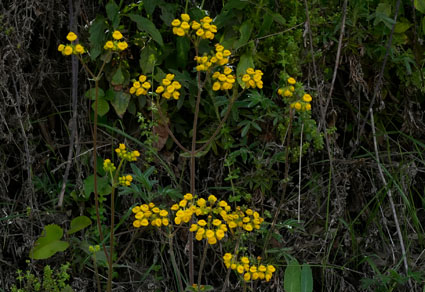
This work provides the first description of the Chilean endemic Calceolaria maulensis sp. nov., known from a coastal locality near Empedrado and four disjunct pre-Andean river valleys in the Maule Region of central Chile. Calceolaria maulensis grows within remnant patches of Nothofagus-dominated and mixed sclerophyllous-deciduous forest. It differs from the other perennial herbaceous taxa with rosette-arranged leaves and yellow corollas, by having closed yellow flowers with a well-developed upper lip and filaments as long as the anthers. Based on IUCN criteria, with an extent of occurrence <5000 km2 (3221 km2) and an Area of Occupancy <500 km2 (32 km2), Calceolaria maulensis should be considered Endangered (EN). More extensive surveys of the poorly collected lowlands of the Maule foothills and coastal range are needed.
References
- Arroyo, M.T.K., Cavieres, L., Marticorena, C. & Muñoz-Schick, M. (1995) Convergence in the Mediterranean Floras in Central Chile and California: Insights from Comparative Biogeography. In: Arroyo, M.T.K., Zedler, P.H. & Fox, M.D. (Eds.) Ecology and Biogeography of Mediterranean Ecosystems in Chile, California, and Australia. Springer, New York, pp. 43–88. https://doi.org/10.1007/978-1-4612-2490-7_3
- Arroyo, M.T.K., Marquet, P., Marticorena, C., Simonetti, J., Cavieres, L., Squeo, F. & Rozzi, R. (2004) Chilean winter rainfall-Valdivian forests. In: Mittermeier, R.A., Gil, P.R., Hoffmann, M., Pilgrim, J., Brooks, T., Mittermeier, C.G., Lamoreux, J. & Da Fonseca, G.A.B. (Eds.) Hotspots Revisited: Earth’s Biologically Wealthiest and Most Threatened Ecosystems. CEMEX, México, pp. 99–103.
- Azócar de la Cruz, G., Alfaro, G., Alonso, C., Calvo, R. & Orellana, P. (2022) Modeling the ignition risk: Analysis before and after megafire on Maule Region, Chile. Applied Sciences 12 (18): 9353. https://doi.org/10.3390/app12189353
- Bachman, S., Moat, J., Hill, A.W., de la Torre, J. & Scott, B. (2011) Supporting Red List threat assessments with GeoCAT: geospatial conservation assessment tool. In: Smith, V. & Penev, L. (Eds.) e-Infrastructures for data publishing in biodiversity science. ZooKeys 150: 117–126. https://doi.org/10.3897/zookeys.150.2109
- Bentham, G. (1846) Scrophulariaceae. In: de Candolle, A. (Ed.) Prodromus systematis naturalis regni vegetabilis, 10: pp. 186–586. https://doi.org/10.5962/bhl.title.286
- Blume, C.L. von (1851) Ord. Cupulifereae. In: Blume, C.L. von. Museum Botanicum Lugduno-Batavum sive stirpium Exoticarum, Novarum vel Minus Cognitarum ex Vivis aut Siccis Brevis Expositio et Descriptio, 1. Brill, Leiden, pp. 305–320. https://doi.org/10.1163/9789004587724_022
- Casanova, M., Luzio, W. & Maldonado, R. (2007) Correlación entre World Reference Base y Soil Taxonomy para los suelos de la VII Región del Maule de Chile. Revista de la Ciencia del Suelo y Nutrición Vegetal 7 (2): 14–21. https://doi.org/10.4067/S0718-27912007000200002
- Cosacov, A., Sérsic, A.N., Sosa, V., De-Nova, J.A., Nylinder, S. & Cocucci, A.A. (2009) New insights into the phylogenetic relationships, character evolution, and phytogeographic patterns of Calceolaria (Calceolariaceae). American Journal of Botany 96 (12): 2240–2255. https://doi.org/10.3732/ajb.0900165
- Ehrhart, C. (2000) Die Gattung Calceolaria (Scrophulariaceae) in Chile. Bibliotheca Botanica 153: 1–283.
- Ehrhart, C. (2005) The Chilean Calceolaria integrifolia s.l. species complex (Scrophulariaceae). Systematic Botany 30 (2): 383–411. https://doi.org/10.1600/0363644054223611
- Eyzaguirre, M.T. (2014) Novedades florísticas en la Reserva Nacional Roblería del Cobre de Loncha: Calceolaria philippii sp. nov. (Calceolariaceae) para la flora de Chile y ampliación de la distribución de Anemone rigida Gay (Ranunculaceae). Gayana Botánica 71 (2): 280–283. https://doi.org/10.4067/S0717-66432014000200013
- Fuentes, E.R., Montenegro, G., Rundel, P.W., Arroyo, M.T.K., Ginocchio, R. & Jaksic, F.M. (1995) Functional approaches to biodiversity in the Mediterranean-type ecosystems of central Chile. In: Davis, G.W. & Richardson, D.M. (Eds.) Mediterranean-Type Ecosystems. Springer, Berlin, Heidelberg, pp. 185–232. https://doi.org/10.1007/978-3-642-78881-9_4
- García, N. (2010) Calceolaria ascendens subsp. exigua, comb. et stat. nov. (Calceolariaceae), endémica de la cordillera de la Costa de Chile central. Gayana Botánica 67 (1): 138–141. https://doi.org/10.4067/S0717-66432010000100014
- Garreaud, R. (2015) The 2010–2015 mega-drought: A lesson for the future. Center for Climate and Resilience Research, Universidad de Chile. [https://www.cr2.cl/wp-content/uploads/2015/11/Megadrought_report.pdf]
- Gay, C. (1849) Historia Física y Política de Chile según documentos adquiridos en esta república durante doce años de residencia en ella y publicada bajo los auspicios del supremo gobierno. Botánica (Flora Chilena). Escrofularíneas. Flora Chilena 5: 181. [https://www.biodiversitylibrary.org/page/671325#page/26/mode/1up]
- Hinojosa, L.F. & Villagrán, C. (1997) Historia de los bosques del sur de Sudamérica, I: Antecedentes paleobotánicos, geológicos y climáticos del Terciario del cono sur de América. Revista Chilena de Historia Natural 70 (2): 225–239.
- IUCN (2024) Guidelines for using the IUCN Red List Categories and Criteria. Version 16. Standards and Petitions Committee of the IUCN Species Survival Commission. Available from: https://nc.iucnredlist.org/redlist/content/attachment_files/RedListGuidelines.pdf (accessed 13 July 2025)
- Lamarck, J.B. (1786) Encyclopédie méthodique, Botanique 2 (1). Panckoucke, Paris; Plomteux, Liege, 400 pp.
- Lavandero, N., Santilli, L. & Pérez, F. (2021) Calceolaria flavida (Calceolariaceae), a new endemic species to central Chile. PhytoKeys 185: 99–116. https://doi.org/10.3897/phytokeys.185.71755
- Lindley, J. (1829) Calceolaria ascendens. The Botanical Register; or Ornamental Flower-Garden and Shrubbery. Consisting of Coloured Figures of Plants and Shrubs, Cultivated in British Gardens; accompanied by their History, Best Method of Treatment in Cultivation, Propagation. 14: t. 1215.
- Linnaeus, C. (1770) Calceolaria pinnata. Kongl. Vetenskaps Academiens Handlingar, ser. 1, 31: 286–292.
- Looser, G. (1950) Notas sobre Lauráceas chilenas. Revista Universitaria 35 (1): 65–76.
- Macbride, J.F. (1937) Flora of Peru: Proteaceae. Publications of the Field Museum of Natural History, Botanical Series 13 (2, 2): 367–375.
- Manara, B. (1992) Some considerations on Latin geographical epithets in binomials. Taxon 41 (3): 524–528. https://doi.org/10.2307/1222825
- Mirbel, M. (1827) Recherches sur la distribution géographique des végétaux phanérogames dans l’Ancien Monde, depuis l’équateur jusqu’au pôle arctique; suivies de la description de neuf especes de la famille des Amentacées. Mémoires du Muséum d’histoire naturelle 14: 349–477.
- Mittermeier, R.A., Turner, W.R., Larsen, F.W., Brooks, T.M. & Gascon, C. (2011) Global biodiversity conservation: the critical role of hotspots. In: Biodiversity Hotspots. Springer, Berlin, Heidelberg, pp. 3–22. https://doi.org/10.1007/978-3-642-20992-5_1
- Molau, U. (1988) Scrophulariaceae. Part I. Calceolarieae. Flora Neotropica Monographs 47: 1–326.
- Molina, G.I. (1782) Saggio sulla storia naturale del Chili del Signor Abate Giovanni Ignazio Molina. Nella Stamperia di S. Tommaso d’Aquino, Bologna, 367 pp. https://doi.org/10.5962/bhl.title.62689
- Muñoz-Schick, M. & Moreira-Muñoz, A. (2009) Calceolaria caleuana M. Muñoz et Moreira nom. nov., nuevo nombre para la especie endémica chilena Calceolaria espinosae M. Muñoz et Moreira (Calceolariaceae). Gayana Botánica 66 (2): 279. https://doi.org/10.4067/S0717-66432009000200012
- Oersted, A.S. (1871) Kongelige Danske Videnskabernes Selskabs Skrifter, Naturvidenskabelig og Mathematisk Afdeling, Series 5, 9: 331–538.
- Orrego, R. (2022) Capítulo 1. Perfil climático y agroclimático de la región del Maule. In: González, J. & Morales, C. (Eds.) Boletín INIA 474. Producción intensiva de berries en macetas en Maule: clima, adaptación y costo de establecimiento. Instituto de Investigaciones Agropecuarias, Villa Alegre, pp. 11–28.
- Pliscoff, P., Folchi, M., Aliste, E., Cea, D. & Simonetti, J.A. (2020) Chile mega-fire 2017: An analysis of social representation of forest plantation territory. Applied Geography 119: 102226. https://doi.org/10.1016/j.apgeog.2020.102226
- Prance, G.T., Plana, V., Edwards, K.S. & Pennington, R.T. (2007) Proteaceae. Flora Neotropica, Monograph 100. New York Botanical Garden Press, Bronx, New York, 218 pp.
- Puppo, P. & Novoa, P. (2012) Revisión de la sección Calceolaria (Calceolariaceae) en Chile. Gayana Botánica 69 (2): 275–285. https://doi.org/10.4067/S0717-66432012000200007
- Rodríguez, R., Marticorena, C., Alarcón, D., Baeza, C., Cavieres, L., Finot, V.L., Fuentes, N., Kiessling, A., Mihoc, M., Pauchard, A., Ruiz, E., Sánchez, P. & Marticorena, A. (2018) Catálogo de las plantas vasculares de Chile. Gayana Botánica 75 (1): 1–430. https://doi.org/10.4067/S0717-66432018000100001
- Ruiz, H. & Pavón, J. (1798) Flora Peruviana, et Chilensis, sive Descriptiones, et icones plantarum Peruvianarum, et Chilensium, secundum systema Linnaeanum digestae, cum characteribus plurium generum evulgatorum reformatis, 1. Typis Gabrielis de Sancha, Madrid, 78 pp. https://doi.org/10.5962/bhl.title.814
- Salas, D. (2025) Calceolaria chasmophila (Calceolariaceae), a new species endemic to the Chilean flora. Gayana Botánica 82 (2): 136–142. https://doi.org/10.4067/S0717-6643202500020136
- Thiers, B.M. (2026 [updated continuously]) Index Herbariorum. Available from: https://sweetgum.nybg.org/science/ih/ (accessed 28 June 2026)
- Valenzuela, A. (1969) El género Calceolaria en la flora chilena. Anales del Museo de Historia Natural de Valparaíso 2: 27–115.
- Villagrán, C. (1995) Quaternary history of the Mediterranean vegetation of Chile. In: Arroyo, M.T.K., Zedler, P.H. & Fox, M.D. (Eds.) Ecology and Biogeography of Mediterranean Ecosystems in Chile, California, and Australia. Springer, New York, pp. 3–20. https://doi.org/10.1007/978-1-4612-2490-7_1
- Vogel, S. (1974) Ölblumen und ölsammelnde Bienen. Tropische und subtropische Pflanzenwelt 7: 283–547.
- Witasek, J. (1905) Die chilenischen Arten der Gattung Calceolaria. Österreichische Botanische Zeitschrift 55 (12): 449–456. https://doi.org/10.1007/BF01790733