
Abstract
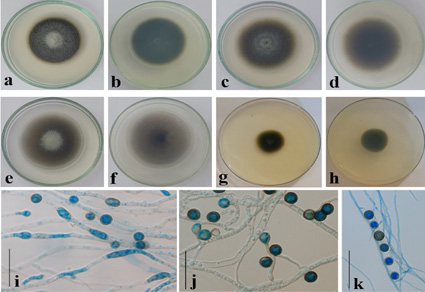
Pseudohumicola indica is established as a new species fungus isolated from leaf litter of Vetal Hill, Pune, Maharashtra, India. The taxonomic identity is supported by morphological features, including pigmented septate hyphae, reduced conidiophores, holoblastic conidiogenous cells, and globose to sub-globose conidia produced directly from hyphae. Multi-gene phylogenetic analysis (ITS, RPB-2, and tub-2) places Pseudohumicola indica NFCCI 6052 as a distinct, well-supported lineage within the genus. A holotype specimen (dried voucher culture) is deposited in the Ajrekar Mycological Herbarium (AMH 10850), and an ex-type living culture is preserved in the National Fungal Culture Collection of India (NFCCI 6052). Detailed descriptions, illustrations, and phylogenetic analyses are provided to support the establishment of this new species.
References
- Aamir, S., Sutar, S., Singh, S.K. & Baghela, A. (2015) A rapid and efficient method of fungal genomic DNA extraction, suitable for PCR based molecular methods. Plant Pathology & Quarantine 5: 74–81. https://doi.org/10.5943/ppq/5/2/6
- Bhunjun, C.S., Dong, Y., Jayawardena, R.S., Jeewon, R., Phukhamsakda, C., Bundhun, D. & Sheng, J. (2020) A polyphasic approach to delineate species in Bipolaris. Fungal Diversity 102 (1): 225–256. https://doi.org/10.1007/s13225-020-00446-6
- Bhunjun, C.S., Phukhamsakda, C., Jayawardena, R.S., Jeewon, R., Promputtha, I. & Hyde, K.D. (2021) Investigating species boundaries in Colletotrichum. Fungal Diversity 107 (1): 107–127. https://doi.org/10.1007/s13225-021-00471-z
- Bhunjun, C.S., Phukhamsakda, C., Jeewon, R., Promputtha, I. & Hyde, K.D. (2021) Integrating different lines of evidence to establish a novel ascomycete genus and family (Anastomitrabeculia, Anastomitrabeculiaceae) in Pleosporales. Journal of Fungi 7 (2): 94. https://doi.org/10.3390/jof7020094
- Brahmanage, R.S., Dayarathne, M.C., Wanasinghe, D.N., Thambugala, K.M., Jeewon, R., Chethana, K.T., Yan, J.Y. & Hyde, K.D. (2020) Taxonomic novelties of saprobic Pleosporales from selected dicotyledons and grasses. https://doi.org/10.5943/mycosphere/11/1/15
- Crous, P.W., Wingfield, M.J., Schumacher, R.K., Summerell, B.A., Giraldo, A., Gené, J., Guarro, J., Wanasinghe, D.N., Hyde, K.D., Camporesi, E., Garethjones, E.B., Thambugala, K.M., Malysheva, E.F., Malysheva, V.F., Acharya, K., Álvarez, J., Alvarado, P., Assefa, A., Barnes, C.W., Bartlett, J.S., Blanchette, R.A., Burgess, T.I., Carlavilla, J.R., Coetzee, M.P.A., Damm, U., Decock, C.A., Denbreeÿen, A., Devries, B., Dutta, A.K., Holdom, D.G., Rooney-Latham, S., Manjón, J.L., Marincowitz, S., Mirabolfathy, M., Moreno, G., Nakashima, C., Papizadeh, M., Shahzadehfazeli, S.A., Amoozegar, M.A., Romberg, M.K., Shivas, R.G., Stalpers, J.A., Stielow, B., Stukely, M.J.C., Swart, W.J., Tan, Y.P., Vanderbank, M., Wood, A.R., Zhang, Y. & Groenewald, J.Z. (2014) Fungal Planet description sheets: 281–319. Persoonia-Molecular Phylogeny and Evolution of Fungi 33 (1): 212–289. https://doi.org/10.3767/003158514X685680
- Dayarathne, M.C. (2016) Taxonomic utility of old names in current fungal classification and nomenclature: Conflicts, confusion & clarifications. Mycosphere 7 (11): 1622–1648. https://doi.org/10.5943/mycosphere/7/11/2
- Devadatha, B., Sarma, V.V., Jeewon, R., Wanasinghe, D.N., Hyde, K.D. & Jones, E.B.G. (2018) Thyridariella, a novel marine fungal genus from India: morphological characterization and phylogeny inferred from multigene DNA sequence analyses. Mycological Progress 17 (7): 791–804. https://doi.org/10.1007/s11557-018-1387-4
- Domsch, K.H., Gams, W. & Anderson, T.H. (1980) Compendium of soil fungi. Volume 1.
- Ellis, M.B. (1976) More Dematiaceous Hyphomycetes. Commonwealth Mycological Institute, Kew, Surrey, England.
- Gams, W. (2015) An ex-type culture cannot always tell the ultimate truth. IMA Fungus 6 (2): A69–A69. https://doi.org/10.1007/BF03449357
- Glass, N.L. & Donaldson, G.C. (1995) Development of primer sets designed for use with the PCR to amplify conserved genes from filamentous ascomycetes. Applied and Environmental Microbiology 61 (4): 1323–1330. https://doi.org/10.1128/aem.61.4.1323-1330.1995
- Gomdola, D., Jeewon, R., Gentekaki, E., Jayawardena, R.S., Hyde, K.D., Alotibi, F. & Wang, Y. (2024) Assigning Xiuguozhangia (genus incertae sedis) to Pseudoberkleasmiaceae (Dothideomycetes, Pleosporomycetidae, Pleosporales) and introducing X. broussonetiae as a novel species. MycoKeys 111: 181. https://doi.org/10.3897/mycokeys.111.136202
- Gomdola, D., Jeewon, R., McKenzie, E.H., Jayawardena, R.S., Al-Otibi, F., Tang, X., Wang, Y. & Fu, L. (2025) Phylogenetic diversity of Colletotrichum species (Sordariomycetes, Glomerellales, Glomerellaceae) associated with plant diseases in Thailand. MycoKeys 119: 137. https://doi.org/10.3897/mycokeys.119.152323.suppl1
- Hao, L., Chen, C., Zhang, R., Zhu, M., Sun, G. & Gleason, M.L. (2013) A new species of Scolecobasidium associated with the sooty blotch and flyspeck complex on banana from China. Mycological Progress 12: 489–495. https://doi.org/10.1007/s11557-012-0855-5
- He, M.Q., Wang, M.Q., Chen, Z.H., Deng, W.Q., Li, T.H., Vizzini, A., Jeewon, R., Hyde, K.D. & Zhao, R.L. (2022) Potential benefits and harms: A review of poisonous mushrooms in the world. Fungal Biology Reviews 42: 56–68. https://doi.org/10.1016/j.fbr.2022.06.002
- Hoang, D.T., Chernomor, O., Von Haeseler, A., Minh, B.Q. & Vinh, L.S. (2018) UFBoot2: improving the ultrafast bootstrap approximation. Molecular Biology and Evolution 35 (2): 518–522. https://doi.org/10.1093/molbev/msx281
- Hongsanan, S., Jeewon, R., Purahong, W., Xie, N., Liu, J.K., Jayawardena, R.S. & Peršoh, D. (2018) Can we use environmental DNA as holotypes? Fungal Diversity 92 (1): 1–30. https://doi.org/10.1007/s13225-018-0404-x
- Hurdeal, V.G., Gentekaki, E., Hyde, K.D. & Jeewon, R. (2021) Where are the basal fungi? Current status on diversity, ecology, evolution, and taxonomy. Biologia 76 (2): 421–440. https://doi.org/10.2478/s11756-020-00642-4
- Hyde, K.D., Jeewon, R., Chen, Y.J., Bhunjun, C.S., Calabon, M.S., Jiang, H.B. & Lumyong, S. (2020) The numbers of fungi: is the descriptive curve flattening? Fungal Diversity 103 (1): 219–271. https://doi.org/10.1007/s13225-020-00458-2
- Hyde, K.D., Noorabadi, M.T., Thiyagaraja, V., He, M.Q., Johnston, P.R., Wijesinghe, S.N. & Dissanayake, L.S. (2024) The 2024 Outline of Fungi and fungus-like taxa. Mycosphere 15 (1): 5146–6239. https://doi.org/10.5943/mycosphere/15/1/25
- Hyde, K.D., Norphanphoun, C., Chen, J., Dissanayake, A.J., Doilom, M., Hongsanan, S., Jayawardena, R.S., Jeewon, R. & Stadler, M. (2018) Thailand’s amazing diversity: up to 96% of fungi in northern Thailand may be novel. Fungal Diversity 93 (1): 215–239. https://doi.org/10.1007/s13225-018-0415-7
- Hyde, K.D., Xu, J., Rapior, S., Jeewon, R., Lumyong, S., Niego, A.G.T. & Stadler, M. (2019) The amazing potential of fungi: 50 ways we can exploit fungi industrially. Fungal Diversity 97 (1): 1–36.
- Index Fungorum. [https://www.indexfungorum.org/names/Names.asp]
- Jayasiri, S.C., Hyde, K.D., Ariyawansa, H.A., Bhat, J., Buyck, B., Cai, L. & Promputtha, I. (2015) The Faces of Fungi database: fungal names linked with morphology, phylogeny and human impacts. Fungal Diversity 74 (1): 3–18. https://doi.org/10.1007/s13225-015-0351-8
- Jiang, H.B., Jeewon, R., Karunarathna, S.C., Phukhamsakda, C., Doilom, M., Kakumyan, P., Suwannarach, N., Phookamsak, R. & Lumyong, S. (2021) Reappraisal of Immotthia in Dictyosporiaceae, Pleosporales: Introducing Immotthia bambusae sp. nov. and Pseudocyclothyriella clematidis comb. et gen. nov. based on morphology and phylogeny. Frontiers in Microbiology 12: 656235. https://doi.org/10.3389/fmicb.2021.656235
- Jeewon, R. (2017) Nomenclatural and identification pitfalls of endophytic mycota based on DNA sequence analyses of ribosomal and protein genes phylogenetic markers: A taxonomic dead end? Mycosphere. https://doi.org/10.5943/mycosphere/8/10/7
- Jeewon, R. & Hyde, K.D. (2016) Establishing species boundaries and new taxa among fungi: recommendations to resolve taxonomic ambiguities. Mycosphere 7 (11): 1669–1677. https://doi.org/10.5943/mycosphere/7/11/4
- Jeewon, R.E.C.Y., Liew, E.C.Y. & Hyde, K.D. (2004) Phylogenetic evaluation of species nomenclature of Pestalotiopsis in relation to host association. Fungal Diversity.
- Jeewon, R., Luckhun, A.B., Bhoyroo, V., Sadeer, N.B., Mahomoodally, M.F., Rampadarath, S. & Hyde, K.D. (2019) Pharmaceutical potential of marine fungal endophytes. In: Endophytes and secondary metabolites, pp. 1–23. https://doi.org/10.1007/978-3-319-90484-9_6
- Jeewon, R., Yeung, Q.S., Wannasinghe, D.N., Rampadarath, S., Puchooa, D., Wang, H.K. & Hyde, K.D. (2018) Hidden mycota of pine needles: Molecular signatures from PCR-DGGE and Ribosomal DNA phylogenetic characterization of novel phylotypes. Scientific Reports 8 (1): 18053. https://doi.org/10.1038/s41598-018-36573-z
- Katoh, K. & Standley, D.M. (2013) MAFFT multiple sequence alignment software version 7: improvements in performance and usability. Molecular Biology and Evolution 30 (4): 772–780. https://doi.org/10.1093/molbev/mst010
- Kornerup, A. & Wanscher, J.H. (1978) Metheun’s Handbook of Colours, IIIrd Ed. Metheun and Co. Ltd., London.
- Larsson, A. (2014) AliView: a fast and lightweight alignment viewer and editor for large datasets. Bioinformatics 30 (22): 3276–3278. https://doi.org/10.1093/bioinformatics/btu531
- Li, J.F., Jiang, H.B., Jeewon, R., Hongsanan, S., Bhat, D.J., Tang, S.M. & Phookamsak, R. (2022) Alternaria: Update on species limits, evolution, multi-locus phylogeny, and classification. Studies in Fungi 8 (1): 1–61. https://doi.org/10.48130/sif-2022-0023
- Liao, C., Doilom, M., Jeewon, R., Hyde, K.D., Manawasinghe, I.S., Chethana, K.T. & Dong, W. (2025) Challenges and update on fungal endophytes: classification, definition, diversity, ecology, evolution and functions. Fungal Diversity 131 (1): 301–367. https://doi.org/10.1007/s13225-025-00550-5
- Lücking, R., Aime, M.C., Robbertse, B., Miller, A.N., Aoki, T., Ariyawansa, H.A. & Schoch, C.L. (2021) Fungal taxonomy and sequence-based nomenclature. Nature Microbiology 6 (5): 540–548. https://doi.org/10.1038/s41564-021-00888-x
- Nguyen, L.T., Schmidt, H.A., Von Haeseler, A. & Minh, B.Q. (2015) IQ-TREE: a fast and effective stochastic algorithm for estimating maximum-likelihood phylogenies. Molecular Biology and Evolution 32 (1): 268–274. https://doi.org/10.1093/molbev/msu300
- Pem, D., Hyde, K.D., Doilom, M., Camporesi, E., Hongsanan, S., Rampadarath, S. & Jeewon, R. (2019) Multigene phylogenetic analyses to establish new Valsaria species and taxonomic significance of spore ornamentation. PLOS ONE 14 (6): e0217982. https://doi.org/10.1371/journal.pone.0217982
- Pem, D., Jeewon, R., Bhat, D.J., Doilom, M., Boonmee, S., Hongsanan, S., Promputtha, I., Xu, J.C. & Hyde, K.D. (2019) Mycosphere notes 275–324: A morpho-taxonomic revision and typification of obscure Dothideomycetes genera (incertae sedis). https://doi.org/10.5943/mycosphere/10/1/22
- Qiao, T.M., Zhang, J., Li, S.J., Han, S. & Zhu, T.H. (2016) Development of nested PCR, multiplex PCR, and loop-mediated isothermal amplification assays for rapid detection of Cylindrocladium scoparium on Eucalyptus. The Plant Pathology Journal 32 (5): 414–422. https://doi.org/10.5423/PPJ.OA.03.2016.0065
- Samerpitak, K., Van der Linde, E., Choi, H.J., Gerrits Van Den Ende, A.H.G., Machouart, M., Gueidan, C. & De Hoog, G.S. (2014) Taxonomy of Ochroconis genus including opportunistic pathogens on humans and animals. Fungal Diversity 65: 89–126. https://doi.org/10.1007/s13225-013-0253-6
- Seifert, K.A. & Gams, W. (2011) The genera of Hyphomycetes–2011 update. Persoonia-Molecular Phylogeny and Evolution of Fungi 27 (1): 119–129. https://doi.org/10.3767/003158511x617435
- Senanayake, I.C., Rathnayaka, A.R., Marasinghe, D.S., Calabon, M.S., Gentekaki, E., Lee, H.B., Hurdeal, V.G., Pem, D., Dissanayake, L.S., Wijesinghe, S.N., Bundhun, D., Nguyen, T.T., Goonasekara, I.D., Abeywickrama, P.D., Bhunjun, C.S., Jayawardena, R.S., Wanasinghe, D.N., Jeewon, R., Bhat, D.J. & Xiang, M.M. (2020) Morphological approaches in studying fungi: Collection, examination, isolation, sporulation and preservation. Mycosphere 11 (1): 2678–2754. https://doi.org/10.5943/mycosphere/11/1/20
- Shen, M., Zhang, J.Q., Zhao, L.L., Groenewald, J.Z., Crous, P.W. & Zhang, Y. (2020) Venturiales. Studies in Mycology 96: 185–308. https://doi.org/10.1016/j.simyco.2020.03.001
- Su, X.J., Luo, Z.L., Jeewon, R., Bhat, D.J., Bao, D.F., Li, W.L., Hao, Y.E., Su, H.Y. & Hyde, K.D. (2018) Morphology and multigene phylogeny reveal new genus and species of Torulaceae from freshwater habitats in northwestern Yunnan, China. Mycological Progress 17 (5): 531–545. https://doi.org/10.1007/s11557-018-1388-3
- Sun, J.Z., Liu, X.Z., McKenzie, E.H., Jeewon, R., Liu, J.K., Zhang, X.L. & Hyde, K.D. (2019) Fungicolous fungi: terminology, diversity, distribution, evolution, and species checklist. Fungal Diversity 95 (1): 337–430. https://doi.org/10.1007/s13225-019-00422-9
- Suthar, M. & Singh, S.K. (2020) Extraction and Partial Characterization of Melanin Pigment from Alternaria burnsii NFCCI 5753 and Cladosporium tenuissimum NFCCI 5754. Mycological Spectrum 1 (1): 28–46. https://doi.org/10.64993/MS.1.1.3
- Tang, A.M., Jeewon, R. & Hyde, K.D. (2007) Phylogenetic utility of protein (RPB2, β-tubulin) and ribosomal (LSU, SSU) gene sequences in the systematics of Sordariomycetes (Ascomycota, Fungi). Antonie van Leeuwenhoek 91 (4): 327–349. https://doi.org/10.1007/s10482-006-9120-8
- Tang, X., Jeewon, R., Jayawardena, R.S., Gomdola, D., Lu, Y.Z., Xu, R.J., Alrefaei, A.F., Alotibi, F., Hyde, K.D. & Kang, J.C. (2024) Additions to the genus Kirschsteiniothelia (Dothideomycetes); Three novel species and a new host record, based on morphology and phylogeny. MycoKeys 110: 35. https://doi.org/10.3897/mycokeys.110.133450.figure5
- Wang, Y., Zhang, Y., Bhoyroo, V., Rampadarath, S. & Jeewon, R. (2021) Multigene phylogenetics and morphology reveal five novel Lasiodiplodia species associated with blueberries. Life 11 (7): 657. https://doi.org/10.3390/life11070657
- White, T.J., Bruns, T., Lee, S.J.W.T. & Taylor, J. (1990) Amplification and direct sequencing of fungal ribosomal RNA genes for phylogenetics. In: PCR protocols: a guide to methods and applications 18 (1), pp. 315–322. https://doi.org/10.1016/b978-0-12-372180-8.50042-1
- Wong Chin, J.M., Jeewon, R., Fahad Alrefaei, A., Puchooa, D., Bahorun, T. & Neergheen, V.S. (2025) Marine-derived fungi from the genus Aspergillus (Ascomycota) and their anticancer properties. Mycology 16 (2): 545–592. https://doi.org/10.1080/21501203.2024.2402309
- Yadav, S.K., Ir, R., Jeewon, R., Doble, M., Hyde, K.D., Kaliappan, I. & Durairajan, S.S.K. (2020) A mechanistic review on medicinal mushrooms-derived bioactive compounds: Potential mycotherapy candidates for alleviating neurological disorders. Planta Medica 86 (16): 1161–1175. https://doi.org/10.1055/a-1177-4834
- Zeng, X.Y., Jeewon, R., Hongsanan, S., Hyde, K.D. & Wen, T.C. (2022) Unravelling evolutionary relationships between epifoliar Meliolaceae and angiosperms. Journal of Systematics and Evolution 60 (1): 23–42. https://doi.org/10.1111/jse.12643
- Zeng, X.Y., Wu, H.X., Hongsanan, S., Jeewon, R., Wen, T.C., Maharachchikumbura, S.S. & Hyde, K.D. (2019) Taxonomy and the evolutionary history of Micropeltidaceae. Fungal Diversity 97 (1): 393–436. https://doi.org/10.1007/s13225-019-00431-8