
Abstract
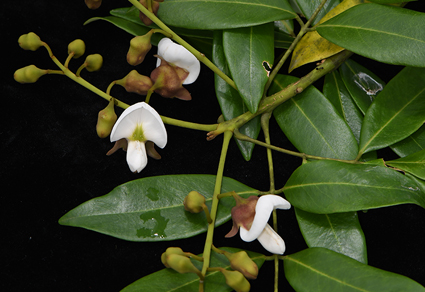
Integrated morphological analyses of flowering and fruiting materials suggest that several Guangdong populations of Ormosia—previously referred to as O. indurata, O. xylocarpa, or O. eugeniifolia based on vegetative specimens—correspond to two new species: O. yangjiangensis and O. taishanensis. Morphologically, O. yangjiangensis most closely resembles O. xylocarpa and O. pubescens. It differs from O. xylocarpa in leaflets thinly coriaceous, raceme axillary or pseudoterminal, legumes lacking a rib along the adaxial suture. Compared to O. pubescens, it is distinguished by its larger flowers (1.8–2.5 × 2.0–2.5 cm) and laterally compressed legumes. O. taishanensis is most similar to O. eugeniifolia but can be distinguished by its raceme axillary or pseudoterminal, legumes possess a prominent rib along the adaxial suture, valves of legume 6–11 mm thick. Both species are known from only a few localities and have very limited population sizes. Based on IUCN Red List criteria, the conservation status of the two new species is assessed as Endangered and Critically Endangered; both are recommended for inclusion as National Second-Class Protected Wild Plants under China’s List of National Key Protected Wild Plants (2021 edition). For the convenience of comparison, a key to all Ormosia species occurring in Guangdong Province is provided.
References
- Bentham, G. (1840) Enumeration of plants collected by Mr Schomburgk in British Guiana. Journal of Botany 2: 38–103. https://doi.org/10.1080/00222933909512423
- Borowiec, M.L. (2016) AMAS: a fast tool for alignment manipulation and computing of summary statistics. PeerJ 3: e1355v1. https://doi.org/10.7287/peerj.preprints.1355v1
- Cardoso, D., de Queiroz, L.P., Pennington, R.T., de Lima, H.C., Fonty, E., Wojciechowski, M.F. & Lavin, M. (2012) Revisiting the phylogeny of papilionoid legumes: new insights from comprehensively sampled early-branching lineages. American Journal of Botany 99 (12): 1991–2013. https://doi.org/10.3732/ajb.1200380
- Cardoso, D.B., Stirton, C.H. & Torke, B.M. (2014) Taxonomy of South American Ormosia (Leguminosae, Papilionoideae): Recircumscription of O. costulata, reinstatement of O. trifoliolata, and the new species O. lewisii from the Brazilian Atlantic Forest. Systematic Botany 39: 1132–1141. https://doi.org/10.1600/036364414X683903
- Cardoso, D., Harris, D.J., Wieringa, J.J., São-Mateus, W.M., Batalha-Filho, H., Torke, B.M., Prenner, G. & Queiroz, L.P. (2017) A molecular-dated phylogeny and biogeography of the monotypic legume genus Haplormosia, a missing African branch of the otherwise American-Australian Brongniartieae clade. Molecular Phylogenetics and Evolution 107: 431–442. https://doi.org/10.1016/j.ympev.2016.12.012
- Casella, F., Vurro, M., Valerio, F., Perrino, E.V., Mezzapesa, G.N. & Boari, A. (2023) Phytotoxic effects of essential oils from six Lamiaceae species. Agronomy 13: 257. https://doi.org/10.3390/agronomy13010257
- Chamala, S., García, N., Godden, G.T., Krishnakumar, V., Jordon-Thaden, I.E., De Smet, R., Barbazuk, W.B., Soltis, D.E. & Soltis, P.S. (2015) MarkerMiner 1.0: A new application for phylogenetic marker development using angiosperm transcriptomes. Applications in Plant Sciences 3 (4): 1400115. https://doi.org/10.3732/apps.1400115
- Chang, R.H. (1984) A Study on the Chinese Ormosia Jacks. Acta Phytotaxonomica Sinica 22 (2): 110–118.
- Costa, J.A.S., Nunes, T.S., Ferreira, A.P.L., Stradmann, M.T.S. & Queiroz, L.P. (2002) Leguminosas forrageiras da Caatinga: Espéciesimportantespara as Comunidadesrurais do Sertão da Bahia; UniversidadeEstadual de Feira de Santana, SASOP: Feira de Santana, Brazil, pp. 1–8.
- De Souza Gregorio, B., Carvalho, C.S., Stirton, C.H., Lewis, G.P., Torke, B.M., Duan, L., Ramos, G., Rocha, L., Zartman, C.E. & Cardoso, D.B.O.S. (2025) Phylogenomics, morphological evolution, and taxonomic revision of Spirotropis, a newly delimited legume genus of ecologically dominant Amazonian tree species. Taxon 74: 572–601. https://doi.org/10.1002/tax.13325
- Ducke, A. (1922) Plantes nouvelles ou peu connues de la région amazonienne. Jardim Botanico Do Rio De Janeiro 3: 135–139.
- Ducke, A. (1925) Plantes nouvelles ou peu connues de la region amazonienne. Jardim Botanico Do Rio De Janeiro 4: 61–71.
- Guindon, S., Dufayard, J.F., Lefort, V., Anisimova, M., Hordijk, W. & Gascuel, O. (2010) New algorithms and methods to estimate maximum-likelihood phylogenies: assessing the performance of PhyML 3.0. Systematic Biology 59 (3): 307–321. https://doi.org/10.1093/sysbio/syq010
- Hall, T.A. (1999) BioEdit: a user-friendly biological sequence alignment editor and analysis program for Windows 95/98/NT. Nucleic Acids Symposium Series 41: 95–98.
- Hance, H.F. (1882) A decade of new Hong-Kong plants. Trimen’s Journal of Botany, British and Foreign 20: 77–80.
- How, F.C. (1951) Critical notes on several species of Ormosia in South China. Acta Phytotaxonomica Sinica 1 (2): 231–236.
- Huber, J. (1909) Materiaes para a Flora Amazonica VII. Plantae Duckeanae austro-guyanenses. Boletim do Museu Goeldi de Historia Natural e Ethnographia 5: 294–436.
- IUCN Standards & Petitions Subcommittee. (2019) Guidelines for Using the IUCN Red List Categories and Criteria. Version 14. IUCN Standards and Petitions Subcommittee.
- Jackson, G. (1811) Accout of Ormosia, a new genus of decandrous plants belonging to the natural order of Leguminosae. The Transactions Linnean Society of London 10: 358–364. https://doi.org/10.1111/j.1096-3642.1810.tb00025.x
- Kolanowska, M. & Szlachetko, D.L. (2025) Importance of type specimens for understanding species boundaries: re-evaluation of the identity of Myoxanthus ceratothallis (Orchidaceae) Annales Botanici Fennici 62: 151–160. https://doi.org/10.5735/085.062.0125
- Johnson, M.G., Gardner, E.M., Liu, Y., Medina, R., Goffinet, B., Shaw, A.J., Zerega, N.J.C. & Wickett, N.J. (2016) HybPiper: extracting coding sequence and introns for phylogenetics from high-throughput sequencing reads using target enrichment. Applications in Plant Sciences 4 (7): e1600016. https://doi.org/10.3732/apps.1600016
- Katoh, K. & Standley, D.M. (2013) MAFFT multiple sequence alignment software version 7: improvements in performance and usability. Molecular Biology and Evolution 30 (4): 772–780. https://doi.org/10.1093/molbev/mst010
- Kleinhoonte, A. (1926) ue Beiträge zur Flora Surinams IV. Recueil des Travaux Botaniques Néerlandais 22: 324–417.
- Liu, B.B., Ma, Z.Y., Ren, C., Hodel, R.G.J., Sun, M., Liu, X.Q., Liu, G.N., Hong, D.Y., Zimmer, E.A. & Wen, J. (2021) Capturing single-copy nuclear genes, organellar genomes, and nuclear ribosomal DNA from deep genome skimming data for plant phylogenetics: A case study in Vitaceae. Journal of Systematics and Evolution 59 (5): 1124–1138. https://doi.org/10.1111/jse.12806
- Liu, H., Su, Z., Yu, S., Liu, J., Yin, X., Zhang, G., Liu, W. & Li, B. (2019) Genome comparison reveals mutation hotspots in the chloroplast genome and phylogenetic relationships of Ormosia species. BioMed Research International 2019: 7265030. https://doi.org/10.1155/2019/7265030
- Liu, J.Q. (2016) “The integrative species concept” and “species on the speciation way”. Biodiversity Science 24 (9): 1004–1008. https://doi.org/10.17520/biods.2016222
- LPWG. (2013) Legume phylogeny and classification in the 21st century: Progress, prospects and lessons for other species-rich clades. Taxon 62: 217–248. https://doi.org/10.12705/622.8
- LPWG. (2017) A new subfamily classification of the Leguminosae based on a taxonomically comprehensive phylogeny. Taxon 66 (1): 44–77. https://doi.org/10.12705/661.3
- Lewis, G.P. (1987) Legumes of Bahia. Royal Botanic Gardens, Kew Press, London.
- Lewis, G.P., Schrire, B., Mackinder, B. & Lock, M. (2005) Legumes of the World. Royal Botanic Gardens, Kew Press, London. https://doi.org/10.2307/25065563
- Lewis, G.P., Schrire, B.D., Mackinder, B.A., Rico, L. & Clark, R. (2013) A 2013 linear sequence of legume genera set in a phylogenetic context: A tool for collections management and taxon sampling. South African Journal of Botany 89: 76–84. https://doi.org/10.1016/j.sajb.2013.06.005
- Mark, J., Newton, A., Oldfield, S. & Rivers, M. (2014) The International Timber Trade: A Working List of Commercial Timber Tree Species. Botanic Gardens Conservation International press, Richmond, 56 pp.
- Mayr, E. (1992) A local flora and the biological species concept. American Journal of Botany 79 (2): 222–238. https://doi.org/10.1002/j.1537-2197.1992.tb13641.x
- Merrill, E.D. & Chen, L. (1943) The Chinese and Indochinese species of Ormosia. Sargentia 3: 77–120. https://doi.org/10.5962/p.315950
- Minh, B.Q., Nguyen, M.A. & von Haeseler, A. (2013) Ultrafast approximation for phylogenetic bootstrap. Molecular Biology and Evolution 30 (5): 1188–1195. https://doi.org/10.1093/molbev/mst024
- Minh, B.Q., Schmidt, H.A., Chernomor, O., Schrempf, D., Woodhams, M.D., von Haeseler, A. & Lanfear, R. (2020) IQ-TREE 2: new models and efficient methods for phylogenetic inference in the genomic era. Molecular Biology and Evolution 37 (5): 1530–1534. https://doi.org/10.1093/molbev/msaa015
- Miquel, F.A.W. (1851) Stirpes Surinamenses Selectae. Arnz. & Soc, Leiden, 17 pp. https://doi.org/10.5962/bhl.title.77484
- Molares, S. & Ladio, A. (2012) The usefulness of edible and medicinal fabaceae in argentine and chilean patagonia: environmental availability and other sources of supply. Evid Based Complement Alternat Med. 901918. https://doi.org/10.1155/2012/901918
- National Forestry and Grassland Administration and the Ministry of Agriculture and Rural Affairs (2021) China’s List of National Key Protected Wild Plants. 18 pp. [http://www.gov.cn/zhengce/zhengceku/2021-09/09/content_5636409.htm]
- Niu, M. (2015) Taxonomic studies on the genus Ormosia in China [Master’s thesis]. University of Chinese Academy of Sciences, Beijing, China.
- Niu, M., Jiang, K.W., Song, Z.Q., Duan, L., Tu, T.Y. & Li, S.J. (2023) Two new synonyms of Ormosia semicastrata (Fabaceae, Papilionoideae, Ormosieae). Phytotaxa 613 (2): 140–152. https://doi.org/10.11646/phytotaxa.613.2.3
- Ottema, S., Mulet-Lazaro, R., Erpelinck-Verschueren, C., van Herk, S., Havermans, M., Varea, A.A., Vermeulen, M., Beverloo, H.B., Gröschel, S., Haferlach, T., Haferlach, C., Wouters, B.J., Bindels, E., Smeenk, L. & Delwel, R. (2021) The leukemic oncogene EVI1 hijacks a MYC super-enhancer by CTCF-facilitated loops. Nature Communications 12: 5679. https://doi.org/10.1038/s41467-021-25862-3
- Pennington, R.T., Stirton, C.H. & Schrire, B.D. (2005) Tribe Sophoreae. In: Lewis, G., Schrire, B., Mackinder, B. & Lock, M. (Eds.) Legumes of the World. Royal Botanic Gardens, Kew, Richmond, pp. 226–249.
- Perrino, E.V. & Calabrese, G. (2018) Endangered segetal species in southern Italy: distribution, conservation status, trends, actions and ethnobotanical notes. Genetic Resource and Crop Evolution 65 (8): 2107–2134. https://doi.org/10.1007/s10722-018-0678-6
- Perrino, E.V. & Signorile, G. (2009) Costa di Monopoli (Puglia): check-list della flora vascolare. Informatore Botanico Italiano 41 (2): 263–279.
- Pisani, D., Pazienza, P., Perrino, E.V., Caporale, D. & De Lucia, C. (2021) The economic valuation of ecosystem services of biodiversity components in protected areas: A review for a framework of analysis for the Gargano National Park. Sustainability 13: 11726. https://doi.org/10.3390/su132111726
- Prain, D. (1900) A list of the Asiatic species of Ormosia. Journal of the Asiatic Society of Bengal 69 (2): 175–186.
- Prain, D. (1904) The Asiatic species of Ormosia. Journal of the Asiatic Society of Bengal 73 (2): 45–46.
- Price, M.N., Dehal, P.S. & Arkin, A.P. (2010) FastTree 2-approximately maximum-likelihood trees for large alignments. PloS One 5 (3): e9490. https://doi.org/10.1371/journal.pone.0009490
- Rudd, V.E. (1965) The American species of Ormosia (Leguminosae). Contributions from the United States National Herbarium 32 (5): 279–383.
- Sun, H. & Michael, A.V. (2010) Ormosia Jackson. In: WU, C.Y. & Raven, P.H. (Eds.) Flora of China, vol. 10. Science Press, Beijing & Missouri Botanical Garden Press, St. Louis, pp. 73–85.
- Tang, J., Zou, R., Wei, X. & Li, D. (2023) Complete chloroplast genome sequences of five Ormosia species: Molecular structure, comparative analysis, and phylogenetic analysis. Horticulturae 9 (7): 796. https://doi.org/10.3390/horticulturae9070796
- Torke, B.M., Cardoso, D., Chang, H., Li, S.J., Niu, M., Pennington, R.T., Stirton, C.H., Xu, W.B., Zartman, C.E. & Chung, K.F. (2022) A dated molecular phylogeny and biogeographical analysis reveals the evolutionary history of the trans-pacifically disjunct tropical tree genus Ormosia (Fabaceae). Molecular Phylogenetics and Evolution 166: 107329. https://doi.org/10.1016/j.ympev.2021.107329
- Turland, N.J., Wiersema, J.H., Barrie, F.R., Greuter, W., Hawksworth, D.L., Herendeen, P.S., Knapp, S., Kusber, W.-H., Li, D.-Z., Marhold, K., May, T.W., McNeill, J., Monro, A.M., Prado, J., Price, M.J. & Smith, G.F. (2018) International code of nomenclature for algae, fungi, and plants (Shenzhen Code) (Regnum Vegetabile, Vol. 159). Koeltz Botanical Books. https://doi.org/10.12705/Code.2018
- Wang, Y.Q. & Chen, B.Y. (1995) New taxa of Guangdong plants. Journal of Tropical and Subtropical Botany 3 (1): 29–33.
- Wei, X., He, G.H., Tang, J.M., Feng, S., Li, Q., Lu, L. & Cai, X.R. (2025) Advances in conservation biology of endangered Ormosia species. Guangxi Sciences 2025, 32 (2): 226–235.
- Wu, T.L., Wei, Z.F., Chen, B.Y. & Deng, Y.F. (2003) Papilionaceae. In: Wu, T.L. (Ed.) Flora of Guangdong, vol. 5. Guangdong Science and Technology Press, Guangzhou, pp. 203–374.
- Yakovlev, G.P. (1971) A contribution to the revision of the genus Ormosia Jacks.: 1. The genera Ruddia Yakovl. and Fedorovia Yakovl (Leguminosae). Botaničeskii Žhurnal (Moscow & Leningrad) 56: 652–658.
- Yakovlev, G.P. (1972) De tribu Sophoreae Spreng. Fabacearum notulae systematicae, 1. Genera Bolusanthus Harms, Diplotropis Benth., Trichocyamos Yakovlev et Bowdichia Kunth. Novosti Sistematiki Vysshchikh Rastenii 9: 197–203.
- Yakovlev, G.P. (1973) De generibus Sweetia Spreng., Machaerium Pers., Angylocalyx Taub., Federovia Yakovl., Placolobium Miq. et Ormosia Jacks. (Fabaceae) notulae systematicae. Novosti Sistematiki Vysshchikh Rastenii 10: 190–193.
- Yan, J.T., He, G.H., Li, X., Feng, S., Wu, Y.Y., Zou, R. & Tang, J.M. (2025) Comparative study on leaf functional traits and environmental adaptability of seedlings of the endangered plants Ormosia olivacea, Ormosia pachycarpa, and Ormosia sericeolucida. Agronomy 15 (11): 2512. https://doi.org/10.3390/agronomy15112512
- Zhang, R., Zhou, Z. & Du, K. (2012) Genetic diversity of natural populations of endangered Ormosia hosiei, endemic to China. Biochemical Systematics and Ecology 40 (2): 13–18. https://doi.org/10.1016/j.bse.2011.09.005
- Zhu, X.Y., Chen, Z.D. & Liu, B. (2015) Species Catalogue of China, Vol. 1, Spermatophytes IV, from Paeoniaceae to Polygalaceae. Science Press, Beijing.