

Abstract
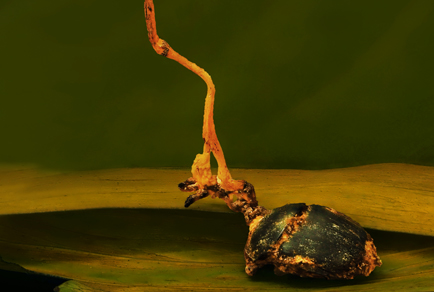
Metarhizium Sorokin (Clavicipitaceae, Hypocreales) is a widely studied entomopathogenic fungi. Currently, Metarhizium has expanded to 92 species worldwide. The rainforests of Malaysia provide ideal ecological conditions that support high fungal diversity. In Malaysia, previous studies on entomopathogenic fungi (EPF) primarily focused on their applications as biological control agents, with limited attention to systematics and taxonomy. However, to date, studies on detailed systematics and phylogeny are still lacking in this region. During the entomopathogenic fungi survey in Sabah, Malaysia, an adult hemipteran host was collected, partially buried in soil near orchid Plocoglottis plicata (Roxb.) Ormerod. A new species, Metarhizium tawauensis (BORH/F03657 and BORH/F03658), is introduced based on detailed morphological observations, scanning electron microscopy (SEM) and is further supported by phylogenetic analyses of a concatenated ITS–TEF-1α–RPB2 dataset. This study expands the known diversity of Metarhizium and provides essential taxonomic and phylogenetic baseline data for the newly described species, M. tawauensis, from Sabah, Malaysia. Future studies should focus on extensive surveys and multilocus genomic analysis to better understand the diversity, distribution and potential biocontrol applications.
References
- Bao, D.F., Hyde, K.D., Maharachchikumbura, S.S., Perera, R.H., Thiyagaraja, V., Hongsanan, S. & Luo, Z.L. (2023) Taxonomy, phylogeny and evolution of freshwater Hypocreomycetidae (Sordariomycetes). Fungal Diversity 121 (1): 1–94. https://doi.org/10.1007/s13225-023-00521-8
- Baró Robaina, Y., Schuster, C., Castañeda-Ruiz, R.F., Gato Cárdenas, Y., Márquez Gutiérrez, M.E., Ponce de la Cal, A. & Leclerque, A. (2024) Metarhizium caribense sp. nov., a novel species of entomopathogenic Metarhizium fungi associated with weevils impairing coffee, sugar cane and sweet potato cultivation. Journal of Fungi 10 (9): 612. https://doi.org/10.3390/jof10090612
- Beys-da-Silva, W.O., Rosa, R.L., Berger, M., Coutinho-Rodrigues, C.J., Vainstein, M.H., Schrank, A. & Santi, L. (2020) Updating the application of Metarhizium anisopliae to control cattle tick Rhipicephalus microplus (Acari: Ixodidae). Experimental Parasitology 208: 107812. https://doi.org/10.1016/j.exppara.2019.107812
- Bischoff, J.F., Rehner, S.A. & Humber, R.A. (2006) Metarhizium frigidum sp. nov.: a cryptic species of M. anisopliae and a member of the M. flavoviride complex. Mycologia 98 (5): 737–745. https://doi.org/10.1080/15572536.2006.11832645
- Bischoff, J.F., Rehner, S.A. & Humber, R.A. (2009) A multilocus phylogeny of the Metarhizium anisopliae lineage. Mycologia 101 (4): 512–530. https://doi.org/10.3852/07-202
- Chen, W.H., Shu, H.L., Li, D., Liang, J.D., Sun, C.L., Zhao, J.H. & Tian, W.Y. (2025) Shedding light on the darkness: Cryptic diversity of cordyceps-like fungi in karst regions of Guizhou Province, China. Mycosphere: Journal of Fungal Biology 16: 2887–2974. https://doi.org/10.5943/mycosphere/16/1/20
- da Costa Silva, J.D., Silva, P.R.R., de França, S.M., Saleh, I.A., de Alcântara Neto, F., El-Tayeb, M.A. & de Melo, M.P. (2025) Metarhizium mendonceae sp. nov.: An important biological control agent for insect pests. PLOS ONE 20 (2): e0310548. https://doi.org/10.1371/journal.pone.0310548
- Ghayedi, S. & Abdollahi, M. (2013) Biocontrol potential of Metarhizium anisopliae (Hypocreales: Clavicipitaceae), isolated from suppressive soils of the Boyer-Ahmad region, Iran, against J2s of Heterodera avenae. Journal of Plant Protection Research 53 (2): 000–000. https://doi.org/10.2478/jppr-2013-0025
- Güerri-Agulló, B., Gómez-Vidal, S., Asensio, L., Barranco, P. & Lopez-Llorca, L.V. (2010) Infection of the red palm weevil (Rhynchophorus ferrugineus) by the entomopathogenic fungus Beauveria bassiana: a SEM study. Microscopy Research and Technique 73 (7): 714–725.
- Guo, H.L., Ye, B.L., Yue, Y.Y., Chen, Q.T. & Fu, C.S. (1986) Three new species of Metarhizium. Acta Mycologica Sinica 5: 177–184.
- Hussien, R.H., Ghareeb, S. & Kalmosh, F.S. (2025) Metarhizium species and their volatile organic compounds: promising alternatives for the two-spotted spider mite, Tetranychus urticae management. BioControl 70 (3): 345–355. https://doi.org/10.1007/s10526-025-10307-3
- Hyde, K.D., Baldrian, P., Chen, Y., Thilini Chethana, K.W., De Hoog, S., Doilom, M. & Walker, A. (2024) Current trends, limitations and future research in the fungi. Fungal Diversity 125 (1): 1–71. https://doi.org/10.1007/s13225-023-00532-5
- Jaronski, S.T. & Jackson, M.A. (2008) Efficacy of Metarhizium anisopliae microsclerotial granules. Biocontrol Science and Technology 18 (8): 849–863. https://doi.org/10.1080/09583150802381144
- Kalkar, Ö., Carner, G.R., Scharf, D. & Boucias, D.G. (2006) Characterization of an Indonesian isolate of Paecilomyces reniformis. Mycopathologia 161 (2): 109–118. https://doi.org/10.1007/s11046-005-0133-z
- Kepler, R.M., Sung, G.H., Ban, S., Nakagiri, A., Chen, M.J., Huang, B. & Spatafora, J.W. (2012) New teleomorph combinations in the entomopathogenic genus Metacordyceps. Mycologia 104 (1): 182–197. https://doi.org/10.3852/11-070
- Kim, S., Heo, I. & Shin, T.Y. (2025) Biodiversity of Metarhizium from Korea and pathogenicity screening of two unrecorded species Metarhizium lepidiotae and Metarhizium robertsii. Entomological Research 55 (2): e70017. https://doi.org/10.1111/1748-5967.70017
- Kobmoo, N., Mongkolsamrit, S., Khonsanit, A., Cedeño-Sanchez, M., Arnamnart, N., Noisripoom, W. & Luangsa-Ard, J.J. (2024) Integrative taxonomy of Metarhizium anisopliae species complex, based on phylogenomics combined with morphometrics, metabolomics, and virulence data. IMA Fungus 15 (1): 30. https://doi.org/10.1186/s43008-024-00154-9
- Li, C., Huang, B., Fan, M., Lin, Y. & Li, Z. (2010) Metacordyceps guniujiangensis and its Metarhizium anamorph: a new pathogen on cicada nymphs. Mycotaxon 111 (1): 221–231. https://doi.org/10.5248/111.221
- Li, Y., Zhao, X.C., Wu, L.X., Wang, Y., Xu, A. & Lin, W.F. (2023) Blackwellomyces kaihuaensis and Metarhizium putuoense (Hypocreales), Two New Entomogenous Fungi from Subtropical Forests in Zhejiang Province, Eastern China. Forests 14: 2333. https://doi.org/10.3390/f14122333
- Li, Y., Zhao, X.C., Wu, L.X., Wang, Y., Xu, A. & Lin, W.F. (2023) Blackwellomyces kaihuaensis and Metarhizium putuoense (Hypocreales), two new entomogenous fungi from subtropical forests in Zhejiang Province, eastern China. Forests 14 (12): 2333. https://doi.org/10.3390/f14122333
- Lin, L., Lin, Y., Keyhani, N.O., Pu, H., Yang, J., Xiong, C. & Guan, X. (2025) New entomopathogenic species in the Clavicipitaceae family (Hypocreales, Ascomycota) from the subtropical forests of Fujian, China. Frontiers in Microbiology 16: 1532341. https://doi.org/10.3389/fmicb.2025.1532341
- Lin, L., Lin, Y., Keyhani, N.O., Pu, H., Yang, J., Xiong, C. & Guan, X. (2025) New entomopathogenic species in the Clavicipitaceae family (Hypocreales, Ascomycota) from the subtropical forests of Fujian, China. Frontiers in Microbiology 16: 1532341. https://doi.org/10.3389/fmicb.2025.1532341
- Liu, T., Chen, W., Zhang, K., Hu, X., Berestetskiy, A., Hu, Q. & Weng, Q. (2025) Three new entomopathogenic fungal species isolated from soil in China. Frontiers in Microbiology 16: 1705425. https://doi.org/10.3389/fmicb.2025.1705425
- Luangsa-ard, J.J., Mongkolsamrit, S., Thanakitpipattana, D., Khonsanit, A., Tasanathai, K., Noisripoom, W. & Humber, R.A. (2017) Clavicipitaceous entomopathogens: new species in Metarhizium and a new genus Nigelia. Mycological Progress 16 (4): 369–391. https://doi.org/10.1007/s11557-017-1277-1
- Luangsa-ard, J.J., Mongkolsamrit, S., Thanakitpipattana, D., Khonsanit, A., Tasanathai, K., Noisripoom, W. & Humber, R.A. (2017) Clavicipitaceous entomopathogens: new species in Metarhizium and a new genus Nigelia. Mycological Progress 16 (4): 369–391. https://doi.org/10.1007/s11557-017-1277-1
- Ma, J.M., Wang, Z.Q., Yang, Z.L., Chen, Y., Li, S.Y. & Yu, H. (2024) Metarhizium puerense (Hypocreales, Clavicipitaceae): a new species from Yunnan, south-western China. Biodiversity Data Journal 12: e129087. https://doi.org/10.3897/bdj.12.e129087.figure2
- Mongkolsamrit, S., Khonsanit, A., Thanakitpipattana, D., Tasanathai, K., Noisripoom, W., Lamlertthon, S. & Luangsa-Ard, J.J. (2020) Revisiting Metarhizium and the description of new species from Thailand. Studies in Mycology 95 (1): 171–251. https://doi.org/10.1016/j.simyco.2020.04.001
- Malaysia Biodiversity Information System (MyBIS). Tawau Hills Park. Available from: https://www.mybis.gov.my (accessed )
- Niego, A.G.T., Lambert, C., Mortimer, P., Thongklang, N., Rapior, S., Grosse, M. & Stadler, M. (2023) The contribution of fungi to the global economy. Fungal Diversity 121 (1): 95–137. https://doi.org/10.1007/s13225-023-00520-9
- Petch, T. (1931) Notes on entomogenous fungi. Transactions of the British Mycological Society 16 (1): 55–75. https://doi.org/10.1016/s0007-1536(31)80006-3
- Radha, T.K., Vishalakshy, P.N., Reddy, P.V., Nithish, A., Chavan, S., Shrivastava, P. & Patil, P. (2025) Evaluation of a native isolate of Metarhizium anisopliae (Metschn.) Sorokin against the mango leaf hopper complex (Idioscopus spp.) infesting mango (Mangifera indica L.) for organic fruit production. Applied Fruit Science 67 (6): 1–13. https://doi.org/10.1007/s10341-025-01643-w
- Rehner, S.A. & Buckley, E. (2005) A Beauveria phylogeny inferred from nuclear ITS and EF1-alpha sequences: evidence for cryptic diversification and links to Cordyceps teleomorphs. Mycologia 97: 84–98. https://doi.org/10.3852/mycologia.97.1.84
- Rombach, M.C., Humber, R.A. & Roberts, D.W. (1986) Metarhizium flavoviride var. minus, var. nov., a pathogen of plant- and leafhoppers on rice in the Philippines and Solomon Islands. Mycotaxon 27: 87–92. https://doi.org/10.5962/p.418873
- Rombach, M.C., Humber, R.A. & Evans, H.C. (1987) Metarhizium album, a fungal pathogen of leaf- and planthoppers of rice. Transactions of the British Mycological Society 88 (4): 451–459. https://doi.org/10.1016/s0007-1536(87)80028-1
- Ronquist, F. & Huelsenbeck, J.P. (2003) MrBayes 3: Bayesian phylogenetic inference under mixed models. Bioinformatics 19 (12): 1572–1574. https://doi.org/10.1093/bioinformatics/btg180
- Sabah Parks. (2024) Tawau Hills Park: Flora and Fauna. Sabah Parks, Sabah, Malaysia. Available from: https://www.sabahparks.org.my (accessed 23 June 2026)
- Samson, R.A. (1974) Paecilomyces and some allied Hyphomycetes. Studies in Mycology 6: 1–119.
- Shang, J., Song, S. & Wang, C. (2024) Metarhizium robertsii. Trends in Parasitology 40 (2): 192–193. https://doi.org/10.1016/j.pt.2023.10.004
- Shapkin, V., Caboň, M., Kolařík, M., Adamčíková, K., Baldrian, P., Michalová, T. & Adamčík, S. (2025) Protein Coding Low‐Copy rpb2 and ef1‐α Regions Are Viable Fungal Metabarcoding DNA Markers Which Can Supplement ITS for Better Accuracy. Ecology and Evolution 15 (4): e71352. https://doi.org/10.1002/ece3.71352
- Sung, G.H., Hywel-Jones, N.L., Sung, J.M., Luangsa-Ard, J.J., Shrestha, B. & Spatafora, J.W. (2007) Phylogenetic classification of Cordyceps and the clavicipitaceous fungi. Studies in Mycology 57: 5–59. https://doi.org/10.3114/sim.2007.57.01
- Thanakitpipattana, D., Tasanathai, K., Mongkolsamrit, S., Khonsanit, A., Lamlertthon, S. & Luangsa-Ard, J.J. (2020) Fungal pathogens occurring on Orthopterida in Thailand. Persoonia 44 (1): 140–160. https://doi.org/10.3767/persoonia.2020.44.06
- Thanakitpipattana, D., Tasanathai, K., Mongkolsamrit, S., Khonsanit, A., Lamlertthon, S. & Luangsa-Ard, J.J. (2020) Fungal pathogens occurring on Orthopterida in Thailand. Persoonia-Molecular Phylogeny and Evolution of Fungi 44 (1): 140–160. https://doi.org/10.3767/persoonia.2020.44.06
- Thongkaewyuan, A. & Chairin, T. (2018) Biocontrol of Meloidogyne incognita by Metarhizium guizhouense and its protease. Biological Control 126: 142–146. https://doi.org/10.1016/j.biocontrol.2018.08.005
- Vega, F.E., Goettel, M.S., Blackwell, M., Chandler, D., Jackson, M.A., Keller, S. & Roy, H.E. (2009) Fungal entomopathogens: new insights on their ecology. Fungal Ecology 2 (4): 149–159. https://doi.org/10.1016/j.funeco.2009.05.001
- Villamizar, L.F., Barrera, G.P., Luange, A., Sagata, K., Gende, P., Chris, S. & Marshall, S.D. (2024) Characterization and screening of new Metarhizium isolates to control the coconut rhinoceros beetle in the Pacific islands. Fungal Biology 128 (7): 2127–2138. https://doi.org/10.1016/j.funbio.2024.08.009
- Wasti, I.G., Fayle, T.M., Kumaran, J.V., Waraich, F.A. & Seelan, J.S. (2024) Fungal community composition in anthropogenically-active and non-active northern Borneo caves. Malayan Nature Journal 76 (3): 261–291. https://doi.org/10.62613/mnj.24/763.05
- Wei, C.Y., Tang, M., Xie, L.Y., Fan, Q., Shen, S.K., Yang, Z.L. & Wang, Y.B. (2024) Metarhizium dianzhongense sp. nov. and New Record of M. bibionidarum (Clavicipitaceae, Hypocreales) Attacking Insects from China. Diversity 16 (4): 201. https://doi.org/10.3390/d16040201
- Wei, D.P., Gentekaki, E., Wanasinghe, D.N., Tang, S.M. & Hyde, K.D. (2022) Diversity, molecular dating and ancestral characters state reconstruction of entomopathogenic fungi in Hypocreales. Mycosphere 13 (2): 281–351. https://doi.org/10.5943/mycosphere/si/1f/8
- White, T.J., Bruns, T., Lee, S.J.W.T. & Taylor, J. (1990) Amplification and direct sequencing of fungal ribosomal RNA genes for phylogenetics. In: PCR protocols: a guide to methods and applications 18 (1). pp. 315–322. https://doi.org/10.1016/b978-0-12-372180-8.50042-1
- Wijayawardene, N.N., Mešić, A., Pošta, A., Tkalčec, Z. & Thines, M. (2022) Outline of Fungi and fungus-like taxa – 2021. Mycosphere 13 (1): 53–453.
- Würf, J. & Schmidt, V. (2025) Phylogenetic reclassification of Metarhizium granulomatis and Metarhizium viride species complex. Pathogens 14 (8): 745. https://doi.org/10.3390/pathogens14080745
- Xiao, Y.P., Wang, Y.B., Hyde, K.D., Eleni, G., Sun, J.Z., Yang, Y. & Wen, T.C. (2023) Polycephalomycetaceae, a new family of clavicipitoid fungi segregates from Ophiocordycipitaceae. Fungal Diversity 120 (1): 1–76. https://doi.org/10.1007/s13225-023-00517-4
- Yang, Y., Xiao, Y.P., Hyde, K.D., Jayawardena, R.S., Lu, Y.Z., Mapook, A. & Li, X.D. (2025) Discovery of a new species and a new geographical record of Metarhizium (Clavicipitaceae, Hypocreales) from China. Phytotaxa 683 (2): 91–105. https://doi.org/10.11646/phytotaxa.683.2.1
- Yao, Y., Fu, K., Wang, X., Du, G., Peng, Y., Smagghe, G. & Chen, B. (2025) Isolation and characterization of a native Metarhizium rileyi strain Mrpgbm2408 from Paralipsa gularis in maize: first data on efficacy and enzymatic host response dynamics. Insects 16 (9): 872. https://doi.org/10.3390/insects16090872
- Yapa, A.T., Thambugala, K.M., Samarakoon, M.C. & de Silva, N. (2025) Metarhizium species as bioinsecticides: potential, progress, applications and future perspectives. New Zealand Journal of Botany 63 (2–3): 439–461. https://doi.org/10.1080/0028825x.2024.2325006
- Zhang, Y., Wen, T., Xiao, Y., Yang, Y. & Peng, X. (2023) A new species of Papiliomyces (Clavicipiteae, Hypocreales) from China. Biodiversity Data Journal 11: e86868. https://doi.org/10.3897/BDJ.11.e86868
- Zhao, L., Groenewald, J.Z., Hou, L.W., Starink-Willemse, M., Beek, B., Grum-Grzhimaylo, O.A. & Crous, P.W. (2025) New insights into acremonium-like fungi in Hypocreales: A taxonomic and phylogenetic perspective. Studies in Mycology.
- Zimmermann, G. (2007) Review on safety of the entomopathogenic fungus Metarhizium anisopliae. Biocontrol Science and Technology 17 (9): 879–920. https://doi.org/10.1080/09583150701593963
- Zimmermann, G., Papierok, B. & Glare, T. (1995) Elias Metschnikoff, Elie Metchnikoff or Ilya Ilich Mechnikov (1845–1916): a pioneer in insect pathology, the first describer of the entomopathogenic fungus Metarhizium anisopliae and how to translate a Russian name. Biocontrol Science and Technology 5 (4): 527–530. https://doi.org/10.1080/09583159550039701