

Abstract
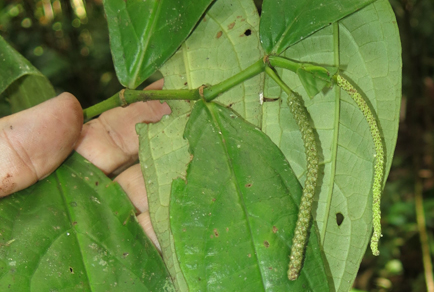
Piper cunianense is described herein as a shrub with stems puberulent to glabrescent, leaves lanceolate and shiny on the adaxial surface when alive, with petioles vaginate to base of the blade. The spikes are pendulous with flowers arranged in a banded pattern around the rachis, floral bracts peltate and densely fimbriate, with fruits wide-obovoid, and deeply 3-sulcate. Piper cunianense is only known from the Cuniã Ecological Station and neighboring region, in the State of Rondônia, Brazil. Illustration, color photograph, distribution map, and morphological comparisons with similar species are presented.
References
- Bachman, S., Moat, J., Hill, A.W., de la Torre, J. & Scott, B. (2011) Supporting Red List threat assessments with GeoCAT: geospatial conservation assessment tool. ZooKeys 150: 117–126. https://doi.org/10.3897/zookeys.150.2109
- Beentje, H. (2016) The Kew plant glossary: An illustrated dictionary of plant terms, 2nd Edition. Royal Botanic Gardens, Kew, 192 pp.
- Bernal, R., Gradstein, S.R. & Celis, M. (Eds.) (2016) Catálogo de Plantas y Líquenes de Colombia. Volumen II. Magnoliaceae a Zygophyllaceae - Especies introducidas y cultivadas. Universidad Nacional de Colombia - Instituto de Ciencias Naturales, Bogotá.
- Boggan, J., Funk, V., Kelloff, C., Hoff, M., Cremers, G. & Feuillet, C. (1997) Checklist of the Plants of the Guianas (Guyana, Surinam, French Guiana), 2nd Edition. Smithsonian Institution, Washington, D.C.
- Bornstein, A. (2024) A formal nomenclature at the rank of subgenus for Neotropical Piper (Piperaceae). Phytoneuron 75: 1–7.
- Cupertino-Eisenlohr, M.A., Oliveira-Filho, A.T. & Simon, M.F. (2021) Patterns of variation in tree composition and richness in Neotropical Non-Flooded Evergreen Forests. Applied Vegetation Science 24: e12522.
- Görts-van Rijn, A.R.A. (2007) Piperaceae. In: Jansen-Jacobs, M.J. (Ed.) Flora of the Guianas, fascicle 24. Royal Botanical Gardens, Kew, pp. 15–163.
- Guimarães, E.F., Medeiros, E.V.S.S. & Queiroz, G.A. (2026) Piper in Flora e Funga do Brasil. Available from: https://floradobrasil.jbrj.gov.br/FB12735 (accessed 28 November 2025)
- Hokche, O., Berry, P.E. & Huber, O. (Eds.) (2008) Nuevo Catálogo de la Flora Vascular de Venezuela. Fundación Instituto Botánico de Venezuela.
- Jaramillo, M.A., Callejas, R., Davidson, C., Smith, J.F., Stevens, A.C. & Tepe, E.J. (2008) A phylogeny of the tropical genus Piper using ITS and the chloroplast intron psbJ – petA. Systematic Botany 33: 647–660. https://doi.org/10.1600/036364408786500244
- Jaramillo, M.A., Nossa-Silva, D. & Majín-Ladino, A.F. (2024) Piper globirhachis, a segregate species across the Marañon River Valley, and the resurrection of Pleiostachyopiper Trel. as a distinct subgenus of Neotropical Piper. Systematic Botany 49: 271–282. https://doi.org/10.1600/036364424x17189138775911
- Jørgensen, P.M. & León-Yánez, S. (1999) Catalogue of the vascular plants of Ecuador. Monographs in Systematic Botany from the Missouri Botanical Garden, vol. 75, 1182 pp.
- IUCN. (2024) Guidelines for Using the IUCN Red List Categories and Criteria, Version 16. Prepared by the Standards and Petitions Committee, International Union for Conservation of Nature, Gland and Cambridge. Available from: https://www.iucnredlist.org/documents/RedListGuidelines.pdf (accessed 25 Aug. 2023)
- Linnaeus, C. (1753) Species Plantarum, Vol. 1. Holmiae, Impensis Laurentii Salvii, 560 pp.
- Moonlight, P.W., Baldaszti, L., Cardoso, D., Elliott, A., Särkinen, T. & Knapp, S. (2024) Twenty years of big plant genera. Proceedings of the Royal Society B: Biological Sciences 291: 20240702. https://doi.org/10.1098/rspb.2024.0702
- Navarro, E.A. (2013) Dicionário Tupi Antigo. A língua indígena clássica do Brasil. 1ª ed. Global, São Paulo, 620 pp.
- POWO. (2026) Plants of the World Online. Facilitated by the Royal Botanic Gardens, Kew. Available from: https://powo.science.kew.org/ (accessed 19 Februbary 2026)
- Steyermark, J.A. (1984) Flora de Venezuela, volume 2, part 2. Instituto Nacional de Parques, Caracas, 619 pp.
- Steyermark, J.A. & Callejas, R. (2003) Piperaceae. In: Steyermark, J.A., Berry, P.E., Yatskievych, K. & Holst, B. (Eds.) Flora of the Venezuela Guayana, volume 7. Missouri Botanical Garden Press, St. Louis, pp. 681–738.
- Thiers, B. continuously updated Index Herbariorum: A global directory of public herbaria and associated staff. New York Botanical Gardens Virtual Herbarium. [http://sweetgum.nybg.org/science/ih/]
- Trelease, W. (1936) Piperaceae. In: Macbride, J.F. (Ed.) Flora of Peru, part 2. Field Museum of Natural History, Botanical Series, Chicago, pp. 3–253.
- Trelease, W. & Yuncker, T.G. (1950) The Piperaceae of Northern South America, volume 1. University of Illinois Press, Urbana, 434 pp + photos.
- Ulloa Ulloa, C., Zarucchi, J.L. & León, B. (2004) Diez años de adiciones a la flora del Perú: 1993-2003. Arnaldoa, Edición Especial: 7–242. https://doi.org/10.5962/bhl.title.63538
- Vásquez Martínez, R., Rojas Gonzáles, R. & van der Werff, H. (2010) Flora del Río Cenepa, Amazonas, Perú. Volumen 2: Angiospermae (Gentianaceae-Zingiberaceae). Monographs in Systematic Botany from the Missouri Botanical Garden, Vol. 114. Missouri Botanical Garden Press, St. Louis.
- Yuncker, T.G. (1951) Piperaceae. In: Steyermark, J.A. Contributions to the flora of Venezuela. Botanical Exploration in Venezuela - I. Fieldiana: Botany 28: 204–209.
- Yuncker, T.G. (1953) The Piperaceae of Argentina, Bolivia and Chile. Lilloa 27: 97–461.
- Yuncker, T.G. (1955) Plants collected in Ecuador by W.H. Camp. Piperaceae. Memoirs of the New York Botanical Garden 9: 147–149.
- Yuncker, T.G. (1972) The Piperaceae of Brazil. Piper, Group I, II, III, IV. Hoehnea 2: 19–366.
- Yuncker, T.G. (1973) The Piperaceae of Brazil II. Piper, Group V; Ottonia; Pothomorphe; Sarcorhachis. Hoehnea 3: 29–284.