
Abstract
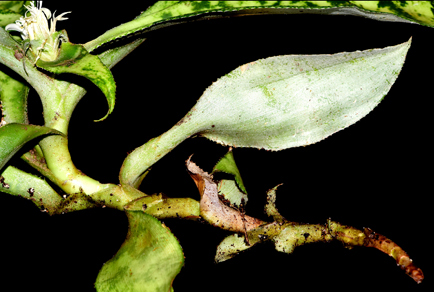
The authors describe and illustrate a new species of Cryptanthus, C. pataxoanus, found within the Monte Pascoal National and Historical Park, and present new data on its closest morphological relative, C. beuckeri, both endemic to the Atlantic Forest of the state of Bahia, Brazil, and assessed as Critically Endangered (CR). The new taxon represents one of the most ornamental discoveries in recent years due to its marbled foliage, with contrasting greenish-yellow and dark green colors, which is similar to C. beuckeri. The main differences between C. pataxoanus and its closest relative include leaf blades not petiolate or the basal ones sometimes subpetiolate, the much broader portion of the blades distinctly longer, the narrower sepals covered by brown-centered trichomes, and petals without glandulose trichomes. The discovery of the new species results from cooperative work with the Pataxó indigenous community living in Barra Velha and Barra Velha do Monte Pascoal Indigenous Lands, located within the boundaries of the Monte Pascoal National and Historical Park. It symbolizes the inexhaustible richness of the Brazilian biodiversity in general and the Atlantic Forest of southern Bahia in particular, despite its current coexistence with high levels of threat.
References
- Bachman, S., Moat, J., Hill, A.W., de la Torre, J. & Scott, B. (2011) Supporting Red List threat assessments with GeoCAT: geospatial conservation assessment tool. ZooKeys 150: 117–126. https://doi.org/10.3897/zookeys.150.2109
- Bonney, R., Phillips, T.B., Ballard, H.L. & Enck, J.W. (2016) Can citizen science enhance public understanding of science? Public Understanding of Science 25: 2–16. https://doi.org/10.1177/0963662515607406
- Brown, M.J.M., Bachman, S.P. & Nic Lughadha, E. (2023) Three in four undescribed plant species are threatened with extinction. New Phytologist 240: 1340–1344. https://doi.org/10.1111/nph.19214
- Callaghan, C.T., Poore, A.G.B., Mesaglio, T., Moles, A.T., Nakagawa, S., Roberts, C., Rowley, J.J.L., Vergés, A., Wilshire, J.H. & Cornwell, W.K. (2021) Three frontiers for the future of biodiversity research using citizen science data. BioScience 71: 55–63. https://doi.org/10.1093/biosci/biaa131
- Convention on Biological Diversity (1992) Article 9. Available from: https://www.cbd.int/convention (accessed 16 November 2025)
- Cronemberger, C., Ribeiro, K.T., Acosta, R.K., Andrade, D.F.C., Marini-Filho, O.J., Masuda, L.S.M., Mendes, K.R., Nienow, S.S., Polaz, C.N.M., Reis, M.R., Sampaio, R., Souza, J.M. & Tófoli, C.F. (2023) Social Participation in the Brazilian National Biodiversity Monitoring Program Leads to Multiple Socioenvironmental Outcomes. Citizen Science: Theory and Practice 8: 1–15. https://doi.org/10.5334/cstp.582
- Cruz, G.A.S., Zizka, G., Silvestro, D., Leme, E.M.C., Schulte, K. & Benko-Iseppon, A.M. (2017) Molecular phylogeny, character evolution and historical biogeography of Cryptanthus Otto & Dietr. (Bromeliaceae). Molecular Phylogenetics and Evolution 107: 152–165. https://doi.org/10.1016/j.ympev.2016.10.019
- Ferreira, D.M.C. (2021) Sistemática e Evolução de Cryptanthus Otto & A. Dietr. (Bromelioideae, Bromeliaceae). PhD Thesis, Centro de Biociências, Universidade Federal de Pernambuco, 246 pp.
- Fidalgo, O. & Bononi, V.L.R. (1984) Técnicas de coleta, preservação e herborização de material botânico, Manual n° 4. Instituto de Botânica, São Paulo, 62 pp.
- Fonseca, G.A.B., Rylands, A., Paglia, A. & Mittermeier, R.A. (2004) Atlantic Forest. In: Mittermeier, R.A., Gil, P.R., Hoffman, M., Pilgrim, J., Brooks, T., Mittermeier, C.G., Lamoreux, J. & Fonseca, G.A.B. (Eds.) Hotspots revisited: earth’s biologically richest and most endangered terrestrial ecoregions. CEMEX, pp. 84–92.
- Gonella, P.M., Rivadavia, F. & Fleischmann, A. (2015) Drosera magnifica (Droseraceae): the largest New World sundew, discovered on Facebook. Phytotaxa 220: 257–267. https://doi.org/10.11646/phytotaxa.220.3.4
- Gouda, E.J., Butcher, D. & Dijkgraaf, L. (cont. updated) Encyclopaedia of Bromeliads, version 5. Utrecht University Botanic Gardens. [http://bromeliad.nl/encyclopedia/] (accessed 21 November 2025)
- Halbritter, H. (1998) Preparing living pollen material for scanning electron microscopy using 2,2-dimethoxypropane (DMP) and critical-point drying. Biotechnic and Histochemistry 73: 137–143. https://doi.org/10.3109/10520299809140519
- Halbritter, H. & Hesse, M. (1993) Sulcus morphology in some monocot families. Grana 32: 87–99. https://doi.org/10.1080/00173 59
- Halbritter, H. & Till, W. (1998) Pollen morphology of Nidularium and related genera. In: Leme, E.M.C. (Ed.) Canistropsis, Bromeliads of the Atlantic Forest. Salamandra, Rio de Janeiro, pp. 114–121.
- Heller, S., Leme, E.M.C., Schulte, K., Benko-Iseppon, A.M. & Zizka, G. (2015) Elucidating phylogenetic relationship in the Aechmea Alliance: AFLP Analysis of Portea and the Gravisia Complex (Bromeliaceae, Bromelioideae). Systematic Botany 40: 716–725. https://doi.org/10.1600/036364415X689177
- Hawksworth, D.L. (2010) Terms used in bionomenclature, the name of organisms (and plant communities). Global Biodiversity Information Facility, Copenhagen, 215 pp.
- IUCN (2012) IUCN Red List Categories and criteria: version 3.1. ed. 2. IUCN Species Survival Commission, pp. 1–30.
- IUCN Standards and Petitions Committee (2024) Guidelines for using the IUCN Red List categories and criteria. Version 16. Prepared by the Standards and Petitions Committee. Available from: https://www.iucnredlist.org/resources/redlistguidelines (accessed 11 January 2026)
- Jordão, L.A., Ferreira, G.C., Bicalho, M., Wimmer, F., Gomes, M., Aragão, L.A., Mello, P.H.A., Amorim, E.T., Fernandez, E.P. & Laque, T. (2022) O MapBiomas e a avaliação do risco de extinção da flora brasileira. Available from: http://mapbiomas-br-site.s3.amazonaws.com/Trabalhos%20vencedores%204ed/MencaoHonrosa_CategoriaDestaqueAplicacoesEmPoliticasPublicas_LucasSBJordao.pdf (accessed 11 January 2026)
- Jussieu, A.L. de (1789) Genera plantarum: secundum ordines naturales disposita, juxta methodum in Horto regio parisiensi exaratam, anno M.DCC.LXXIV. Herissant, Paris, 498 pp. https://doi.org/10.5962/bhl.title.284
- Leme, E.M.C. (2002) Cryptanthus teretifolius, a new species from the coastal zone of Espírito Santo. Cryptanthus Society Journal 17: 15–16.
- Leme, E.M.C., Gonella, P.M., Couto, D.R., Fernandez, E.P., Carvalho, J.D.T. de, Almeida, P.S. de & Mariath, J.E.A. (2023) A “hairy situation” in Minas Gerais, Brazil: a striking new species of Krenakanthus (Bromeliaceae: Bromelioideae) covered with uniseriate trichomes. Phytotaxa 619: 39–62. https://doi.org/10.11646/phytotaxa.619.1.2
- Leme, E.M.C., Heller, S., Zizka, G. & Halbritter, H. (2017) New circumscriptions of Cryptanthus and new Cryptanthoid genera and subgenera (Bromeliaceae: Bromelioideae) based on neglected morphological traits and molecular phylogeny. Phytotaxa 318: 1–88. https://doi.org/10.11646/phytotaxa.318.1.1
- Leme, E.M.C., Ribeiro, O.B.C., Souza, F.V.D., Souza, E.H., Kollmann, L.J.C. & Fontana, A.P. (2020) Miscellaneous new species in the “Cryptanthoid complex” (Bromeliaceae: Bromelioideae) from Eastern Brazil. Phytotaxa 430: 157–202. https://doi.org/10.11646/phytotaxa.430.3.2
- Leme, E.M.C., Souza, E.H., Till, W., Barfuss, M.H.J., Siqueira-Filho, J.A., Kollmann, L.J.C., Couto, D.R., Fraga, C.N., Fontana, A.P., Farias-Castro, A.S. & Silva, J.B.F. (2025) Twenty miscellaneous new species and one new nothogenus and nothospecies in Brazilian Bromeliaceae. Phytotaxa 692: 1–60. https://doi.org/10.11646/phytotaxa.692.1.1
- Leme, E.M.C., Till, W., Kollmann, L.J.C., Moura, R.L. & Ribeiro, O.B.C. (2014) Miscellaneous new species of Brazilian Bromeliaceae—III. Phytotaxa 177: 61–100. https://doi.org/10.11646/phytotaxa.177.2.1
- Leme, E.M.C., Zizka, G., Paule, J., Aguirre-Santoro, J., Heller, S., Ramirez-Morillo, I.M., Halbritter, H., Mariath, J.E.A., Carvalho, J.D.T. & Forzza, C.F. (2021) Re-evaluation of the Amazonian Hylaeaicum (Bromeliaceae: Bromelioideae) based on neglected morphological traits and molecular evidence. Phytotaxa 499: 1–60. https://doi.org/10.11646/phytotaxa.499.1.1
- Leme, E.M.C., Zizka, G., Souza, E.H., Paule, J., Carvalho, J.D.T., Mariath, J.E.A., Halbritter, H. & Ribeiro, O.B.C. (2022) New genera and a new species in the “Cryptanthoid Complex” (Bromeliaceae: Bromelioideae) based on the morphology of recently discovered species, seed anatomy, and improvements in molecular phylogeny. Phytotaxa 544: 128–170. https://doi.org/10.11646/phytotaxa.544.2.2
- Linden, J. & André, E. (1874) Ronnbergia morreniana, Linden & André, Ronnbergia de Morren. L’Illustration Horticole 21: 120–121.
- MapBiomas (2025a) Projeto MapBiomas—Coleção 8 da Série Anual de Mapas de Cobertura e Uso de Solo do Brasil, dados de 2025. Available from: https://https://mapbiomas.org (accessed 11 January 2026)
- MapBiomas (2025b) Projeto MapBiomas—Coleção 8 da Série Anual de Mapas de Cobertura e Uso de Solo do Brasil, dados de 1985 e 2025. Available from: https://https://mapbiomas.org (accessed 11 January 2026)
- Martini, A.M.Z., Fiaschi, P., Amorim, A.M. & Paixão, J.L.da (2007) A hot-point within a hot-spot: a high diversity site in Brazil’s Atlantic Forest. Biodiversity Conservation 16: 3111–3128. https://doi.org/10.1007/S10531-007-9166-6
- Moraes, M.D., Messina, T. & CNCFlora (2012) Cryptanthus beuckeri É.Morren (Bromeliaceae) in Lista Vermelha da Flora Brasileira: Centro Nacional de Conservação da Flora / Instituto de Pesquisas Jardim Botânico do Rio de Janeiro. Available from: https://cncflora.jbrj.gov.br/ficha/5994 (accessed 27 January 2026)
- Morren, E. (1880) Broméliacées nouvelles. La Belgique Horticole 30: 238–242.
- Morren, E. (1881) Description du Cryptanthus beuckeri, sp. nov., Cryptanthus de M. S. De Beucker. La Belgique Horticole 31: 242–243.
- Morren, É. & André (1874) Ronnbergia morreniana Linden & André, Ronnbergia de Morren, Broméliacées. In: Linden, J.J. & Andre, E. (Eds.) L‘Illustration Horticole. Vol. 21. pp. 120.
- Ostroski, P., Saiter, F.Z., Amorim, A.M. & Fiaschi, P. (2020) Angiosperm emdemism in a Brazilian biodiversity hot-point. Brazilian Journal of Botany 43: 397–404. https://doi.org/10.1007/s40415-020-00603-w
- Otto, F. & Dietrich, A. (1836) Eine neue Gattung aus der Familie der Bromeliaceae. Berliner Allgemeine Gartenzeitung 4: 297–300.
- Punt, W., Horn, P.P., Blackmore, S., Nilsson, S. & Thomas, A. (2007) Glossary of pollen and spore terminology. Review of Paleobotany and Palynology 143: 1–81. https://doi.org/10.1016/j.revpalbo.2006.06.008
- QGIS Association (2024) QGIS Geographic Information System. Open Source Geospatial Foundation Project. Available from: http://www.qgis.org (accessed 22 June 2026)
- Scharf, U. & Gouda, E.J. (2008) Bringing Bromeliaceae back to homeland botany. Journal of the Bromeliad Society 58: 123–129.
- Schulte, K. & Zizka, G. (2008) Multi locus plastid phylogeny of Bromelioideae (Bromeliaceae) and the taxonomic utility of petal appendages and pollen characters. Candollea 63: 209–225.
- Smith, L.B. & Downs, R.J. (1979) Bromeliaceae (Bromelioideae). Flora Neotropica Monograph 14 (3): 1493–2142.
- Souza, E.H. & Leme, E.M.C. (2021) New Cryptanthus species (Bromeliaceae: Bromelioideae) from the state of Bahia, Brazil. Phytotaxa 523: 179–191. https://doi.org/10.11646/phytotaxa.523.2.5
- Thiers, B.M. (2019 [cont. updated]) Index Herbariorum. New York Botanical Garden. Available from: http://sweetgum.nybg.org/science/ih/ (accessed 27 May 2019)
- Turland, N.J., Wiersema, J.H., Barrie, F.R., Gandhi, K.N., Gravendyck, J., Greuter, W., Hawksworth, D.L., Herendeen, P.S., Klopper, R.R., Knapp, S., Kusber, W.-H., Li, D.-Z., May, T.W., Monro, A.M., Prado, J., Price, M.J., Smith, G.F. & Zamora Señoret, J.C. (2025) International Code of Nomenclature for algae, fungi, and plants (Madrid Code). University of Chicago Press, Chicago, Regnum Vegetabile, v. 162.
- Vohland, K., Land-Zandstra, A., Ceccaroni, L., Lemmens, R., Perelló, J., Ponti, M., Samson, R. & Wagenknecht, K. (2021) The science of citizen science. Springer, Cham, 529 pp. https://doi.org/10.1007/978-3-030-58278-4