

Abstract
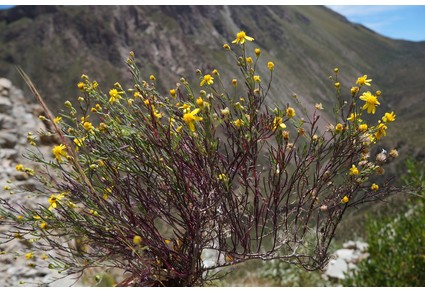
We present the study of Senecio tamboensis, a new species endemic to the Tambo River basin in Moquegua, southern Peru. This taxon is closely related to members of S. sect. Corymbosi ser. Simplices. Senecio tamboensis is distinguished from its closest relative, S. yurensis, by its linear-lanceolate leaves with an acute to acuminate apex, decurrent base, entire or rarely pinnatifid margins, and slight pubescence on both adaxial and abaxial surfaces. Its cypselae are more elongated and narrower than in S. yurensis. A comparative table is provided to differentiate similar species from Peru, Bolivia, and Argentina, along with details on the geographic distribution, habitat, and examined material of the new species. A lectotypification and taxonomic comments for an associated South American Senecioninae, Pentacalia urbanii, are also presented.
References
- Acuña, R. (2011) José Jerónimo Triana heredero de una tradición botánica. Unibiblos, Bogotá, 31 pp.
- Acuña Castillo, R., Luebert, F., Henning, T. & Weigend, M. (2019) Major lineages of Loasaceae subfam. Loasoideae diversified during the Andean uplift. Molecular Phylogenetics and Evolution 141: e106616. https://doi.org/10.1016/j.ympev.2019.106616
- Antonelli, A., Nylander, J.A.A., Persson, C. & Sanmartín, I. (2009) Tracing the impact of the Andean uplift on Neotropical plant evolution. Proceedings of the National Academy of Sciences of the United States of America 106 (24): 9749–9754. https://doi.org/10.1073/pnas.0811421106
- Avila, F.A., Funk, V.A., Diazgranados, M., Díaz-Piedrahita, S. & Vargas, O. (2016) Asteraceae. In: Bernal, R., Gradstein, S.R. & Celis, M. (Eds.) Catálogo de Plantas y Líquenes de Colombia. Panamericana Formas e Impresos S.A., Bogotá, pp. 830.
- Aymard, G.A. (2017) Lectotypifications and nomenclatural notes of José Jerónimo Triana’s species of Dilleniaceae. Harvard Papers in Botany 22: 77–80. https://doi.org/10.3100/hpib.v22iss2.2017.n1
- Benítez de Rojas, C.E. (1997) Diversidad de las Solanaceae en los Andes de Venezuela. Acta Botánica Venezuélica 20 (1): 81–92.
- Brako, L. & Zarucchi, J. (1993) Catalogue of the Flowering Plants and Gymnosperms of Peru. Monographs in Systematic Botany from the Missouri Botanical Garden 45: 1–1286.
- Bremer, K. & Anderberg, A.A. (1994) Asteraceae: Cladistics & Classification. Timber Press, Portland, Oregon.
- Cabrera, A.L. (1939) Las especies tucumanas del género Senecio (Compositae). Lilloa 5 (1): 65–120.
- Cabrera, A.L. (1941) Compuestas bonaerenses. Revisión de las compuestas de la provincia de Buenos Aires la capital federal y la Isla Martín García. Revista del Museo de La Plata. Nueva Serie. Sección Botánica 4: 1–450.
- Cabrera, A.L. (1946) Rehabilitación del género Chersodoma Philippi (Compositae). Revista del Museo de La Plata, Nueva Serie, Sección Botánica 6 (27): 343–355.
- Cabrera, A.L. (1949) El género Senecio en Chile. Lilloa 15: 27–501.
- Cabrera, A.L. (1950) Notes on the Brazilian Senecioneae. Brittonia 7: 53–74. https://doi.org/10.2307/2804930
- Cabrera, A.L. (1984) Nuevas especies bolivianas del género Senecio (Compositae). Hickenia 2 (4): 13–25.
- Cabrera, A.L. (1985) El género Senecio (Compositae) en Bolivia. Darwiniana 26 (1–4): 79–217.
- Cabrera, A.L., Freire, S.E. & Riza Espinar, L. (1999) Tribu VIII. Senecioneae. In: Hunziker, A.T. (Ed.) Flora Fanerogámica Argentina 62. Museo Botánico de Córdoba, Córdoba, pp. 3–164, 171–179.
- Correa, A. (2003) Revision of the genus Paragynoxys (Asteraceae, Senecioneae–Tussilagininae). Brittonia 55 (2): 157–168. https://doi.org/10.1663/0007-196X(2003)055[0157:ROTGPA]2.0.CO;2
- Cuatrecasas, J. (1951) Studies on Andean Compositae—II. Fieldiana Botany 27 (2): 1–74.
- Cuatrecasas, J. (1953a) Senecioneae andinae novae. Collectanea Botanica 3 (3): 261–307.
- Cuatrecasas, J. (1953b) Neue und bemerkenswerte andine Compositen. Feddes Repertorium Specierum Novarum Regni Vegetabilis 55 (2–3): 120–153. https://doi.org/10.1002/fedr.19530550203
- Cuatrecasas, J. (1981) Studies in Neotropical Senecioneae. II. Transfers to genus Pentacalia of North Andean species. Phytologia 49: 241–260. https://doi.org/10.5962/bhl.part.15138
- Cuatrecasas, J. (1986) Dos géneros nuevos de Compositae de Colombia. Caldasia 15 (71–75): 1–14.
- Cuatrecasas, J. & Robinson, H.E. (1993) New species of Pentacalia (Senecioneae: Asteraceae) from Ecuador, Peru, and Bolivia. Novon 3: 284–301. https://doi.org/10.2307/3391473
- D’Altroy, T.N. (2015) Funding the Inka empire. In: Shimada, I. & Shinoda, K.-I. (Eds.) Diversity and Unity in the Inka Empire: A Multidisciplinary Vision. University of Texas Press, Austin, pp. 97–118. https://doi.org/10.7560/760790-008
- DeVore, M.L. & Stuessy, T.F. (1995) The place and time of origin of the Asteraceae with additional comments on the Calyceraceae and Goodeniaceae. In: Hind, D.J.N. (Ed.) Advances in Compositae Systematics. Royal Botanic Gardens, Kew, pp. 23–40.
- Díaz-Piedrahita, S. (1991) José Triana: su vida, su obra y su época. Academia Colombiana de Ciencias Exactas, Físicas y Naturales, Bogotá, 186 pp.
- Díaz-Piedrahita, S. & Cuatrecasas, J. (1999) Asteráceas de la Flora de Colombia: Senecioneae I. Academia Colombiana de Ciencias Exactas, Físicas y Naturales, Bogotá.
- Díaz-Piedrahita, S. & Garcia-Yanes, F. (2009) Flora de la Real Expedición Botánica del Nuevo Reyno de Granada, vol. 48. Ediciones Cultura Hispánica–ICANH, Madrid–Bogotá.
- Diemer, M. (1998) Leaf lifespans of high-elevation, a seasonal Andean shrub species in relation to leaf traits and leaf habit. Global Ecology & Biogeography Letters 7: 457–465. https://doi.org/10.2307/2997715
- Ehlers, T.A. & Poulsen, C.J. (2009) Influence of Andean uplift on climate and paleoaltimetry estimates. Earth and Planetary Science Letters 281 (3): 238–248. https://doi.org/10.1016/j.epsl.2009.02.026
- Escobari, B., Borsch, T., Quedensley, T. & Gruenstaeudl, M. (2021) Plastid phylogenomics of the Gynoxoid group (Senecioneae, Asteraceae). American Journal of Botany 108 (11): 2235–2256. https://doi.org/10.1002/ajb2.1775
- Espinoza, T.E.B. & Kessler, M. (2022) A monograph of the genus Polylepis (Rosaceae). PhytoKeys 203: 1–274. https://doi.org/10.3897/phytokeys.203.83529
- Espinoza, V. & Iaffaldano, G. (2023) Rapid absolute plate motion changes inferred from high-resolution relative spreading reconstructions. Earth and Planetary Science Letters 604: e118009. https://doi.org/10.1016/j.epsl.2023.118009
- Forsaith, C.C. (1920) Anatomical reduction in some alpine plants. Ecology 1 (2): 124–135. https://doi.org/10.2307/1929080
- Funk, V.A. (1997) Xenophyllum Funk, a new genus extracted from Werneria s.l. (Compositae: Senecioneae). Novon 7: 235–241. https://doi.org/10.2307/3391934
- Funk, V.A., Robinson, H., McKee, G.S. & Pruski, J. (1995) Neotropical montane Compositae with an emphasis on the Andes. In: Churchill, S.P. (Ed.) Biodiversity and Conservation of Neotropical Montane Forests. New York Botanical Garden, New York, pp. 451–471.
- Grisebach, A. (1879) Symbolae ad floram Argentinam, vol. 24. Dieterich’sche Verlags-Buchhandlung, Göttingen.
- Hedberg, O. (1964) Features of afroalpine plant ecology. Acta Phytogeographica Suecica 49: 1–144.
- Hernández Camacho, J.I. & Ortiz Quijano, R. (1992) Origen y distribución de la biota suramericana y colombiana. In: Halffter, G. (Ed.) La diversidad biológica de Iberoamérica I. Acta Zoologica Mexicana, Xalapa, pp. 55–104.
- Hieronymus, G. (1901) Plantae Lehmannianae praesertim in Columbia et Ecuador collectae, additis quibusdam ab aliis collectoribus ex iisdem regionibus allatis determinatae et descriptiae. Compositae II. Botanische Jahrbücher für Systematik, Pflanzengeschichte und Pflanzengeographie 28 (5): 558–659.
- Hind, D.J.N. (2011) An annotated preliminary checklist of the Compositae of Bolivia. Version 2. Royal Botanic Gardens, Kew.
- Hind, D.J.N. (2022) Rockhausenia, a new genus of Senecioneae. Kew Bulletin 77 (3): 691–714. https://doi.org/10.1007/s12225-022-10040-5
- Hoffmann, J., Liberona, A.E., Muñoz, F. & Watson, M. (1998) Plantas altoandinas en la flora silvestre de Chile. Ediciones Fundación Claudio Gay, Santiago, 279 pp.
- Houston, J. & Hartley, A.J. (2003) The central Andean west-slope rainshadow and its potential contribution to the origin of hyper-aridity in the Atacama Desert. International Journal of Climatology 23: 1453–1464. https://doi.org/10.1002/joc.938
- Hunziker, A.T. (1979) South American Solanaceae: A Synoptic Survey. In: Hawkes, J.G., Lester, R.N. & Skelding, A.D. (Eds.) The Biology and Taxonomy of the Solanaceae. Linnean Society Symposium Series 7 (3), Academic Press, London, pp. 49–85.
- Jankiewicz, L.S. & Stecki, Z.J. (1976) Some mechanisms responsible for differences in tree form. In: Cannell, M.G.R. & Last, F.T. (Eds.) Tree Physiology and Yield Improvement. Academic Press, New York, pp. 157–172.
- Jáuregui, D., Lapp, M., Torrecilla, P. & Ruiz-Zapata, T. (2016) Anatomía de raíces y tallos de especies de Pentacalia Cass. (Asteraceae) presentes en Venezuela. Pittieria 40: 6–27.
- Jeffrey, C. (1992) The Tribe Senecioneae (Compositae) in the Mascarene Islands with an Annotated World Check-List of the Genera of the Tribe: Notes on Compositae: VI. Kew Bulletin 47: 49–109. https://doi.org/10.2307/4110768
- Josse, C., Cuesta, F., Navarro, G., Barrena, V., Becerra-Ramirez, M.T., Cabrera, E., Chacón-Moreno, E., Ferreira, W., Peralvo, M., Saito, J., Tovar, A. & Naranjo, L. (2011) Physical Geography and Ecosystems in the Tropical Andes. In: Herzog, S.K., Martínez, R., Jørgensen, P.M. & Tiessen, H. (Eds.) Climate Change and Biodiversity in the Tropical Andes. MacArthur Foundation, Paris, pp. 152–169.
- Kramer, P.J. & Kozlowski, T.T. (1979) Physiology of Woody Plants. Elsevier Science, New York, 411 pp.
- Lapp, M. (2020) Taxonomía de Pentacalia Cass. (Asteroideae-Asteraceae) en Venezuela. Ernstia 30: 49–245.
- Lapp, M., Jáuregui, D., Torrecilla, P. & Ruiz-Zapata, T. (2013) Anatomía de la lámina foliar de diez especies de Pentacalia Cass. (Senecioneae—Asteraceae), presentes en Venezuela. Ernstia 23: 25–46.
- Lapp, M., Ruiz-Zapata, T., Torrecilla, P. & Escala, M. (2015) Staminal micromorphology in species of Pentacalia Cass. (Asteraceae) present in Venezuela. Pittieria 39: 171–190.
- Luna-Vega, I., Morrone, J.J., Alcántara-Ayala, O. & Espinosa-Organista, D. (2001) Biogeographical affinities among neotropical cloud forests. Plant Systematics and Evolution 228: 229–239. https://doi.org/10.1007/s006060170031
- Luteyn, J.L. (1999) Páramos: A Checklist of Plant Diversity, Geographical Distribution, and Botanical Literature. New York Botanical Garden Press, New York, 278 pp.
- Mendoza-Cifuentes, H. (2000) Las especies de Rubiaceae del flanco oriental de la Cordillera Oriental, norte de Los Andes, Colombia. Biota Colombiana 1: 224–226.
- Meyen, F.J.F. & Walpers, W.G. (1843) Novorum Actorum Academiae Caesareae Leopoldinae-Carolinae Naturae Curiosorum 19 (Suppl. 1). Jenae Friedrich Frommann, Bonn, 576 pp.
- MINAM (2009) Indicadores Ambientales de Moquegua. Serie: Indicadores Ambientales. Ministerio del Ambiente, Perú. Available from: https://repositoriodigital.minam.gob.pe/handle/123456789/890 (accessed 24 May 2026)
- Molisch, H. (1929) Die Lebensdauer der Pflanze. Gustav Fischer, Berlin.
- Montesinos-Tubée, D.B. (2011) Diversidad Florística de la cuenca alta del rio Tambo-Ichuña, Moquegua, Perú. Revista Peruana de Biología 18 (1): 119–132. https://doi.org/10.15381/rpb.v18i1.156
- Montesinos-Tubée, D.B. (2012) Lista anotada de nuevas adiciones para la flora andina de Moquegua, Perú. Revista Peruana de Biología 19 (3): 303–312. https://doi.org/10.15381/rpb.v19i3.1045
- Montesinos-Tubée, D.B. (2015) Flora Moqueguana. Guía práctica para la identificación de flora silvestre. Anglo American, Lima, Perú, 252 pp.
- Montesinos-Tubée, D.B. & Chicalla-Rios, K.J. (2021) Senecio huaynaputinaensis (Compositae), una especie nueva de las faldas del volcán Huaynaputina en el departamento de Moquegua, sur de Perú. Boletín de la Sociedad Argentina de Botánica 56 (1): 33–43. https://doi.org/10.31055/1851.2372.v56.n1.29299
- Moreira-Muñoz, A., Monge, M., Grossi, M.A., Avila, F.A., Morales-Fierro, V., Heiden, G., Britto, B., Beck, S., Nakajima, J., Salgado, V.G., Rodríguez-Cravero, J.F. & Gutiérrez, D.G. (2024) South America holds the greatest diversity of native daisies (Asteraceae) in the world: an updated catalogue supporting continental-scale conservation. Frontiers in Plant Science 15: e1393241. https://doi.org/10.3389/fpls.2024.1393241
- Nordenstam, B. (1978) Taxonomic studies in the tribe Senecioneae (Compositae). Opera Botanica 44: 1–83.
- Nordenstam, B., Pelser, P.B., Kadereit, J.W. & Watson, L.E. (2009) Senecioneae. In: Funk, V.A., Susanna, A., Stuessy, T.F. & Bayer, R.J. (Eds.) Systematics, Evolution, and Biogeography of Compositae. International Association for Plant Taxonomy, Vienna, pp. 503–525.
- Panero, J.L. & Crozier, B.S. (2016) Macroevolutionary dynamics in the early diversification of Asteraceae. Molecular Phylogenetics and Evolution 99: 116–132. https://doi.org/10.1016/j.ympev.2016.03.007
- Pelser, P.B., Kennedy, A.H., Tepe, E.J., Shidler, J.B., Nordenstam, B., Kadereit, J.K. & Watson, L.E. (2010) Patterns and causes of incongruence between plastid and nuclear Senecioneae (Asteraceae) phylogenies. American Journal of Botany 97 (5): 856–873. https://doi.org/10.3732/ajb.0900287
- Pelser, P.B., Nordenstam, B., Kadereit, J.W. & Watson, L.E. (2007) An ITS phylogeny of tribe Senecioneae (Asteraceae) and a new delimitation of Senecio L. Taxon 56 (4): 1077–1104. https://doi.org/10.2307/25065905
- Pruski, J.F. (2018) Compositae of Central America–VII. Digitacalia, Dresslerothamnus, Pentacalia, Zemisia, their microcharacters, and some other Senecioneae. Phytoneuron 2018-53: 1–112.
- Pruski, J.F. (2021) Studies of Neotropical Compositae XV. The new genus Chaetacalia, retention of Aetheolaena, Culcitium, Haplosticha, and Iocenes, two new species of Senecio, and Lasiocephalus revisited again (Senecioneae: Senecioninae). Phytoneuron 2021-65: 1–83.
- Rangel, J.O. (2000) Colombia Diversidad Biótica III. La región de vida paramuna de Colombia, vol. 3. Universidad Nacional de Colombia, División de Investigación; Instituto de Investigación de Recursos Biológicos Alexander von Humboldt, Santafé de Bogotá.
- Reinales, S. & Parra-Osorio, C. (2022) Disentangling the historical collection of José Jerónimo Triana from the República de la Nueva Granada between 1851 and 1857. Taxon 71: 420–439. https://doi.org/10.1002/tax.12653
- Rivera Díaz, O. & Fernández-Alonso, J. (2002) Análisis corológico de la flora endémica de la Serranía de Perijá, Colombia. Anales del Jardín Botánico de Madrid 60 (2): 347–369. https://doi.org/10.3989/ajbm.2002.v60.i2.96
- Rosbakh, S. & Poschlod, P. (2018) Killing me slowly: Harsh environment extends plant maximum life span. Basic and Applied Ecology 28: 17–26. https://doi.org/10.1016/j.baae.2018.03.003
- Rusby, H.H. (1912) New species from Bolivia, collected by R.S. Williams–II. Bulletin of the New York Botanical Garden 8 (28): 98–135.
- Sanmartín, I. & Ronquist, F. (2004) Southern Hemisphere biogeography inferred by event-based models: plant versus animal patterns. Systematic Biology 53 (2): 278–298. https://doi.org/10.1080/10635150490423430
- Stevens, G.C. & Perkins, A.L. (1992) The branching habits and life history of woody plants. The American Naturalist 139: 267–275. https://doi.org/10.1086/285327
- Thiers, B. (continuously updated) Index Herbariorum: A global directory of public herbaria and associated staff. New York Botanical Garden’s Virtual Herbarium. Available from: https://sweetgum.nybg.org/science/ih/ (accessed 20 September 2023)
- Thomas, H. (2013) Senescence, ageing and death of the whole plant. New Phytologist 197 (3): 696–711. https://doi.org/10.1111/nph.12047
- Tropicos.org (2023) Tropicos. Missouri Botanical Garden. Available from: https://tropicos.org/ (accessed 14 July 2023)
- Ulloa Ulloa, C., Zarucchi, J.L. & León, B. (2004) Diez años de adiciones a la flora del Perú: 1993–2003. Arnaldoa, edición especial: 1–242. https://doi.org/10.5962/bhl.title.63538
- Vision, T.J. & Dillon, M.O. (1996) Sinopsis de Senecio L. (Senecioneae, Asteraceae) para el Perú. Arnaldoa 4 (1): 23–46.