

Abstract
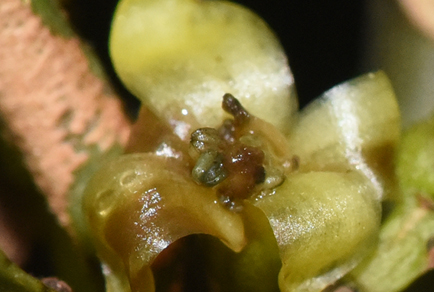
A new species of Roucheria (Linaceae) was revealed through a vegetation monitoring campaign in a long-term permanent plot in Santa Teresa municipality, Espírito Santo state, southeastern Brazil. Here, we describe and illustrate Roucheria krenakiana, a canopy tree of the montane Atlantic Forest, which stands out for its obovate leaves with obtuse apex, crenulate margins and flowers with pale green petals and 3 to 5 styles, as well as congested axillary cymules, caducous stipules, and a glabrous ovary with 3–5 locules. We provide its description, illustration, phenology, a preliminary conservation assessment, and a discussion of its morphological relationships with closely related species. Our study highlights that long-term forest monitoring, when integrated with systematic voucher collecting, strengthens the documentation of poorly known lineages, and can reveal undescribed species.
References
- Amorim, A.M., Jardim, J.G., Lopes, M.M.M., Fiaschi, P., Borges, R.A.X., Perdiz, R.D.O. & Thomas, W.W. (2009) Angiospermas em remanescentes de floresta montana no sul da Bahia, Brasil. Biota Neotropica 9: 313–348. https://doi.org/10.1590/S1676-06032009000300028
- Ariza-Cortés, W., Toro-Murillo, J.L. & Lores-Medina, A. (2009) Análisis florístico y estructural de los bosques premontanos en el municipio de Amalfi (Antioquia, Colombia). Colombia Forestal 12 (1): 81–102. https://doi.org/10.14483/udistrital.jour.colomb.for.2009.1.a07
- Baker, T.R., Pennington, R.T., Dexter, K.G., Fine, P.V.A., Fortune-Hopkins, H., Honorio, E.N., Huamantupa-Chuquimaco, I., Klitgård, B.B., Lewis, G.P., Lima, H.C., Ashton, P., Baraloto, C., Davies, S., Donoghue, M.J., Kaye, M., Kress, W.J., Lehmann, C.E.R., Monteagudo, A., Phillips, O.L. & Vasquez, R. (2017) Maximising synergy among tropical plant systematists, ecologists and evolutionary biologists. Trends in Ecology & Evolution 32: 258–267. https://doi.org/10.1016/j.tree.2017.01.007
- Bentham, G. & Hooker, J.D. (1862) Lineae. Genera plantarum 1: 241–247. Reeve, London. [https://www.biodiversitylibrary.org/page/654746#page/255/mode/1up]
- BFG [Brazil Flora Group] (2022) Brazilian Flora 2020: Leveraging the power of a collaborative network. Taxon 71 (1): 178–198. https://doi.org/10.1002/tax.12640
- Cardoso, D. (2025) barRoso: Biodiversity Analysis and Record Reconciliation for Organizing Specimen Observations. R Package version 1.0. [https://github.com/dboslab/barRoso]
- Cardoso, P. (2017) red: an R package to facilitate species red list assessments according to the IUCN criteria. Biodiversity Data Journal 5: e20530. https://doi.org/10.3897/BDJ.5.e20530
- Chase, M.W. & Hills, H.H. (1991) Silica gel: an ideal material for field preservation of leaf samples for DNA studies. Taxon 40 (2): 215–220. https://doi.org/10.2307/1222975
- Chamberlain, S., Barve, V., Mcglinn, D., Oldoni, D., Desmet, P., Geffert, L. & Ram, K. (2023) rgbif: interface to the Global Biodiversity Information Facility API. R Package Version 3.7.7. [https://CRAN.R-project.org/package=rgbif]
- Chao, A., Chiu, C.H., Hu, K.H. & Zelený, D. (2023) Revisiting Alwyn H. Gentry’s forest transect data: latitudinal beta diversity patterns are revealed using a statistical sampling-model-based approach. Japanese Journal of Statistics and Data Science 6 (2): 861–884. https://doi.org/10.1007/s42081-023-00214-1
- Ducke, A. (1947) New forest trees and climbers of the Amazon (sixth series). Tropical Woods 90: 7–30.
- Ellis, B., Daly, D.C., Hickey, L.J., Johnson, K.R., Mitchell, J.D., Wilf, P. & Wing, S.L. (2009) Manual of Leaf Architecture. Cornell University Press, Ithaca, pp. 4–112. https://doi.org/10.1079/9781845935849.0000
- Fiaschi, P. & Pirani, J.R. (2005) Four new species of Schefflera (Araliaceae) from Espírito Santo State, Brazil. Kew Bulletin 60: 77–85. [https://www.jstor.org/stable/4110886]
- Fonseca-Cortés, A., Cardoso, D.B.O.S., Snak, C. & Queiroz, L.P. (2023) A new endemic species of Macropsychanthus (Leguminosae: Papilionoideae) from the Brazilian Atlantic Forest. Phytotaxa 620 (3): 225–234. https://doi.org/10.11646/phytotaxa.620.3.3
- Fraga, C.N. & Saavedra, M.M. (2006) Three new species of Elvasia (Ochnaceae) from the Brazilian Atlantic Forest, with an emended key for subgenus Hostmannia. Novon 16: 483–489. https://doi.org/10.3417/1055-3177(2006)16[483:TNSOEO]2.0.CO;2
- Gentry, A.H. (1988) New species and a new combination for plants from trans-Andean South America. Annals of the Missouri Botanical Garden 75 (4): 1429–1439. https://doi.org/10.2307/2399294
- Goldenberg, R., Reginato, M. & Michelangeli, F.A. (2020) Miconia lucenae (Melastomataceae), a new species from montane Atlantic Forest in Espírito Santo, Brazil. PeerJ 8: e8752. https://doi.org/10.7717/peerj.8752
- Hallier, H. (1921) Beiträge zur Kenntnis der Linaceae (DC. 1819) Dumort. Beihefte zum Botanischen Centralblatt Abt. 39 (2): 49, 1–178.
- Harris, J. & Harris, M. (2001) Plant Identification terminology: an illustrated glossary. Spring Lake Publishing, Payson, Utah.
- Jardim, A.G. (1999) A revision of Roucheria Planch. and Hebepetalum Benth. (Hugoniaceae). Master’s thesis, University of Missouri–St. Louis, St. Louis, USA.
- Jardim, A. & Berry, P.E. (1999) A new species of Roucheria and a new species of Hebepetalum (Hugoniaceae) from the Venezuelan Guayana. Novon 9 (4): 520–523. https://doi.org/10.2307/3392154
- Lima, R.A., Sánchez‐Tapia, A., Mortara, S.R., ter Steege, H. & Siqueira, M.F. (2023) plantR: An R package and workflow for managing species records from biological collections. Methods in Ecology and Evolution 14 (2): 332–339. https://doi.org/10.1111/2041-210X.13779
- Linnaeus, C. (1753) Species plantarum, vol. 2. Salvius, Stockholm, 640 pp.
- Lobão, A.Q. & Johnson, D.M. (2007) Xylopia decorticans (Annonaceae) a new cauliflorous species from Brazil. Contributions of the University of Michigan Herbarium 25: 207–211.
- Lopes, L.C.M., Mariano-Neto, E. & Amorim, A.M. (2015) Estrutura e composição florística da comunidade lenhosa do sub-bosque em uma floresta tropical no Brasil. Boletim do Museu de Biologia Mello Leitão 37 (4): 361–391.
- Machado, D.N.S., Barros, A.A.M., Ribas, L.A.A., Damasceno, D.B.M., Huamantupa-Chuquimaco, I. & Peixoto, A.L. (2024) Florestas tropicais: o legado do botânico Alwyn Howard Gentry. Gentryana 3 (1): e341. https://doi.org/10.55873/gentryana.v3i1.341
- Martini, A.M.Z., Fiaschi, P., Amorim, A.M. & Paixão, J.L.D. (2007) A hot-point within a hot-spot: a high diversity site in Brazil’s Atlantic Forest. Biodiversity and Conservation 16 (11): 3111–3128. https://doi.org/10.1007/s10531-007-9166-6
- McDill, J.R. & Simpson, B.B. (2011) Molecular phylogenetics of Linaceae with complete generic sampling and data from two plastid genes. Botanical Journal of the Linnean Society 165: 64–83. https://doi.org/10.1111/j.1095-8339.2010.01096.x
- McDill, J., Repplinger, M., Simpson, B.B. & Kadereit, J.W. (2009) The phylogeny of Linum and Linaceae subfamily Linoideae, with implications for their systematics, biogeography, and evolution of heterostyly. Systematic Botany 34 (2): 386–405. https://doi.org/10.1600/036364409788606244
- Peixoto, A.L. & Gentry, A. (1990) Diversidade e composição florística da mata de tabuleiro na Reserva Florestal de Linhares (Espírito Santo, Brasil). Revista Brasileira de Botânica 13 (1): 19–25.
- Peixoto-Filho, P.G., A.L. & Jesus, R.M. (2000) Espécies vegetais descritas a partir de espécimes coletados na Reserva Florestal de Linhares, Espírito Santo, Brasil. Boletim do Museu de Biologia Mello Leitão 11 (12): 35–48.
- Planchon, J.E. (1847) Sur la famille des Linées. The London Journal of Botany 6: 141–146.
- Planchon, J.E. (1848) Sur la famille des Linées (continued). The London Journal of Botany 7: 473–501.
- Phillips, O.L., Baker, T.R., Feldpausch, T.R. & Brienen, R.J.W. (2016) Manual de campo para o estabelecimento e remedição de parcelas da RAINFOR. The Royal Society/RAINFOR network. [https://forestplots.net/upload/pt/ManualsPT/RAINFOR_field_manual_PT.pdf]
- Phillips, O.L. (2025) How Al Gentry changed tropical ecology. Annals of the Missouri Botanical Garden 110 (1): 111–127. https://doi.org/10.3417/2025931
- R Core Team (2025) R: A language and environment for statistical computing. R Foundation for Statistical Computing, Vienna, Austria. [https://www.R-project.org/]
- Saiter, F.Z., Brown, J.L., Thomas, W.W., Oliveira‐Filho, A.T. & Carnaval, A.C. (2016) Environmental correlates of floristic regions and plant turnover in the Atlantic Forest hotspot. Journal of Biogeography 43 (12): 2322–2331. https://doi.org/10.1111/jbi.12774
- Secco, R.D.S. & Silva, S.M.B. (1990) Materiais para a Flora Amazônica-VIII. Contribuição à Sistemática das Linaceae da Amazônia Brasileira. Boletim do Museu Paraense Emílio Goeldi, Belém, Série Botânica 6: 113–135. [https://www.biodiversitylibrary.org/page/53233108]
- Soares-Silva, J.P. (2021) Revisão Taxonômica de Linaceae para o Brasil. Dissertação (Mestrado). Universidade Estadual Paulista UNESP), São José do Rio Preto, Brasil.
- Thomaz, L.D. & Monteiro, R. (1997) Composição florística da mata atlântica de encosta da Estação Biológica de Santa Lúcia, município de Santa Teresa-ES. Boletim do Museu de Biologia Mello Leitão 7: 3–48.