
Abstract
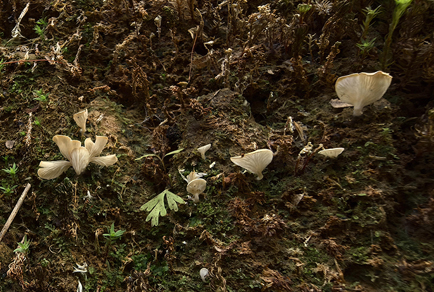
Omphalina microcarpa, a new basidiolichen species, is described from southern China based on morphological and molecular evidence. Morphologically, it is characterized by the small basidiomata measuring 3–12 mm in diam; pleurotoid, flabelliform to spathuliform and white to pale yellow pileus; lacrymoid to amygdaliform basidiospores measuring 4.5–6 × 4–4.5 µm; and having some maize yellow to deep yellow ellipsoid moss cells at the lamellae and stipe base. Phylogenetic analysis of the internal transcribed spacer (ITS) of ribosomal DNA showed that the new collections in this study formed an independent and undescribed lineage within the genus Omphalina. The present study provides a detailed description, including illustrations, comparative notes on related taxa, and results of its phylogenetic analysis.
References
- Bertazzo-Silva, F.A., Costa, A.L., Furlan-Lopes, C., D’Ávila, M.F., Carvalho, E.L., Putzke, J. & Schaefer, C.E.G.R. (2025) Cold discoveries: morphological and phylogenetic analyses unveil four new species of Omphalina (Agaricales, Basidiomycota) in Antarctica. Mycological Progress 24 (1): 1–17. https://doi.org/10.1007/s11557-025-02063-6
- Bjorbækmo, M.F.M., Carlsen, T., Brysting, T., Vrålstad, T., Høiland1, K., Ugland, K.I., Geml, J., Schumacher, T. & Kauserud, H. (2010) High diversity of root associated fungi in both alpine and arctic Dryas octopetala. BMC Plant Biology 10 (10): 244. https://doi.org/10.1186/1471-2229-10-244
- Gardes, M. & Bruns, T.D. (1993) ITS primers with enhanced specificity for basidiomycetes‐application to the identification of mycorrhizae and rusts. Molecular Ecology 2 (2): 113–118. https://doi.org/10.1111/j.1365-294X.1993.tb00005.x
- Geml, J., Timling, I., Robinson, H.C., Lennon, N., Nusbaum, H.C., Brochmann, C., Noordeloos, M.E. & Taylor, D.L. (2012) An arctic community of symbiotic fungi assembled by long‐distance dispersers: phylogenetic diversity of ectomycorrhizal basidiomycetes in Svalbard based on soil and sporocarp DNA. Journal of Biogeography 39 (1): 74–88. https://doi.org/10.1111/j.1365-2699.2011.02588.x
- Gulden, G. (2005) A preliminary guide to the macromycetes in the Finse area. Hardangervidda, Norway. 48 pp.
- Hay, C.R.J., Thorn, R.G. & Jacobs, C.R. (2018) Taxonomic survey of Agaricomycetes (Fungi: Basidiomycota) in Ontario tallgrass prairies determined by fruiting body and soil rDNA sampling. The Canadian Field-Naturalist 132 (4): 407–424. https://doi.org/10.22621/cfn.v132i4.2027
- He, M.Q., Cao, B., Liu, F., Boekhout, T., Denchev, T.T., Schoutteten, N., Denchev, C.M., Kemler, M., Gorjón, S.P. & Begerow, D. (2024) Phylogenomics, divergence times and notes of orders in Basidiomycota. Fungal Diversity 126 (1): 127–406. https://doi.org/10.1007/s13225-024-00535-w
- Ishaq, M., Khan, M.B., Ullah, S., Fiaz, M. & Khalid, A.N. (2019) Infundibulicybe kotanensis sp. nov. (Tricholomataceae), a new species from Buner, Pakistan. Phytotaxa 418 (2): 195–202. https://doi.org/10.11646/phytotaxa.418.2.4
- Katoh, K. & Standley, D.M. (2013) MAFFT multiple sequence alignment software version 7: improvements in performance and usability. Molecular Biology and Evolution 30 (4): 772–780. https://doi.org/10.1093/molbev/mst010
- Kauffman, C.H. (1918) Omphalina. In: Quél. The Agaricaceae of Michigan. Johnson Reprint Corporation, New York, pp. 347–350. https://doi.org/10.5962/bhl.title.58545
- Liu, D., Goffinet, B., Wang, X.Y., Hur, J.S., Shi, H.X., Zhang, Y.Y., Yang, M.X., Li, L.J., Yin, A.C. & Wang, L.S. (2018) Another lineage of basidiolichen in China, the genera Dictyonema and Lichenomphalia (Agaricales: Hygrophoraceae). Mycosystema 37 (7): 849–864. https://doi.org/10.13346/j.mycosystema.170246
- Lücking, R., Hodkinson, B.P. & Leavitt, S.D. (2017) The 2016 classification of lichenized fungi in the Ascomycota and Basidiomycota–Approaching one thousand genera. The Bryologist 119 (4): 361–416. https://doi.org/10.1017/S0024282917000378
- Ludwig, E. (2001) Pilzkompendium. Band 1. Beschreibungen. Die kleineren Gattungen der Makromyzeten mit lamelligem Hymenophor aus den Ordnungen Agaricales, Boletales und Polyporales. IHW-Verlag, Eching, 758 pp.
- Lutzoni, F.M. (1997) Phylogeny of lichen-and non-lichen-forming omphalinoid mushrooms and the utility of testing for combinability among multiple data sets. Systematic Biology 46 (3): 373–406. https://doi.org/10.1093/sysbio/46.3.373
- Minh, B.Q., Nguyen, M.A.T. & Von-Haeseler, A. (2013) Ultrafast approximation for phylogenetic bootstrap. Molecular Biology and Evolution 30 (5): 1188–1195. https://doi.org/10.1093/molbev/mst024
- Moreno, G., Picado, J.A., Rosario, P. & Alvarado, P. (2021) Contribución al estudio de los hongos del campus exteron de la universidad de alcalá. Sociedad Micológica de Madrid 45.
- Nguyen, L.T., Schmidt, H.A., Von-Haeseler, A. & Minh, B.Q. (2015) IQ-TREE: a fast and effective stochastic algorithm for estimating maximum-likelihood phylogenies. Molecular Biology and Evolution 32 (1): 268–274. https://doi.org/10.1093/molbev/msu300
- Osmundson, T.W., Robert, V.A., Schoch, C.L., Baker, L.J., Smith, A., Robich, G., Mizzan, L. & Garbelotto, M.M. (2013) Filling gaps in biodiversity knowledge for macrofungi: contributions and assessment of an herbarium collection DNA barcode sequencing project. PloS One 8 (4): e62419. https://doi.org/10.1371/journal.pone.0062419
- Pérez Gorjón, S. (2020) Genera of corticioid fungi: keys, nomenclature, and taxonomy. Studies in Fungi 5 (1): 125–309. https://doi.org/10.5943/sif/5/1/12
- Quélet, L. (1886) Gen. VII Omphalina, Q. Enchiridion fungorum in Europa media et praesertim in Gallia vigentium. Paris, 43 pp. https://doi.org/10.5962/bhl.title.47025
- Rathnayaka, A.R., Tennakoon, D.S., Jones, G.E.B., Wanasinghe, D.N., Bhat, D.J., Priyashantha, A.K.H., Stephenson, S.L., Tibpromma, S. & Karunarathna, S.C. (2025) Significance of precise documentation of hosts and geospatial data of fungal collections, with an emphasis on plant-associated fungi. New Zealand Journal of Botany 63 (2–3): 462–489. https://doi.org/10.1080/0028825X.2024.2381734
- Redhead, S.A., Lutzoni, F., Moncalvo, J.M. & Vilgalys, R. (2002) Phylogeny of agarics: partial systematics solutions for core omphalinoid genera in the Agaricales (euagarics). Mycotaxon 83: 19–57. https://doi.org/10.5962/p.414960
- Ronquist, F., Teslenko, M., Mark, P., Ayres, D.L., Darling, A., Höhna, S., Larget, B., Liu, L., Suchard, M.A. & Huelsenbeck, J.P. (2012) MrBayes 3.2: Efficient Bayesian phylogenetic inference and model choice across a large model space. Systematic Biology 61 (3): 539–542. https://doi.org/10.1093/sysbio/sys029
- Vilgalys, R. & Hester, M. (1990) Rapid genetic identification and mapping of enzymatically amplified ribosomal DNA from several Cryptococcus species. Journal of Bacteriology 172 (8): 4238–4246. https://doi.org/10.1128/jb.172.8.4238-4246.1990
- Vizzini, A., Consiglio, G., Setti, L. & Ercole, E. (2012) The phylogenetic position of Haasiella (Basidiomycota, Agaricomycetes) and the relationships between H. venustissima and H. splendidissima. Mycologia 104 (3): 777–84. https://doi.org/10.3852/11-334
- Vizzini, A., Consiglio, G., Marchetti, M. & Alvarado, P. (2020) Insights into the Tricholomatineae (Agaricales, Agaricomycetes): a new arrangement of Biannulariaceae and Callistosporium, Callistosporiaceae fam. nov., Xerophorus stat. nov., and Pleurocollybia incorporated into Callistosporium. Fungal Diversity 101 (1): 211–259. https://doi.org/10.1007/s13225-020-00441-x
- Voitk, A., Saar, A., Moncada, B. & Lickey, E.B. (2022) Circumscription and typification of sphagnicolous omphalinoid species of Arrhenia (Hygrophoraceae) in Newfoundland and Labrador: three obligate and one facultative species. Mycological Progress 21 (6): 57. https://doi.org/10.1007/s11557-022-01806-z
- Vu, D., Groenewald, M., De, V.M., Gehrmann, T., Stielow, B., Eberhardt, U., Al-Hatmi, A., Groenewald, G.Z., Cardinali, G., Houbraken, J., Boekhout, T., Crous, P.W., Robert, V. & Verkley, G.J.M. (2018) Large-scale generation and analysis of filamentous fungal dna barcodes boosts coverage for kingdom fungi and reveals thresholds for fungal species and higher taxon delimitation. Studies in Mycology 92 (1): 135–154. https://doi.org/10.1016/j.simyco.2018.05.001
- Wang, F., Wang, K., Cai, L., Zhao, M., Kirk, P.M., Fan, G., Sun, Q., Li, B., Wang, S. & Yu, Z. (2023) Fungal names: a comprehensive nomenclatural repository and knowledge base for fungal taxonomy. Nucleic Acids Research 51 (D1): D708–D716. https://doi.org/10.1093/nar/gkac926
- Xia, W.X., Wang, C.Q., Li, T.H., Deng, W.Q., Yue, H.M. & Zhang, M. (2025) Cuphophyllus striatus (Cuphophyllaceae, Agaricales), a new species from southwestern China. Phytotaxa 701 (2): 207–215. https://doi.org/10.11646/phytotaxa.701.2.7
- Xiang, C.Y., Gao, F., Jakovlić, I., Lei, H.P., Hu, Y., Zhang, H., Zou, H., Wang, G.T. & Zhang, D. (2023) Using PhyloSuite for molecular phylogeny and tree‐based analyses. iMeta 2 (1): e87. https://doi.org/10.1002/imt2.87
- Zhang, D., Gao, F., Jakovlić, I., Zou, H., Zhang, J., Li, W.X. & Wang, G.T. (2020) PhyloSuite: An integrated and scalable desktop platform for streamlined molecular sequence data management and evolutionary phylogenetics studies. Molecular Ecology Resources 20 (1): 348–355. https://doi.org/10.1111/1755-0998.13096
- Zhang, T.T., Zhu, X.Y., Vizzini, A., Li, B.T., Cao, Z.H., Guo, W.Q., Qi, S., Wei, X.L. & Zhao, R.L. (2022) New insights into lichenization in Agaricomycetes based on an unusual new basidiolichen species of Omphalina s. str. Journal of Fungi 8 (10): 1033. https://doi.org/10.3390/jof8101033