
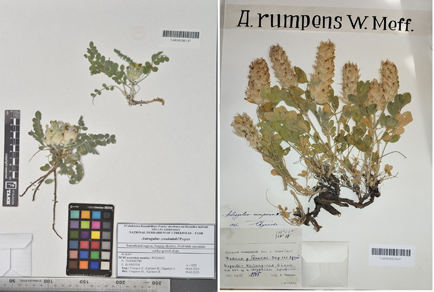

Abstract
The taxonomic position of Astragalus zerabulaki Popov, a narrowly distributed species from Uzbekistan, has long been controversial. To clarify its systematic status, we sequenced and compared the complete chloroplast genomes and nuclear ribosomal regions of A. zerabulaki and A. rumpens. The complete chloroplast genome of A. zerabulaki (123,542 bp; GC 34.0%) differs slightly from that of A. rumpens (123,551 bp; GC 34.1%) and exhibits 614 nucleotide variations, including 491 indels and 123 SNPs. Sliding-window analysis identified several hypervariable regions (accD–ycf4, rps8–rpl14, ycf2–ndhB), while SSR analysis revealed a unique C/G mononucleotide repeat in A. zerabulaki. Phylogenetic analyses based on plastid and nuclear datasets recovered A. zerabulaki, A. rumpens, A. agrestis, and A. arbuscula as a well-supported clade. These molecular distinctions confirm A. zerabulaki as a genetically and geographically distinct species within section Chaetodon Bunge.
References
- Azani, N., Bruneau, A., Wojciechowski, M.F. & Zarre, S. (2017) Molecular phylogenetics of annual Astragalus (Fabaceae) and its systematic implications. Botanical Journal of the Linnean Society 184 (3): 347–365. https://doi.org/10.1093/botlinnean/box032
- Azani, N., Bruneau, A., Wojciechowski, M.F. & Zarre, S. (2019) Miocene climate change as a driving force for multiple origins of annual species in Astragalus (Fabaceae, Papilionoideae). Molecular Phylogenetics and Evolution 137: 210–221. https://doi.org/10.1016/j.ympev.2019.05.008
- Bagheri, A., Maassoumi, A.A., Brassac, J. & Blattner, F.R. (2023) Dated phylogeny of Astragalus section Stereothrix (Fabaceae) and allied taxa in the Hypoglottis clade. Biology 12 (1): 138. https://doi.org/10.3390/biology12010138
- Bagheri, A., Maassoumi, A.A., Rahiminejad, M.R., Brassac, J. & Blattner, F.R. (2017) Molecular phylogeny and divergence times of Astragalus section Hymenostegis: An analysis of a rapidly diversifying species group in Fabaceae. Scientific reports 7 (1): 14033. https://doi.org/10.1038/s41598-017-14614-3
- Beier, S., Thiel, T., Münch, T., Scholz, U. & Mascher, M. (2017) MISA-web: a web server for microsatellite prediction. Bioinformatics 33 (16): 2583–2585. https://doi.org/10.1093/bioinformatics/btx198
- Buono, D., Kadereit, G., Liston, A., Zarre, S. & Morales‐Briones, D.F. (2025) Building a robust backbone for Astragalus using a clade‐specific target enrichment bait set. American Journal of Botany 112 (8): e70084. https://doi.org/10.1002/ajb2.70084
- Bunge, A. (1868) Generis Astragali species Gerontogeae. Pars prior, claves diagnosticae. Mem. Pres. Acad. Imp. Sci. St. Petersb Septième Série 11: 1–140.
- Bunge, A. (1869) Generis Astragali species Gerontogeae. Pars altera, Specierum enumeration. Mem. Pres. Acad. Imp. Sci. St. Petersb Septième Série 15: 1–245.
- Dierckxsens, N., Mardulyn, P. & Smits, G. (2017) NOVOPlasty: de novo assembly of organelle genomes from whole genome data. Nucleic acids research 45 (4): e18–e18.
- Jiao, F., Yisilam, G., Zhang, A., Yang, X., Zhang, J. & Tian, X. (2025) Comparative and phylogenetic analyses based on the complete chloroplast genomes of Limonium (Plumbaginaceae) species. BMC Plant Biology 26 (1): 116. https://doi.org/10.1186/s12870-025-07913-9
- Karimov, B., Asatulloev, T., Buxorov, G., Turginov, O., Naralieva, N., Azimova, D., Tojibaev, K. & Yusupov, Z. (2024) Analysis of chloroplast genomes of ten central Asian Fritillaria species and their phylogenetic relationships. Nordic Journal of Botany 2024 (12): e04413. https://doi.org/10.1111/njb.04413
- Karimov, B., Yuldashev, K., Sindorov, A., Nuridinov, D., Yusupov, Z., Kim, S. & Tojibaev, K. (2025a) Plastome evidence for the reclassification of Scorzonera gageoides within Gelasia (Asteraceae). Journal of Asia-Pacific Biodiversity online first. https://doi.org/10.1016/j.japb.2025.11.005
- Karimov, B., Tojibaev, S.K., Azimova, D., Yusupov, Z. & Liu, L. (2025b) Comparative analysis of complete chloroplast genomes of Cousinia (Asteraceae) species. Frontiers in Plant Science 16: 1522950. https://doi.org/10.3389/fpls.2025.1522950
- Katoh, K. & Standley, D.M. (2013) MAFFT multiple sequence alignment software version 7: improvements in performance and usability. Molecular biology and evolution 30 (4): 772–780. https://doi.org/10.1093/molbev/mst010
- Kearse, M., Moir, R., Wilson, A., Stones-Havas, S., Cheung, M., Sturrock, S., Buxton, S., Cooper, A., Markowitz, S., Duran, C., Thierer, T., Ashton, B., Meintjes, P. & Drummond, A. (2012) Geneious Basic: an integrated and extendable desktop software platform for the organization and analysis of sequence data. Bioinformatics 28 (12): 1647–1649. https://doi.org/10.1093/bioinformatics/bts199
- Khassanov, F. & Esankulov, A.S. (2015) Lectotypifications in the genus Astragalus L. s.l. (Fabaceae) in the flora of Uzbekistan. Stapfia 103: 67–73.
- Komiljon, T., Karimov, F., Azimov, I., Chang, K. & Jang, C.G. (2018) Two new records for the flora of Uzbekistan from south-west Tian-Shan. Journal of Asia-Pacific Biodiversity 11 (3): 449–451. https://doi.org/10.1016/j.japb.2018.06.006
- Kumar, S., Stecher, G., Suleski, M., Sanderford, M., Sharma, S. & Tamura, K. (2024) MEGA12: Molecular Evolutionary Genetic Analysis version 12 for adaptive and green computing. Molecular Biology and Evolution 41 (12): msae263. https://doi.org/10.1093/molbev/msae263
- Lavin, M. & Delgado, S.A. (1990) Pollen brush of Papilionoideae (Leguminosae): morphological variation and systematic utility. American Journal of Botany 77 (10): 1294–1312. https://doi.org/10.1002/j.1537-2197.1990.tb11381.x
- Letunic, I. & Bork, P. (2021) Interactive Tree Of Life (iTOL) v5: an online tool for phylogenetic tree display and annotation. Nucleic acids research 49 (W1): W293–W296. https://doi.org/10.1093/nar/gkab301
- Li, H. (2013) Aligning sequence reads, clone sequences and assembly contigs with BWA-MEM. arXiv preprint arXiv:1303.3997. https://doi.org/10.48550/arXiv.1303.3997
- Li, H., Handsaker, B., Wysoker, A., Fennell, T., Ruan, J., Homer, N., Marth, G., Abecasis, G., Durbin, R. & 1000 Genome Project Data Processing Subgroup. (2009) The sequence alignment/map format and SAMtools. Bioinformatics 25 (16): 2078–2079. https://doi.org/10.1093/bioinformatics/btp352
- Linnaeus, C. (1753) Species Plantarum. Volume 1–2. Impensis Laurentii Salvii, Stockholm. https://doi.org/10.5962/bhl.title.669
- Ma, H.T., Chen, Q.Y., Rao, J.H., Wang, K.L., Jiang, B. & Zhang, Y.Z. (2025) A Comprehensive Comparative Analysis and Phylogenetic Investigation of the Chloroplast Genome Sequences in Four Astragalus Species. Current Issues in Molecular Biology 47 (12): 978. https://doi.org/10.3390/cimb47120978
- Maassoumi, A.A. & Ashouri, P. (2022) The hotspots and conservation gaps of the mega genus Astragalus (Fabaceae) in the Old-World. Biodiversity and Conservation 31 (8): 2119–2139. https://doi.org/10.1007/s10531-022-02429-2
- Moghaddam, M., Wojciechowski, M.F. & Osaloo, S.K. (2023) Characterization and comparative analysis of the complete plastid genomes of four Astragalus species. Plos one 18 (5): e0286083. https://doi.org/10.1371/journal.pone.0286083
- Nikitina, E., Karimov, B. & Tojiboeva, U. (2025) Complete chloroplast genome of the medicinally important plant Ajuga turkestanica (Regel) Briq. (Lamiaceae) from Uzbekistan. Journal of Asia-Pacific Biodiversity 19 (1): 117–130. https://doi.org/10.1016/j.japb.2025.07.003
- Osaloo, S.K., Maassoumi, A.A. & Murakami, N. (2003) Molecular systematics of the genus Astragalus L. (Fabaceae): Phylogenetic analyses of nuclear ribosomal DNA internal transcribed spacers and chloroplast gene ndhF sequences. Plant Systematics and Evolution 242 (1): 1–32. https://doi.org/10.1007/s00606-003-0014-1
- Osaloo, S.K., Maassoumi, A.A. & Murakami, N. (2005) Molecular systematics of the Old World Astragalus (Fabaceae) as inferred from nrDNA ITS sequence data. Brittonia 57 (4): 367–381. https://doi.org/10.1663/0007-196X(2005)057[0367:MSOTOW]2.0.CO;2
- Perrino, E.V., Wagensommer, R.P. & Medagli, P. (2014) The genus Aegilops L. (Poaceae) in Italy: taxonomy, geographical distribution, ecology, vulnerability and conservation. Systematics and Biodiversity 12 (3): 331–349. https://doi.org/10.1080/14772000.2014.909543
- Perrino, E.V., Wagensommer, R.P., Mezzapesa, G.N. & Trani, A. (2024) Stachys italica Mill.: synecology, functional compounds and potential use of an Italian endemic taxon. Planta 260: 138. https://doi.org/10.1007/s00425-024-04571-3
- Podlech, D. (1983) Zur taxonomie und nomenclatur der tragacanthoiden Astragali. Mitteilungen (aus) der Botanischen Staatssammlung München 19: 1–23.
- Podlech, D. & Zarre, S. (2013) A taxonomic revision of the genus Astragalus L. (Leguminosae) in the old world (3-volume set). Natural History Museum/Naturhistorisches Museum Wien 2: 1039–150.
- Popov, M.G. (1947) New species of the genus Astragalus from Central Asia. Botanical Materials of the Herbarium of the Komarov Botanical Institute of the Academy of Sciences of the USSR, Series 10: 22–28.
- Puchkova, E.G. (1967) Species of the Chaetodon section and its position in the genus Astragalus. FAN, Tashkent, 52 pp.
- Rozas, J., Ferrer-Mata, A., Sánchez-DelBarrio, J.C., Guirao-Rico, S., Librado, P., Ramos-Onsins, S.E. & Sánchez-Gracia, A. (2017) DnaSP 6: DNA sequence polymorphism analysis of large data sets. Molecular biology and evolution 34 (12): 3299–3302. https://doi.org/10.1093/molbev/msx248
- Shermatov, G.M. & Nabiev, M.M. (1981) Sect. Chaetodon Bunge. In: Conspectus Florae Asiae Mediae. Vol. 6. Tashkent: FAN, pp. 235–240.
- Stamatakis, A. (2014) RAxML version 8: A tool for phylogenetic analysis and post-analysis of large phylogenies. Bioinformatics 30: 1312–1313. https://doi.org/10.1093/bioinformatics/btu033
- Su, C., Duan, L., Liu, P., Liu, J., Chang, Z. & Wen, J. (2021) Chloroplast phylogenomics and character evolution of eastern Asian Astragalus (Leguminosae): Tackling the phylogenetic structure of the largest genus of flowering plants in Asia. Molecular Phylogenetics and Evolution 156: 107025. https://doi.org/10.1016/j.ympev.2020.107025
- Team, R.C. (2019) R: A language and environment for statistical computing. R Foundation for Statistical Computing, Vienna.
- Tian, C., Li, X., Wu, Z., Li, Z., Hou, X. & Li, F.Y. (2021) Characterization and comparative analysis of complete chloroplast genomes of three species from the genus Astragalus (Leguminosae). Frontiers in Genetics 12: 705482. https://doi.org/10.3389/fgene.2021.705482
- Tojibaev, K.S., Beshko, N.Y., Azimova, D.E. & Turginov, O.T. (2015) Distribution patterns of species of the genus Astragalus L. (sect. Macrocystis, Laguropsis and Chaetodon) in the territory of Mountain Middle Asian province. Turczaninowia 18 (2): 17–38. https://doi.org/10.14258/turczaninowia.18.2.3
- Tojibaev, K.Sh., Beshko, N.Yu., Kodirov, U.Kh., Batoshov, A.R. & Mirzalieva, D.U. (2018) Cadastre of the flora of Uzbekistan: Samarkand Province. FAN Publishing House of the Academy of Sciences of the Republic of Uzbekistan, Tashkent, 220 pp.
- Wagensommer, R.P. (2023) Floristic studies in the light of biodiversity knowledge and conservation. Plants 12 (16): 2973. https://doi.org/10.3390/plants12162973
- Wagensommer, R.P., Medagli, P., Turco, A. & Perrino, E.V. (2020) IUCN Red List Evaluation of the Orchidaceae endemic to Apulia Region (Italy) and considerations on the application of the IUCN protocol to rare species. Nature Conservation Research 5 (Suppl.1) https://doi.org/10.24189/ncr.2020.033
- Wickham, H. (2016) Programming with ggplot2. In Ggplot2: elegant graphics for data analysis. Springer International Publishing, Cham, 241–253. https://doi.org/10.1007/978-3-319-24277-4_2
- Yusupov, Z., Turginov, O., Karimov, B., Buxorov, G. & Tojibaev, K. (2025) Fritillaria yakutiae sp. nov. (Liliaceae) from Surkhandarya, Uzbekistan. Nordic Journal of Botany 2025 (10): e04813. https://doi.org/10.1002/njb.04813