

Abstract
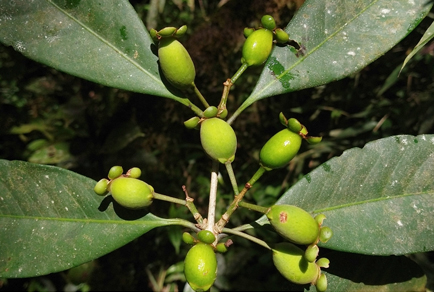
Eugenia P.Micheli ex L. is the largest genus of Myrtaceae in the Neotropics, with Brazil representing its main center of diversity. During fieldwork conducted in high-altitude Dense Ombrophilous Forest of the Serra do Mar State Park (Núcleo Cunha), São Paulo, Brazil, previously unidentified specimens were recognized as a new species of Eugenia sect. Umbellatae. Here we describe and illustrate Eugenia erythrosepala, and provide taxonomic comments, a distribution map, a preliminary conservation assessment, and an identification key to related species. The new species is morphologically similar to Eugenia adenantha, sharing glabrous branches and leaves, markedly canaliculate petioles, elliptic leaf blades with an acuminate apex, 8–14 pairs of secondary veins, two marginal veins, persistent bracteoles, and single-seeded fruits. It differs, however, by its shrubby habit up to 1.8 m tall (vs. a tree up to 16 m tall), smaller leaves 3–6 cm long (vs. 6.5–10 cm), longer pedicels 18–20 mm (vs. 3–15 mm), and fewer ovules per locule, 3–5 (vs. 12–22). Eugenia erythrosepala is also morphologically similar to E. gracillima, sharing glabrous branches and leaves, elliptic leaves with 9–14 pairs of secondary veins, inflorescences with late vegetative growth, and persistent bracteoles in fruits. It is distinguished by its membranaceous leaf blades (vs. chartaceous), secondary veins inserted at 45–55° (vs. 60–70°), triangular glabrous bracts (vs. ovate to lanceolate and slightly puberulous), orbicular to deltoid bracteoles (vs. ovate), sepals orbicular with acute apex (vs. ovate-oval with rounded apex), longer filaments 6–8 mm (vs. up to 5.5 mm), longer styles 9–11 mm (vs. 5–6 mm), longer pedicels 18–20 mm (vs. 7–18 mm), and ovoid to ellipsoid fruits (vs. globose). The species is currently known from two nearby localities above 1,100 m a.s.l. in riparian environments and is preliminarily assessed as Data Deficient (DD) according to IUCN criteria due to limited sampling and restricted records. Additionally, we provide the first description of the fruits of Eugenia longibracteata and present an updated conservation assessment for this species, now classified as Critically Endangered (CR) based on its restricted distribution, small area of occupancy, and current anthropic and natural threats.
References
- Bachman, S., Moat, J., Hill, A.W., de la Torre, J. & Scott, B. (2011) Supporting Red List threat assessments with GeoCAT: Geospatial conservation assessment tool. ZooKeys 150: 117–126. https://doi.org/10.3897/zookeys.150.2109
- Berg, O. (1855–1856) Revisio Myrtacearum Americae. Linnaea 27: 1–472.
- Berg, O. (1857) Myrtaceae. In: Martius, C.F.P. von (Ed.) Flora Brasiliensis 14 (1). R. Oldenbourg, Monachii et Lipsiae [Munich; Leipzig], pp. 1–528.
- Berg, O. (1859) Supplementum Myrtacearum. In: Martius, C.F.P. von (Ed.) Flora Brasiliensis 14 (1). pp. 529–665.
- Cicco, V., Galvani, E., Forti, M.C., Arcova, F.C.S., Ranzini, M., Cielo Filho, R. & Maruyama, L.S.C. (2019) Interceptação da chuva em ambiente de Mata Atlântica em clima tropical de altitude. Revista Brasileira de Climatologia 24: 88–109. https://doi.org/10.5380/abclima.v24i0.61648
- Corel Corporation (2026) CorelDRAW [vector editing software]. Alludo. Available from: https://www.coreldraw.com (accessed 17 March 2026)
- De Candolle, A.P. (1828) Myrtaceae. In: Prodromus Systematis Universalis Regni Vegetabilis 3. pp. 207–296.
- Google LLC. Google Earth Pro (v. 7.3). Available from: https://www.google.com/earth/about/versions/ (accessed 6 February 2026)
- IUCN (International Union for Conservation of Nature) (2001) Red List Categories and Criteria: Version 3.1. IUCN, Gland, Switzerland and Cambridge, U.K.
- IUCN (International Union for Conservation of Nature) (2019) Guidelines for Using the IUCN Red List Categories and Criteria. Version 13. Prepared by the Standards and Petitions Subcommittee. Available from: http://www.iucnredlist.org/documents/RedListGuidelines. pdf (accessed 17 March 2026)
- Karsten, G.K.W.H. (1848–1849) Auswahl neuer und schön blühender Gewächse Venezuelas. Deckershen Geheimen Ober-Hofbuch, Berlin, 40 pp.
- Kiaerskou, H. (1893) Enumeratio myrtacearum brasiliensium quas collegiunt Glaziou, Lund, Mendonça, Raben, Reinhardt, Schenck, Warming aliique. In: Warming, E. (Ed.) Symbolarum ad floram Brasiliae Centralis cognoscendam 39, pp. 1–199. https://doi.org/10.5962/bhl.title.4459
- Linnaeus, C. (1753) Species Plantarum. Impensis Laurentii Salvii, Stockholm, 471 pp.
- Mattos, J.R. (2005) Considerações sobre Calycorectes O.Berg. Loefgrenia 120: 1–24.
- Mazine, F.F. & Souza, V.C. (2009) New Species of Eugenia sect. Racemosae (Myrtaceae) from the Atlantic Forest, Eastern Brazil. Novon 19: 83–84. https://doi.org/10.3417/2007034
- Mazine, F.F., Bünger, M., Faria, J.E.Q., Fernandes, T., Giaretta, A., Valdemarin, K.S., Santana, K.C., Souza, M.A.D. & Sobral, M. (2026) Eugenia. In Flora e Funga do Brasil. Jardim Botânico do Rio de Janeiro. Available from: https://floradobrasil.jbrj.gov.br/FB10503 (accessed 17 March 2026)
- Mazine, F.F., Faria, J.E.Q., Giaretta, A., Vasconcelos, T.N.C., Forest, F. & Lucas, E. (2018) Phylogeny and biogeography of the hyper-diverse genus Eugenia (Myrtaceae: Myrteae), with emphasis on E. sect. Umbellatae, the most unmanageable clade. Taxon 67: 752–769. https://doi.org/10.12705/674.5
- POWO (2026) Plants of the World Online. Facilitated by the Royal Botanic Gardens, Kew. Published on the Internet. Available from: http://www.plantsoftheworldonline.org/ (accessed 17 March 2026)
- Serra Acima (2026) A enchente na região de Cunha: Catástrofe ou conseqüência? Serra Acima Associação de Cultura e Educação Ambiental. Available from: https://www.serracima.org.br/a-enchente-na-regiao-de-cunha-catastrofe-ou-consequencia/ (accessed 13 February 2026)
- SEMIL (2026) Plano de Manejo do Parque Estadual da Serra do Mar. Secretaria do Meio Ambiente do Estado de São Paulo, Instituto Florestal, São Paulo, 514 pp. Available from: https://fflorestal.sp.gov.br/planos-de-manejo/planos-de-manejo-planos-concluidos/plano-de-manejo-pe-serra-do-mar/ (accessed 13 February 2026)
- Sobral, M. (2007) Evolução do conhecimento taxonômico no Brasil (1990–2006) e um estudo de caso: a família Myrtaceae no município de Santa Teresa, Espírito Santo. PhD thesis, Universidade Federal de Minas Gerais, Belo Horizonte, Brazil.
- Sobral, M. (2013) Eight new Atlantic Rainforest species and nomenclatural notes in Brazilian Myrtaceae. Phytotaxa 135 (1): 43–61. https://doi.org/10.11646/phytotaxa.135.1.6
- Thiers, B. (2026) Index Herbariorum: A Global Directory of Public Herbaria and Associated Staff. New York Botanical Garden’s Virtual Herbarium. Available from: http://sweetgum.nybg.org/science/ih/ (accessed 17 March 2026)
- Valdemarin, K.S., Mazine, F.M. & Souza, V.C. (2024) Eugenia (Myrtaceae) from Reserva Natural Vale, Espírito Santo, a center of plant endemism in the Brazilian Atlantic Rainforest. Phytotaxa 651 (1): 1–79. https://doi.org/10.11646/phytotaxa.651.1.1
- Valdemarin, K.S., Souza, V.C. & Mazine, F.F. (2020) Two new and threatened Eugenia (Myrtaceae) species from the Atlantic Forest of Espírito Santo, Brazil. Phytotaxa 468 (2): 203–213. https://doi.org/10.11646/phytotaxa.468.2.4
- Valdemarin, K.S., Mazine, F.F. & Souza, V.C. (2019) Eugenia ochracea (Myrtaceae, Myrteae), a new species from Atlantic Forest of Espírito Santo, Brazil. Brittonia 71: 318–324. https://doi.org/10.1007/s12228-019-09567-y