
Abstract
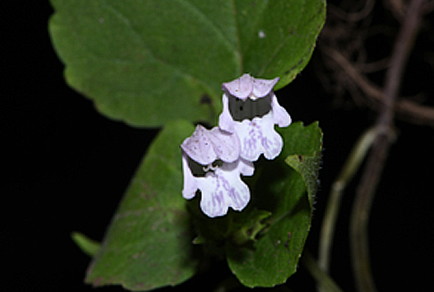
During a taxonomic revision of the genus Meehania (Lamiaceae), we re-evaluated the identity and nomenclatural status of Meehania faberi (Hemsley) C. Y. Wu. The protologue cited two specimens without designating a holotype; further study revealed that these specimens represent two distinct species. Therefore, in this paper, we designate a lectotype for Meehania faberi (Hemsl.) C. Y. Wu, provide a description of the new species, and assign it the name M. triangularis. The lectotypification of M. faberi and the recognition of M. triangularis clarify a long-standing nomenclatural and taxonomic confusion in the genus Meehania.
References
- Abedini, A. (2013) Evaluation Biologique et Phytochimique des Substances Naturelles d’Hyptis Atrorubens Poit. (Lamiaceae), Sélectionnée par un Criblage D’extraits de 42 Plantes. Ph.D. Thesis, Université du Droit et de la Santé-Lille II, Lille, France.
- Ben Mahmoud, K., Mezzapesa, G.N., Abdelkefi, F. & Perrino, E.V. (2024) Nutritional value and functional properties of an underexploited Tunisian wild beet (Beta macrocarpa Guss.) in relation to soil characteristics. Euro-Mediterranean Journal for Environmental Integration 9: 705–720. https://doi.org/10.1007/s41207-024-00468-5
- Britton (1894) Meehania: A proposed new Genus of Labiatae. Bulletin of the Torrey Botanical Club 21: 33–34. https://doi.org/10.2307/2478033
- Casella, F., Vurro, M., Valerio, F., Perrino, E.V., Mezzapesa, G.N. & Boari, A. (2023) Phytotoxic Effects of Essential Oils from Six Lamiaceae Species. Agronomy 13: 257. https://doi.org/10.3390/agronomy13010257
- Chen, C. (1977) Meehania. In: Wu, C.Y. & Li, H.W. (Eds.) Flora Reipublicae Popularis Sinica, Vol. 65. Science Press, pp. 334–344.
- Dein, M., Wickramasinghe, P.C. & Munafo Jr, J.P. (2020) Characterization of key odorants in Meehan’s mint, Meehania cordata. Journal of Agricultural and Food Chemistry 68 (38): 10388–10396. https://doi.org/10.1021/acs.jafc.9b06729
- Deng, T., Nie, Z.L., Drew, B.T., Volis, S., Kim, C., Xiang, C.L., Zhang, J.W., Wang, Y.H. & Sun, H. (2015) Does the Arcto-Tertiary biogeographic hypothesis explain the disjunct distribution of Northern Hemisphere herbaceous plants? The case of Meehania (Lamiaceae). PLoS One 10 (2): e0117171. https://doi.org/10.1371/journal.pone.0117171
- Hemsley, W.B. (1890) Dracocephalum faberi Hemsley. Journal of the Linnean Society Botany 26: 291.
- Jin, X.F., Chen, Z.H. & Ding, B.Y. (2018) A new species and a new variety of Lamiaceae from Zhejiang, eastern China. Nordic Journal of Botany 36 (12). https://doi.org/10.1111/njb.01869
- Li, H.W. & Hedge, I.C. (1994) Meehania Britton. In: Wu, Z.Y. & Raven, P.H. (Eds.) Flora of China, Vol. 17. Beijing/St. Louis: Science Press/ Missouri Botanical Garden, pp. 122–124.
- Özkan, M. (2008) Glandular and eglandular hairs of Salvia recognita Fisch. and Mey. (Lamiaceae) in Turkey. Bangladesh Journal of Botany 37: 93–95. https://doi.org/10.3329/bjb.v37i1.1571
- Perrino, E.V., Wagensommer, R.P., Mezzapesa, G.N. & Trani, A. (2024) Stachys italica Mill.: synecology, functional compounds and potential use of an Italian endemic taxon. Planta 260: 138. https://doi.org/10.1007/s00425-024-04571-3
- POWO (2025) Plants of the World Online. Facilitated by the Royal Botanic Gardens, Kew. Published on the Internet
- Takano, A., Sakaguchi, S., Li, P., Matsuo, A., Suyama, Y., Xia, G.H., Liu, X. & Isagi, Y. (2020) A Narrow Endemic or a Species Showing Disjunct Distribution? Studies on Meehania montis-koyae Ohwi (Lamiaceae). Plants 9 (9): 1159. https://doi.org/10.3390/plants9091159
- Turland, N.J., Wiersema, J.H., Barrie, F.R., Gandhi, K.G., Gravendyck, J., Greuter, W., Hawksworth, D.L., Herendeen, P.S., Klopper, R.R., Knapp, S., Kusber, W.-H., Li, D.-Z., May, T.W., Monro, A.M., Prado, J., Price, M.J., Smith, G.F. & Zamora Señoret, J.C. (Eds.) (2025) International Code of Nomenclature for algae, fungi, and plants (Madrid Code) adopted by the Twentieth International Botanical Congress Madrid, Spain, July 2025.
- Wu, C.Y. & Li, H.W. (1977) Meehania. In: Wu, C.Y. & Li, X.W. (Eds.) Flora Reipublicae Popularis Sinicae. Bei-jing:Science Press, pp. 334–344.
- Wu, C.Y. (1959) Revisio Labiatarum Sinensium. Acta Phytotaxonomica Sinica 8: 1–66.
- Xia, G.H. & Li, G.Y. (2011) Meehania montis koyae, a new record of Lamiaceae from China. Guihaia 31 (5): 581–583.