
Abstract
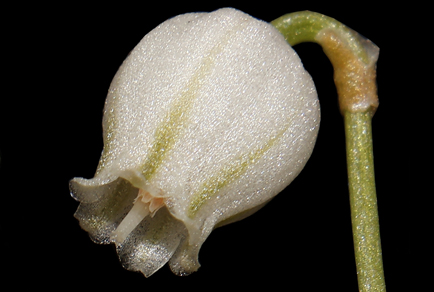
Our field exploration in southern Namibia in August 2016 revealed an undescribed species of Litanthus, sharing diagnostic characters of the genus, including 1(–2)-flowered inflorescence, two subopposite spurred bracts, nodding flowers with tepals connate into a long tube, included stamens with an elongation of the anther connective into a small, translucent, membranous flap and stigma with six minute, erect teeth. However, the new species clearly differs from the two currently known species in the genus by distinct morphological characters, habitat, and biogeography. Recent phylogenetic study also confirms its placement in the genus and its independence from other related species. Here we describe Litanthus deserticola, a new species of the genus Litanthus, representing the first record of this genus in Namibia. This species description is based on plants occurring in desertic regions showing a single, nodding, urceolate flower with very short, reflexed lobes, stamens adnate to tepals and arising from their lower fourth, with ovate tapering filaments which are longer than anthers. A complete morphological description of the new species as well as data on ecology, distribution and differences with related taxa is provided, including a comprehensive identification key to facilitate future taxonomic work in the genus.
References
- Angiosperm Phylogeny Group (2003) An update of the Angiosperm Phylogeny Group classification for the orders and families of flowering plants: APG II. Botanical Journal of the Linnean Society 141: 399–436. https://doi.org/10.1046/j.1095-8339.2003.t01-1-00158.x
- Angiosperm Phylogeny Group (2009) An update of the Angiosperm Phylogeny Group Classification for the orders and families of flowering plants: APG III. Botanical Journal of the Linnean Society 161: 105–121. https://doi.org/10.1111/j.1095-8339.2009.00996.x
- Angiosperm Phylogeny Group (2016) An update of the Angiosperm Phylogeny Group Classification for the orders and families of flowering plants: APG IV. Botanical Journal of the Linnean Society 181: 1–20. https://doi.org/10.1111/boj.12385
- Atlas of Namibia Team (2022) Atlas of Namibia: its land, water and life. Namibia Nature Foundation, Windhoek, 83 pp.
- Baker, J.G. (1871) A revision of the genera and species of herbaceous capsular gamophyllous Liliaceae. Journal of the Linnean Society, Botany 11: 349–436. https://doi.org/10.1111/j.1095-8339.1870.tb00068.x
- Baker, J.G. (1873) On Schizobasis, a new genus of Liliaceae from Cape Colony. Journal of Botany, British and Foreign 11: 105.
- Chase, M.W., Reveal, J.L. & Fay, M.F. (2009) A subfamilial classification for the expanded asparagalean families, Amaryllidaceae, Asparagaceae and Xanthorrhoeaceae. Botanical Journal of the Linnean Society 161: 132–136. https://doi.org/10.1111/j.1095-8339.2009.00999.x
- Craven, P. (ed.) (1999) A checklist of Namibian Plant Species. Southern African Botanical Diversity Network Report nº 7. SABONET, Windhoek, Namibia, 204 pp.
- Crouch, N.R. & Martínez-Azorín, M. (2024) Schizobasis litanthiflora (Hyacinthaceae, Urgineoideae), a new species from the Tugela River Basin of KwaZulu-Natal, South Africa. Phytotaxa 672 (2): 199–207. https://doi.org/10.11646/phytotaxa.672.2.6
- Goldblatt, P. & Manning, J.C. (2000) Cape Plants, a conspectus of the Cape flora of South Africa. Strelitzia 9. South African National Biodiversity Institute, Pretoria, 743 pp.
- Harvey, W.H. (1844) Litanthus, a new genus of Asphodeleae from South Africa. The London Journal of Botany 3: 314–315.
- Hooker, J.D. (1872) Litanthus pusillus. Curtis’s Botanical Magazine, Ser. 3, 28: t. 5995.
- IPNI (2025+) The international plant names index. Available from: http://www.ipni.org (accessed June 2025)
- Jessop, J.P. (1977) Studies in the bulbous Liliaceae in South Africa 7. The taxonomy of Drimia and certain allied genera. Journal of South African Botany 43 (4): 265–319. https://doi.org/10.5962/p.397096
- Klaassen, E.S. & Kwembeya, E.G. (eds.) (2013) A Checklist of Namibian Indigenous and Naturalised Plants. Occasional Contributions No. 5, National Botanical Research Institute, Windhoek, Namibia, 592 pp.
- Leistner, O.A. & Morris, J.W. (1976) Southern African place names. Annals of the Cape Provincial Museum 12: 1–565.
- Manning, J.C. & Goldblatt, P. (2018) Systematics of Drimia Jacq. (Hyacinthaceae: Urgineoideae) in southern Africa. Strelitzia 40. South African National Biodiversity Institute, Pretoria, 173 pp.
- Manning, J.C., Goldblatt, P. & Fay, M.F. (2004) A revised generic synopsis of Hyacinthaceae in Sub-Saharan Africa, based on molecular evidence, including new combinations and the new tribe Pseudoprospereae. Edinburgh Journal of Botany 60: 533–568. https://doi.org/10.1017/S0960428603000404
- Manning, J.C., Deacon, J. & Goldblatt, P. (2013) A review of the Litanthus group of Drimia Jacq. (Hyacinthaceae: Urgineoideae) with the description of a second species, Drimia stenocarpa, from Western Cape. South African Journal of Botany 90: 96–100. https://doi.org/10.1016/j.sajb.2013.10.006
- Martínez-Azorín, M., Crespo, M.B. & Juan, A. (2007) Taxonomic revision of Ornithogalum subg. Cathissa (Salisb.) Baker (Hyacinthaceae). Anales del Jardín Botánico de Madrid 64: 7–25. https://doi.org/10.3989/ajbm.2007.v64.i1.47
- Martínez-Azorín, M., Crespo, M.B. & Juan, A. (2009) Taxonomic revision of Ornithogalum subg. Beryllis (Hyacinthaceae) in the Iberian Peninsula and the Balearic Islands. Belgian Journal of Botany 142: 140–162.
- Martínez-Azorín, M., Crespo, M.B., Juan, A. & Fay, M.F. (2011) Molecular phylogenetics of subfamily Ornithogaloideae (Urgineoideae) based on nuclear and plastid DNA regions, including a new taxonomic arrangement. Annals of Botany (Oxford) 107: 1–37. https://doi.org/10.1093/aob/mcq207
- Martínez-Azorín, M., Crespo, M.B., Dold, A.P., Pinter, M. & Wetschnig, W. (2015) New combinations and lectotype designations in Asparagaceae subfam. Scilloideae. Phytotaxa 201 (2): 165–171. https://doi.org/10.11646/phytotaxa.201.2.7
- Martínez-Azorín, M., Crespo, M.B., Alonso, M.Á., Pinter, M., Crouch, N.R., Dold, A.P., Mucina, L., Pfosser, M. & Wetschnig, W. (2023a) A generic monograph of the Hyacinthaceae subfam. Urgineoideae. Phytotaxa 610 (1): 1–143. https://doi.org/10.11646/phytotaxa.610.1.1
- Martínez-Azorín, M., Crespo, M.B., Alonso, M.Á., Pinter, M., Crouch, N.R., Dold, A.P., Mucina, L., Pfosser, M. & Wetschnig, W. (2023b) Molecular phylogenetics of subfamily Urgineoideae (Urgineoideae): Towards a coherent generic circumscription informed by molecular, morphological and distributional data. Journal of Systematics and Evolution 63 (1): 42–63. https://doi.org/10.1111/jse.12905
- Moore, T. & Masters, M.T. (1866) Rare and interesting plants now in bloom at Kew. The Gardeners Chronicle and Agricultural Gazette 1866: 971–972.
- Mucina, L. & Rutherford, M.C. (eds.) (2024) Zonal biomes of Southern Africa. Springer Nature, Cham, 311 pp. https://doi.org/10.1007/978-3-031-63731-5
- Pfosser, M. & Speta, F. (2001) Bufadienolides and DNA sequences: on lumping and smashing of subfamily Hyacinthaceae (Urgineoideae). Stapfia 75: 177–250.
- Pfosser, M. & Speta, F. (2004) From Scilla to Charybdis—is our voyage safer now? Plant Systematics and Evolution 246: 245–263. https://doi.org/10.1007/s00606-004-0153-z
- Pfosser, M., Knirsch, W., Pinter, M., Ali, S., Dutta, S. & Wetschnig, W. (2012) Phylogenetic relationships of Malagasy Hyacinthaceae. Plant Ecology and Evolution 145: 65–72. https://doi.org/10.5091/plecevo.2012.590
- Speta, F. (1998a) Hyacinthaceae. In: Kubitzki, K. (Ed.) The families and genera of vascular plants, vol. 3. Springer, Berlin, pp. 261–285. https://doi.org/10.1007/978-3-662-03533-7_35
- Speta, F. (1998b) Systematische Analyse der Gattung Scilla L. s.l. (Hyacinthaceae). Phyton (Horn, Austria) 38 (1): 1–141.
- Thiers, B. (2025+) Index Herbariorum: A global directory of public herbaria and associated staff. New York Botanical Garden's Virtual Herbarium. Available from: http://sweetgum.nybg.org/ih/ (accessed June 2025)
- Turland, N.J., Wiersema, J.H., Barrie, F.R., Gandhi, K.N., Gravendyck, J., Greuter, W., Hawksworth, D.L., Herendeen, P.S., Klopper, R.R., Knapp, S., Kusber, W.-H., Li, D.-Z., May, T.W., Monro, A.M., Prado, J., Price, M.J., Smith, G.F. & Zamora Señoret, J.C. (Eds.) (2025) International Code of Nomenclature for algae, fungi, and plants (Madrid Code). [Regnum Vegetabile 162]. University of Chicago Press, Chicago. https://doi.org/10.7208/chicago/9780226839479.001.0001