

Abstract
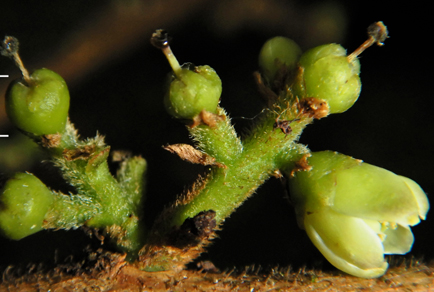
Here, we describe a new species of Symplocos from Colombia distinguished by a characteristic abaxial leaf indument, sericeous buds and small corollas 4.0–5.6 mm in length. A description of pollen of this species is provided, along with photographs of the living specimen showing its habit and reproductive structures. Additionally, a preliminary conservation status evaluation is presented.
References
- Armenteras, D., Gast, F. & Villareal, H. (2003) Andean forest fragmentation and the representativeness of protected natural areas in the eastern Andes, Colombia. Biological Conservation 113: 245–256.
- Beentje, H.J. (2010) The Kew plant glossary: an illustrated dictionary of plant terms. Royal Botanic Gardens, Kew, London, 164 pp.
- Brand, A. (1901) Symplocaceae. Das Pflanzenreich: regni vegetabilis conspectus 6: 1–100. [https://www.biodiversitylibrary.org/page/20830528]
- Castellanos-Mora, L. & Agudelo-Hz, W. (2021) Spatial scenarios of land-use/cover change for the management and conservation of paramos and Andean forests in Boyacá, Colombia. Environmental Sciences Proceedings 3: 1–9. https://doi.org/10.3390/IECF2020-08023
- Correa, F. (2005) Sociedad y naturaleza en la mitología Muisca. Tabula Rasa 3: 197–222. https://doi.org/10.25058/20112742.235
- Cuatrecasas, J. (1950) Contributions to the flora of South America: studies in South American plants-II. Fieldiana Botany 27 (1): 55–113. [https://www.biodiversitylibrary.org/page/2380890]
- De Candolle, A. (1844) Prodromus systematis naturalis regni vegetabilis, vol. 8. Treuttel & Wurtz, Paris, 684 pp.
- Ellis, B., Daly, D.C., Hickey, L.J., Johnson, K.R., Mitchell, J.D., Wilf, P. & Wing, S.L. (2009) Manual of leaf architecture. Comstock, Ithaca, 190 pp. https://doi.org/10.1079/9781845935849.0000
- Endlicher, S. (1847) Synopsis coniferarum. Scheitlin & Zollikofer, Switzerland, 368 pp. [https://www.biodiversitylibrary.org/item/52342]
- Erdtman, G. (1966) Pollen morphology and plant taxonomy, angiosperms. Hafner, New York, 9 pp.
- Fritsch, P.W., Kelly, L.M., Wang, Y., Almeda, F. & Kriebel, R. (2008) Revised infrafamilial classification of Symplocaceae based on phylogenetic data from DNA sequences and morphology. TAXON 57: 823–852. https://doi.org/10.1002/tax.573013
- Fritsch, P.W., Manchester, S.R., Stone, R.D., Cruz, B.C. & Almeda, F. (2015) Northern Hemisphere origins of the amphi‐Pacific tropical plant family Symplocaceae. Journal of Biogeography 42: 891–901.
- Humboldt, A., Bonpland, A., Poiteau, P.A., Schoell, F. & Turpin, P.J.F. (1808) Plantes équinoxiales recueillies au Mexique. Schoell, Paris, 191 pp. https://doi.org/10.5962/bhl.title.460
- Jacquin, N.J. (1760) Enumeratio systematica plantarum. Haak, Leiden, 41 pp. [https://www.biodiversitylibrary.org/page/622958]
- Linnaeus, C. (1753) Species plantarum 1. Salvius, Stockholm, 1200 pp. [https://www.biodiversitylibrary.org/page/358215]
- Linnaeus, C. (1759) Systema naturae editio cecima. Salvius, Stockholm, 1384 pp. [https://www.biodiversitylibrary.org/page/586916]
- Manchester, S.R., Lott, T.A., Herrera, F., Hooghiemstra, H., Wijninga, V.M. & Fritsch, P.W. (2021) Symplocos fruits from the Pliocene of Colombia. Systematic Botany 46: 416–421. https://doi.org/10.1600/036364421X16231782047398
- Oken, L. (1841) Allgemeine Naturgeschichte für alle Stände. Hoffmannsche Verlags-Buchhandlung, Stuttgart, 1448 pp.
- Pérez Arbeláez, E. (1996) Plantas útiles de Colombia. DAMA Fondo FEN, Colombia Jardín Botánico, Bogotá, 831 pp.
- Pinaya, J.L.D., Pitman, N.C., Cruz, F.W., Akabane, T.K., Lopez, M.D.C.S., Pereira-Filho, A.J., Grohman, C.H., Santos Reis, L., Ferreira Rodrigues, E.S., Ceccantini, G.C.T. & De Oliveira, P.E. (2024) Humid and cold forest connections in South America between the eastern Andes and the southern Atlantic coast during the LGM. Scientific Reports 14: 2080.
- Roubik, D. & Moreno, J.E. (1991) Pollen and spores of Barro Colorado Island. Monographs in Systematic Botany vol. 36. Missouri Botanical Garden, St. Louis, 270 pp. https://doi.org/10.2307/4110734
- Saint-Hilaire, A. (1822) Voyage dans l’intérieur du Brésil, La province Cisplatine et les missions dites du Paraguay. Mémoires du Muséum d’histoire naturelle 9: 337–380. [https://www.biodiversitylibrary.org/page/34824813]
- Ståhl, B. (1996) The genus Symplocos (Symplocaceae) in Colombia. Candollea 51: 323–364. https://doi.org/10.5169/seals-879413
- Velásquez, C. (1999) Atlas palinológico de la flora vascular paramuna de Colombia: Angiospermae. Universidad Nacional de Colombia, Medellín, 161 pp.
- Villota, A., León-Yánez, S. & Behling, H. (2015) Mid-and late Holocene vegetation and environmental dynamics in the Llanganates National Park, Anteojos Valley, central Ecuadorian Andes. Palynology 39: 350–361.
- Wijninga, V.M. (1996) Neogene ecology of the Salto de Tequendama site (2475 m altitude, Cordillera Oriental, Colombia): the paleobotanical record of montane and lowland forests. Review of Palaeobotany and Palynology 92: 97–156.