

Abstract
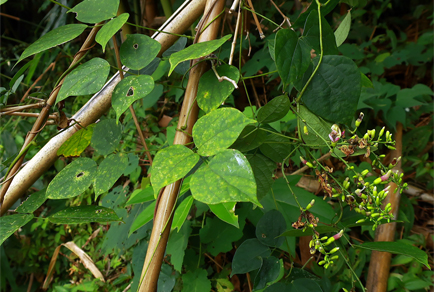
Apios calcicola Z.C.Lu & B.Pan bis, from karst terrain of Guangxi and Guizhou Provinces, China, is described here as a new species. This new species resembles two other widespread species, A. carnea and A. fortunei. However, it can be easily distinguished from A. carnea by its twisted and asymmetric flowers and conspicuous tubers, and from A. fortunei by its trifoliolate leaves, and purplish red and larger flowers. Molecular evidence suggests its position related to A. fortunei. Conservation status of A. calcicola is evaluated as Data Deficient (DD). The key to the Apios species is also updated.
References
- Ben Mahmoud, K., Mezzapesa, G.N., Abdelkefi, F. & Perrino, E.V. (2024) Nutritional value and functional properties of an underexploited Tunisian wild beet (Beta macrocarpa Guss.) in relation to soil characteristics. Euro-Mediterranean Journal for Environmental Integration 9: 705–720. https://doi.org/10.1007/s41207-024-00468-5
- Brullo, S., Tomaselli, V. & Wagensommer, R.P. (2015) A new species of Odontites (Orobanchaceae) from southern Italy. Phytotaxa 213 (3): 271–281. https://doi.org/10.11646/phytotaxa.213.3.7
- Dunn (1903) Descriptions of New Chinese Plants. Linnean Society of London Zoology Transactions 35 (247): 483–518. https://doi.org/10.1111/j.1095-8339.1903.tb00699.x
- Edgar, R.C. (2004) MUSCLE: multiple sequence alignment with high accuracy and high throughput. Nucleic Acids Research 32 (5): 1792–1797. https://doi.org/10.1093/nar/gkh340
- Egan, A.N., Vatanparast, M. & Cagle, W. (2016) Parsing polyphyletic Pueraria: Delimiting distinct evolutionary lineages through phylogeny. Molecular Phylogenetics and Evolution 104: 44–59. https://doi.org/10.1016/j.ympev.2016.08.001
- Fabricius, P.C. (1759) Enumeratio, Methodica Plantarum. Litteris Ioannis Drimbornii, Helmstadii, 239 pp.
- Hoang, D.T., Chernomor, O., von Haeseler, A., Minh, B.Q. & Vinh, L.S. (2018) UFBoot2: Improving the ultrafast bootstrap approximation. Molecular Biology and Evolution 35: 518–522. https://doi.org/10.1093/molbev/msx281
- IUCN (2024) Guidelines for using the IUCN Red List Categories and Criteria. Version 16. Prepared by the Standards and Petitions Committee
- Kearse, M., Moir, R., Wilson, A., Stones-Havas, S., Cheung, M., Sturrock, S., Buxton, S., Cooper, A., Markowitz, S., Duran, C., Thierer, T., Ashton, B., Meintjes, P. & Drummond, A. (2012) Geneious Basic: an integrated and extendable desktop software platform for the organization and analysis of sequence data. Bioinformatics 28 (12): 1647–1649. https://doi.org/10.1093/bioinformatics/bts199
- Maximowicz, C.J. (1873) Diagnoses plantarum novarum Japoniae et Mandshuriae. Bulletin de l’Académie Impériale des Sciences de Saint-Pétersbourg 18: 371–402.
- Nguyen, L.T., Schmidt, H.A., von Haeseler, A. & Minh, B.Q. (2015) IQTREE: A fast and effective stochastic algorithm for estimating maximum likelihood phylogenies. Molecular Biology and Evolution 32 (1): 268–274. https://doi.org/10.1093/molbev/msu300
- Orsenigo, S., Bacchetta, G., Calevo, J., Castello, M., Cogoni, D., Gennai, M., Licht, W., Montagnani, C., Perrino, E.V., Pinna, S.M., Silletti, G.N., Vela, E., Viciani, D., Vidali, M., Wagensommer, R.P., Zappa, E. & Fenu, G. (2016) Global and Regional IUCN Red List Assessments: 1. Italian Botanist 1: 61–85. https://doi.org/10.3897/italianbotanist.1.8647
- Ren, B. (2005) Systematics of the genera Apios Fabr. and Cochlianthus Benth. (Fabaceae). M. Sc. Dissertation. Institute of Botany, Chinese Academy of Sciences, Beijing.
- Ren, B., Zhu, X.Y. & Jiang, Y.C. (2007) Systematic significance of leaf epidermal features in Apios and Cochlianthus (Leguminosae). Acta Phytotaxonomica Sinica 45 (3): 274–284. https://doi.org/10.1360/aps050016
- Sa, R. & Gilbert, M.G. (2010) Apios. In: Wu, Z.Y., Raven, P.H. & Hong, D.Y. (Eds.) Flora of China, Vol. 10. Missouri Botanical Garden, St. Louis, pp. 203–204.
- Siti-Munirah, M.Y. & Dome, N. (2023) Thismia kenyirensis (Thismiaceae), a new species from Taman Negeri Kenyir, Terengganu, Peninsular Malaysia. PhytoKeys 221: 61–72. https://doi.org/10.3897/phytokeys.221.98571
- Thiers, B. (2025) Index Herbariorum: A global directory of public herbaria and associated staff. New York Botanical Garden’s Virtual Herbarium. Available from: http://sweetgum.nybg.org/ih/ (accessed 12 October 2025)
- Turczaninow, N.S. (1840) Bulletin de la Société impériale des naturalistes de Moscou 13: 69.
- Wallich, N. (1830) Plantae Asiaticae Rariores 1. Treuttel and Wurtz, London, 41–68, pl. 47, pl. 62.
- Wang, J.F., Jiang, K.W., Zhong, J.P., Chen, Y., Wu, D.H., Li, B.H., Pan, B., Wan, K.Y., Chen, Z.H. & Wu, L.H. (2025) Apios chindiana (Fabaceae: Papilionoideae: Phaseoleae), a new species from East China. Phytotaxa 697 (3): 245–254. https://doi.org/10.11646/phytotaxa.697.3.3
- Wei, Y.Z. (2005) Apios. In: Li, S.G. & Wei, F.N. (Eds.) Flora of Guangxi, Vol. 2. Guangxi Science and Technology Publishing House, Nanning, pp. 612–614.
- Woods, M. (1988) A revision of Apios and Cochlianthus (Leguminosae). PhD Dissertation. Southern Illinois University, Carbondale.
- Woods, M. (2005) A revision of the North American species of Apios (Fabaceae). Castanea 70: 85–100. https://doi.org/10.2179/0008-7475(2005)070[0085:AROTNA]2.0.CO;2
- Xiao, X.N. (1988) Apios. In: Ye, N.G. (Ed.) Flora Guizhouensis, Vol. 7. Sichuan Nationalities Publishing House, Chengdu, pp. 571–574.
- Zhang, F., Feng, S., Zhou, J.J., Zhang, R., Liu, L.H., Yang, C.Z., Yu, X.L. & Pan, B. (2018) Apios chendezhaoana (Fabaceae), an overlooked species and a new combination from China: evidence from morphological and molecular analyses. Phytotaxa 371 (1): 1–16. https://doi.org/10.11646/phytotaxa.371.1.1