

Abstract
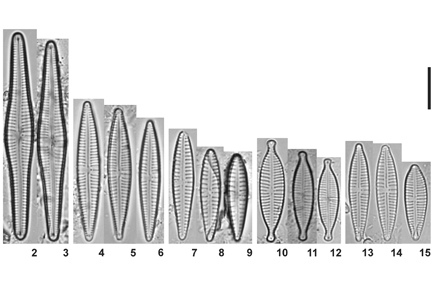
A taxonomic study of the genus Gomphonema was conducted in periphytic samples collected in preserved environments of a mountainous region from southern Brazil, “Mananciais da Serra”, located in Piraquara, State of Paraná. The analyses were performed using light and scanning electron microscopy, resulting in the record of eight species of the genus Gomphonema. One of them, Gomphonema serrana P.C. Ferreira et T.V. Ludwig sp. nov., was formally proposed. The new species is proposed based on particular morphological characteristics summarized in the clavate-lanceolate valves whose margins gradually attenuate towards the acute apical and rounded basal poles. The basal margins are slightly concave. Also, a coarse granulation and an isolated central pore decorate the axial area. Gomphonema brasiliensis var. demerarae and G. reimeri are taxa similar to G. serrana and are properly compared. Gomphonema pseudobohemicum was recorded for the first time in Brazil, expanding knowledge of the global distribution of the genus. Furthermore, the results reinforce the role of diatoms as environmental bioindicators, as these species occur in low conductivity and acidic conditions, typical of well-preserved oligotrophic environments.
References
- Abarca, N., Jahn, R., Zimmermann, J. & Enke, N. (2014) Does the Cosmopolitan Diatom Gomphonema parvulum (Kützing) Kützing Have a Biogeography? Plos One 9: 1–18. https://doi.org/10.1371/journal.pone.0086885
- Abarca, N., Zimmermann, J., Kusber, W.H., Mora, D., Van,A.T., Skibbe, O. & Jahn, R. (2020) Defining the core group of the genus Gomphonema Ehrenberg with molecular and morphological methods. Botany Letters 167 (1): 114–159. https://doi.org/10.1080/23818107.2019.1694980
- Amaral, M.W.W., Medeiros, G., Daufenbach, V., Sampaio, S.C., Reis, R.R.D., Ludwig, T.A.V. & Bueno, N.C. (2024) Taxonomy of epilithic diatoms and teratological forms under the presence of metals in surface sediment. Phytotaxa 647 (3): 237–273. https://doi.org/10.11646/phytotaxa.647.3.3
- Azevedo, J.S., Talgatti, D.M., Torgan, L.C., Pereira, A.C. & Melo, S. (2018) O gênero Gomphonema (Bacillariophyta) na comunidade perifítica do rio e reservatório de Curuá-una (Santarém, Pará, Brasil). Rodriguésia 69 (2): 765–776. https://doi.org/10.1590/2175-7860201869234
- Bahls, L.L. (2006) Northwestern Diatoms: A photographic catalogue of species in the Montana Diatom Collection with ecological optima, associates, and distribution records for the nine northwestern United States. Montana Diatom Collection, Montana, 464 pp.
- Bahls, L. & Luna, T. (2018) Diatoms from Wrangell-St. Elias National Park, Alaska, USA. Phytokeys 113: 33–57. https://doi.org/10.3897/phytokeys.113.29456
- Bąk, M., Witkowski, A. & Lange-Bertalot, H. (2006) Diatom flora diversity in the strongly eutrophicated and β-mesosaprobic waters of the Szczecin Lagoon, NW Poland, southern Baltic Sea. In: Ognjanova-Rumenova, N. & Manoylov, K. (Eds.) Advances in phycological studies. Festschrift in honour of Prof. Dobrina Temniskova-Topalova. Pensoft Publishers, Sofia–Moscow, pp. 293–317.
- Bicudo, D.C. & Menezes, M. (2006) Gêneros de Algas de Águas Continentais do Brasil, chave para identificação e descrições. Vol. 2. Rima, São Carlos, 502 pp.
- Chiosi, P., Silva, R.L., Beaumord, A.C. & Torgan, L.C. (2021) Diatomáceas (Bacillariophyta) epilíticas da Bacia Hidrográfica do Rio Itajaí, Santa Catarina, Brasil. Iheringia, Série Botânica 76: e2021007.
- Cox, E. & Van de Vijver, B. (2024) What constitutes a stigma? A review of isolated pores in raphid diatoms (Bacillariophyceae) and the value of precise terminology. Journal of Phycology 60 (6): 1498–1513. https://doi.org/10.1111/jpy.13522
- Dantas, Ê.W., Moura, A.N., Bittencourt-Oliveira, M.C., Arruda Neto, J.D.T. & Cavalcante, A.D.C. (2008) Temporal variation of the phytoplankton community at short sampling intervals in the Mundaú reservoir, Northeastern Brazil. Acta Botanica Brasilica 22 (4): 970–982. https://doi.org/10.1590/S0102-33062008000400008
- Ehrenberg, C.G. (1832) Über die Entwickelung und Lebensdauer der Infusionsthiere; nebst ferneren Beiträgen zu einer Vergleichung ihrer organischen Systeme. Abhandlungen der Königlichen Akademie der Wissenschaften zu Berlin, Physikalische Klasse, 154 pp.
- Ehrenberg, C.G. (1838) Die Infusionsthierchen als vollkommene Organismen. Ein Blick in das tiefere organische Leben der Natur. Verlag von Leopold Voss, Leipzig, i–xviii, 548 pp.
- Ehrenberg, C.G. (1843) Verbreitung und Einfluss des mikroskopischen Lebens in Süd- und Nord-Amerika. Abhandlungen der Königlichen Akademie der Wissenschaften zu Berlin 1841: 291–445, 4 pls.
- Ferreira, P.C., Kava, V.M. & Ludwig, T.A.V. (2023) Humidophila (Bacillariophyceae) in subtropical mountain springs and subaerial habitats, Paraná state, Brazil, with the description of H. piraquarae sp. nov. Fottea 23 (1): 8–20. https://doi.org/10.5507/fot.2022.008
- França, A.A., Dunck, B., Rodrigues, L., Fonseca, B.M. & Felisberto, S.A. (2021) Gomphonema Ehrenberg (Bacillariophyta) de córregos prístinos do Cerrado brasileiro. Iheringia, Série Botânica 76. https://doi.org/10.21826/2446-82312021v76e2021019
- Frenguelli, J. (1941) Diatomeas del Río de La Plata, Argentina. Revista del Museo de La Plata, Sección Botânica 15: 213–334.
- Gong, Z. & Li, Y.L. (2012) Gomphonema yaominae sp. nov. Li, a new species of diatom (Bacillariophyta) from lakes near Yangtze River, China. Phytotaxa 54: 59–64. https://doi.org/10.11646/phytotaxa.54.1.6
- Gray, S.F. (1821) A natural arrangement of British plants. Baldwin, Cradock & Joy, London, 824 pp.
- Grunow, A. (1878) Algen und Diatomaceen aus dem Kaspischen Meere. In: Schneider, O. (Ed.) Naturwissenschaftliche Beiträge zur Kenntnis der Kaukasusländer, auf Grund seiner Sammelbeute. Dresden, 132 pp.
- Guiry, M.D. & Guiry, G.M. (2025) AlgaeBase. World-wide electronic publication, National University of Ireland, Galway. Available from: https://www.algaebase.org (accessed 10 February 2026).
- Hofmann, G., Lange-Bertalot, H. & Werum, M. (2013) Diatomeen im Süßwasser—Benthos von Mitteleuropa. Bestimmungsflora Kieselalgen für die ökologische Praxis. Koeltz Scientific, Königstein, 2, 625 pp.
- Hustedt, F. (1965) Neue und wenig bekannte Diatomeen. IX. Süßwasserdiatomeen aus Brasilien, insbesondere des Amazonasgebietes. Internationale Revue der gesamten Hydrobiologie 50 (3): 391–410.
- IAT—Instituto Água e Terra. (2023) Classificação da Vegetação—Litoral Paranaense. Available from: https://www.iat.pr.gov.br/Pagina/Dados-e-Informacoes-Geoespaciais-Tematicos (accessed 10 December 2025).
- Jiang, Z., Liu, Y., Kociolek, J.P. & Fan, Y.W. (2018) One new Gomphonema (Bacillariophyta) species from Yunnan Province, China. Phytotaxa 349: 257–264. https://doi.org/10.11646/phytotaxa.349.3.6
- Kermarrec, L., Bouchez, A., Rimet, F. & Humbert, J.F. (2013) First Evidence of the Existence of Semi-Cryptic Species and a Phylogeographic Structure in the Gomphonema parvulum (Kützing) Kützing Complex (Bacillariophyta). Protist 164 (5): 686–705. https://doi.org/10.1016/j.protis.2013.07.005
- Kociolek, J.P. & Kingston, J.C. (1999) Taxonomy, ultrastructure, and distribution of some gomphonemoid diatoms from rivers in the United States. Canadian Journal of Botany 77: 686–705. https://doi.org/10.1139/B99-007
- Koponen, T.J. (1968) Generic revision of Mniaceae. Annales Botanici Fennici 5: 117–151.
- Krammer, K. & Lange-Bertalot, H. (1986) Bacillariophyceae. In: Ettl, H., Gerloff, J., Heynig, H. & Mollenhauer, D. (Ed.) Süßwasserflora von Mitteleuropa. Vol. 2 (1). G. Fischer, Stuttgart, 876 pp.
- Krasske, G. (1948) Diatomeen tropischer Moosrasen. Svensk Botanisk Tidskrift 42 (4): 404–443.
- Kulikovskiy, M.S., Kociolek, J.P., Solak, C.N., Kutnetsova, I.V. & Glushchenko, A.M. (2023) New and interesting taxa from the diatom genus Gomphonema Ehrenberg in shallow, nearshore sites on the eastern coast of Lake Baikal. Plants 12: 1835, 1–26. https://doi.org/10.3390/plants12091835
- Kützing, F.T. (1844) Die Kieselschaligen Bacillarien oder Diatomeen. W. Köhne, Nordhausen, 152 pp.
- Kützing, F.T. (1849) Species algarum. F.A. Brockhaus, Lipsiae, 922 pp.
- Lange-Bertalot, H. & Metzeltin, D. (1996) Oligotrophie-Indikatoren. 800 Taxa repräsentativ für drei diverse Seen-Typen: Kalkreich. Iconographia Diatomologica, vol. 2. 390 pp.
- Lange-Bertalot, H., Cavacini, P., Tagliaventi, N. & Alfinito, S. (2003) Diatoms of Sardinia. Rare and 76 new species in rock pools and other ephemeral waters. Iconographia Diatomologica, vol. 12. 438 pp.
- Lange-Bertalot, H., Külbs, K., Lauser, T., Nörpel-Schempp, M. & Willmann, M. (1996) Diatom taxa introduced by Georg Krasske. Dokumentation und Revision der von Georg Krasske beschriebenen Diatomeen-Taxa. Iconographia Diatomologica, vol. 3. 358 pp.
- Levkov, Z., Krstic, S., Metzeltin, D. & Nakov, T. (2007) Diatoms of Lakes Prespa and Ohrid, about 500 taxa from ancient lake system. Iconographia Diatomologica, vol. 16. 611 pp.
- Levkov, Z., Mitić-Kopanja, D. & Reichardt, E. (2016) The diatom genus Gomphonema from the Republic of Macedonia. Diatoms of Europe. Diatoms of the European Inland Waters and Comparable Habitats 8: 552 pp.
- Mertens, A., van der Wal, J., Verweij, G., Pex, B., van Dulmen, A. & van Dam, H. (2025) A revised list of diatom ecological indicator values in The Netherlands. Ecological Indicators 172: 113219. https://doi.org/10.1016/J.ECOLIND.2025.113219
- Marquardt, G.C. & Bicudo, C.E.M. (2014) Criptógamos do Parque Estadual das Fontes do Ipiranga, São Paulo, SP. Algas 36: Bacillariophyceae (Cymbellales). Hoehnea 41 (2): 209–246.
- Marra, R.C., Tremarin, P.I., Algarte, V.M. & Ludwig, T.A. (2016) Epiphytic diatoms (Diatomeae) from Piraquara II urban reservoir, Paraná state. Biota Neotropica 16 (4): e20160200. https://doi.org/10.1590/1676-0611-BN-2016-0200
- Medeiros, G., Amaral, M.W.W., Ferreira, P.C., Ludwig, T.V. & Bueno, N.C. (2018) Gomphonema Ehrenberg (Bacillariophyceae, Gomphonemataceae) of the São Francisco Falso River, Paraná, Brazil. Biota Neotropica 18 (3): e20170495. https://doi.org/10.1590/1676-0611-BN-2017-0495
- Metzeltin, D. & Lange-Bertalot, H. (1998) Tropical Diatoms of South America I. Iconographia Diatomologica, vol. 5. 275 pp.
- Metzeltin, D. & Lange-Bertalot, H. (2003) Diatoms from the “Island Continent” Madagascar. Iconographia Diatomologica, vol. 11. 286 pp.
- Metzeltin, D. & Lange-Bertalot, H. (2007) Tropical Diatoms of the South America II. Special remarks on biogeographic disjunction. Iconographia Diatomologica, vol. 18. 877 pp.
- Moreira-Filho, H. & Valente-Moreira, I.M. (1981) Avaliação taxonômica e ecológica das diatomáceas (Bacillariophyceae) epífitas em algas pluricelulares obtidas nos litorais dos Estados do Paraná, Santa Catarina e São Paulo. Boletim do Museu Botânico Municipal 47 (1–2): 1–17.
- Osório, N.C., Tremarin, P.I., Ludwig, T.A.V. & Rodrigues, L. (2017) Gomphonema Ehrenberg (Bacillariophyceae) in a lotic environment of the Upper Paraná River floodplain, Brazil. Acta Scientiarum. Biological Sciences 39 (2): 135–147. https://doi.org/10.4025/actascibiolsci.v39i2.32134
- Patrick, R. & Reimer, C.W. (1975) The Diatoms of the United States: Exclusive of Alaska and Hawaii. Entomoneidaceae, Cymbelaceae, Gomphonemaceae, Epithemiaceae. Monographs of the Academy of Natural Sciences of Philadelphia, vol. 2 (2). pp. 1–213.
- Pires, E.C.C. (2013) Gomphonemataceae e Cymbellaceae (Bacillariophyceae) da bacia hidrográfica litorânea do Paraná, Brasil. Master’s Dissertation, Universidade Federal do Paraná, Curitiba, PR, Brazil, 216 pp.
- Rabenhorst, L. (1864) Flora europaea algarum aquae dulcis et submarinae. Sectio I. Algas diatomaceas complectens, cum figuris generum omnium xylographice impressis. Apud Eduardum Kummerum, Lipsiae [Leipzig], 359 pp.
- Reichardt, E. (1999) Zur Revision der Gattung Gomphonema. Die Arten um G. affine/insigne, G. angustatum/micropus, G. acuminatum sowie gomphonemoide Diatomeen aus dem Oberoligozän in Böhmen. Iconographia Diatomologica, vol. 8. 203 pp.
- Reichardt, E. (2015a) Gomphonema gracile Ehrenberg sensu stricto et sensu auct. (Bacillariophyceae): A taxonomic revision. Nova Hedwigia 101 (3–4): 367–393. https://doi.org/10.1127/nova_hedwigia/2015/0275
- Reichardt, E. (2015b) Taxonomy and distribution of Gomphonema subtile Ehrenberg (Bacillariophyceae) and six related taxa. Fottea 15 (1): 27–38. https://doi.org/10.5507/fot.2015.003
- Ruwer, D.T., Ludwig, T.A.V. & Rodrigues, L. (2019) Two new diatom species (Bacillariophyceae) from Brazilian floodplain: Actinella hermes-moreirae sp. nov. and Gomphonema mutunensis sp. nov. Phytotaxa 395 (2): 71–80. https://doi.org/10.11646/phytotaxa.395.2.3
- Sanepar. (2025) Mananciais da Serra. Available from: https://www.aesbe.org.br/wp-content/uploads/2018/02/Revista-Sanear-Edicao-32.pdf (accessed 19 February 2026)
- Silva, A.M.D., Ludwig, T.A.V., Tremarin, P.I. & Vercellino, I.S. (2010) Diatomáceas perifíticas em um sistema eutrófico brasileiro (Reservatório do Iraí, estado do Paraná). Acta Botanica Brasilica 24 (4): 997–1016. https://doi.org/10.1590/S0102-33062010000400015
- Silva-Lehmkuhl, A.M., Tremarin, P.I., Vercellino, I.S. & Ludwig, T.A.V. (2019) Periphytic diatoms from an oligotrophic lentic system, Piraquara I reservoir, Paraná state, Brazil. Biota Neotropica 19 (2): e20180568. https://doi.org/10.1590/1676-0611-BN-2018-0568
- Simonsen, R. (1974) The diatom plankton of the Indian Ocean Expedition of R/V “Meteor”, 1964–65. Meteor Forschungsergebnisse. Reihe D-Biologie 19: 1–66.
- Skibbe, O., Abarca, N., Forrest, F. & Werner, P. (2022) Exploring diatom diversity through cultures—a case study from the Bow River, Canada. Journal of Limnology 81 (2095): 227–255. https://doi.org/10.4081/jlimnol.2022.2095
- Smith, W. (1856) A synopsis of the British Diatomaceae; with remarks on their structure, functions and distribution; and instructions for collecting and preserving specimens. The plates by Tuffen West. In two volumes. Vol. II. London.
- Tremarin, P.I., Bertolli, L.M., Faria, D.M., Costin, J.C. & Ludwig, T.A.V. (2009) Gomphonema Ehrenberg e Gomphosphenia Lange-Bertalot (Bacillariophyceae) do Rio Maurício, Paraná, Brasil. Biota Neotropica 9 (4): 111–130. https://doi.org/10.1590/S1676-06032009000400013
- Tundisi, J.G. & Matsumura-Tundisi, T. (2008) Limnologia. Oficina de textos, São Paulo, SP, Brazil, 631 pp.
- Van de Vijver, B., Ector, L. & Williams, D.M. (2020) Observations on and typification of Gomphonema naviculoides W. Smith (Gomphonemataceae, Bacillariophyta). Notulae Algarum 159: 1–7.