
Abstract
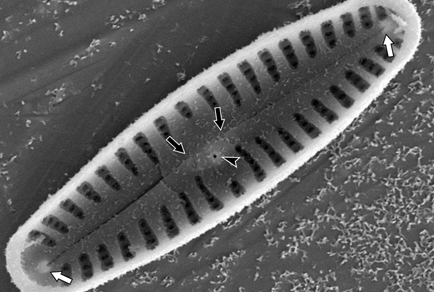
In this study, we investigate the diversity of diatom communities in several watercourses located in the Karaginsky district, Northeastern Kamchatka, Russia. The studied waterbodies are characterized by a wide range of ecological conditions in terms of pH level, electrical conductivity and solute concentration. Our analysis indicates the richness of diatom communities in the studied area. Hereby, we illustrate 24 most abundant diatom species from the analyzed waterbodies. Light microscopy-based morphological diagnoses are presented for all taxa. Notes on the distribution of the abundant diatom taxa and their ecological characteristics are provided. In addition, a new species—Gomphonema lepskayae sp. nov.—is described based on the results of light and scanning electron microscopy. The new species is distinguished from related taxa by valve symmetry, striae arrangement, morphology of axial and central areas and structure of the isolated pore.
References
- Abarca, N., Stancheva, R., Skibbe, O., Schimani, K., Kusber, W.H., Zimmermann, J. & Jahn, R. (2023) Gomphadelpha (Bacillariophyceae)—a new genus name for taxa formerly subsumed in the Gomphoneis herculeana-group. Nova Hedwigia 117 (1–4): 213–254. https://doi.org/10.1127/nova_hedwigia/2023/0859
- Ács, E., Ari, E., Duleba, M., Dressler, M., Genkal, S.I., Jakó, E., Rimet, F., Ector, L. & Kiss, K.T. (2016) Pantocsekiella, a new centric diatom genus based on morphological and genetic studies. Fottea, Olomouc 16 (1): 56–78. https://doi.org/10.5507/fot.2015.028
- Agardh, C.A. (1831) Conspectus criticus diatomacearum. Part 3. Literis Berlingianus, Lund, pp. 33–48.
- Bahls, L.L. (2012) Seven new species in Navicula sensu stricto from the Northern Great Plains and Northern Rocky Mountains. Nova Hedwigia 141: 19–38.
- Barinova, S.S., Anissimova, O.V. & Medvedeva, L.A. (2006) Biodiversity of algae-environmental indicators. Pilies Studio, Tel Aviv, 498 pp.
- Batterbee, R.W. (1986) Diatom analysis. In: Berglund, B.E. (Ed.) Handbook of Holocene palaeoecology and palaeohydrology. John Wiley & Sons Ltd., London, pp. 527–570.
- Bory de Saint-Vincent, J.B.G.M. (1822a) Achnanthes. In: Audouin, I. (Ed.) Dictionnaire Classique d’Histoire Naturelle. Rey & Gravier, Libraires-éditeurs, Baudouin Frères, Paris, pp. 79–80.
- Bory de Saint-Vincent, J.B.G.M. (1822b) Bacillariées. Dictionnaire Classique d’Histoire naturelle 2: 127–129.
- Cantonati, M. & Lange-Bertalot, H. (2006) Achnanthidium dolomiticum sp. nov. (Bacillariophyta) from oligotrophic mountain springs and lakes fed by dolomite aquifers. Journal of Phycology 42 (6): 1184–1188. https://doi.org/10.1111/j.1529-8817.2006.00281.x
- Cleve, P.T. & Grunow, A. (1880) Beiträge zur Kenntniss der Arctischen Diatomeen. Kongliga Svenska-Vetenskaps Akademiens Handlingar 17 (2): 1–121.
- Cleve, P.T. & Möller, J.D. (1882) Diatoms, Part VI. Upsala: Esatas Edquists Boktryckeri, Upsala, 324 pp.
- Compère, P. (2001) Ulnaria (Kützing) Compère, a new genus name for Fragilaria subgen. Alterasynedra Lange-Bertalot with comments on the typification of Synedra Ehrenberg. In: Jahn, R., Kociolek, J.P., Witkowski, A. & Compère, P. (Eds.) Lange-Bertalot Festschrift. Studies on diatoms dedicated to Prof. Dr. Dr. h.c. Horst Lange-Bertalot on the occasion of his 65th birthday. A.R.G. Gantner Verlag K.G., Ruggell, pp. 97–101.
- Czarnecki, D.B. (1994) The freshwater diatoms culture collection at Loras College, Dubuque, Iowa. Memoirs of the California Academy of Sciences 17: 155–174.
- Desmazières, J.B.H.J. (1830) Plantes Cryptogames du nord de la France. Published by the author, Lille, 500 pp.
- Ehrenberg, C.G. (1832) Über die Entwickelung und Lebensdauer der Infusionsthiere; nebst ferneren Beiträgen zu einer Vergleichung ihrer organischen Systeme. Abhandlungen der Königlichen Akademie Wissenschaften zu Berlin, Physikalische Klasse 1831: 1–154.
- Ehrenberg, C.G. (1838) Atlas von Vier und Sechzig Kupfertafeln ze Christian Gottfried Ehrenberg über Infusionsthierchen. Verlag von Leopold Voss, Leipzig, 52 pl.
- Ehrenberg, C.G. (1854) Mikrogeologie. Einundvierzig Tafeln mit über viertausend grossentheils colorirten Figuren, Gezeichnet vom Verfasser. Verlag von Leopold Voss, Leipzig, 31 pp.
- Fazlutdinova, A.I., Allaguvatova, R.Z. & Gaysina, L.A. (2023) Ecotonic Communities of Diatoms in the Southeastern Part of the Kamchatka Peninsula. Earth 4 (2): 209–222. https://doi.org/10.3390/earth4020011
- Fritsch, F.E. (1935) The structure and reproduction of the algae. Volume I. Introduction, Chlorophyceae. Xanthophyceae, Chrysophyceae, Bacillariophyceae, Cryptophyceae, Dinophyceae, Chloromonineae, Euglenineae, Colourless Flagellata. Cambridge University Press, Cambridge, 791 pp.
- Genkal, S.I. & Lepskaya, E.V. (2023) Diatoms (Bacillariophyta) of the Tolmachev reservoir (Kamchatka, Russia). Botanica Pacifica 12: 133–139. https://doi.org/10.17581/bp.2023.12101
- Genkal, S.I. & Kharitonov, V.G. (2008) On the morphology and taxonomy of Hannaea arcus (Bacillariophyta). Novosti Sistematiki Nizschikh Rastenii 42: 14–23. https://doi.org/10.31111/nsnr/2008.42.14
- Genkal, S.I. & Lepskaya, E.V. (2013) Stephanodiscus popovskayae, a new species from the volcanic lakes of Kamchatka in East Asia, Russia. Diatom Research 28: 365–372. https://doi.org/10.1080/0269249X.2013.809667
- Genkal, S.I. & Lepskaya, E.V. (2014) Centric diatom algae of volcanic Verkhneavachinsk lakes (Kamchatka). Inland Water Biology 7: 1–9. https://doi.org/10.1134/S1995082914010064
- Genkal, S.I. & Lepskaya, E.V. (2015) Materials to the Flora of Bacillariophyta of Lake Kronotskoye (the Kamchatka Peninsula, Russia). Int. J. Algae 17: 14–22. https://doi.org/10.1615/InterJAlgae.v17.i1.20
- Genkal, S.I., Lupikina, E.G. & Lepskaya, E.V. (2004) Cyclotella tripartita (Bacillariophyta) from lakes of Kamchatka and Eastern Baikal Region, Botanicheskii Zhurnal 89: 426–435.
- Gogorev, R.M., Chudaev, D.A. & Gololobova, M.A. (2024) Addition to the glossary of diatom morphology. Novosti sistematiki nizshikh rastenii 58 (1): 35–58. https://doi.org/10.31111/nsnr/2024.58.1.A35
- Gogorev, R.M., Chudaev, D.A., Stepanova, V.A. & Kulikovskiy, M.S. (2018) Russian and English terminological glossary on morphology of diatoms. Novosti sistematiki nizshikh rastenii 52 (2): 265–309. https://doi.org/10.31111/nsnr/2018.52.2.265
- Gregory, W. (1856) Notice of some new species of British fresh-water Diatomaceae. Quarterly Journal of Microscopical Science, New Series 4: 1–14. https://doi.org/10.1242/jcs.s1-4.13.1
- Grunow, A. (1878) Algen und Diatomaceen aus dem Kaspischen Meere. In: Schneider, O. (Ed.) Naturwissenschaftliche Beiträge zur Kenntnis der Kaukasusländer, auf Grund seiner Sammelbeute. Dresden Burdach, Dresden, pp. 98–132.
- Guiry, M.D. & Guiry, G.M. (2025) AlgaeBase. World-wide electronic publication, National University of Ireland, Galway. Available from: http://www.algaebase.org (accessed 17 August 2025)
- Guiry, M.D. (2013) Taxonomy and nomenclature of the Conjugatophyceae (=Zygnematophyceae). Algae. An International Journal of Algal Research 28: 1–29. https://doi.org/10.4490/algae.2013.28.1.001
- Håkansson, H. (1990) Cyclotella tripartita nov. sp. and the relationship to similar taxa. In: M. Ricard (Ed.) Ouvrage dédié a H. Germain/Ouvrage Mémoire Henry Germain. Koeltz Scientific Books, Koenigstein, pp. 75–82.
- Hassall, A.H. (1845) A history of the British freshwater algae, including descriptions of the Desmideae and Diatomaceae. S. Highley, H. Baillière; Sunderland & Knox; J.B. Baillière; T.O. Weigel, London, Edinburgh, Paris & Leipzig, 462 pp.
- Hassall, A.H. (1850) A microscopic examination of the water supplied to the inhabitants of London and the suburban districts; illustrated by coloured plates, exhibiting the living animal and vegetable productions in Thames and other waters, as supplied by the several companies; with an examination, microscopic and general, of their sources of supply, as well as the Henly-on-Thames and Watford plans, etc. Samuel Highley, London, 66 pp.
- Haworth, E.Y. (1990) Diatom name validation. Diatom Research 5 (1): 195–196. https://doi.org/10.1080/0269249X.1990.9705104
- Houk, V. & Klee, R. (2004) The stelligeroid taxa of the genus Cyclotella (Kützing) Brébisson (Bacillariophyceae) and their transfer into the new genus Discostella gen. nov. Diatom Research 19 (2): 203–228. https://doi.org/10.1080/0269249X.2004.9705871
- Huber-Pestalozzi, G. (1942) Das Phytoplankton des Süßwassers Systematik und Biologie 2. Teil 2. Hälfte Diatomeen Unter Mitwirkung von Dr. Friedr. Hustedt Bremen. In: Thienemann, A. (Ed.) Die Binnengewässer Einzeldarsstellungen aus der Limnologie und ihren Nachbargebieten. Unter Mitwirkung von Fachgenossen herausgegeben von Dr. August Thienemann. Schweizerbart’sche Verlagsbuchandlung, Stuttgart, pp. 367–549.
- Hustedt, F. (1939) Die Diatomeenflora des Küstengebietes der Nordsee vom Dollart bis zur Elbemündung. I. Die Diatomeenflora in den Sedimenten der unteren Ems sowie auf den Watten in der Leybucht, des Memmert und bei der Insel Juist. Adhandlungen des Naturwissenschaftlichen Verein zu Bremen 31 (2/3): 571–677.
- Jones, V. & Solomina, O. (2015) The geography of Kamchatka. Global and Planetary Change 134: 3–9. https://doi.org/10.1016/j.gloplacha.2015.06.003
- Karpenko, V.I., Andrievskaya, L.D. & Koval, M.V. (2013) Nutrition and growth characteristics of Pacific salmon in marine waters. KamchatNIRO, Petropavlovsk-Kamchatsky, 303 pp.
- Kezlya, E.M., Glushchenko, A.M. & Kulikovskiy, M.S. (2024) Diatom Diversity from Watercourses of North-Eastern Kamchatka with Description of One New Species. Diversity 16 (9): 592. https://doi.org/10.3390/d16090592
- Khursevich, G. & Kociolek, J.P. (2012) A preliminary, worldwide inventory of the extinct, freshwater fossil diatoms from the orders Thalassiosirales, Stephanodiscales, Paraliales, Aulacoseirales, Melosirales, Coscinodiscales, and Biddulphiales. Nova Hedwigia Beiheft 141: 315–364.
- Krammer, K. (1982) Valve morphology in the genus Cymbella C.A. Agardh. In: Helmcke, J.-G. & Krammer, K. (Eds.) Micromorphology of diatom valves. Vol. 11. J. Camer, Vaduz, pp. 1–299.
- Krammer, K. (2002) Cymbella. In: Lange-Bertalot, H. (Ed.) Diatoms of Europe. Vol. 3. A.R.G. Gantner Verlag K.G., Ruggell, pp. 1–584.
- Kulikovskiy, M.S., Glushchenko, A.M., Genkal, S.I. & Kuznetsova, I.V. (2016) Identification book of diatoms from Russia. Filigran, Yaroslavl, 804 pp.
- Kützing, F.T. (1834) Synopsis diatomearum oder Versuch einer systematischen Zusammenstellung der Diatomeen. Linnaea 8: 529–620. https://doi.org/10.5962/bhl.title.65634
- Kützing, F.T. (1844) Die Kieselschaligen Bacillarien oder Diatomeen. Zu finden bei W. Köhne, Nordhausen, 152 pp. https://doi.org/10.5962/bhl.title.64360
- Lange-Bertalot, H. & Genkal, S.I. (1999) Diatoms from Siberia I—Islands in the Arctic Ocean (Yugorsky-Shar Strait). Iconographia Diatomologica 6: 1–271. https://doi.org/10.5962/bhl.title.64360
- Lange-Bertalot, H. (1976) Eine Revision zur Taxonomie der Nitzschiae lanceolatae Grunow. Die “klassischen” bis 1930 beschreibenen Süßwasserarten Europas. Nova Hedwigia 28 (2–3): 253–308.
- Lange-Bertalot, H. (1999) Neue Kombinationen von Taxa aus Achnanthes Bory (sensu lato). Iconographia Diatomologica 6: 270–283.
- Lange-Bertalot, H., Hofmann, G., Werum, M., Cantonati, M. & Kelly, M.G. (2017) Freshwater benthic diatoms of Central Europe: over 800 common species used in ecological assessment. Koeltz Botanical Books, Schmitten-Oberreifenberg, 908 pp.
- Lange-Bertalot, H., Külbs, K., Lauser, T., Nörpel-Schempp, M. & Willmann, M. (1996) Diatom taxa introduced by Georg Krasske. Documentation and revision. Iconographia Diatomologica 3: 2–358.
- Lepskaya, E.V. & Bonk, T.V. (2021) Specifics of pelagic feeding by Daphnia longiremis Sars in the Kurile Lake in terms of structural transformation of phytoplankton. The researches of the aquatic biological resources of Kamchatka and the North-West Part of the Pacific Ocean 63: 50–58. https://doi.org/10.15853/2072-8212.2021.63.50-58
- Lepskaya, E.V. (2004) Phytoplankton in the Ecosystem of Lake Kurilskoye. Institute of Marine Biology, Far Eastern Branch of the RAS, Vladivostok, 157 pp.
- Lepskaya, E.V., Bonk, T.V. & Bekker, E.I. (2019) Freshwater microalgae and invertebrates in the basin of Talovskoye Lake (Koryak Reserve, Kamchatka). Res. Aquat. Biol. Resour. Kamchatka North-West Part Pac. Ocean 52: 108–119. https://doi.org/10.15853/2072-8212.2019.52.108-119
- Lepskaya, E.V., Jewson, D.H. & Usoltseva, M.V. (2010) Aulacoseira subarctica in Kurilskoye Lake, Kamchatka: A deep, oligotrophic lake and important Pacific salmon nursery. Diatom Research 25: 323–335. https://doi.org/10.1080/0269249X.2010.9705853
- Lepskaya, E.V., Koval, M.V., Bazarkina, L.A., Bonk, T.V., Bochkova, E.V., Bugaev, V.F., Vinogradova, D.S., Losenkova, K.V., Gavruseva, T.V., Sviridenko, V.D, Sergeenko, N.V., Ustimenko, E.A. & Gorodovskaya, S.B. (2014) Formation and modern state of ecosystem in Tolmachevskoye reservoir (Kamchatka) and the acclimatized there population of kokanee (Oncorhynchus nerka kennerlyi). Izv. TINRO 178: 95–115. https://doi.org/10.26428/1606-9919-2014-178-95-115
- Levkov, Z. (2009) Amphora sensu lato. In: Lange-Bertalot, H. (Ed.) Diatoms of Europe: Diatoms of the European inland waters and comparable habitats. A.R.G. Gantner Verlag K.G., Ruggell, pp. 5–916.
- Levkov, Z., Mitic-Kopanja, D. & Reichardt, E. (2016) The diatom genus Gomphonema in the Republic of Macedonia. In: Lange-Bertalot, H. (Ed.) Diatoms of Europe: Diatoms of the European inland waters and comparable habitats. Volume 8. Koeltz Botanical Books, Oberreifenberg, pp. 1–552.
- Liu, Q., Glushchenko, A., Kulikovskiy, M., Maltsev, Y. & Kociolek, J.P. (2019) New Hannaea Patrick (Fragilariaceae, Bacillariophyceae) Species from Asia, with Comments on the Biogeography of the Genus. Cryptogamie, Algologie 40 (5): 41–46. https://doi.org/10.5252/cryptogamie-algologie2019v40a5
- Lyngbye, H.C. (1819) Tentamen hydrophytologiae danicae continens omnia hydrophyta cryptogama Daniae, Holsatiae, Faeroae, Islandiae, Groenlandiae hucusque cognita, systematice disposita, descripta et iconibus illustrata, adjectis simul speciebus norvegicis. Commissis Librariae Gyldendaliae, Copenhagen, 248 pp. https://doi.org/10.5962/bhl.title.6079
- Mironov, A., Maltsev, Y., Kociolek, J.P., Kezlya, E., Liu, Y. & Kulikovskiy, M. (2024) Description of Encyonemataceae fam. nov. and Witkowskiaceae fam. nov. (Bacillariophyceae, Cymbellales) based on molecular and morphological analyses. Scientific Reports 14 (1): 31045. https://doi.org/10.1038/s41598-024-82213-0
- Nakov, T., Guillory, W.X., Julius, M.L., Theriot, E.C. & Alverson, A.J. (2015) Towards a phylogenetic classification of species belonging to the diatom genus Cyclotella (Bacillariophyceae): Transfer of species formerly placed in Puncticulata, Handmannia, Pliocaenicus and Cyclotella to the genus Lindavia. Phytotaxa 217 (3): 249–264. https://doi.org/10.11646/phytotaxa.217.3.2
- Østrup, E. (1910) Danske Diatoméer med 5 tavler et Engelsk résumé. Udgivet paa Carlsbergfondets bekostning. C.A. Reitzel Boghandel Bianco Lunos Bogtrykkeri, Copenhagen, 323 pp. https://doi.org/10.5962/bhl.title.1044
- Pascher, A. (1914) Über Flagellaten und Algen. Berichte der Deutschen Botanischen Gesellschaft 32: 136–160. https://doi.org/10.1111/j.1438-8677.1914.tb07573.x
- Patrick, R.M. & Reimer, C.W. (1966) The diatoms of the United States exclusive of Alaska and Hawaii. Volume 1: Fragilariaceae, Eunotiaceae, Achnanthaceae, Naviculaceae. Monographs of the Academy of Natural Sciences of Philadelphia 13: 1–688.
- Petersen, J.B. (1938) Fragilaria intermedia-Synedra Vaucheriae? Botaniska Notiser 1938 (1–3): 164–170.
- Potapova, M. (2014) Diatoms of Bering Island, Kamchatka, Russia. Nova Hedwigia, Beiheft 143: 63–102.
- Pritchard, A. (1861) A history of infusoria, including the Desmidiaceae and Diatomaceae, British and foreign. Whittaker and Co., London, 968 pp. https://doi.org/10.5962/bhl.title.101827
- Rabenhorst, L. (1864) Flora europaea algarum aquae dulcis et submarinae. Sectio I. Algas diatomaceas complectens, cum figuris generum omnium xylographice impressis. Apud Eduardum Kummerum, Leipzig, 359 pp. https://doi.org/10.5962/bhl.title.7029
- Reichardt, E. & Lange-Bertalot, H. (1991) Taxonomische Revision des Artencomplexes um Gomphonema angustum—G. dichotomum—G. intricatum—G. vibrio und ahnliche Taxa (Bacillariophyceae). Nova Hedwigia 53 (3–4): 519–544.
- Reichardt, E. (1997) Taxonomische Revision der Artencomplexes um Gomphonema pumillum (Bacillariophyceae). Nova Hedwigia 65: 99–129. https://doi.org/10.1127/nova.hedwigia/65/1997/99
- Reichardt, E. (2020) Diatomeen in Karstquellen im Naturpark Altmühltal. Berichte der Bayerischen Botanischen Gesellschaft 90: 147–176.
- Round, F.E., Crawford, R.M. & Mann, D.G. (1990) The diatoms. Biology and morphology of the genera. Cambridge University Press, Cambridge, 747 pp.
- Schmidt, A.W.F. (1875) Atlas der Diatomaceen-kunde. Series I: Heft 3. Verlag von Ernst Schlegel, Aschersleben, 12 pl. https://doi.org/10.5962/bhl.title.64396
- Self, A.E., Klimaschewski, A., Solovieva, N., Jones, V.J., Andrén, E., Andreev, A.A., Hammarlund, D. & Brooks, S.J. (2015) The relative influences of climate and volcanic activity on Holocene lake development inferred from a mountain lake in central Kamchatka. Global and Planetary Change 134: 67–81. https://doi.org/10.1016/j.gloplacha.2015.06.012
- Shkurina, N.A., Lepskaya, E.V. & Belyakova, G.A. (2004) Diatoms of Lake Dalneye (Kamchatka). Issl. Vod. Bio. Res. Kamchatka and the North-Western part of the Pacific Ocean 7: 88–93.
- Sládecek, V. (1973) System of water quality from the biological point of view. Archiv für Hydrobiologie–Beiheft Ergebnisse der Limnologie 7 (1): 218.
- Sládecek, V. (1986) Diatoms as indicators of organic pollution. Acta Hydrochimica et Hydrobiologica 14 (5): 555–566. https://doi.org/10.1002/aheh.19860140519
- Smith, W. (1851) Notes on the Diatomaceae, with descriptions of British species included in the genera Campylodiscus, Surirella and Cymatopleura. Annals and Magazine of Natural History, series 2 7: 1–14.
- Smith, W. (1856) A synopsis of the British Diatomaceae; with remarks on their structure, functions and distribution; and instructions for collecting and preserving specimens. The plates by Tuffen West. In two volumes. Vol. II. John van Voorst, London, 107 pp.
- Sorokin, Y.I. & Paveljeva, E.B. (1972) On the quantitative characteristics of the pelagic ecosystem of Dalnee Lake (Kamchatka). Hydrobiologia 40 (4): 519–552. https://doi.org/10.1007/BF00019987
- Stachura-Suchoples, K. & Williams, D.M. (2009) Description of Conticribra tricircularis, a new genus and species of Thalassiosirales, with a discussion on its relationship to other continuous cribra species of Thalassiosira Cleve (Bacillariophyceae) and its freshwater origin. European Journal of Phycology 44 (4): 477–486. https://doi.org/10.1080/09670260903225431
- Thiers, B. (2025) Index Herbariorum: A global directory of public herbaria and associated staff. New York Botanical Garden’s Virtual Herbarium. Diatom Herbarium, HD, K.A. Timiryazev Institute of Plant Physiology, Russian Academy of Sciences, Moscow, Russia. Available from: https://sweetgum.nybg.org/science/ih/herbarium-details/?irn=267855 (accessed 17 August 2025)
- Thomas, E.W., Kociolek, J.P., Lowe, R.L. & Johansen, J.R. (2009) Taxonomy, ultrastructure and distribution of gomphonemoid diatoms (Bacillariophyceae) from Great Smoky Mountains National Park (U.S.A.). Beihefte zur Nova Hedwigia 135: 201–237.
- Tuji, A. (2020) Transfer of the Gomphoneis tetrastigmata species complex and related taxa to the genus Gomphonella (Bacillariophyceae). Bulletin of the National Museum of Nature and Science. Series B, Botany 46 (2): 65–73.
- Warming, E. (1884) Haandbog i den systematiske botanik: naermest til brug for laerere og universitets-studerende. P.G. Philipsens, Kjøbenhavn, 434 pp.
- Williams, D.M. & Round, F.E. (1988) Fragilariaforma, nom. nov., a new generic name for Neofragilaria Williams & Round. Diatom Research 3 (2): 265–267. https://doi.org/10.1080/0269249X.1988.9705039
- Yoshitake, S., Fukushima, H., Kimura, T., Lepskaya, E.V. & Kobayashi, T. (2009) Variability of the pennate diatom Gomphonema ventricosum Gregory from far eastern lakes. Acta Botanica Croatica 68: 421–430.
- Zaporozhets, O.M. & Zaporozhets, G.V. (2010) Biological characteristics of pacific salmon producers from the Nalycheva River (Eastern Kamchatka) and the spatiotemporal diversity of their species. In: Tokranov, A.M. (Ed.) Conservation of biodiversity of Kamchatka and coastal waters: materials of XI international scientific conference, Petropavlovsk-Kamchatsky, Nov. 24–25 2010. Proceedings of the Kamchatka Branch of the Pacific Institute of Geography of the Far Eastern Branch of the Russian Academy of Sciences, Petropavlovsk-Kamchatsky, pp. 258–261.